
Sign up to save your podcasts
Or

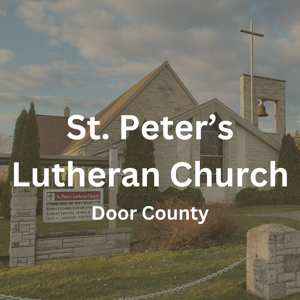


Saint Peter’s Lutheran Church in Door County serves Sturgeon Bay, Wisconsin, and other communities throughout Northeast Wisconsin.
Text: Mark 10:2-16
Liturgical Date: Pentecost 20, Proper 22 B
Calendar Date: October 6, 2024
Location: Saint Peter’s Lutheran Church in Door County
Preacher: Rev. Dr. Christopher D. Jackson
The following transcript was generated via AI and does not match the sermon as it was preached 1:1.
In the name of the Father, and of the Son, and of the Holy Spirit. Amen.
I’d like for us to open up our hymnals to page 276. About halfway down on page 276, you’ll find the vows of holy matrimony. There are two sets of vows: one made to God, and the other made between the groom and the bride. Today, we’re going to read the groom’s vows to the bride, but we’ll replace the names. For the groom, we will say “Christ,” and for the bride, we will say “Church.” Please read along with me:
I, Christ, take you, Church, to be my wedded wife, to have and to hold from this day forward, for better, for worse, for richer, for poorer, in sickness and in health, to love and to cherish till death us do part, according to God’s holy will. And I pledge to you my faithfulness.
The world looks at these vows and thinks Christians who make them are utterly crazy. I’ve even earned a bit of a reputation with some brides because I insist on using these vows. They’ll ask, “Can we write our own vows?” and I say, “No.” Why? Because Christian marriage is about saying, “I intend to live into what God intends for marriage.” We don’t define marriage for ourselves. We acknowledge that marriage is what God has made it to be, and we want to live into that.
So, we use these vows to reflect that. But when we really look at them, we can see why the world might think these vows are nuts. “For better,” they might say, “Sure, for better.” But “for worse”? That’s where they think we’re crazy. Why? Because when we say, “For better and for worse,” we’re not just embracing our spouse’s best qualities. We’re also taking on their worst qualities, their faults. The world sees that and says, “That’s nuts!”
Then there’s “for richer,” which the world might say, “Sure, of course!” But what about “for poorer”? When we say this, we’re saying, “My wealth, if I have any, is yours. And your poverty, if you have nothing, is also mine.”
“In sickness and in health.” The world hears “health” and says, “That sounds great!” But when we pledge to be there in sickness, as Christians, we do so because we understand that the marital bond is meant for mutual support, especially when we’re at our weakest. That’s when we need support the most.
“To love and to cherish,” and finally, the part the world finds utterly baffling: “till death us do part.” It’s not “till I fall out of love” or “till I get the seven-year itch” or “till we have a different view of life.” No, it’s “till death us do part, according to God’s holy will.”
This bond says, “All that is mine is yours, and all that is yours is mine—even your downfalls.” The world just can’t comprehend it. In fact, just last week, I came across an article while scrolling through my Google feed. It was from Kevin O’Leary—you might know him from Shark Tank. He said, “You’re nuts if you combine finances with your spouse.” Well, go ahead and call me crazy, Kevin O’Leary! Because, as Christians, we are willing to form bonds that the world cannot understand.
The world can’t understand these bonds because, first of all, they don’t understand creation, and secondly, they don’t understand redemption. But we know that Christ has bound Himself to us in every way. It doesn’t make sense according to our fallen human nature, but Christ has bound Himself to us, and in doing so, He has opened our eyes and hearts. That’s why we’re willing to bind ourselves to others.
In today’s Gospel lesson, the Pharisees try to trap Jesus. They ask Him, “Is it lawful for a man to divorce his wife?” Jesus puts them to shame. He acknowledges that Moses did give provisions for divorce in the Law, but He explains that divorce was never God’s original intention. Moses allowed it to limit the damage caused by broken marriages, but this was not God’s plan from the beginning. Jesus points them back to creation and reminds them that we were made male and female and that we were made to be bound together in a one-flesh union. “What God has joined together, let not man put asunder.”
I am convinced that we Christians can perceive the natural created order in ways the world cannot. We see it for what it truly is, but the world’s perception is clouded by sin. Romans makes it clear that the Law of God is written on the hearts of all people, but sin distorts the way we perceive it. That’s why so many in the world consider what is good to be bad, and what is bad to be good.
Why do people get it so mixed up? Sinfulness clouds the mind so that people cannot perceive what is written on their hearts and what is clearly evident in the world. But Christ, through His redemptive work, has brought light to our darkened minds. He is the light that shines in the darkness, allowing us to perceive what sinful man distorts in his own mind.
We are able to see the one-flesh union not only because our minds have been clarified but also because our hearts have been purified. How so? Christ dwells in us. He has united Himself to us, and He has done so for the purpose of redemption. In His redeeming work, Christ has intimately bound Himself to us—what we could call a one-flesh union. How? The eternal Son of God took on human flesh and became one with us. He shared in all things with us, except for sin. Yet, even though He was without sin, He shared in the consequences of sin.
Isn’t what Christ has done for us reflected in the vows of marriage, which we recited earlier? Let’s take a look.
Christ, our bridegroom, came and joined Himself to us. He joined us for our better, but in a sense, for His worse—at least temporarily. How? Why? He came to us, full of our sin and transgressions, and He took our sin upon Himself. He shared in the consequences of our sin so that we, fallen in our sinfulness, might share in His goodness and righteousness.
Speaking of righteousness, this too we have received from Him. He took our unrighteousness, and we received His righteousness. This is the great exchange: for richer, for poorer. We ought to have hands full of good gifts and beautiful treasures to offer to the Lord—acts of loving obedience to the Father and works of loving service to our neighbors. Yet, because of our sin, our hands have been emptied of such gifts. Instead of giving good things to God and our neighbor, we have let our hands remain empty in sin. But Christ, in the great exchange of the cross, took on our poverty—our lack of righteousness—and gave us the wealth of His righteousness. He gave us His life, a life of ultimate loving obedience to the Father, a life of ultimate loving service to us, His neighbors, and His sacrifice for us on the cross.
In sickness and in health. Brothers and sisters, sin is a disease—a disease that results in death. As it says in Romans, “The wages of sin is death.” Christ, though He was not sin-sick Himself, took the consequences of that sin-sickness upon Himself when He died for our sake. Why? So that He could be our healer, restoring us and giving us His health, renewing us with life everlasting.
Brothers and sisters in Christ, Jesus has bound Himself to us in our redemption. Because Christ has opened our eyes to the natural order of creation, and because He has transformed our hearts through His redeeming work, we as Christians are glad to bind ourselves to one another in ways that the world cannot understand. That’s why we are glad to commit ourselves in marital unions that the world finds baffling. That’s also why we are glad to bind ourselves to our fellow Christians in ways that the world cannot comprehend.
The world cannot understand the bonds we share as a Christian congregation. Week after week, we gather together in this room to hear God’s Word, to worship, and to support one another. The world looks at that and says, “What foolishness!” Imagine it: a beautiful fall day like today—Sunday, October 6, 2024. The sun is shining, the air is warm, and the leaves are turning beautiful colors. Yet, here you are, in church, sitting together in a room, listening to a man in a robe reading from a text thousands of years old. The world looks at that and says, “You must be nuts!”
You must be nuts to give your hard-earned money to the church, so that your fellow Christians can continue to receive this preaching and teaching. But as Christians, we are glad to gather together, to receive God’s Word, to share in one bread and one cup as a sign of our unity in Christ. We gladly contribute to the spiritual needs of one another because we know that, in Christ, we are one.
We know that we are one not only with the Christians around us now but also with Christians throughout history, from the patriarchs and prophets to the apostles and beyond. We are united with Christians of all times, and we look forward to being united with Christians in the future when Christ returns in power and glory.
We are thankful for the inheritance we’ve received from the patriarchs, the prophets, and the apostles. As it says in Hebrews, we strive to pay close attention—and even closer attention—to the message of the Gospel that we have received. This is not only for our own benefit but also for the generations of Christians to come.
Christ embraced the little children and said, “Do not hinder them, for to such belongs the Kingdom of God.” In the same way, we as Christians are eager to bless the coming generations. We give, even from our estates and wills, so that the children of the church can continue to receive the gift of Holy Baptism here at Saint Peter’s Lutheran Church. We want to ensure that, in time, those same children will bring their future brides and grooms here to receive the blessing of God’s Word and to make the holy vows of matrimony.
In turn, their children and their children’s children will be able to come here and receive God’s Word in Holy Baptism, in Sunday school, in Vacation Bible School, and in worship. We are glad to bind ourselves to the coming generations because we know that, in Christ, we have all been made one.
Brothers and sisters in Christ, let us celebrate! Let us rejoice that Christ has bound Himself to us, taking our sin upon Himself and giving us His righteousness. He has made Himself one flesh with us, and we gladly live into God’s intention for marital union, esteeming it as a reflection of Christ’s relationship with the Church. Let us also live into the bond we share with our fellow Christians, as Christ has bound Himself to us.
In the name of the Father, and of the Son, and of the Holy Spirit. Amen.
The post Sermon: Christian Bonds in Marriage & Congregation first appeared on Saint Peter's Lutheran Church.
Title: Christian Peace
Text: Mark 9:50
Liturgical Date: Pentecost 19, Proper 21 B
Calendar Date: September 29, 2024
Location: Saint Peter’s Lutheran Church in Door County, Forestville, WI
Preacher: Rev. Dr. Christopher D. Jackson
TRANSCRIPT
The following transcript is an ai rendered transcript from the sermon audio. Therefore, it does not match the audio 1:1. It has also been modified for readability.
In the name of the Father and of the Son and of the Holy Spirit, Amen.
Peace is valuable. Peace is fragile—at least, peace as we know it in this world. Yet, it’s so valuable that we’ll go to great lengths to get it. Peace in our hearts. Peace in our minds. If we aren’t resting in peace—whether in our hearts or our minds—it can make every moment of our lives quite miserable, can’t it? Our households can hardly be considered homes if they aren’t marked by peace. When communities or nations are marked by conflict instead of peace, think about all the wasted energy that could be used for the common good. Instead, it’s wasted on conflict.
It’s no accident that when a nation is at war or caught in civil war, famine and disease often follow. All the energy that could be used to bless one another is expended on conflict, and everyone suffers in the process. Peace is so valuable that one of the great emperors of old paid a large price for it. In 532, Emperor Justinian of the Roman Empire—what some call the Byzantine Empire, though they knew themselves as Romans—wanted peace with their only real rival: Persia. So, what did he do? He formed a treaty with Persia, which is now modern-day Iran, and sealed it by gifting Persia 11,000 pounds of gold. They called it the “Treaty of Eternal Peace.” It was supposed to end warfare between Persia and Rome forever. Yet, it lasted only eight years.
Peace is valuable, and people are willing to pay a great cost for it, but it’s also fragile and rare. Peace is elusive. But as Christians, we have the source of true peace—the peace which passes all worldly understanding. This is the peace of God.
Today, we’ll talk about the three “P’s” of Christian peace: Patience, Purification, and Pridelessness. Peace is something God offers as one of the gifts of salvation. In fact, we could say that peace is salvation itself. After all, what is sin but hostility and conflict with God? Saint Paul says the sinful mind is enmity against God. That’s one of those church words that means “conflict.” The sinful mind is in conflict with God. God is the source of all good blessings and the source of life. When we sin, we act against God’s interest and life itself. We hurt and harm our neighbors, and in doing so, we find ourselves at odds with God.
Sin is conflict with God, the source of light. When we sin, we align ourselves with the forces of darkness and evil. Because God is in opposition to all darkness, evil, and wickedness, our sin puts us in conflict with Him. Yet, praise be to God that He has established peace with us. Though we put ourselves in conflict with God through our sin, God has reconciled Himself to us through His Son.
How did He do this? Jesus became the propitiation for our sins. Yes, that’s another fancy church word, but it means that Jesus took upon Himself the wrath that we deserved because of our sin. God, who is opposed to all that is unholy, poured out His wrath upon Jesus on the cross 2,000 years ago. There, Jesus became sin itself and bore the punishment for us. Praise God, this reconciling work didn’t just stop with God reconciling Himself to us; He also reconciles us to Him.
The message of grace, mercy, and forgiveness in Jesus Christ is used by the Holy Spirit to transform our hearts. The Spirit pours the love of God into our hearts, creating a new inner self. As Saint Paul says, “I have been crucified with Christ, and it is no longer I who live, but Christ who lives in me.” We receive the Spirit, which no longer opposes God but cries out, “Abba, Father!” Our hearts are reconciled to God by the power of the Holy Spirit and the message of the Gospel.
This peace we have with God brings about inner peace, which in turn leads to peace with one another. But to have peace with one another, we need patience—probably the most critical virtue. In our Gospel lesson today, we see an example of this. The disciples encountered a man who was casting out demons in Jesus’ name, yet he wasn’t fully following them or Jesus. The disciples asked Jesus if they should stop him, but Jesus said no. He told them, “No one who does a mighty work in my name will soon afterward speak evil of me.” Jesus was telling them to have patience with this man, as he was on a journey toward a fuller understanding of who Jesus is.
This kind of patience is commanded elsewhere in Scripture. Love is patient, love is kind, and love does not insist on its own way. As Christians, we are uniquely gifted to have peace with one another through patience and kindness that doesn’t insist on having its own way. Why? Because we, as Christians, have all the time in the world. In fact, we have more time than the world itself. This world is passing away, but we have eternal life.
Those who are worldly have to have everything now. It’s “my way or the highway” because they know each moment might be their last. They have no patience for circumstances. But as Christians, we can be patient with one another because we know that God will bring about all things in His own time. We don’t mark time by moments; we mark time by eternity. This gives us patience not only with others but also with our circumstances.
Sometimes, our conflict isn’t with other people; it’s with our situation. We wish our careers were going better, or that we were at peace with our health or wealth. As Christians, we can have patience and contentment with our lot in life, knowing that while this life offers good gifts, the greatest gift is still to come—the gift of eternal life.
Peace also comes through purification. This is another key point Jesus speaks about in Mark 9 when He talks about cutting off the hand or foot that causes you to sin, or gouging out the eye. When He speaks of being “salted with fire,” He is referring to the process of purification—of eliminating the passions within us that are contrary to God’s will. As Jesus indicates, when we have this purification, it leads to peace with one another.
James speaks about this in our Epistle lesson from last week. He asks, “Why do you have conflicts among yourselves? Isn’t it because your passions are at war within you?” You desire but do not have, so you murder. The conflict we have with one another stems from the conflict within us—the old sinful self that seeks its own good rather than the good of others. It wars against the Spirit of Christ that dwells within us and causes us to do things contrary to Christ’s way.
How are we purified? James gives the answer at the end of that passage in chapter 4: “God gives more grace.” It is the grace of God that purifies us from the passions at war within us. As we confess our sins and embrace the grace, mercy, and forgiveness won for us by Christ on the cross, the old selfish Adam in us dies little by little. Day by day, more of the new man arises within us and shines out.
Finally, the third “P” of Christian peace is Pridelessness. This is another element of Christ’s teaching in Mark 9. The disciples had been arguing on the road to Capernaum about who was the greatest among them. Jesus, knowing this, explained to them that the greatest in the kingdom of God is the servant of all—referring ultimately to Himself. In the same way, when we humble ourselves and serve others without pride, this leads to peace.
The world is filled with people in conflict, clamoring over one another, trying to put others beneath them in order to elevate themselves. But the Christian opts out of this game—a game that has no winners and only breeds conflict. The Christian, following Christ’s example, humbly serves others. In that service, we find peace with our neighbors, as we seek not to serve ourselves, but to imitate Christ and serve others.
Finally, if it’s not obvious already, all of this—patience, purification, and pridelessness—comes only by the power of God. It is by the power of God and the eternal life we have in Christ that we can be patient. It is by God’s grace that we are purified. And it is only through the power of Christ dwelling within us that we can humbly serve our neighbors without pride.
Therefore, peace—whether it’s peace with our circumstances, peace with our neighbors, or inner peace—comes through prayer. Peace is valuable. Emperors of old were willing to pay 11,000 pounds of gold to secure it, but peace in this world is elusive and fragile. Our peace, however, is an eternal peace, because it has been purchased by something far more valuable than gold or silver. It has been won for us by the blood of Christ Jesus.
In the name of the Father, and of the Son, and of the Holy Spirit. Amen.
Saint Peter’s Lutheran Church in Door County serves Egg Harbor and other communities throughout Northeast Wisconsin.
The post Sermon: Christian Peace first appeared on Saint Peter's Lutheran Church.
Saint Peter’s Lutheran Church serves communities throughout Wisconsin, including Sturgeon Bay.
Text: Mark 9:14–29
Liturgical Date: Pentecost 15 Proper 17 B
Calendar Date: 2024-09-16
Location: Saint Peter’s Lutheran Church in Door County, Forestville, WI
Preacher: Rev. Dr. Christopher D. Jackson
TRANSCRIPT
The following transcript was generated via artificial intelligence from the audio file. Text does not 1:1 match audio. Text may contain errors.
In the name of the Father, and of the Son, and of the Holy Spirit. Amen.
Before we dive into the sermon proper, I’d like to share a personal note that’s been weighing on my mind today. Having just renewed my commitment to the calling you extended to me—to preach the Gospel to you, to teach you God’s Word—I am mindful of the warnings we hear in Scripture. In James, it says, “Not many of you should become teachers, my brothers, for you know that we who teach will be judged with greater strictness.” As I reflect on these words, I ask for your prayers—frequent prayers—that I might be found faithful to this calling. I pray that I would preach and teach God’s Word faithfully, without mixing in human-made doctrines or ideas, but always remaining true to the faith that was once delivered to us by the prophets and apostles.
Now, onto the sermon proper.
It might be an apocryphal story, but it’s one that makes for a good preacher’s illustration. The story goes that, after the Titanic hit the iceberg, it didn’t immediately start to list heavily. For a time, things seemed normal, so much so that some people on board continued going about their business as usual. There’s even a story that some of them were polishing the brass on the ship, focusing on removing the tarnish from the brass fixtures while completely unaware of the much bigger problem—the fact that the hull of the ship had been breached.
We see something similar in our Gospel lesson today. There are obvious problems all around, but Jesus wants us to recognize the bigger issue—the one that may not be immediately visible. That issue is faithlessness. And He is the solution to that problem.
Let’s take a look at some of the problems we see in today’s Gospel reading.
First, we encounter the scene where Jesus returns to the rest of His disciples. He had gone up the Mount of Transfiguration with Peter, James, and John, where He showed them His glory—revealing that He is not just a man, but the very Son of God. When they come back down to the crowd, what do they see? The scribes are arguing with the remaining disciples.
Immediately, we recognize a problem. The scribes, rather than seeking the truth, are more interested in scoring points against Jesus and His disciples in front of the crowd. They’re sowing conflict and leading others astray. That’s the first problem.
But there’s more. Why were the scribes arguing with the disciples in the first place? The scribes had seized on an opportunity to attack Jesus, taking advantage of a failure by the disciples. A man had brought his son, who was afflicted by a demon, to Jesus’ disciples, but they were unable to cast it out. The scribes saw this failure as a chance to undermine Jesus and His ministry.
When the crowd saw Jesus returning, they were amazed and ran to greet Him. Jesus asked, “What are you arguing about with them?” And a man from the crowd answered, “Teacher, I brought my son to you, for he has a spirit that makes him mute. Whenever it seizes him, it throws him down, and he foams at the mouth, grinds his teeth, and becomes rigid. I asked your disciples to cast it out, but they could not.”
This brings us to the third problem: the disciples were powerless in this moment. What they thought was within their reach—what they believed they could do—they couldn’t. They failed to heal the boy.
But Jesus sees a deeper issue, a root problem. That problem is faithlessness. He says, “O faithless generation, how long am I to be with you? How long am I to bear with you? Bring the boy to me.”
Faithlessness runs through the entire situation.
There’s the faithlessness of the scribes. Consider the cruelty of their response—here is a boy suffering greatly, and a father who is heartbroken over his son’s affliction. As parents, we know that when our children hurt, we hurt. Yet instead of being moved by compassion, the scribes see this as an opportunity to score points, to advance their agenda. They are faithless in their response to this man and his son’s pain.
There’s also the faithlessness of the man himself. He brought his son to Jesus’ disciples, hoping they could heal him, but they were unable to do so. He begins to doubt, not only in the disciples but perhaps even in God’s power. He placed his hope in the wrong place—his faith rested in the disciples rather than in Jesus Himself.
And then there’s the faithlessness of the disciples. Later in the passage, they ask Jesus privately, “Why couldn’t we cast out the demon?” They too had placed their faith in their own abilities rather than relying on God’s power.
Faithlessness is present everywhere in this story. And this, Jesus shows us, is the deeper, more fundamental issue. Yes, the demonic affliction of the boy is a serious problem. But the greater issue—the root of all the problems here—is the faithlessness of the generation. Everyone involved in this situation has been afflicted by a lack of faith.
Brothers and sisters in Christ, this faithlessness we see is precisely what the devil aims for. It’s his work, and it reveals the true nature of demonic affliction.
In today’s world, many people dismiss stories like this from the Bible. They argue that these accounts were written in a time when people didn’t have a modern understanding of medical and psychological issues. So, they explain away demonic possession by attributing it to conditions like epilepsy or other physical ailments. Maybe this boy wasn’t really possessed by a demon, they say—perhaps he had a medical condition that caused his symptoms.
But here’s the problem with that line of thinking: it creates a false divide between the material and the spiritual. The modern mind likes to draw a sharp line between the two, separating what can be scientifically observed from what is of the soul. People think that issues of faith and spiritual warfare are completely distinct from the material challenges we face in life—whether it be sickness, poverty, or conflict.
Scripture, however, allows for no such division. Let me encourage you to look up Martin Luther’s Large Catechism, where he explains the petition from the Lord’s Prayer, “Deliver us from evil.” What you find there may surprise you. Luther writes that all kinds of evil—whether they are natural disasters, social unrest, or personal afflictions—have their root in the work of the evil one.
God, after all, is the author of peace. Christ is called the Prince of Peace. So wherever there is discord, we know it is the work of sin. God is the giver of all good gifts, and wherever there is deprivation, poverty, or want, it is the work of the devil. God is a God of wisdom and order, and where we see disorder, chaos, or confusion, we are witnessing the influence of the devil.
What I am trying to say is this: there isn’t a neat dividing line between the physical and the spiritual. The material and the spiritual are deeply intertwined. When we face difficulties in this world—whether it’s sickness, relational strife, or poverty—these are not just isolated, worldly problems. Behind these visible issues, we often find spiritual forces at work.
Saint Paul speaks to this very issue in Ephesians chapter 6, where he tells us, “We do not wrestle against flesh and blood, but against the rulers, against the authorities, against the cosmic powers over this present darkness, against the spiritual forces of evil in the heavenly places.” Paul acknowledges that people tend to look at the surface of things, but he encourages us to see the deeper reality—the spiritual battle that is always present behind the material struggles we face.
Paul also tells us how we can defend ourselves in this battle. One of the most important defenses he mentions is the shield of faith, with which we can extinguish all the flaming darts of the evil one. This is where our discussion ties back to the problems in the Gospel lesson—faithlessness is at the core of every issue we see.
The problems we face in this world often feel like physical or material issues. Maybe you’re dealing with a medical condition, some form of pain or illness. Or perhaps you are struggling with strained relationships—discord in your home, alienation from a loved one, or tension at work. Or maybe you are facing financial difficulties, feeling like you can never get ahead.
Whatever the visible issue, know this: the devil will use these challenges to try to undermine your faith. He will whisper lies into your heart, making you doubt that you are truly a child of God. He’ll try to convince you that if God really loved you, He wouldn’t allow you to suffer in these ways. He’ll sow seeds of doubt, making you question God’s goodness and His promises.
In times of relational discord, the devil will tempt you to believe that God is not truly the God of peace He claims to be. In moments of financial strain, he will try to make you question whether God will really provide for your needs, even though God has promised to give you your daily bread. And when you are overwhelmed by physical afflictions, Satan wants nothing more than for you to lose heart, to believe that God has abandoned you.
But let me remind you, dear friends: these are the fiery darts of the evil one. His goal is to undermine your faith at every turn. The problems we face may seem material on the surface, but at their root, they are spiritual. Our ultimate problem is a problem of faith.
Why is faith the root problem? Because the root of all sin is unbelief. When we sin, it’s because we are failing to trust in God’s promises. Think about the First Commandment: “You shall have no other gods before me.” Luther explains that this means we are to fear, love, and trust in God above all things.
When we allow the cares and concerns of this world to overwhelm us, when we lose sight of God’s promises, we are breaking this First Commandment. Every other sin flows from this one.
Take, for example, the commandment not to bear false witness against our neighbor. God commands us to speak well of our neighbor, to defend them, and to uphold their reputation. But how often do we fall into the trap of gossip and backbiting? When we speak ill of our neighbor, what we’re really saying to God is, “I don’t trust You. I think things will go better for me if I tear this person down.” That’s unbelief, plain and simple. And unbelief is the root of every sin.
And this is precisely what Jesus wants us to understand in today’s Gospel lesson: our fundamental problem is unbelief, or faithlessness. But even as He confronts this problem, He also reveals that He is the solution.
When the father in the story sees Jesus, he cries out, “If you can do anything, have compassion on us and help us.” To this, Jesus responds, “If you can? All things are possible for one who believes.” Immediately, the father of the child cried out, “I believe; help my unbelief!”
What a profound and honest statement. The man acknowledges that, while he has some faith, it is mixed with doubt, and he pleads with Jesus to strengthen his faith. Let that be our cry as well. “I believe; help my unbelief!” We, too, must recognize that our faith is often weak, and we need Christ to help us trust in Him more fully.
Christ confronts the unbelief of all those around Him with a powerful demonstration of His authority over evil. He casts out the demon, showing His power over the forces of darkness. But this miracle is about more than just freeing one boy from demonic affliction—it’s about confronting the deeper, spiritual problem that plagues all of humanity: faithlessness.
And isn’t this what Christ ultimately accomplished through His death and resurrection? The devil sought to lead Jesus astray, tempting Him to abandon the Father’s plan, to doubt His calling to lay down His life for the sake of the world. But Christ remained faithful—faithful even to the point of death on a cross.
Through His death, Christ conquered sin, death, and the devil. And through His resurrection, He demonstrated His victory over these powers once and for all. As we look to the cross, we see the depth of God’s love for us, and we see the solution to our faithlessness. In the cross and the empty tomb, we find forgiveness for our unbelief, for our doubts, for our sins.
This is why Christ calls us to faith. He is not only calling us to believe in His power but to believe in His victory—His victory over the forces of evil, over the powers of sin and death. And He invites us to trust that His victory is for us, that through Him, we are set free from the fear of death and the power of the devil.
Brothers and sisters, as you go through the trials and challenges of this life, whatever they may be, do not lose faith. When you are confronted with your own sinfulness, when the devil seeks to make you doubt, remember the shield of faith that God has given you. That faith, which is a gift from God, is what enables you to stand firm in the face of all the devil’s attacks.
Look to Christ. He is your shield. He is the one who extinguishes the fiery darts of the evil one. He is the one who has already won the victory on your behalf.
And so, in those moments when your faith feels weak, when you are struggling with doubts, turn to Him. Pray, “Lord, I believe; help my unbelief!” And know that He is faithful to answer that prayer. He is faithful to strengthen your faith through His Word, through His sacraments, and through the fellowship of His people.
In the name of the Father, and of the Son, and of the Holy Spirit. Amen.
The post Sermon: Jesus – The Solution to Our Faith Problem first appeared on Saint Peter's Lutheran Church.
Text: Mark 7:31-37
Liturgical Date: Pentecost 16, Proper 18 B
Calendar Date: September 8, 2024
Location: Saint Peter’s Lutheran Church in Door County, Forestville, WI
Preacher: Rev. Dr. Christopher D. Jackson
THE FOLLOWING IS AN AI GENERATED TRANSCRIPT OF THE SERMON THAT WAS PREACHED. IT DOES NOT MATCH 1:1 WITH THE SERMON AS IT WAS PREACHED.
In the name of the Father, and of the Son, and of the Holy Spirit. Amen.
You may be seated.
God speaks, and so we believe. We believe, and so we speak. El tema del sermón de hoy es que la palabra de Dios nos da fe (The theme of today’s sermon is that God’s Word gives us faith).
I remember this moment very clearly, one of my clearest memories from when I was a young father. I think Thomas was about three years old, and we were driving down the street in Lexington, KY. He had a phrase that he wanted to tell me, and he said it, but all the words were in the wrong order. After saying it, he realized it didn’t sound quite right—something was off. So, he tried again and again, repeating it over and over until, finally, the words were in the right order. It sounded just like something Mom or Dad would say.
What was he doing there? He was trying to reflect the way we talked to him. Our mouths, our tongues, reflect what our parents say to us. That’s such a strong reality that if you grow up speaking one particular language, even if you study another language for years, you’ll never sound exactly like a native speaker. In the same way, God speaks His Word to us, and by that Word, He makes us His children. He opens our tongues so that we can speak to Him in prayer and so we can speak to others about Him.
This brings us to what we’re going to talk about today: our Gospel lesson from Mark chapter 7, where we see Jesus healing a man who is both deaf and has a speech impediment. Let’s take a closer look at these verses.
Verse 31: “Then Jesus returned from the region of Tyre, and went through Sidon to the Sea of Galilee, in the region of the Decapolis.”
Now, some of these names—Tyre, Sidon, the Sea of Galilee, Decapolis—might be unfamiliar or confusing. Today, let’s focus on one of them: Decapolis. The word “Decapolis” literally means “ten cities.” These cities were located in the northeastern region of where Jesus ministered, mostly in what we would now call Syria. They were established a few hundred years earlier by Alexander the Great, the famous Greek emperor and general who spread Greek civilization from Greece all the way to India. He set up cities along his route, and ten of these were in what we now call Syria.
By the time of the Romans, these cities had become thoroughly Roman, though the Greek culture still prevailed. At the center of that culture was the worship of false gods and goddesses. In fact, the temples in the Decapolis were a little unusual. While most temples in the Greek and Roman world were enclosed—essentially houses for idols—the temples in the Decapolis were often open-air. The idols and statues representing their gods were on display out in the open.
Verse 32: “And they brought to Him a man who was deaf and had a speech impediment, and they begged Him to lay His hand on him.”
Now, I imagine this wasn’t the only person brought to Jesus for healing, but Mark chooses to tell us about this particular man. Why? Because his physical condition reflects a spiritual problem. He lived among people who worshiped idols—false gods who could not hear their prayers and who could not speak to them. His deafness and inability to speak mirrored the idolatry of those around him.
Psalm 115 explains this well: “Why should the nations say, ‘Where is their God?’ Our God is in the heavens; He does all that He pleases. Their idols are silver and gold, the work of human hands. They have mouths, but do not speak; eyes, but do not see. They have ears, but do not hear; noses, but do not smell. They have hands, but do not feel; feet, but do not walk; and they do not make a sound in their throat. Those who make them become like them; so do all who trust in them.”
This is why Mark focuses on this one man—his deafness and muteness symbolized the spiritual deafness and muteness of those who worshiped false gods. They were unable to hear the truth or speak it.
Verses 33-34: “And taking him aside from the crowd privately, Jesus put His fingers into his ears, and after spitting, touched his tongue. And looking up to heaven, He sighed and said to him, ‘Ephphatha,’ that is, ‘Be opened.’”
These verses might strike us as odd. Why did Jesus, who had the power to heal with just a word, go through these seemingly strange actions—putting His fingers in the man’s ears, spitting, touching his tongue, sighing, and then speaking the word, “Ephphatha”? Why not just heal the man with a simple command?
To understand this, think about how Psalm 115 described the idols of false gods. They have mouths but cannot speak, ears but cannot hear, hands but cannot feel. In other words, they cannot lift a finger to help anyone. But Jesus? He does lift a finger. He uses His hands, His breath, and His words to heal this man. Where the idols are powerless, Jesus is active and compassionate. He sighs—a deep, meaningful prayer for this man. He touches his ears and tongue, breaking the bonds of deafness and muteness that have plagued him.
Unlike the lifeless idols, Jesus is full of life and power. And by His Word, this man’s ears are opened, his tongue is released, and he is able to speak clearly.
Verse 35: “And his ears were opened, his tongue was released, and he spoke plainly.”
This man, who had been silent and cut off from the world, is now given the gift of speech. And what does he do with it? He speaks! The miracle here is not just physical but spiritual. This man has been given the ability to hear and speak the Word of God, and his life is forever changed.
Verses 36-37: “And Jesus charged them to tell no one. But the more He charged them, the more zealously they proclaimed it. And they were astonished beyond measure, saying, ‘He has done all things well. He even makes the deaf hear and the mute speak.’”
Though Jesus tells them not to speak of this miracle, they cannot keep quiet. They are astonished and full of joy. Jesus has done what no one else could do. He has made the deaf hear and the mute speak.
This passage shows us the power of God’s Word. Just as Jesus spoke to this man and opened his ears and mouth, God speaks to us today through His Word, opening our hearts and minds to believe and proclaim His message. Through Christian education, we pass on this Word to others, especially to the next generation, so that they too may hear, believe, and speak of the wonders of God.
In many ways, the man healed by Jesus represents all of us. In our sinfulness, we are spiritually deaf and mute. We may not worship golden idols, but we can easily fall into worshiping other things—money, status, or even our own self-interest. And just like the idols of old, these things cannot hear our prayers or help us in our need. But Jesus can. He speaks His Word to us, and by His grace, He opens our ears to hear and our mouths to proclaim His truth.
This is why Christian education is so important. God speaks to us through His Word, and we in turn speak that Word to others. We teach our children, our friends, and our neighbors about the God who loves them and has acted for their salvation. We are called to pass on the faith, just as Jesus opened the ears and mouth of the man in the Decapolis.
This is why we at St. Peter’s engage in the work of Christian education. Whether it’s Sunday School for the youngest members of our congregation, catechism classes for our middle schoolers, or adult Bible studies, we are passing on the Word of God. We are speaking so that others may hear, believe, and speak as well.
There are many ways to get involved in this vital work. You can volunteer as a Sunday School teacher or assist with Bible studies. You can even help by providing meals for our English as a Second Language (ESL) classes, ensuring that we have a welcoming environment for those who want to learn. If you’re unsure of how to contribute, talk to our teachers or leaders—they will gladly find a way for you to help.
The greatest need, though, is for students. We need people to show up, to be present and willing to learn and grow in their faith. Whether it’s encouraging your children, grandchildren, or yourself to engage with the Word of God, this is how we help hearts be shaped by God’s truth.
And remember, Christian education doesn’t just happen in the church. It happens at home, too. If you’ve been blessed with children, grandchildren, nieces, or nephews, take time to teach them the basics of the faith. Even from a very young age, children can begin learning the Lord’s Prayer, the Creed, and Bible stories. When my children were infants, I would say the Apostles’ Creed and the Lord’s Prayer to them, and by the time they were two, they could already fill in the blanks when I would pause while saying these prayers. It’s amazing how God’s Word takes root in young hearts.
Even if you don’t have children, God has still blessed you with your own soul. Make the Word of God a regular part of your life through personal devotions and study. God continues to speak to us through His Word, and it is through that Word that He turns our hearts to faith and trust in Him.
Our God is the God who speaks, and He has spoken to us through His Son, Jesus Christ. By His Word, we have been given faith, forgiveness, and the promise of eternal life. Let us imitate Him by speaking His Word to others, so that they too may come to know the blessings of God in Christ Jesus.
In the name of the Father, and of the Son, and of the Holy Spirit. Amen.
The post Sermon: God Speaks so We Believe. We Believe so We Speak first appeared on Saint Peter's Lutheran Church.
Man’s Ifs and God’s Becauses
Text: Mark 7:14-23
Liturgical Date: Pentecost 15, Proper 17 B
Calendar Date: 2024-09-01
Location: Saint Peter’s Lutheran Church in Door County
Preacher: Rev. Dr. Christopher D. Jackson
The following transcript does not match the recording 1:1. It was automatically transcribed via software, and the transcription was modified by artificial intelligence to make it more appropriate for consumption via reading.
TRANSCRIPT
In the name of the Father and of the Son and of the Holy Spirit. Amen.
Today, we are talking about man’s “ifs” and God’s “becauses.” Much of what troubles us in this world is on account of the “ifs”—the “ifs” we impose upon ourselves and the “ifs” that we impose upon others. We think to ourselves: I would be happy if… I’d be happy if my health were better. I’d be happy if I had a few more zeros at the end of my bank balance. I would be happy if my career were a little bit more successful. I would be happy if I got along better with my family or friends.
Fears are usually caused by “ifs.” What if the stock market crashes? What if I lose my job? What if the wrong people get elected?
And others impose their “ifs” upon us. You would be better, more acceptable, if you had the right opinions. If you wore the right fashions. If you hung around with the right crowd.
But the truth of the matter is that even if the “ifs” line up in our favor, there are always more “ifs.” The promises we and others attach to these “ifs” don’t hold water because there are always more grounds for sorrow and fear. That’s why what the Pharisees offered ultimately didn’t hold up.
Jesus replaces all of their “ifs” with God’s “becauses.” Now, the “becauses” of God, when we first hear them, can initially hurt. But ultimately, the “becauses” of God are our only source of hope, confidence, true happiness, and joy.
The Pharisees made all kinds of promises that were based on “ifs.” If you’ll remember, Jesus and the Pharisees recently had a confrontation, which we read about in last week’s Gospel. But if you weren’t here last week, or just need a refresher, Jesus had a confrontation with the Pharisees over the issue that some of His disciples were not washing their hands before they ate.
Now, here’s what the Pharisees were not upset about: they weren’t upset because the disciples had dirty or grimy hands. That wasn’t the situation at all. Nor was it that the Pharisees were concerned about germs—germs hadn’t even been discovered yet. That wasn’t their concern. Instead, the Pharisees seemed to be worried about contracting ritual impurity by means of the hands and the food eaten with those hands.
Based on what Jesus says here, we can piece together a little bit of the logic of the Pharisees. In the Law that God gave through Moses, He commanded the Israelites not to eat impure foods. Now, these impure foods weren’t intrinsically impure. How do we know this? Adam didn’t have this command. He could eat anything. This command didn’t apply to Noah, nor did it apply to Abraham, the father of the Israelites. But God, in His divine purposes, which we saw a glimpse of in our Old Testament lesson, gave the Israelites commands regarding pure and impure foods as part of preserving and identifying a people unto Himself.
For instance, certain impure foods, like pork, were forbidden. They couldn’t eat the flesh of a pig, nor could they eat shellfish—no lobster, no shrimp. That was simply what God’s Law, given through Moses, commanded the Israelites at that time.
However, the Pharisees seemed to think: What if you’re out and about in the markets and you brush up against someone who has been made impure because they ate impure foods? Or what if you touch something that came into contact with something impure—like pork or shellfish? You might unknowingly contract ritual impurity by eating with hands that had touched impure things. So, they said, “Therefore, you ought to wash your hands when you come back from the marketplace and before you eat.” They borrowed some ideas from the rituals given to the priests in the Temple, but none of this is spelled out in Moses’ Law.
The logic goes like this: Moses, by the inspiration of God, says if you eat this, you will be impure. And so the Pharisees say, if you want to be pure, therefore you need to do this—wash your hands. The Pharisees created all these extra rules out of fear: What if this happens? What if that happens?
Now, I want to be clear: the Law that God gave through Moses was good, and it served a distinct purpose. But Jesus is showing that this Law, as good as it was, was contingent. Its purpose had been fulfilled. Jesus says, Look, it’s not what goes into you that defiles you, but what comes out of a person that defiles them.
This piqued the interest of the people. When they entered the house, the disciples asked Him about the parable (verses 17 and following). And Jesus said to them, “Are you also without understanding? Do you not see that whatever goes into a person from outside cannot defile them, since it enters not their heart but their stomach, and is expelled?” Then Mark adds this crucial parenthetical statement: “Thus He declared all foods clean.”
This is a wonderful set of verses for lots of reasons. First of all, Jesus’ imagery is actually a little more graphic than what comes through in English—just use your imagination a little! But I love Mark’s aside: “Thus He declared all foods clean.” This gives us a glimpse into how God reveals truth. Through the Gospel of Mark, we know this teaching comes from Peter’s recollections, as Mark was essentially his scribe.
Peter had many experiences that led him to understand the full import of what Jesus was teaching here. If you want to see how Peter came to fully understand this, here’s your Bible study homework: read Acts 10 and 15. In Acts 10, Peter receives a vision where God tells him, “What God has made clean, do not call common.” Later, in Acts 15, Peter continues to wrestle with the role of Mosaic Law, particularly with regard to the Gentiles.
These laws had a purpose in preserving the Israelites, but now that purpose was fulfilled with the coming of the Messiah. These were “ifs,” not “becauses.” And Jesus says, What comes out of a person is what defiles them.
Jesus, with these words, supplants the “ifs” of the Mosaic Law and the “ifs” of the Pharisees with the “becauses” of God. Moses said, If you refrain from eating these foods, you will not be ritually impure. The Pharisees said, If you want to be sure of this, wash your hands before you eat. But Jesus says all that has come to an end. What makes you truly impure is not food—it’s what’s inside you: the evil thoughts and actions that come from the heart.
At this point, we might think to ourselves, Well, I’d rather hear what the Pharisees have to say with their “ifs,” because at least there’s the promise that if I do these things, I won’t be impure! But Jesus, the Great Physician, gives us a hard diagnosis—and it’s the truth that frees us. No matter how many “ifs” we check off, there are always more “ifs” we can’t meet.
That’s why, brothers and sisters in Christ, our hope, our confidence, our joy, our salvation cannot rest on the “ifs” of this world. Instead, we must look to the “becauses” of God.
Yes, God’s “becauses” can be hard to hear. The law Jesus preaches is far harder than what the Pharisees taught. But the Gospel of our Lord Jesus Christ is far stronger yet. Christ, the Son of God, took on human flesh for your sake because of who He is—the God of eternal and infinite love. It’s because of that love that He was born of the Virgin Mary, sharing our human weaknesses—except for the weakness of sin. His heart was purely devoted to love for the Father and love for you. And that’s why He sacrificed Himself for your sake, out of pure, unadulterated love.
Because of His righteous life and atoning death, you can have confidence. You are holy, not because you checked off a bunch of “ifs,” but because of who Christ is and what He has done for you. You are pure because Christ is pure. You are a child of God because Christ has made you His brother, His sister. Therefore, you can have confidence in your eternal life—because of who Christ is and what He has done for you.
This changes our perspective on the “ifs” of this life. Even if I am poor, I will be content, knowing of the treasures that await me in heaven. Even if I am sick, I will be joyful, knowing that I will have ultimate healing when Christ returns in power and glory. Even if I am rejected in this world because of my beliefs, I will hold my head high and not be ashamed, because I am a child of God.
Brothers and sisters in Christ, let us not seek our hopes in the “ifs” of this world. Let not the “ifs” of this world bog us down in sorrow and fear. Instead, let us have confidence, joy, and hope in the “becauses” of God.
In the name of the Father and of the Son and of the Holy Spirit, Amen.
The post Sermon: Man’s Ifs and God’s Becauses first appeared on Saint Peter's Lutheran Church.
Text: Mark 7:1-13
Liturgical Date: Pentecost 14, Proper 16 (B)
Calendar Date: August 25, 2024
Location: St. Peter’s Lutheran Church, Forestville, WI
Preacher: Rev. Dr. Christopher D. Jackson
TRANSCRIPT
Note: Transcription, editing, and formatting done by AI.
In the name of the Father and of the Son and of the Holy Spirit. Amen.
Do you desire to have a heart that burns with love for God and for His people? Christ reminds us that if this is our desire, which I hope it is for all of you, we must pay careful attention to our doctrine—the teachings we hold, believe, and promote in our homes and in our congregation. This is our theme for today: Doctrines of the Heart.
Many people like to draw a sharp dividing line between matters of doctrine and matters of the heart. In fact, this is a criticism often leveled against congregations like St. Peter’s, where we take doctrine very seriously. Some may accuse us of focusing so much on doctrine that we neglect the heart. However, Christ shows us the truth: what we believe, preach, and teach deeply affects the heart. It can lead us to know, love, and trust in God, or, on the other hand, harden our hearts against Him.
As we have been doing for the past few months, we will take a close look at our Gospel lesson, examining it verse by verse. As we do so, we will explore this theme.
The Pharisees gathered to Jesus with some of the scribes who had come from Jerusalem. They noticed that some of His disciples ate with hands that were defiled, that is, unwashed. The Pharisees and all the Jews do not eat unless they wash their hands properly, holding to the tradition of the elders. And when they come from the marketplace, they do not eat unless they wash.
Now, what’s going on here with all this talk of Pharisees and the washing of hands? Let’s take a moment to understand the Pharisees before we get into the washing of hands. The Pharisees had a tendency to extend the Law of God into areas where it was never intended to apply. They often extended the various codes and customs of the Temple and, before that, the Tabernacle into the daily life of every Israelite.
The logic behind this extension went something like this: God has called us to be a kingdom of priests, so it makes sense that our households should reflect God’s commands to the priests. This is what seems to be happening here with the washing of hands. There’s no commandment in the Old Testament that requires the vast majority of people to wash their hands before eating, or after returning from the marketplace. The Pharisees had extended the ritual washings of the Tabernacle and Temple into the daily life of the people.
It’s important to note that this wasn’t about hygiene. The Pharisees weren’t concerned with dirt, grime, or germs—they didn’t even know germs existed. The washing was so ritualized that they would use as little water as possible, just going through the motions. The focus was on a ritualized sense of purity.
This is why the Pharisees were upset with Jesus and His disciples. Some of the disciples did not keep the custom which the Pharisees taught. Mark goes on to discuss this further, saying that the Pharisees also observed many other traditions, such as the washing of cups, pots, copper vessels, and even dining couches.
Now, here’s a little aside that Mark includes. The word “dining couches” has puzzled people for centuries. Some early versions of the Bible don’t include this word, while others do. The confusion likely arose because when people copied the Bible by hand, they would often do so by listening to someone read the text aloud. If the person copying thought they heard something that didn’t make sense—like “dining couches”—they might have left it out. But it seems that this was indeed part of the original text, and most modern Bibles include it.
In the ancient world, people didn’t eat at elevated tables while sitting in chairs. Instead, they ate lying on their sides with their heads pointed towards the table and their feet radiating outward. This is the context for Jesus washing the disciples’ feet—they were all lying on their sides, and He went around to wash the feet that were sticking out from the table.
The inclusion of “dining couches” also touches on an important point about baptism. The Greek word used here for “washing” is the same word, baptizo, that Jesus used when He commanded His disciples to baptize in the name of the Father, Son, and Holy Spirit. Some Christians argue that baptism isn’t valid unless the person is fully immersed in water. While immersion is a perfectly valid form of baptism and can symbolize the death and resurrection of Christ, it is not required. Any amount of water, whether sprinkled or poured, makes a valid baptism.
Mark continues by saying that the Pharisees and scribes asked Jesus, “Why do your disciples not walk according to the tradition of the elders, but eat with defiled hands?” Jesus replied, quoting Isaiah: “Well did Isaiah prophesy of you hypocrites, as it is written, ‘This people honors me with their lips, but their heart is far from me; in vain do they worship me, teaching as doctrines the commandments of men.’”
Jesus wasn’t condemning tradition itself. Traditions can be good and salutary when they convey the Word of God. However, the Pharisees were teaching their own commandments, developed over time, as if they were from God. Their traditions revealed the hardness of their hearts and led others away from God.
Jesus gives an example: the Pharisees taught that if a person made a vow to dedicate something to God, even if that vow went against God’s command to honor one’s parents, the vow must be kept. This meant that if someone vowed not to use their wealth to care for their aging parents, they were bound by that vow, even if their parents suffered as a result. This teaching prevented people from repenting and hardened their hearts against God.
What does this mean for your life as a Christian today?
1. Seek to Know the Truth
First, seek to know the truth. Immerse yourself in the Bible and listen to good, faithful preaching and teaching. This truth will build you up, strengthen you against false teaching, and lead you in the way of eternal life.
2. Do Not Let Unscriptural Demands Burden Your Conscience
Second, don’t let unscriptural demands burden your conscience. The world, and sometimes even people within the church, may make demands that are not based on Scripture. Don’t let these demands weigh you down, but let your conscience be freed by the true doctrine of God’s Word.
3. Trust in God’s Word
Third, when God’s Word confronts you with something that doesn’t make sense to you, trust in His Word. Don’t stand in judgment over God’s Word, but let it shape and mold you into the vessel of love that He desires you to be.
4. Hold Fast to the Doctrine of Justification
Finally, and most importantly, hold fast to the doctrine of justification through God’s free grace and mercy in the righteous life and atoning death of Jesus. The Holy Spirit uses this doctrine to turn our hearts to God, transforming our cold, stony hearts into fertile fields that bear fruit for Him and for others.
Brothers and sisters in Christ, hold fast to good, true, and right doctrine so that your heart might burn with love for God and for others.
In the name of the Father and of the Son and of the Holy Spirit, Amen.
The post Sermon: Doctrines of the Heart first appeared on Saint Peter's Lutheran Church.
Text: John 6:22-35
Liturgical Date: Pentecost 11, Proper 13 B
Calendar Date: August 4, 2024
Location: Saint Peter’s Lutheran Church, Forestville, WI
Preacher: Rev. Dr. Christopher D. Jackson
Text: John 15:26-27, 16:4b-15
Liturgical Date: The Day of Pentecost (B);
Calendar Date: May 19, 2024
Preacher: Rev. Dr. Christopher D. Jackson
Location: Saint Peter’s Lutheran Church, Forestville, WI
Text: Jonah 3:1–5; Liturgical Date: Epiphany 3B; Location: St. Peter’s Lutheran Church, Forestville, WI; Preacher: Rev. Dr. Christopher D. Jackson
From the publisher's feed