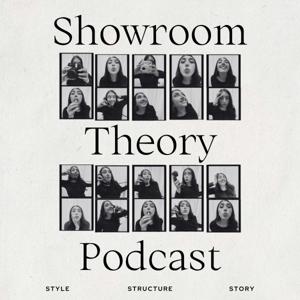
This essay is a companion to a conversation with designer Lou Simmonds, founder of Luna Bea, on the Showroom Theory podcast. While the episode traces the trajectory of a brand from viral success to personal recalibration, the ideas it surfaces extend far beyond a single designer. At its core, this is a conversation about performance, visibility, and the quiet shift happening within bridal culture. This essay expands on those themes, examining what it means to move from image to embodiment in a post-algorithmic era.
Sometimes, the most honest thing you can do is lay on the floor. Not because something has gone wrong, but because you’re done performing.
In a recent conversation, one I’ve come to cherish very much, Lou Simmonds of Luna Bea described this act of surrender to me as a “nervous system reset.” A moment of collapse and recalibration. No optimization, no strategy, no audience - just stillness.
And this idea stayed with me, because it feels increasingly rare. Not just in life, but in bridal. More and more, it feels like we’re living in an era of endless acceleration. More images, more references, more access, and more pressure to arrive fully formed, aesthetically coherent, immediately legible.
The modern bride is no longer just getting dressed; she’s constructing an image. And somewhere inside that construction, something is starting to fracture.
Not taste.Or access.Or creativity.
But feeling.
The Era of Being Seen
There was a moment not long ago when the world of bridal started to speed up.
For those of us inside the industry, that acceleration didn’t feel abrupt. It felt like access. Like expansion. Like possibility. There were suddenly more designers were entering the conversation, more imagery to look at, and more points of view to explore. The internet, the great equalizer of our age, flattened what had once been a relatively closed system.
Suddenly, a bride in any city could see everything. Reference everything. Build a visual language for herself from an endless stream of gowns, icons, aesthetics, and moods.
And for a while, that felt like freedom.
But somewhere along the way, that access became expectation.
For brides, the expectation wasn’t just to find something beautiful anymore, but to define yourself through it. Quickly, clearly, and convincingly. To arrive at your wedding not just as a person getting dressed, but as a fully realized concept. The dress, the styling, the setting - all working together to communicate something legible. Something that could be understood, and more importantly, recognized. The bride became an image.
Or maybe more accurately, a series of images orchestrated in advance. Moodboarded, refined, and cross-referenced against what had already been validated by a quiet, collective consensus. Pinterest became an authority and TikTok only accelerated the cycle.
What felt directional one week became ubiquitous the next, and without really noticing, the underlying question shifted from How do I want to feel? to How does this read?
It’s a subtle shift, but it changes everything. Because once something is designed to be perceived, it’s no longer just yours. Instead, it’s being shaped by an imagined audience, by taste hierarchies, and by what has already been deemed “good,” “cool,” “elevated,” or “correct.”
And that’s where the idea of the “Cool Bride” quietly took hold of us all.
Not as a rule, exactly. But more like a frequency… a shared understanding of what looks right right now. Effortless, but considered. Minimal, but intentional. Fashion-forward, but not trying too hard, which of course requires trying very hard.
The Cool Bride was never a single look; it was a framework. One that, whether intentionally or not, asked brides to filter themselves. To edit. To refine. To get closer and closer to something that already existed, rather than something that felt entirely their own.
The thing about frameworks like this one is that they often don’t feel restrictive at first - they feel helpful and clarifying. They provide a way to cut through the noise until one day, everything starts to look the same. Not identical, but adjacent. Like variations on a single theme or different executions of the same idea. And when everything out there references everything else, it becomes harder to see yourself inside of it. It’s harder to tell if you actually like it, or if you simply recognize it. Harder to know if the dress is expressing you, or if you’re expressing the dress.
Of course, this is just the natural result of saturation. The consequence of an industry that became incredibly good at producing images, distributing them, and teaching us how to read them. But what fashion (and bridal, by association) has failed to do, is teach us how to feel inside of them.
Eventually that catches up to you. Not all at once or dramatically, but in the small moments:
Standing in a fitting room, looking at yourself, and feeling… slightly outside of it. Scrolling past something objectively beautiful and feeling… nothing at all. Or, sometimes, needing to step away entirely.
To lay on the floor.To stop refining, stop referencing, and come back to something quieter, less defined, and maybe more honest.
The Moment of Arrival
If you were anywhere near bridal a few years ago, you probably remember the viral La Lune gown. It was a style that seemed to appear all at once - liquid silk, an open back, and billowy sleeves that floated more like air than fabric. La Lune photographed beautifully, which meant that it also traveled quickly. Across Pinterest, across Instagram, across the soft, unspoken whisper network of references that now shape how bridal taste circulates.
This dress wasn’t just popular, it was instantly recognizable. It was the kind of dress that becomes shorthand for a certain kind of bride, a certain kind of wedding, and a certain kind of feeling.
And from the outside of Luna Bea, the instant virality of La Lune looked like the brand’s arrival. The kind of moment most designers can only dream of. A moment that lands, that connects, that moves through the industry with ease. The kind of visibility that suggests clarity, direction, and momentum.
But visibility has a way of distorting things.
It creates the impression of a fully formed world, even when that world is still in progress. It fills in gaps that haven’t actually been resolved yet and assumes infrastructure where there might only be instinct and preternatural talent.
When I asked Lou what that period actually felt like inside of her brand, she didn’t describe it as a breakthrough. She described it as disorienting.
“I didn’t actually have a brand,” she said.
There’s something so specific about that moment - when something you’ve made takes on a life of its own before you’ve had the chance to fully understand it yourself. When the outside perception solidifies faster than your internal sense of what you’re building.
And suddenly, that disconnect generates immense pressure. Pressure to define it, to expand it, or to meet the version of yourself that other people have already decided exists. This is part of the founder narrative we don’t talk about enough.
We talk about virality like it’s a clean arc from discovery to growth to success. But more often than not, it accelerates everything at once. It compresses time. It asks for decisions before there’s been space to think. It rewards continuation over reflection. And if you’re not careful, virality can pull you away from the very thing that made the work resonate in the first place.
For Lou, that distance showed up slowly.
In the expectations that followed La Lune.In the need to produce, to respond, to keep moving.In the subtle shift from making something because it felt right, to making something because it made sense.And then, eventually, it showed up in her body.
In between commiserating about social media and celebrating motherhood, Lou told me about the physical discomfort that forced her to step back and reassess not just what she was making, but how she was living, working, and relating to the brand that had formed so swiftly around her. The way she explained it, the realization came not as a dramatic rupture, but a quiet interruption. A moment that asked her to step out of the pace she had been moving in, and return to something slower, less defined, and less externally driven.
When she described what came next for Luna Bea, she doesn’t call it a reinvention. She calls it a return, which feels important.
Reinvention suggests distance. A break from what came before. A pivot toward something new. But a return is different. Return assumes that what you’re looking for isn’t somewhere else; it’s underneath. It might be slightly buried or obscured by momentum, expectation, or noise, but it’s still present. And under those circumstances, the work becomes less about creating something entirely new and more about removing what doesn’t belong to you. Letting things soften, slow down, and feel like something again.
A Return to Feeling
What Lou described doesn’t feel isolated. It feels familiar, like something we’re collectively experiencing. Not because everyone is making the same work, but because more and more people seem to be arriving at the same realization from completely different directions. That something about the current pace, the current pressure, the current way of seeing bridal isn’t entirely sustainable. Not creatively. Not emotionally. And certainly not physically.
The response isn’t loud. It’s not a clean break or a named movement. It’s quieter than that.
Revolution in bridal looks like hesitation. Like slowing down where things used to speed up. Like choosing something that doesn’t immediately make sense on a moodboard, but feels right in and on the body. It looks like designers stepping slightly outside of what they know will perform and brides questioning whether the version of themselves they’ve been constructing actually feels like them. Revolution is a growing discomfort with getting it “right,” if getting it right means losing something along the way.
And maybe that’s the shift.
Not toward something new, but away from something that stopped feeling true. Because when everything is optimized for visibility, the feeling of it gets edited out, smoothed over, and replaced with something more legible and more shareable.
And you can only do that for so long before it starts to register. In small ways at first: a dress that looks perfect in photos but feels strangely distant when you put it on, a decision that makes sense on paper but doesn’t quite land in your body, or a growing awareness that you’re referencing more than you’re responding.
Eventually, the script flips back from Does this work? to Does this feel like me?
It’s a different kind of question - slower, less efficient, and harder to answer, because it requires you to step outside of everything you’ve been shown and return to something internal that doesn’t always translate. But I think that’s where tenderness starts to enter. Not tenderness as a soft-focus version of bridal, but as a way of working and paying attention to the body, the moment, and the person inside the dress.
“The small things are the big things,” Lou told me.
It’s a simple idea, sure, but it shifts our entire framework. Because if the small things matter most, then the goal isn’t perfection, it’s merely presence.
Not constructing an image that holds up from every angle, but creating something that feels right from the inside out. Something that doesn’t require constant adjustment, constant awareness, or constant performance. Something that lets you just drop in.
Make decisions that don’t need to be explained.Choose something that isn’t immediately recognizable, but is immediately yours.Step out of the loop of looking, and back into the experience of being.
And sometimes, that starts in very small ways. In a fitting room, in one quiet decision, or in the willingness to pause… occasionally, on the floor.
What a Return Actually Looks Like
What has stayed with me about Lou’s story isn’t just the pace she stepped away from, but the way she described coming back to the work. Not with a fresh concept, or a clearer strategy for growth, or a more refined version of what she already knew would work. Just with more attention.
Attention paid to the way something feels on the body, how it moves, and whether a decision was coming from instinct, or from expectation.
Because when you’re working from expectation, the process tends to narrow. Things fit quickly into the box of what’s already been proven, or they don’t. But when you’re working from instinct, it’s slower. Less efficient. Not everything resolves right away. But that leaves more room for it to feel intuitive and for allowing the work to move in directions that weren’t as immediately obvious, or as easily categorized. Not as a rejection of what came before, but as a way of staying connected to it.
And that feels, in some ways, like the larger shift happening in bridal right now.
I sense that we’re on the precipice of a move toward something less fixed. Where the goal isn’t for everyone to arrive fully formed and ready to dominate the industry, but to stay responsive to the unfolding signals. Where the process matters as much as the image. Where the final result doesn’t have to explain itself immediately to be valid.
And in an industry built on recognition, choosing not to resolve something too quickly is its own kind of resistance.
What Doesn’t Scale
There’s a practical tension sitting underneath all these philosophical ramblings.
The systems that shape bridal are built for consistency, measurable growth, structured collections, timelines, and production cycles. They require a certain level of clarity and predictability. But what Lou described, and what this shift seems to be asking for, doesn’t operate that way. It’s slower, more responsive, and more dependent on proximity - to the work, to the body, to the person it’s being made for. And those things are harder to standardize.
Lou shared honestly about how quickly that distance can be introduced. More demand leads to more structure, more process, more layers between the designer and the work itself. More never-ending calls to DHL. None of that is inherently wrong (except long hold times an cranky operators), but it does change the relationship.
Decisions get made differently.The work moves differently.And over time, it can become harder to stay connected to the instinct that shaped it in the first place.
So the question becomes less about how to scale, and more about how to stay close.
What needs to remain intact as things expand?What can evolve without losing the core of the work?
And whether success, in this context, is always defined by scale, or if it might also be defined by something more specific. Something felt.
Back to the Floor
There will always be a version of bridal that moves quickly. One that responds, adapts, and circulates. One that produces images that are easy to understand, easy to share, easy to place.
That doesn’t go away, and to be honest, I wouldn’t want it to. At least, not completely.
But alongside it, something else is taking shape. Something quieter, less immediate, less concerned with how a dress or a brand translates on first glance, and more concerned with how it feels over time.
It doesn’t announce itself as a shift because it doesn’t need to. You notice it in smaller ways:
In the dress that doesn’t quite fit a category, but fits you.In the decision that doesn’t require over-explanation.In the moment where you stop looking outward and start paying attention to your own response.
Revolution isn’t about rejecting fashion, or beauty, or intention. If anything, it’s a way of returning to them more honestly, without quite as much noise. And maybe that’s enough.
Not to have it fully resolved or to get it exactly right. But just to feel something, and trust it.
And sometimes, that process doesn’t look particularly polished. Sometimes it looks like stepping away, like letting things sit, like giving yourself a second before deciding how you want to be seen, or, occasionally,
laying on the floor.
Thanks for reading! Subscribe to receive new posts and support my work.
This is a public episode. If you would like to discuss this with other subscribers or get access to bonus episodes, visit showroomtheory.substack.com