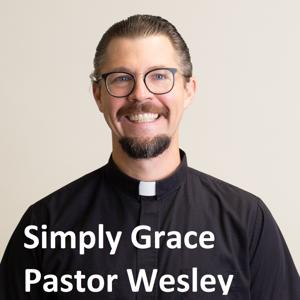
Simply Grace

Simply Grace

By Rev. Wesley MenkeReligion & SpiritualityArts
Download on the App Store

Simply Grace episodes

  • Non-violent Faith
    10 April 2022
    In this sermon for Passion Sunday Pastor Wesley discusses how Jesus confronted power without violence as an act of love. Wesley shares a personal story from his own life about a non-violent confrontation.
    23 min
  • Letting Go of the Past
    Rev. Wesley Menke
    3 April 2022 
    Fifth Sunday in Lent
    Sermon 
    All three passages talk about the same thing: forgetting the past.
    In Isaiah it has to do with forgetting how God led the people out of slavery through the red sea.
    In Philipians it has to do with Paul forgetting all of the status and privilege he had.
    In the Gospel it has to do with facing a difficult reality: we won’t always have Jesus.
    Mary’s behavior seemed odd to them, spending a year’s wages on perfume for Jesus. Judas’ criticism on its face seems to have merit. When we remember Judas we typically remember how he betrayed Judas to be crucified, but we don’t talk about how he stole. It’s really said to think about. Why?
    Judas is a victim of the temptation to works-righteousness. He suffers from the delusion that he can secure his own well being apart from God. Perhaps he idolizes something from the past; when Jesus’ ministry was growing rapidly and he was doing mighty acts. I imagine that Judas was increasingly uncomfortable with the direction Jesus’ ministry was going. It was headed toward crucifixion. So Jesus makes it plain. You won’t always have me. I won’t always be with you.
    We don’t like to talk about that in church, but there it is in the Holy Bible. You won’t always have Jesus. There are times in our life when we will feel like Jesus isn’t there. When we feel this way it may be tempting to dwell in the past, and linger in our minds in a time in our life when we felt that God smiled on us. We might be tempted to do things to revitalize the past and to somehow replicate the so-called golden days of the past. But this isn’t what God wants us to do. God tells us in the Bible in each of these passages that we must forget the past and move on.
    This is some tough medicine, but it is what we have to do in order to move on. We can do this because we must believe that God will do something new.
    But hold on a minute. What’s so bad about remembering the past? Isn’t it a good thing to learn about history? Aren’t there beautiful things from our past that there is no point in forgetting? Can’t the past be a comforting salve to help us through the present moment? Indeed it can be. It is dangerous to completely forget the past; it is like historical amnesia. Forgetting the past can lead us to repeat the same mistakes over and over again. Having an active memory can be the one things that saves us from getting hurt in the same ways again and again.
    So how do we make sense of this? We must understand what it means to have faith differently than we are accustomed to. Faith is often misunderstood to be a passive thing. But this is not what we read about in Philipians. Paul describes faith as basically replicating the crucifixion of Jesus. Paul says in so many words that he wants to suffer and die as Jesus did so that he can also experience the resurrection of Jesus. So faith is about actively sacrificing ourselves like Jesus did for us.
    Have you ever stopped to think about the scandal of the cross? Are we called to suffer an ignominious death like Jesus? Paul seems to think that we are. We are each called to take up our crosses and follow Jesus. Depending on who you are; your cross might look a little different. Your cross may be abstaining from an activity that gives you a lot of pleasure and distraction but really isn’t all that good for your or for other people. Rather than feeling sorry for oneself you can see your cross to bear as an act of worship.
    So what about God’s grace? Isn’t grace supposed to free us from the guilt of not being perfect people? Indeed it is. Grace reminds us that no matter
    16 min
  • Not the Center of the Universe
    Rev. Wesley Menke
    27 March 2022 
    Fourth Sunday in Lent
    You know the other day I went to Death Valley with Sheri. It’s quite a unique place to go to. Some people say that it is the hottest place on Earth. It turns out that what that means is that in 1913; they recorded a temperature of 134 degrees Fahrenheit. What the heck is the deal with Farenheit at non-metric units? You have to consider that for every other day in the year someplace else is just as hot if not hotter than Death Valley. We are not the center of the universe. You are not the center of the universe. 
    Take for example the Prodigal Son. He realized as he was eating pig slop. Do you know how they get pig slop? Rotten food from restaurants. It’s actually a good way to deal with food waste. But you don’t want to eat. So the young man realizes that if he wants to better himself then he has to go apologize to his father at home. The Prodigal Son understands that he is not the center of the universe. So he humbles himself and he has faith. It took an act of faith to go home. His faith leads to his salvation.
    The Prodigal Father accepts his son; because of grace. The Prodigal Father really loves both of his sons. I wonder if there were daughters? Love can be practical and emotional. A Father’s love doesn’t exist to be reciprocated. The Father realizes that he is not the center of the universe. He must love his children unconditionally. Do you know that that is what it means to have children. It means to love them as God would love them. It is very nice and comforting when that love is reciprocated; it is a blessing of the highest order. But for better or worse a parent is to love their child unconditionally. Prodigal means in excess. The Prodigal Son lived in excess through self destructive behavior. The Prodigal Father loves and forgives in excess and so is also called Prodigal; the Prodigal Father. God is Grace. 
    Then there’s Big Brother. He is the rule follower; but he’s also a bit selfish. Big Brother is watching you. Big brother thinks that he is the center of the universe; because he fears his loss of an inheritance. He saw that fatted calf as belonging to him. He is angry that his father didn’t consult him. The father reminds big brother that he is not the center of the universe.
    So the food in Death Valley was amazing. We ate at a bar. They had really good french fries. We checked out the buffet. It looked kind of; medium. But it was okay, because we had it for free the next morning in the breakfast burritos. We were at a golf course and there was a shotgun tournament happening. It was kind of interesting to see golfing with breakfast burritos in the hottest place on earth. 
    My favorite meal that we had there by far was the pizza. We wanted to know if it was good or not. So I asked the bartender how the pizza was? He said it was about 14 inches. So we got a pepperoni. It had a 14″ diameter, and that’s all you could really say about it. It had probably been frozen, but it was actually very good!
    The thing is; you know you are going to eat differently when you are traveling. That is why the food got so much better when God’s people entered into the promised land. When they were in the desert they ate WhatsThis or Manna for 40 years. That’s a long time. That’s a lifetime. But you eat whatever it takes to survive. You do that when you know that you are not the center of the universe. But now they were able to eat off of the land: fresh fruit and vegetables, and  milk and honey. This is God’s grace. It is helpful for us to remember that we are all visitors here.
    That is Paul says that we don’t evaluate others on external criteria. God makes us new creations. Even our current self will change into something else. Jesus changed when he died for us on th
    21 min
  • Strange Fruit
    Rev. Wesley Menke
    20 March 2022 
    Third Sunday in Lent
    Because we are spiritual and physical beings sometimes there is a disconnect between how we feel in the moment and how we look and feel about ourselves. Once I traveled to Thailand and suffered terrible jet-lag. I remember feeling like I was made of sand bags dragging myself around, and feeling physically very bad. Looking back, however, I feel joyous and springing with energy at how I had that awesome experience.
    The other night I couldn’t sleep. I got up and had a cookie. It tasted good and made me feel better. One cooke led to five, and then five led to almost the whole box. I felt great at the time. A few minutes later I felt terrible. Looking back I feel embarrassed. 
    Just because you are someone else suffers physically doesn’t mean that their soul is bad. Jesus is confronted with some news about Galileans being persecuted by Herod. Their blood was mixed with their other blood sacrifices. I think they were persecuted for not adhering to strict temple worship. Jesus said they weren’t worse sinners, nor where another group of people who died in a construction accident when the tower of Siloam fell on them. But then Jesus says that unless you repent you will suffer a worse fate.
    Jesus talks about our souls. Whether you are rich or poor, healthy or sick, powerful or weak,  your soul will stand before God in judgment. Jesus tells you to repent; to change. Change from what?
    You are saved by grace through faith, and not by works. Whatever you accomplish on Earth and the measures of the world will not help you to face the judgement of God. Rather, God loves you unconditionally and forgives you of all of your sins. Believe it and have faith in God’s mercy!
    Jesus goes on to tell a parable of a fig tree. It was planted in a vineyard for three years and yielded no fruit. Then the owner wanted to cut it down, but the gardener begged for one more year to care for it, and to see if fruit was yielded. Jesus was talking about Jerusalem and himself. The tree is Jerusalem and it is planted in the vineyard which is the holy land. The three years are his ministry. He will give his life on the tree. He will be the strange fruit that hangs from the tree upon which we feast at communion. It reminds me of the song, “Strange Fruit” as sung by Billie Holliday. This motif is explored in one of the most difficult, and most compelling works of theology in recent history: James Cone’s, “The Cross and the Lynching Tree.” 
    The repentance Jesus asks us to do is to change from violence and hate toward peace and unconditional love.
    27 min
  • Children of Abraham
    Rev. Wesley Menke
    13 March 2022 
    Second Sunday in Lent
    The city and country have had a long standing tension. Cities tend to aggregate resources from the country, sometimes the city can be scene as hostile to the country, as exploitative. I hear this in the words of Jesus from Luke 13. Jerusalem had been a place that at times was violent toward prophets and messengers of God. Jesus was from Galilee, not Jerusalem, and he is threatened with violence. So what does he do? He retreats. God provides a peaceful retreat for Jesus. We can do what Jesus did, we can retreat from harm into God’s grace, if not physically, then at least spiritually.
    Paul writes in Philippians that each of us are citizens of heaven. This is significant because it means that no matter our geographical differences on Earth we all belong to the same spiritual family. This is important to keep in mind when violence escalates in our world. We must keep a vision of all of humanity sharing the same spiritual home: heaven. I imagine heaven as a place where all people of all religions are welcome. Currently the war in Ukraine is stressing interfaith relationships. Many Jewish and Muslim people live in Ukraine, not to mention Christians. 
    I struggled with the reading this week from Genesis 15. Why? Because in it; it appears that God appeases Abraham’s complaint that a slave will not inherit his possessions, and that God will give Abraham land from almost all of the middle east. In a time of conquest and war, this passage can be used to justify conquest. But it shouldn’t be used that way. As I prayed and reread the passage all week long, it became clear to me that God was not condoning slavery or conquestion. God was inviting Abraham to change his worldview: to not see Eliezar as a slave, but has his own flesh and blood, his own family, and full of dignity. In this way the promise of land is not one of dominance, it is one of stewardship. God called Abraham to be a godfather to the many peoples, lands, and even religions of the world. We are to understand ourselves as siblings in one human family. We are included not because we are so great, but because of God’s grace to admit us in like a loving adoption. We must work for peace. Amen.
    20 min
  • Angel Stop Lights
    Rev. Wesley Menke
    6 March 2022 
    First Sunday in Lent
    War and violence are all too real. The current war in Ukraine is a sobering reminder of this. One of the things that helps to create peace is faith. Faith is a non-violent act. The devil tempts Jesus in three different ways, each with things that can result in harm to others. So Jesus responds creatively and with faith.
    The first temptation is to turn stone into bread. This is a temptation to capitalize on the needs and scarcity of others. Rather than succumbing to this test Jesus reframes the confrontation into the power of God’s word. The Word of God is supreme in its power and its ability to shape minds and behaviors.  During the pandemic we had to fast form communion. Why? Because it was not safe to gather and break bread. Worship continued and we were forced to focus on God’s word which is what makes the sacraments holy anyway.
    The second temptation is when the devil led Jesus up to a high place and showed him all the kingdoms of the world, and offered them to Jesus in exchange for Jesus’ submission. The devil offered glory and authority! Jesus reframed the offer to highlight what is more important worship and service to God. Empire and nation building has been fraught with violence from time immemorial. Religion has been used to justify much of this. The reading from Deuteronomy 26 would have us remember that all land belongs to God as do we. While people move from one place to another; all places belong to God.
    The third temptation is a violence against self. The devil tempts Jesus to attempt suicide. Suicide, a disease of despair, affects many types of people, but especially persons who have been traumatized by violence. Veterans of war and combat are at risk of suicide. Let me say that if you have thougth about suicide, please don’t do it. We need you here. God forgives our sins and has purposes for us to exist. Jesus said to not test God. This means we are to work for justice, and to build and create just and safe structures for the flourishing of human life.
    A few weeks ago I was struck by a vehicle as I was walking across the street. I am so blessed and lucky that it wasn’t worse. I had a dream last week in which I relived it. In the dream I was protected by angels. The angels glowed red, green, and yellow. They had lights on them. Then the angels grew into stoplights posted around the corners of the intersection. To not test God means to work for justice and peace.
    21 min
  • Three Stories on Lent
    Rev. Wesley Menke
    2 March 2022 
    Ash Wednesday
    When I was a youth minister I challenged the youth to give up something or fast for Lent. The teenage girls responded very enthusiastically saying they would skip lots of meals. At first I was impressed, and then I was concerned. Adolescents really shouldn’t be skipping meals. After talking with the pastor we contacted parents and asked them to reframe the discussion with their youth, as did I the following youth group. I had to repent as a leader from something that I thought was a good idea, but really wasn’t. This is the danger of works-righteousness. This is what Jesus warned against in Matthew 6. Public displays of piety can lead to some hurtful outcomes. Rather, let your piety be simple and intimate between you and God. 
    Lent is about more than repentance, it is also grounded in an awareness of our mortality. On Ash Wednesday we say, “Remember you are dust and to dust you shall return.”  A couple of years after the story I shared I had gotten married and my wife and I were expecting the birth of our first born child. My wife gave birth on Ash Wednesday that year right about the time many people were at church. I was aware of the tremendous sacrifice she made, risking her life to bring life into the world. She reminded me of Jesus, who gave his life for us. In the book of Joel chapter 2, we read about the day of the Lord being thick with darkness and unknowing, like death itself. By grace we fear not death, but have faith. The deepest night and darkness spring forth life. 
    Finally Lent is about serving God not out of fear or wanting to earn God’s favor, but simply to do what is right and needed in the world, to endure some degree of suffering. The first time I put on a clerical shirt with the collar was at home, as I was preparing to do a teaching parish. Just seconds after putting the clergy shirt on my wife told me that the baby’s dirty diaper needed to be changed. I thought that was kind of ironic and coincidental. It was good preparation for pastor ministry. We each serve God by serving those who are in need, but rolling up our sleeves and caring for others in practical simple ways. That’s something you can do this Lent.
    Link to bulletin and videos of this worship service.
    14 min
  • Listen to Jesus and Do What He Did
    Luke 9:28-36, (37-43a)
    Jesus seems to get grumpy and annoyed that this father asks him to heal his son. Why? Could it be that Jesus expects not only his 12 disciples, but all of his disciples to be able to do the things that he does? We are tempted to think that working and serving God is reserved for special people, but it is a task for all people. Because you are saved by grace through faith, you are called to serve like Jesus. A couple of chapters before this passage the 12 disciples are called, named, and immediately sent as apostles, there was no lag time. In your baptism you are called and commissioned as an apostle of Jesus. 
    Sometimes people ask me to do things as a pastor. I ask them, “Why”? They say that I am their personal conduit or connection to God. I say, “No. I am not.” I really mean that. If you expect me to be your conduit to God, then you will be terribly disappointed. I am no holier than anyone else. Through baptism, we are all the priesthood of all believers. A pastor is more like a coach, who has taken time for extra education, and made a commitment to serve the church in a professional capacity. But spiritually there is no ontological difference between a pastor and a lay person. 
    When Jesus was transfigured before the disciples God’s own voice said to “Listen to him.” You are invited to listen and learn from Jesus to be his disciple and his apostle commissioned and sent to preach, teach, pray, and let God’s spirit heal.
    Exodus 34:29-35
    Moses wore a veil after he spent time with God, because it made his whole face to glow. His glowing face would distract the people and prevented them to receiving the Law, the Wisdom God shared with Moses. Imagine the isolation and loneliness Moses felt. Maybe some were tempted to think that such a proximity to God was something that couldn’t be shared, that the people could not receive it because they weren’t good enough. But this wrong. The people innovated a kind of wearable technology, the veil, that allowed fellowship to be restored and for the sharing of all the commandments. So all flesh, all people, are able to receive this word of God!
    2 Corinthians 3:12 – 4:2
    The irony and challenge of interpreting the reading from second Corinthians is the likelihood of missing the point completely. On the face value it would appear that Paul is judging people based on their ethnic identity. Some have tried to use this passage as a proof-text to make prejudicial judgments against Jews, as if there were some kind of problem with their minds. But it is just the opposite. You will remember that Paul is a great missionary and evangelist who wanted to expand the scope of the church to include non-Jewish people within the worshiping community of Jesus. What Paul is saying is that there is a veil over our minds when we think that God’s promises are for only certain groups of people. Faith is a spiritual gift: it does not depend on flesh. The Lord is Spirit, and the Lord will move in the hearts of anyone who accepts this Spirit. What unites us isn’t anything with the flesh, but it is the Spirit that brings us together. You are saved by grace through faith and not by works!
    One time I went to Nicaragua in college, one of my friends went with me, James Pike. We were in college. Our pastor, shortly after arriving to this remote village, prayed for a sick girl, and the girl was miraculously healed. So many people came to be healed as well. Unfortunately our pastor had to leave because his father had died. So we were without a pastor and had to the praying on our own. We did have at least one nurse in our group too, who did much of the healing work. Though difficult at the time, it taught us that we are expected to do the same things as our pastor. We are each expected to be an apostle of Jesus.

    24 min
  • Bound
    Rev. Wesley Menke
    20 February 2022 
    7th Sun After Epiphany
    Well there was some sad news recently. The ELCA youth gathering is canceled this summer. We are a part of the ELCA. The ELCA means Evangelical Lutheran Church in America. Some people say, “Elka,” and others say, “E.L.C.A.” We are the largest Lutheran denomination in the United States. The youth gathering typically happens every three years and regularly draws at least 30,000 people for about a week during the summer in large metropolitan centers with adequate hotel and convention accommodations. The youth gathering is the largest thing that we do, outpacing by far our church wide assemblies. For many high school Lutherans  attending the youth gathering is a rite of passage and one that multiple generations of families share. In the 60’s musicians like Pete Seeger and pastors such as Martin Luther King Junior were noted speakers, and controversial at their times. In fact, one of the traditions of the youth gathering is to gently push the envelope a little bit.
    I attended a youth gathering called River of Hope in 1997. It was a good experience, and it was an interesting experience. I remember checking into our hotel and taking an elevator up to our floor. When we got off the elevator some boys had duct taped the button down on the ice maker and a huge pile of ice was filling up the hallway. That was kind of crazy. You bring together tens of thousands of teenagers and there will be some shenanigans. But for the most part we behaved ourselves and it was a very powerful experience that can shape and mold a young person in very positive ways. 
    I led youth groups to youth gathering in 2003 to San Antonio, then 2006 and 2009 in New Orleans. The youth gatherings in New Orleans were particularly meaningful because of the devastation that was caused by Hurricane Katrina in 2005. At the time there was overwhelming pressure to cancel the youth gathering. Imagine all of those thousands of parents sending their children to New Orleans after everything that had been witnessed on TV. But in one of its finer moments the Lutherans doubled down and said, we will not cancel, we will go to New Orleans and do a gathering unlike any we’ve done before. We went and worked, and cleaned, served, painted, and planted. And as one of our finer moments of ecumenism the Lutheran Church Missouri Synod did the exact same thing. There was so much service activity in New Orleans following Katrina that when I went there some New Orleanians from a Lutheran congregation said that it felt like immediately after the hurricane hit Lutherans in Minnesota got in their cars and drove down to help, showing up just days later, and staying for a long time.
    Then three years later we all went back and did it again. Many teen-agers petitioned to come as servant corps young adult volunteers because they didn’t want to miss out. It was highly unusual to have the youth gathering be in the same spot twice in a row. But we had a purpose, so we did it. 
    So 2021 was supposed to be in the Twin cities. It was rescheduled because of Covid to 2022. And just this past couple of weeks, news was released that it would be canceled in 2022 as well. What a contrast to 15 years ago. Then we decided to take the risk in order to serve a higher purpose. This time around we choose to avoid the risk. For the record, I understand and I agree with the decision. The difference is that now gathering itself is the risk. It doesn’t matter where. 15 years ago we were able to go to a particular place and help churches that had been flooded. Today all of the churches have experienced devastation. We are now the ones who need to be helped, and we are like this in every town, city, state, country, all over the world. 
    The theme was going to be, “Boundless: God beyond measure.” I agree that we cannot mesure God, but I wonder if this migh
    24 min

About Simply Grace

From the publisher's feed

A collection of thoughts, ideas, and interpretations of the Gospel