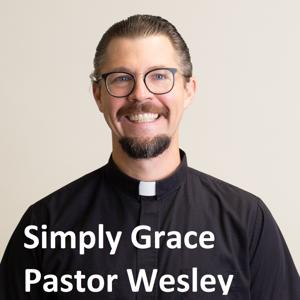
Simply Grace

Simply Grace

By Rev. Wesley MenkeReligion & SpiritualityArts
Download on the App Store

Simply Grace episodes

  • Human Beings as Sacred Space
    Sermon 15 May 2022
    Rev. Wesley Menke
    I believe that we are saved by grace through faith and not by our works. What is grace? Once upon a time there was a man named Peter. He became the leader of the church. Peter was Jewish , and so he assumed that you had to be Jewish in order to be saved by God. All of this changed when he had a dream about animals coming down from heaven. God said, “What I make clean is clean.” In other words grace is something God does, God saves us despite our differences. Grace doesn’t depend on us, it doesn’t matter your religion, gender, race, color, orientation, politics or nationality. It’s a costly gift for all. That is grace. It means you as a person and your body is a sacred space.
    We are saved by grace through faith and not by works. What is faith? Faith is being faithful to God and each other; it is non-violent, non-abusive, and does no harm. In our gospel lesson from John 13 Jesus says that he is leaving and we can’t go with. Have you ever felt that God has left you? 
    This past Thursday we remembered Dietrich Bonhoeffer. He was killed by the Nazis because he was judged to be a race traitor. He aligned himself with the Jewish people and criticized the power of the state. He had faith. Faith tells us that we should do no harm to ourselves or others. When we harm others we harm ourselves. We should love ourselves and our neighbors. We should love ourselves and our neighbors. Jesus loved us. That’s the New Commandment. 
    All human beings have an inherent dignity, and sanctity that must not be violated by any form of abuse: physical, emotional, spiritual, or verbal. The human body is a sacred space to which we must be faithful and peaceful no matter the person’s gender, race, language, culture, religion, or citizenship. We call on all religious leaders to practice peaceful accompaniment in all areas of their life: personal, religious, professional, and public. Pray for peace. No to War. Yes to kindness and compassion. God lives among mortals. A new heaven and a new Earth. Jerusalem will be as beautiful or as a bride. Amen.
    10 min
  • Tabitha and Other Mothers
    Sermon 07 May 2022
    Rev. Wesley Menke
    Today is Mother’s Day, and I’d like to wish a very happy Mother’s Day to all of the Mothers. Motherhood is a very important vocation, probably the most important job any human being could do. Motherhood is also extremely varied. There are many different kinds of mothers. 
    Once, a few years back, I was working with a couple who was getting married. They shared with me about their families. I asked the groom about his parents. He said quite firmly and directly, “my mother is both my mother and my father.” He meant that she had so seriously taken her job to raise him, that he didn’t consider her to be a “single mother” but to be both. Wow! There are so many different kinds of mothers.
    Some women who don’t have biological children are still mothers to children in their lives; taking on a role of caring for the children, they are sometimes called “other mothers.” This is probably how Dorcas was according to Acts 9. We find out about Dorcas who was a disciple and her life was committed to doing good deeds and acts of charity. That’s pretty much the definition of a mother: someone committed to good deeds and acts of charity day after day after day. 
    It’s impressive how they treated her body. They washed her, clothed her, and put her in a room for people to come and say goodbye. They send for Peter to come and be with them during this time of sadness and mourning. When Peter gets there they show him the clothing that she made for them. Then Peter asks everyone to get out of the room, and he when he is alone with her he says, “Tabitha get up!” She does. It’s totally remarkable and incredible that Peter has the power to bring someone back from the dead. It’s unbelievable! Peter has come a long way from denying Jesus and fishing. He is doing the ministry taught him to do, and he is performing miracles! Way to go Peter! This is a great example of the capacity each of us has as disciples of Jesus. We are not just passive beneficiaries we are co-workers with Jesus.
    I do wonder, why? What is the purpose of bringing her back to life?. I think one possibility is that nobody else knew how to sew. What would Tabitha do with her new lease on life? Maybe she would take these extra days given to her and teach others to do the work that she had been doing. Maybe she would get around to teaching others how to sew. According to the text, the main purpose for this thing to happen was to impress upon people the power of Jesus, and thereby bring people to believe in the Lord. Verse 42 says that this miracle become well known in Joppa and so many believed in the Lord.
    But what does that mean? To believe in the Lord? We can suppose that it means to believe that Jesus is the Lord, the king, the savior sent from God. To believe in the Lord is to believe in Jesus and everything that he stood for. It means to believe that he died on the cross for our sin; and rose again. It means to believe that we are saved by grace through faith, and not by our works. 
    Tabitha was a woman of great faith. We know that she had faith because of how she lived her life. She was committed to good deeds and charity. Good deeds and charity are not always easy. Sometimes when we do a good deed or an act of charity people may not appreciate it. Oftentimes we may feel that people don’t deserve charity, because they have made choices that got them into a not good place. But that’s the thing about grace: it is God’s unconditional love for all people whether they deserve it or not. People like Tabitha love unconditionally because they have faith that that is how God is. 
    While the miracle of Tabitha coming back to life is certainly impressive, it is really just the icing on the cake. So many people came to have faith in t
    21 min
  • The Last Temptation of Peter
    Sermon 2022.05.01
    There’s good news and there’s bad news. Which would you like to hear first? The bad? Okay, we’ll start with the bad. Following Jesus leads to suffering and death. So what’s the good news? Following Jesus leads to resurrection, and abundant eternal life.  
    Our good friend Connie Wolfe who was the Camp Director when Sheri and I met one fateful summer 22 years ago. Connie was and is a minister of youth and families, and one of her favorite Bible verses is John 10:10, “I came that you may have life, and have it abundantly.” Abundant life contains both high and lows. The alternative to abundant life is death, or an approximation to death. 
    Take Peter for example. He denied Jesus three times at the time of his arrest and crucifixion. Each time that Peter did this he was closing himself off from the judgment, shame, and scorn he would receive from the crowd. He protected himself from this pain. But there was a cost to do this. The cost is that he also lost his ability to feel the profound joy and bliss of life too. He wasn’t being true to himself or God. 
    You can imagine Peter in the Upper Room, pacing back and forth, locked inside going crazy like a rat in a cage. No. He wasn’t the rat, he hadn’t stooped that low, but he was a coward. Expletives; and colorful ones at that! That’s what I imagine Peter uttering in the upper room. He paces back and forth and speaking to himself out loud for everyone to hear he keeps saying over and over again: What am I going to do? What am I going to do? What am I going to do? 
    Half the disciples have moved on. Peter was a coward, Jesus was dead, or not, nobody was quite sure. The other half of the disciples sat, watching Peter pace back and forth, waiting for what to do next. Peter would be in charge, they were sure of it. They were waiting for him to make a move. The rock. Petros. 
    Then Peter stops in the middle of the room. He starts laughing very loudly. He grasps his head and doubles over laughing louder still. “What is it Peter?” someone asks. 
    “Fishing! I need to go fishing! Yes, that’s just what I need. Some peace and quiet out on the water. Away from all these people. Away from Jerusalem. Who’s coming with me?” 
    “Jesus Christ. How could he have done this?” wondered Peter. “He gets himself killed. We are all toast. They want us dead too. He shows up resurrected, walking through walls. Solid as a rock himself. He calls me a rock! He’s the rock. Did you feel his sands and his side? He was completely impenetrable. Strange. Bizarre. Unnatural. Then he breathes on us? He tells us to forgive. No surprise there. Then he’s gone. What am I supposed to do now? I don’t get it!
    Fishing. That’s what we’ll do. It will be nice. To be back on the lake. To see my family; my wife; my mother in law. My kids.”
    Something like that happened. So he goes back to the Lake. What did his wife say? Was she with him? Based on Peter’s sensitive temperament she was probably all for him going fishing. And he comes up with nothing.
    Have you ever had a great idea that turned out to be not such a great idea? We are all scientists. We all experiment with ideas and behavior to see what happens. Peter conducts a fishing experiment and concludes that he now sucks at fishing. 
    He’s back in that moment of despair and panic of the Upper Room. He won’t be able to live out a peaceful life on the lake. You know they made a movie called, “The Last Temptation of Christ.” They could make one called, “The Last Temptation or the First Temptation of Peter,” to walk away from it all and go back to fishing. But there was a dryness to this option, it seemed to be doomed; this path. Then a sinking feeling settles into his stomach if he is to follow the Way of Jesus, then what will keep him from being crucified himself?
    As Peter looked into the darkness

    22 min
  • Practice Forgiveness to Thomas
    Rev. Wesley Menke
    24 April 2022 Easter 2
    The disciples were on high alert. They were out of towners and the local officials, the Judeans, had conspired to crucify Jesus. They could very well be next. It was the first day of the week, Sunday, the day of the resurrection. Jesus is able to get into their locked room undetected. Was his resurrected body able to pass through walls and doors? Remember that he was not just a ghost, but his entire body had come alive in some kind of different life. What does this mean? Then when he is with the disciples he shows them his hands, feet, and side, and there is scarring where he had been hurt. You have to ask yourself how we are to make sense of this?
    When people experience the death of a loved one, there is often a feeling or question as to what happened to the soul. Does the soul leave the body? Maybe. Whether or not it does, it would seem that God’s design is to put bodies back together and resurrect them. Sometimes people ask me if I feel that cremation is acceptable within Christianity. I say that it depends. If the person is still alive then it is certainly not permissible. But if we are talking about a dead body, then there is no problem with cremation. When the time comes for us to be resurrected like Jesus, then God will figure it out, God will pull together the raw material wherever it might have gone. But we don’t talk about that a lot, really. Mostly when we talk about life after death it has to do with souls leaving bodies and going up to heaven. Is it more difficult to imagine a dead body coming back to life? Maybe it is. 
    Some people have wondered about where everyone will live. If all the dead from all of time were to come back to life, then where would everyone live? Would we have to build more housing? How will we get food for everyone? Food won’t be required for a resurrected body, so I suppose we don’t have to worry about feeding everyone.
    Resurrection seems to bump up against what is physically possible. Everything that we know about anything is that it all dies. So is resurrection some kind of fantasyland that doesn’t even really exist? So let’s talk about Thomas, the twin. Thomas isn’t there when Jesus shows up on the first day of the week. But he is there one week later. Thomas touches Jesus and believes. Jesus isn’t a ghost, he has a body. So Thomas believes. I think that’s a pretty honest account of how faith works. We are all like Thomas in some ways. We question and we doubt, and that’s okay. The problem, if there is one, is that despite our rational brains we have these peculiar experiences that nudge us toward faith. People have dreams about Jesus. Things happen in our life, interventions, and we walk away moved to believe that Jesus is alive, real, loves us, has power, and ought to be listened to. 
    In so many ways traditional Christian belief is so out of step with popular belief. Perhaps more strange than the physical resurrection of Jesus, is the not frequently discussed doctrine of no free will. Luther wrote a whole treatise called, “The Bondage of the Will.” So what? The point is that faith itself isn’t really a choice. Some people have faith and some people don’t. That’s just how it is. It’s kind of like political preferences. It is completely possible that some people are just more inclined to be liberal, and some people are just more inclined to be conservative. There may not be much choice, it’s just kind of built into people’s personalities. 
    We shouldn’t judge people based on whether they have faith or not. We shouldn’t judge people on their political preferences either. Judge not; lest ye be judged. Think about Thomas again. One week he didn’t believe. The next week he did believe. People change too. Why did Thomas change? He changed because he had an experience with Jesus. Jesus changed him, and Jesus changes us too. Thomas wasn’t any more virtuous the second
    20 min
  • Easter 2022 Remembering Resurrection
    We all know the women disciples were smarter and stronger than the men. They went to the tomb first, they overcame their fear. But when it was empty they didn’t understand. The angels helped them to remember. We forget how good God is. God help us remember your resurrection and to be remembered in to one body.
    15 min
  • Easter Vigil 2022
    Rev. Wesley Menke
    16 April 2022 Easter Vigil
    In the beginning. Can you believe that? There was a beginning! It’s comforting really to think that we could go back to when it all started. Maybe by going back to the beginning we could figure out where it all went wrong and how we got into this mess in the first place!
    What mess am I talking about? You name it! We’ve all got messes. Am I right? Places where life didn’t just not go as planned, but it totally went off the rails! What’s surprising, however, is that when we go to the beginning we find that things were good…they were very good! God made light, air, water, land, stars, birds, fish, animals, humans, and rest; and it was all very good! And even when problems happened, God was there to provide and help us work through the problems.
    Take slavery for example. God’s people were enslaved in Egypt for decades, for a generation. But then God called on a very special person to lead the people into freedom and throw off the scourge of oppression. Who was this special leader? Her name was Miriam! Miriam’s leadership began when her baby brother was thrown into the Nile river to die; but she intervened and delivered the boy to someone who could help. Not just anyone; the daughter of Pharaoh. Her baby brother grew up; and even though he had his issues, he managed to help get the people out of Egypt, and when they finally made it through the Red Sea: Miriam was there supervising: to make sure Moses didn’t mess it up! She led all the women in a song which we heard read tonight. By Maria. And in case you didn’t know. Miriam is the Hebrew form of Maria. 
    One of the great privileges of having freedom and prosperity is sharing it with others. Isaiah the prophet writes in chapter 55 of his book that so bountiful and wonderful is God’s grace and what God has done for God’s people that it has not gone unnoticed. Rather the whole world has seen and heard about what God has done with God’s people and for that reason others want to get in on the action! Isaiah says that, “You shall call nations that you don’t know and nations that you don’t know shall stream to you!” 
    It is overwhelming to consider all of the people God brings into our life. People can come to you with such overwhelming needs that you might feel that you don’t have the resources to deal with them. When people come into our lives they have their own ideas, their own way of doing things, and we struggle to know what to do about it; or how to help. That is how King Nebudchanazzar felt about all the Jewish people he liberated from Jerusalem. Out of his own graciousness he brought these people to Babylon to teach them the enlightened ways of that great empire. But despite his best efforts; they just wouldn’t learn. In particular Shadrac, Meshac, and Abendego would not learn the ways of the Babylonians and insisted on maintaining their religious and cultural uniqueness. So the king felt he had no other choice but to destroy them. So he threw them into a fiery furnace. 
    In an act of sheer strangeness they didn’ die, they weren’t burned, and when they came out, they didn’t even smell like smoke. The other night we decided to have a fire in a firepit in the backyard. I smelled like smoke for days. I had to wash my clothing and towels multiple times to get the smoke smell out. So how could Shadrac, Meshac, and Abendego come out smelling like a rose? How come we don’t experience the same level of protection and miracles?
    Paul tells us why. He says that if Christ died on a cross even though he was without sin, and if we are baptized into his same baptism, then we expect the cross in our own lives too. We can expect suffering that we don’t deserve. But, just as Christ was raised from the dead, we can expect new life and resurrection in our lives too even after suffering and death. Why? Because we are saved by Grace, through faith, and not by ou
    15 min
  • Good Friday - Where is God?
    In this Good Friday Sermon from 2022 Pastor Wesley explores the question of theodicy, How could God let this happen? Where is God? Grace can be seen in the kindness and mercy that regular people show to Jesus at the time of and immediately following his death on the cross.
    34 min
  • Maundy Thursday - How to Design a Ministry
    In this Maundy Thursday homily Pastor Wesley recaps the Lenten teaching series on how to do ministry tying it in with Jesus’ washing the disciples feet.
    6 Six steps to plan a ministry and meet Jesus
    HungryWho?ThirstyWhat?NakedWhen?SickWhere?PrisonHow?StrangerWhy? (Grace)
    18 min
  • How to do Communion
    In this Lenten worship service Pastor Wesley teaches the basics of how to share Holy Communion, a task that all baptized Christians should be prepared to do.
     Five elements to Holy Communion or practicing fellowship
    Bread & WineJesus (Grace)PeopleBelieveBibleWords of InstitutionPrayerForgivenessSalvationEternal LifeEat & DrinkFaith
    25 min

About Simply Grace

From the publisher's feed

A collection of thoughts, ideas, and interpretations of the Gospel