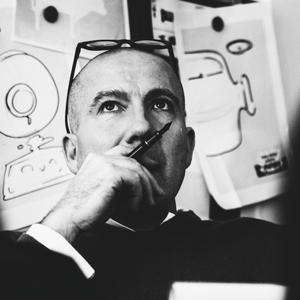
STUFF FROM THE LOFT - Dave Dye

STUFF FROM THE LOFT - Dave Dye

By Dave DYEBusinessManagement
Download on the App Store

STUFF FROM THE LOFT - Dave Dye episodes

  • MARK DENTON HAS A BOOK TO SELL!
    On my way to record this interview a weird thought popped into my head.
    Weird, because I’ve been reading books on designers for thirty odd years and I’d never spotted it.
    Also weird, because it’s the opposite of the received wisdom.
    The thought was this ‘Good designers can work in many styles, great designers have a distinctive style’.
    As Art Directors and Designers we're taught to put our skills at the service of the brand.
    Let’s say you’re designing for IBM on Monday and Kleenex Toilet Tissue on Tuesday, your output should be as diverse as the products.
    You should leave your personal preferences at home.
    Be led by the problem.
    You should be a chameleon.
    Ask anyone, everyone knows this is true.
    But it’s not.
    Take my, and any civilised person’s favourite designer; Paul Rand; you can spot his work a mile off, the hand-writing, playful cut-outs and use of space.
    Herb Lubalin, few use or could use type the way he did, so it’s easy to pick his work out of a line-up.
    Brownjohn, Vignelli, Fletcher, Gill, Kalman, Scher, you name them, if they are great they’ll have their own style.
    Their own aesthetic world made up with favourite fonts, colours and techniques.
    I went to hear Paul Rand talk once, I thought he'd be all precious and delicate, talking about abstract concepts.
    I couldn't have been more wrong, he was blunt, grouchy and straight-talking, more like a New York cabbie than an Artiste.
    Anyway, someone asked him if he was worried that he had a style.
    "NO? WHY THE HELL WOULD I BE?
    I like what I like, other people like what they like, so our work comes out different.
    My work's unique to Me, their work's unique to them.
    It’s a good thing."
    Out taste is shaped by the culture we take in and gravitate towards as we grow up.
    But when we try to copy it we can't help but add a few dollops of ourselves, which warps it into a new shape.
    I read an interview with Bryan Ferry where he talked about how much he regretted giving away his influences, he said it made it easier for people to copy him. (I think he was referring to David Sylvian at the time, shows you how long ago it was.)
    But it's odd, Bryan Ferry copied Smokey Robinson, Ella Fitzgerald, Frank Sinatra and a whole bunch of other folks and it came out Bryan Ferry.
    I've been trying to think of someone whose work is like Mark Denton's.
    I couldn’t and still can’t.
    He once described the issue like this ‘People look at my work and put me in this little box, the thing is, I like it in here.’
    We had a great chat about Mark’s new book and all the ingredients that make up the fruit cake that is Mark’s brain.
    Enjoy.  
    p.s. It's on sale here https://www.coy-com.com/shop
    It'll make a great Christmas present.
    Particularly for kids (If you rip out page 292).
    Also parents and grandparents alike (again, probably best rip out page 292).
    And anyone interested in design.
    Or puerilty.
    p.p.s. If none of that appeals to you, maybe you have a damp patch on the wall that you need to cover?
    https://www.jealousgallery.com/artists/mark-denton-esq?

    1 hr 38 min
  • RADIO: Paul Burke interviews Nick Angell.
    Back in the seventies there was a tv show called The Waltons.
    A depression era family mooched about Virginia's Blue Ridge Mountains dealing with various social and moral issues, it was all very wholesome.
    At the end, after some member of the family had realised the error of their ways, they'd cut to the usual end device: A shot of their quaint wooden house at the night.
    We’d hear a voice ‘Goodnight Jon Boy’, gradually we'd hear all the other members of the family shout their goodnights.
    It was slightly chaotic and you were reminded that there were a lot of Waltons living cheek by jowl in that house.
    A decade later I was given a brief for The Observer Newspaper - a 48 sheet poster to promote their property section.
    Bingo! Show that end shot with ‘Goodnight Jon Boy’, ‘Goodnight Mary Lou’ plus another fifty goodnights and names in text, underneath was ‘If you’re looking for a bigger home, take a look in The Observer.’
    The Creative Directors loved.
    The Account team presented it.
    The client bought it.
    Kind of.
    They thought it would make a better radio ad.
    Heartbreaking.
    Rather than have a big, glorious proof to put in my book, I’d have a little cassette.
    It got made.
    It got into D&AD, my first entry.
    It won gold at Creative Circle, my first award.
    Maybe it'd worked out best after all?
    I placed that little cassette in my book.
    It was the only thing in there that had won an award.
    I’d show my book to the great and the good at the agencies I hoped to graduate to, without exception they’d get to the end, see the cassette and start zipping the book up.
    ‘I have a radio ad…it’s won an award’ I’d say.
    'Great' they'd say, continuing to zip.
    I’d push a bit further ‘Would you like to hear it?’
    The answers would range from ‘I’ve got a meeting I have to be at’ to ‘No...I’m sure it’s pretty good if it’s won an award.’
    No fucker would listen to it.
    My only award winning piece of work.
    What is it with radio?
    Why do we treat it like the runt of the media litter?
    A few months ago I thought it would be good to post something on radio advertising.
    Partly because I think it'll start to grow due to the booming podcast world, partly because it's the perfect subject matter for a podcast.
    Whilst thinking about how to go about it, I noticed that one of the best producers of radio ads had just closed up shop; Angell Sound.
    Owner, Nick Angell, had consistently produced some of our country's best radio ads over the last thirty or so years.
    But for a decade or so after the whole Walton’s episode (or ‘Waltongate’ as I call it), I’d avoided radio briefs whenever possible, so didn’t feel sufficiently knowledgeable to grill Nick.
    Fortunately, I have a mate who's more than qualified, Paul Burke, copywriter at BMP/DDB, JWT & AMV/BBDO.
    I was going to say he's one of the few to truly embrace the possibilities of radio, but I can't think of who the others would be? So maybe he's the only creative to truly embrace the possibilities of radio.
    It's lead him to set up his own radio production company, teach and promote the joys of radio.
    Not only that, like the man from Delmonte 'He say yes!'.
    So here they are.
    Enjoy.
    1 hr 27 min
  • Richard Shotton.
    One of my favourite tweeters.
    Always insightful, but more than that, Richard always seems so excited to share each idea or thought.
    He writes his tweets like they're Breaking News.
    Richard, like all of my favourite tweeters nowadays share the same job title; Behavioural Insight Bod.
    (Or some version of.)
    Traditionally, planners looked at behaviour, but not in the same way, not with such insight and usefulness.
    Which is weird.
    Why, when your whole business is built around communicating with human beings would you not have a whole department set up to understand human beings?
    Well now they're out on the net, sharing observations on how humans work for free, just check out Richard at https://twitter.com/rshotton...Hang on! Hang on! Not now, listen to this first.
    It’s different from my usual, chronologically structured podcasts, this one's all over the map.
    You can hear in real time as Richard and I try to get our heads around what's happening with humans and ad agencies today.
    The result is that there are:
    a) Far more thoughtful pauses than usual.
    b) The number of 'Mmmms' is off the charts.
    c) Julius Caeser features more than Bill Bernbach.
    d) If you're in the creative department, I'm afraid there's a whole bunch of difficult to pronounce European philosopher's names you'll need to google.
    But on a lighter note, listen out for Richard crunching his way through a Bourbon biscuit about halfway through.
    Enjoy.
    1 hr 40 min
  • Adrian Holmes.
    One of the nice things about doing these interviews is getting to know people who you’ve only previously knew though their work.
    So, when I write one of these intros I try to reflect on what I’ve learnt about the interviewee, to capture the characteristics that have helped them create such great work and succeed in such a competitive business.
    But as different as they all are, they all share the same characteristic; They care.
    When they commit, they’re all in.
    Whether making an ad or a cup of tea they want it to be as good as possible.
    They keep pushing when others decide ‘that’ll do’.
    A few years back, a friend of mine wandered into Adrian’s office to leave a message, he found that the desk was filled with random sets of letters and numbers.
    Some were ticked, some crossed and one had a question mark.
    He stood there looking at them trying to figure out what fiendish creativity was going on.
    Until, a few weeks later, when he bumped into Adrian, who’d just taken delivery of his new BMW, it turned out that Adrian had been trying to pick the most visually pleasing arrangement of letters and numbers before committing to a number plate.
    Then there was the time that Adrian, irritated at having to fold his copy of Campaign to fit into his briefcase, found someone to make him a new, bespoke briefcase, unfolded Campaign size.
    Also, you’ll notice something different when you look through Adrian’s work, along with the names of the agencies and clients, you’ll also see the year it ran, the art director, director, illustrator, photographer and typographer.
    You’ll see subheads.
    You won’t hear the sound of my phone beeping or Adrian not being able to recall a Creative Directors name. (It was edited, re-recorded and fixed.)
    And at the end of this post you’ll see an article titled ‘My Portfolio’, look closely at the first line and you’ll notice that the word firing’ is fractionally bolder than the rest, that’s because underneath is the word ‘giving’, Campaign had misquoted him, Adrian and his scalpel fixed it.
    I’m not sure you can learn to care passionately about the details, but if you do, your work be better for it.
    2 hr 11 min
  • Graham Fink. (Pt. 1)
    Context.
    It’s the word that comes to mind every time I think about writing one of these intros.
    What seems familiar today was once considered very left-field, risky or just plain crazy.
    Each pushes the peanut along for the next generation.
    Take the 1988 D&AD Annual, it’s hard to believe now, but all but one ad in the press and poster section had black headlines, the one that didn’t was Graham Fink’s Metropolitan Police campaign.
    I was a generation behind Graham, so watched from afar as he and his writer Jeremy Clarke tried to push the peanut forward.
    They made ads taking the piss out of other ads, (Hamlet), they got England’s Cricket Captain to stick two fingers up to the establishment after being arrested for smoking dope, (Hamlet again), and they were the first to blow a million pounds on the production of a single tv ad, (B.A.).
    I had a great chat with ‘Finky’, hope you enjoy it.
    1 hr 41 min
  • Nick Gill.
    He’s never tried to become his own brand, hang out at the right clubs or promote himself.
    He doesn’t bounce from jury to jury, job to job or club to club.
    And you’ll never read his latest theory on marketing in the trade mags.
    Nick Gill is currently Chief Creative Officer of BBH, his third agency in 30 years.
    We had a great chat, hope you enjoy.
    1 hr 31 min
  • Bob Hoffman: The Ad Contrarian.
    I was just about to write ‘the business I joined 30 years ago is unrecognisable today’.
    But then it occurred to me; that’s bullshit.
    Take today, either side of writing this I’m working on a global brief.
    The brand has an existing line that needs to be given new meaning, its felt to be a little too heavy, and possibly a bit esoteric in certain markets.
    We need to make it lighter, more upbeat and positive.
    Also, it’d be handy if we could use some kind of visual link to the product, as it’s going to run in a wide range of countries.
    Overall, they just need to feel cooler and more relevant to a younger audience.
    That was happening thirty years ago.

    Sure, the thoughts may end up in some new locations and appear in slightly different shapes and sizes, but the process isn’t that different.
    There is one big difference though, the creative bods were way more cynical back then, for example, every element of a brief would be challenged:
    ‘Is that REALLY true?’
    ‘It may be true but people won’t believe it!’.
    ‘Why should anyone believe that?’
    ‘Is there really nothing better to say?’
    ‘That’s two messages, pick one’.
    ‘Why would that make me buy it?’
    ‘Posters are the wrong place for that message’
    ‘That’s way to complicated for TV!’
    ‘Who would be arsed to read about that?’
    ‘They haven’t got much money, let’s spend it all on tv… or posters?’

    Then digital turned up.
    It was a challenge for the creatives of my generation, not understanding the channels or tech but understanding why you weren’t allowed to question it.
    Why weren’t we allowed to take that same cynical approach that we’d taken to all information we’d be given, whether propositions or posters, creatives adopted the stance of super cynical member of the public.
    We couldn’t do that with digital, if you took that position with anything that involved a single pixel you risked being seen as a ‘dinosaur’.
    So people adapted, they avoided appearing cynical by using phrases like ‘there’s never been a better time to be in the business’ or ‘I’ve never felt more alive than when I’m being briefed on social media’ or ‘You want to brief me on a digital banner? I feel like I’ve died and gone to heaven’.
    Questions started being replaced by buzz words, the aim was to get as many into a conversation before it collapsed due to their volume.
    It created a kind of MaCarthyite environment where most were too afraid to call it as they saw it.
    1 hr 31 min
  • Tim Riley.
    Words.
    Boy, they’ve really fallen off their perch.
    They used to be so respected, as were the people who knew how to use them.
    They could breathe life into cold, dead facts, in their hands ‘our beer costs a lot’ could become ‘Reassuringly expensive’.
    Better and shorter.
    Writers would often burn the midnight oil in an effort to get the maximum meaning from the minimum word count.
    It’s odd, because people have never read more than they do today, Facebook, Twitter, Snapchat, Google, emails, texts, not to forget books, magazines and the odd newspaper.
    In fact today, there’s no part of the communication process that doesn’t rely on words, including the deck that explains the communication process.
    But for some reason, the skill of using them effectively is no longer being taught or even valued.
    Tim Riley has been choosing his words carefully for three decades now, we had a great chat about his time using them at some the best agencies in London.
    Hope you enjoy it.
    2 hr 7 min
  • Chris Palmer (Pt. 1: Advertising)
    Chris Palmer.
    My 5th boss.
    His 1st job was as John Hegarty’s writer.
    He won 5 D&AD silvers in his first in his first year.
    Set up and agency in his 4th year.
    Become one the most in demand directors of the last 25 years.
    Launched, arguably, London’s No 1 production company over over the last two decades; Gorgeous.
    Also, Mark Denton says Chris can draw better than him.
    Annoying isn’t it?
    We had a great chat, hope you enjoy it.
    2 hr 21 min
  • Tom McElligott

    After years of being amazed at what was on the net, I’m now increasingly surprised at what’s not.
    Three years ago I was trawling for a particular ad of Tom’s, not only couldn’t I find it I could barely find any of his work.
    Outraged, I gathered together as much of his work as I could lay my hands on and put out a post called ‘Hands Up Who’s Heard Of Tom McElligott’.
    I was trying to be snarky and ironic, like you may write ‘Hands Up Who’s Heard Of John Lennon?’.

    Two things happened:

    1. An enormous amount of people checked it out, 65k.
    Most had never heard of him, he was being shared and referred to on Twitter and Facebook a ‘really cool pre-internet guy’.

    2. A few members of his department got in touch to point out that some of the ads featured were not under Tom’s watch, they were overseen by Pat Burnham.
    Then Pat Burnham emailed me; I opened it cautiously.
    ‘Just wanted to get in touch to say thank you, I really enjoyed your blog post, best, Pat.’

    It made me feel bad.
    What can I do to make amends? Interview him, I’d never done it before but it seemed like a good thing to do.

    I’ve now posted about 50 interviews.

    So it feels appropriate that Tom is my first podcast interview. 
    He hasn’t given an interview for 25 years and said he doesn’t plan on giving one on the next 25.
    I Hope you enjoy listening to Tom as much as I did.

    2 hr 22 min

About STUFF FROM THE LOFT - Dave Dye

From the publisher's feed

Interviews with the best advertising, design, photographic, typographic, illustration and film directing talent that are still alive*.
(*It's just easier.)

More shows like STUFF FROM THE LOFT - Dave Dye

Rugby Union Weekly by BBC Radio 5 Live

Rugby Union Weekly

316 Listeners

The Rest Is History by Goalhanger

The Rest Is History

15,606 Listeners

The Rest Is Politics by Goalhanger

The Rest Is Politics

3,040 Listeners

The News Agents by Global

The News Agents

1,139 Listeners

The Rest Is Entertainment by Goalhanger

The Rest Is Entertainment

840 Listeners