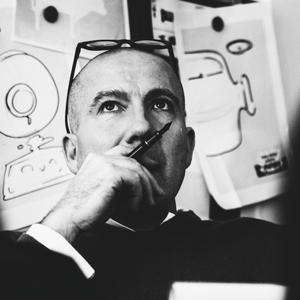
STUFF FROM THE LOFT - Dave Dye

STUFF FROM THE LOFT - Dave Dye

By Dave DYEBusinessManagement
Download on the App Store

STUFF FROM THE LOFT - Dave Dye episodes

  • Episode 36: TIM DELANEY: HOW TO DO PREMIUM.
    'We want a Patek Philippe!'.I'm told intermediaries hear that phrase on a regular basis.The problem is, most ad agencies can't do it.Most are unable translate the signals and nuances of the world's of premium and fashion.It's why the majority of advertising in those categories is produced in-house.But that's not perfect either, they may capture the right vibes but they rarely create anything with substance.They rarely position a brand or create long-term adverting campaigns.Much of it being indistinguishable from the editorial that surrounds it.One agency has operated in the sweet spot between the two; Leagas Delaney.Over the last forty odd years, they've produced long running campaigns for everyone from Harvey Nicholls to Porsche, from Garrards to Pictet, from Dom Perrignon to Harrods.Patek Phillipe is a perfect example.The advertising has the right look and feel, which is gently evolved year on year, but for the last 27 years it's been based on a single thought; 'You never own a Patek Phillippe, you merely look after it for the next generation'.It's why people now ask for a Patek Philippe - they want a property that lasts.So I thought I'd ask Tim how he goes about creating a long-term campaign for a premium brand.Rather than a scattershot of brands I thought it would be more helpful to focus on the detail of one, I chose Harrods.Full disclosure: I used to work on Harrods at Leagas Delaney back in the 90s.Every square inch of the agency's walls were covered in ads, not digital print outs - expensively framed high-end proofs.A walk up the stairwell, from the basement to the top floor, was like flipping through the last ten D&AD annuals.On the 4th floor, outside my office, was the Harrods campaign.As much as we admired it, it wasn't the kind of work you aspire to do when you're in your 20s.Who wants posh, elegant and timeless when you could have punchy, different and cool?At the time, the ads seemed too mannered-  'Dare we suggest this', 'May we recommend that'.Why be so snooty?Why not be chattier?They also seemed to have this kind of 'knowing' tone, one said 'Prove the Beatles wrong'.(Every time my partner Sean would walk past he'd give a different interpretation - "What? Strawberry Fields isn't Forever?", "So...You can hide your love away?" or "She didn't come in through the bathroom window?".)Then there were the sale ads; they didn't change for about fifteen years.Same headline in ever media channel.Same photographer year after year.The only thing that changed were the shots. (Which were basically products shots.)I remember Tom Carty scanning that wall, taking in all those sale ads, from ceiling to floor, then reading the headline 'There's only one Harrods. There's only one sale'.After a beat, he added 'There''s only one fucking ad!'But as you clock up the years, your goals change.Crazy, cool and punchy are no longer the North Stars.They maybe be for one brand, but not every brand.People put a variety of personalities in the same shopping basket.They may buy a science fiction phone and put it in a case made by a 200 year old leather company.They may juice from a kooky, knockabout start-up and wine from pretentious, unfriendly wine company.So you start trying harder to create work that reflects the businesses personality, not your own.You avoid the temptation to starting from scratch every year (because it's fun), putting your energy into building and refining what you've started.Nurturing it.Because long-lasting campaigns are far more valuable than endless short-term firework displays.They should be listed alongside the rest of a companies assets, like warehouses, machinery and staff.How much is 'Just do it' worth?Or, getting back to Harrods, how much is 'There's only one sale'?35 years after it was written, it's still running (albeit in a bastardised form).So how did it start?
    1 hr 7 min
  • Episode 34: Oli Beale
    “Hello Dave,
    We’ve not met before. I’m an ad creative too.
    I felt compelled to write and tell you how much I’m enjoying your blog. I’ve learnt loads. (Now I’ve started writing this email I feel a bit silly!)
    Anyway, keep pumping your stuff from the loft out into the ether.
    It’s wonderful.
    Thanks,
    Oli.”
    I got that email in 2013.
    I wondered where this charming young man went to college or was on placement, so I googled him: ‘Partner and Executive Creative Director at Anomaly.’
    Before that Creative Director at Mother.
    Before that – Wieden + Kennedy (where he’d won a pencil, the yellow one, for one of the coolest ideas of that year; The Kaiser Chiefs album launch.)
    What an unusually modest guy?
    Since then I’ve worked with Oli a few times (once on the Virgin Trains campaign below) he was just as modest and charming as he presents himself in that email. (Listen to the podcast if you don’t believe me.)
    But what I found and what I love about Oli, is whatever he touches – multi-million pound ad campaigns, complaints letters or tweets, his humour, intelligence and humanity come radiating out, like he literally can’t help himself.
    Psychologists have a term for it – ‘Talent’.
    (We had a lovely chat, hope you enjoy it.)
    1 hr 56 min
  • Episode 32: Another post about radio advertising. (Sorry.)
    There may even be another one, along with Paul Burke I’m trying to track down the 100 best radio ads.
    (If you have any send them in.)
    But onto this one, one of the surprising joys of doing this blog is unexpected things that turn upon my doorstep.
    Proofs, agency brochures, old DVDs, all manner of ephemera. (Or ‘crap’ as my wife calls it.).
    It’s lead me to post blogs on David Abbott’s BT Pitch, Fallon McElligott’s Rolling Stone campaign (thanks for the tear-sheets Brian Burch, posting soon), and this one: ’21 Years Of Radio Advertising’.
    A one celebration of the best of the U.K’s radio advertising, it includes advice and reflection from some of its best practitioners; Tim Delaney, David Abbott, John Hegarty and more.
    Interestingly, it says on the cover ‘Commercial Radio. It’s time has come.’
    I wasn’t aware of that in 1994.
    I have no idea who sent me this, whoever you are; thank you.
    For the rest of you; enjoy.
    1 hr 9 min
  • Mary Wear.
    ‘Remember how seriously we all took it?
    Not that we took ourselves seriously or that we didn’t have fun, but we just tried so, so hard to make great work.
    It may be chip paper to most people, but we’d really sweated every last detail.
    Even on the bad ads, we'd stay lat trying desperately to improve them.
    Like we were on a mission.
    It seemed so important.’
    I enjoyed chatting to Mary.
    Although afterwards, I must confess, I was a little irritated; why on earth had she never set up her own agency?
    Or run her own Creative Department for that matter?
    (And why wasn’t that one of my questions?)
    She was born to do it.
    She’s such a clear thinker, funny, ballsy and confident, as you’ll hear.
    Also, and this is often gets overlooked - in 1987 Mary picked up the coveted Whitbread Most Promising Beginner Award at The Creative Circle.
    Hope you enjoy it.
    2 hr 41 min
  • PODCAST: Rick Sittig
    Many of you won’t recognise that name.
    You won't find it attached to tweets about how hot his latest campaign is next to a picture of his latest lunch; he doesn't do social media.
    You won't find his agency in any new business tables; they only handle three clients at a time, so tend to have long client relationships.
    You won't find their scripts in any production companies; they direct them in-house.
    This is because, when, 23 years ago, the goal for his new agency was that the clients should be in the limelight, not the agency.
    While I've heard many say that kind of thing, I've never seen anyone actually do it.
    They gave themselves an undercover name; The Kowloon Wholesale Seafood Co.
    Then disguised the outside of the agency like a run-down seafood operation, just to throw off any potential clients who happen to be in the area.
    And just to be awkward, he changed his name from Dick to Rick Sittig.
    You won't find either of them in any of advertising's Hall of Fame's.
    Which is weird.
    Because between them they’ve done some of the best, most famous, longest running ad campaigns ever.
    Jack In The Box, Joe Isuzu, the Energiser Bunny and the Nissan Pathfinder to name but a few.
    So at the risk annoying Rick by bringing on some unwanted adulation - if anyone out there works for the One Show, Art Directors Club or Clios; come on, induct this man immediately.
    It’s embarrassing.
    1 hr 56 min
  • PODCAST: Rory Sutherla...
    That's not a mistake, it's my attempt to graphically warn you that this podcast ends abruptly.
The idea was that I'd grill Rory on some of the issues facing our business today.
He is easily one of the most thoughtful, smartest guys in our business, just check out some of his quotes below if you don't believe me.
But rather than ask softball questions that were too broad, I thought it'd be more interesting to make it binary.
Forcing a result.
I framed the questions in terms of hiring for a new agency.
For example, would it be better that people felt relaxed and comfortable in the office or fearful? Should we prioritise diversity over ability? Would misfits be more valuable in developing work than the well-adjusted.
That was the plan anyway.
But, firstly, I wasn't at Wave, I was on away territory (Sea Container’s House) so I didn’t have control over the tech and interruptions.
Secondly, I asked a warm up question to get the ball rolling - ‘What is Advertising?’.
I’d imagined three, four, maybe even five minutes before we got to the interview?
Wrong.
Fearing we wouldn't get to any of the pre-prepared questions, we abandoned it after 45 minutes.
The upside is that it lead us down some interesting avenues, the downside was that you’ll hear a record scratch type ending as a lady kicks us both out of our room.
Never the less, I thoroughly enjoyed recording it, hope you enjoy listening to it.
     
    Some of my favourite Rory quotes:
     
    "Military strategy is in some ways very much like marketing - you can't be conventionally logical as a military strategist, because the enemy will be able to predict what you are going to do."
     
    “A flower is a weed with an advertising budget.”
     
    "It doesn't pay to be logical if everyone else is being logical.''
    

''Dare to be trivial."
     
    "Google understood that if you're just a search engine, people assume you're a very, very good search engine."
     
    "Once you have a very, very large budget, you actually look for expensive things to spend it on."
     
    “If you had retroactively applied the rules of scientific rationalism to all of the major scientific discoveries of the past 500 years you would have invalidated most of them. Perhaps most (penicillin, the X-Ray, the microwave, Aspirin, radio, Archimedes in the bath) were the product of “inspired opportunism”.
As he once put it: “a methodology was an ideology Galileo could not afford.”
     
    “The human mind does not run on logic any more than a horse runs on petrol.”
     
    “It’s important to remember that big data all comes from the same place – the past. A new campaigning style, a single rogue variable or a ‘black swan’ event can throw the most perfectly calibrated model into chaos.”
     
    “Henry Ford’s reaction to a consultant who questioned why he paid $50,000 a year to someone who spent most of his time with his feet on his desk. 'Because a few years ago that man came up with something that saved me $2,000,000' he replied. 'And when he had that idea his feet were exactly where they are now."
     
    “It is much easier to be fired for being illogical than it is for being unimaginative.
The fatal issue is that logic always gets you to exactly the same place as your competitors.”
     
    "The problem with logic is that it kills magic."
     
    “To put a value on the digital world by only tallying the money that changes hands is a little like trying to place a value on sex by simply measuring the amount spent on prostitution.”
     
    “I think the first role of marketing is to make a decision easy to make.
And that means firstly clarity in terms of choice, and secondly it means lack of anxiety."
     
    "Solving problems using rationality is like playing golf with only one club."
     
    "A good guess that stands up to observation is still science. So is a lucky accident."
     
    "What the spreadsheet has done is to create in organisations and governments an over-reliance on numbers (by no means always meaningful or even accurate) with result that often spurious numeric(continued)

    2 hr 22 min
  • Gary Goldsmith
    Pick up any New York Art Directors Club Annual from the sixties and you can feel the heat coming off the pages.
    The Writers are using words previously confined to conversation, the Art Directors are trying to find new ways to present the information (‘Creating new pages’ as Helmut Krone put it.)
    Then, the seventies.
    A whole different story; the experimentation and energy appear to have dried up.
    True, there are still lots of good thoughts and lines, but in terms of how it's presented the search for 'a new page' seems to have come to an end.
    Maybe it was agreed at some Annual General Art Directors meeting that Art Directors should stop pfaffing around, decide once and for all what a god damn ad should look like!
    If it was, the look they settled on was this;
    All headlines should be set in a bold serif font.
    Squeezed.
    (In the spring you’re allowed to use initial caps for each word.)
    Underneath the headline should be a photo (the more serious the better).
    100 words of copy should be divided into two columns and placed under the picture.
    Put a logo bottom left.
    Job done.
    It's odd, because the job of an art director is to set a distinctive tone and get attention.
    To do both, you have to create something that looks different from the norm.
    All companies aren't the same and unusual get's more attention than familiar.

    As the '70's ended so did the Art Direction lockdown.
    Art Directors began to play again.
    One of the leading players was Gary Goldsmith.
    Take a look at his VW Rabbit ad from 1981.
    It looks nothing like an ad, let alone a VW ad.
    Or his Chivas Regal Christmas ad.
    Where's the lovely photograph of the whiskey they had in the previous 200 award-winning Chivas ads?
    Giant letters turning up at all angles?
    Copy out of a brightly coloured box, a box printed in a 5th colour (it added $1m to the cost of production).
    What the hell was he playing at?
    I guess that’s the point, look through the work below you can feel the joy of a human being communicating to others.
    He'll hate me for saying this, but as a small child I used to look through the One Shows to find Gary's work.
    Each client would always have its own distinctive look.
    If the clients were premium the ads felt premium, if the clients were more basic the ads felt more basic.
    Every campaign had a bespoke look.
    The only thing they had in common was that they felt intelligent and playful.
    I had a great chat with Gary, hope you enjoy it.
    2 hr 35 min
  • David Kolbusz.
    When you start out in your advertising career, Pentel in one hand, Macbook in  the other, you seem to be surrounded by good work.
    Awards books are choc-a-bloc with it.
    As you go on, year by year, you seem to see less and less.
    For example, the first D&AD Annual looked at probably had an 80/20 ratio of good to bad.
    10 years later those percentages are likely to have flipped.
    As you move on you become less swayed by awards, famous names or cool agencies, you now have 10 years of data to compare any new idea to - Is it as fresh as A? As funny as B or, actually, isn’t it just a reworking of C?
    It’s hard not to.
    You’re no longer that naïve, impressionable young thing you once were.
    In the music business they believe that our musical taste can be tracked back to our 16th summer; that's when we were most impressionable and hungry for experiences.
    As you get older it gets harder to find that tingle of excitement you feel when you experience things for the first time.
    In advertising, not being easily excited can be seen as being jaded.
    In fashion, architecture and many other creative they have different name for it; knowledge.
    I say this for two reasons;
    a) I’ve seen A LOT of stuff.
    b) David's stuff always causes a tingle, (not a minty-fresh, mouth tingle, but a work-fresh, excitement tingle).
    Somehow, he manages to produce work that feels like it's avoided committees, cliches and compromises.
    Whereas most work can be quickly categorised as good or bad, with David’s I often have to think about first.
    The Orange spot with the couple dancing; Is that good?
    The Guardian ‘3 Little Piggies’; Is that good?
    The Coal Drops Yard Branding with the seemingly random bunch of shapes, pictures and colours; Is that good?
    None are what you’d expect.
    Each take balls to go with.
    All are hard to ignore or forget.
    Much of the work he’s created and overseen at Drog5 London feels as though the team enjoyed thinking it up, then just couldn’t wait to make it and show the world.
    Good work tends to have that vibe.
    Unfortunately, we recorded this a while back, and David being David, he came up with a cunning way to make this podcast not only unusual, but complicated to make.
    Eventually, for reasons that would take too long to go into, it's coming out in a non-unusual, uncomplicated, familiar format. (Soz David.)
    It means that we don’t cover the great work Droga5 have been knocking out over the last year or so, like their exceptionally tingley Super Bowl ad for Amazon.
    Enjoy.
    1 hr 30 min
  • ALAN BROOKING.
    I'm guessing you're not as familiar with that name as were with others I've posted?
    But you'll be familiar with his work.
    Saatchi's 'Pregnant Man'?
    BBH's 'Black Sheep' poster?
    CDP's 'Wolf In Sheeps Clothing'?
    Yes? All shot by Alan.
    Because they're such a fantastic ideas, they look as though anybody could've shot them.
    The images are so simple and clear you can't imagine done them any other way.
    But each is the end result of a series of choices.
    Take a look at the casting contacts from the the 'Pregnant Man' ad, the alternative models look ridiculous, but they didn't on January 21st 1970.
    Look at the 'Black' sheep ad Alan shot for John Hegarty (and Barbra Nokes), just a bunch of sheep with a black one plonked in the middle?
    Nope.
    If shot side-on, they'd blend into each other after the first row and not fill the poster.
    If shot from above you wouldn't see them in that classic, side-on profile.
    So Alan used his map reading skills (acquired through Rally driving) to find a steep incline, so that the sheep rose up, filling the poster with graphic sheep profiles, almost like cut outs, but better for being shot for real.
    Then there's the 'Wolf In Sheeps Clothing'; How hard can it be to fling a sheep's pelt over a wolf?
    Very, as it turns out.
    Wolves don't like modelling, so Alan borrowed some sheep pictures from a friend, photographer Adrian Flowers, then comped the two together.
    In Alan's words, he wasn't a photographer, he was  'an adman with a camera', simply trying to bring the ideas to life.
    He'd learnt how to do this from his years as a top art director at CPV and CDP, getting to work on a regular basis with photographers like Elliott Erwitt, Duffy and Terrence Donovan.
    We had a great chat, hope you enjoy it.
    2 hr 22 min
  • TREVOR BEATTIE.
    'Recorded any new podcasts lately?'
    I get asked this a few times every week.
    The askees range from college attendees to retired adman.
    As I pick the people I interview, they seem as famous as The Beatles to me, but they're often unknown to the askees.
    After offering up a name and watching a blank expression appear, I reach for a quick handle, something from culture that I think they'll know.
    Occasionally it's an ad fact; 'Set Up Fallon before his name was lopped off' (Tom McElligott), but it's better if it's something that's escaped from the pages of Campaign and the various awards annuals and seeped into the culture.
    A good test is whether it would pique the interest of your parents.
    For example, mine wouldn't be fussed about who founded Fallon, but they might be interested in the bloke who 'Created those Smash Martians and Cresta Bear ads, yet wasn't John Webster' (Chris Wilkins), or the 'Typographer who used to be in a band with David Bowie' (Dave Wakefield) or maybe the guy who 'Shot all those Gary Lineker Walker's ads' (Paul Weiland).
    Should I bump into another askee before I post this, and they haven't heard the name Trevor Beattie, the problem wouldn't be trying to think of a cultural link they may know, it will be trying to figure out which one is most relevant to the person in front of me.
    I could create a very bespoke answer.
    Because Trevor seems to have had a disproportionate amount of brushes with popular culture.
    Here's a few that spring to mind:
    He went to school with UB40.
    Worked for the bloke who wrote the R-Whites 'Secret Lemonade Drinker'.
    Did those Weetabix 'Skinhead' ads.
    Got Bob Hoskins to do the voiceover.
    Hired by the guy who wrote Campari's 'No, Luton Airport'.
    Wrote those ads where people turn into Bertie Bassett.
    Created an Irish Tourist Board campaign featuring Wendy Craig and Billy Beaumont.
    Wrote 'Cats Like Felix Like Felix' in 1989 (it's still used).
    Discovered Holly Willoughby for Pretty Polly ad.
    Wrote ‘Hello Boys’.
    Shot with Hugh Hudson.
    Did that 'Cometh The Hour' David Beckham ad.
    Created that F.C.U.K. campaign.
    Owns the biggest Muhummad Ali collection in the world.
    Did a Unicef ad with Nelson Mandela.
    Persuaded Chris Cunningham to direct his first commercial.
    Shot an ad with David Lynch.
    Used John Shuttleworth for Yorkshire Tea ads.
    Rewrote Lionel Bart's ‘Food, Glorious Food’ for McCain’s ad.
    Pays for hundreds Veterans to go back to the beaches of Normandy to commemorate D-Day every year.
    Approved 'Double Life'.
    Invested in 'Lock Stock and Two Smoking Barrels'.
    Bought the original Abbey Road sign.
    Approved Peter Kay’s John Smith's campaign.
    Oversaw the marketing for Tony Blair and New Labour for three successful General Election campaigns.
    Created poster for that film 'Layer Cake'.
    Hired Zowie Bowie.
    Produced the cult film ‘Moon’.
    Made a documentary about Rudolph Nuryev.
    Produced a documentary about the history of the Spitfire.
    Producing a film about Brian Epstein.
    Trekked to the South Pole with Buzz Aldrin.
    Produced a documentary about Thalidomide (Attacking The Devil).
    With Harold Evans.
    Going to space in 2020.
    (At the time of writing he's desperately trying to make a film about Hilda Ogden.)

    We had a great chat, hope you enjoy it.
    1 hr 45 min

About STUFF FROM THE LOFT - Dave Dye

From the publisher's feed

Interviews with the best advertising, design, photographic, typographic, illustration and film directing talent that are still alive*.
(*It's just easier.)

More shows like STUFF FROM THE LOFT - Dave Dye

Rugby Union Weekly by BBC Radio 5 Live

Rugby Union Weekly

316 Listeners

The Rest Is History by Goalhanger

The Rest Is History

15,606 Listeners

The Rest Is Politics by Goalhanger

The Rest Is Politics

3,040 Listeners

The News Agents by Global

The News Agents

1,139 Listeners

The Rest Is Entertainment by Goalhanger

The Rest Is Entertainment

840 Listeners