
Sign up to save your podcasts
Or



Send us Fan Mail
Follow Maha @kenar.embroidery on Instagram. English description below.
العناوين الأساسية للحلقة
0:29 التعريف بالضيفة: مها أبو سيدو، مصممة أزياء تراثية من غزة وصاحبة مشروع كنار، تتحدث عن ارتباطها بفلسطين وعن انتقالها من غزة إلى مصر.
1:26 بداية الحكاية مع التطريز: تعلقت بالثوب الفلسطيني منذ عروض الأزياء في طفولتها، وتعلمت التطريز من والدتها، وكان أول ثوب لها عام 2016.
3:40 اسم كنار ومعناه: اختارت الاسم بعد دراسة، وهو يرتبط بحزام الثوب او كناره وبالعمارة الفلسطينية وبفكرة تأطير التطريز.
4:31 كنار في غزة: مشروع ضم أكثر من 160 سيدة، وكان مصدر رزق ومساحة للحكايات.
5:16 أثر الحرب: فقدت المكان والأشخاص وتعب سنوات طويلة.
14:09 البدء من جديد في مصر: بناء فريق جديد من نساء نازحات، بعضهن جديدات على التطريز، وانضمام مطرِّزات ذوات خبرة من نابلس وغزة.
16:03 تحديات المواد الخام: شحن الخيوط والأقمشة من فلسطين إلى الإمارات ثم إلى مصر.
17:20 منتجات كنار: التطريز على القبعات، وقلادة سرو غزة، والتعاون مع "تيتة ليلى"، ومجموعة "موطني" على ملابس الشارع.
23:11 قيمة العمل اليدوي: الفرق بين التطريز اليدوي والتطريز بالماكينة، وأهمية أن يدرك المشتري الوقت والجهد وراء كل قطعة.
26:11 تعليم التطريز: دورات للمبتدئات والمتقدمات في بلدية الزهراء، وانطلاق مشاريع ومعارض صغيرة بين المشاركات.
29:55 الختام: كلمة مها الأخيرة
31:11 كيفية التواصل مع مها وكنار
You’ll hear about:
>> 0:29: Introducing the guest – Maha Abu Seido, a heritage fashion designer from Gaza and founder of Kinar, talks about her connection to Palestine and her move from Gaza to Egypt
>> 1:26: How her story with tatreez began – She became attached to the Palestinian thobe through fashion shows in her childhood, learned embroidery from her mother, and made her first thobe in 2016.
>> 3:40: The name Kinar and its meaning – She chose the name after careful study. It is tied to the kinar belt, to Palestinian architecture, and to the idea of framing embroidery.
>> 4:31: Kinar in Gaza – A project that brought together more than 160 women and was both a source of livelihood and a space for stories.
>> 5:16: The impact of the war – She lost the place, the people, and years of hard work.
>> 14:09: Starting over in Egypt – Building a new team of displaced women, some new to embroidery, joined by experienced embroiderers from Nablus and Gaza.
>> 16:03: The challenge of raw materials – Shipping threads and fabrics from Palestine to the UAE and then to Egypt.
>> 17:20: Kinar's products – Embroidered caps, the Gaza cypress necklace, the collaboration with Teta Laila, and the "Watani" streetwear collection.
>> 23:11: The value of handmade work – The difference between hand embroidery and machine embroidery, and why buyers should understand the time and effort behind each piece.
>> 26:11: Teaching embroidery – Beginner and advanced courses at Al-Zahra municipality, and small projects and exhibitions launched by the participants.
>> 29:55: Closing – Maha's final message.
>> 31:11: How to reach Maha and Kinar
Rate, Review, & Follow on Your Favorite Podcast Platform
“I love Palestinian embroidery and Tatreez Talk.” <– If that sounds like you, please consider rating and reviewing our show! This helps us elevate the vibrant narratives of Palestinian embroiderers and support more tatreez-ers — just like you — in learning more about tatreez and connecting with each other. You can find us on Spotify, Apple Podcast, and others -- just scroll to the bottom, tap to rate with five stars, and select “Write a Review.” Then be sure to let us know what you loved most about the episode!
Also, if you haven’t done so already, follow the podcast. We’re adding a bunch of bonus episodes to the feed and, if you’re not following, there’s a good chance you’ll miss out. Follow now!
Boycott Resolute RGL. Click here for more information.
Follow us @tatreeztalk
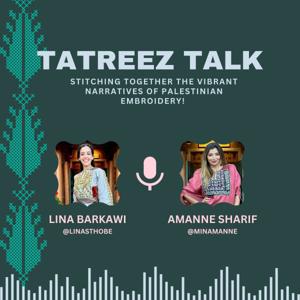
Follow Amanne @minamanne & Lina @linasthobe
Send us Fan Mail
MEET LIANE, A MULTIMEDIA ARTIST AND EDUCATION CONSULTANT WHOSE PALESTINIAN ROOTS RUN THROUGH RAMLEH, HAIFA, GAZA, AND JERUSALEM, BY WAY OF KUWAIT (@lianeya; Website; Crafting Solidarity Substack). Born and raised in Kuwait, Liane then went to college in California and spent a decade across the Middle East before settling near Dearborn.
Tatreez came to her in 2020, during the pandemic, when a needlepoint class and a few free online resources turned into a full-blown obsession. Only once she was hooked did she realize she had been watching it her whole life. Her grandmother from Haifa, taught embroidery by missionaries as a girl, stitched until the end of her life, and even after Parkinson’s set in, her hands went still whenever she held a needle.
Liane talks about her two-month art residency at the Qattan Foundation in 2022, compares growing up surrounded by Palestinians in Kuwait with life in the US, and she also shares her grandmother’s monumental heirloom pieces, including a two-meter floral bouquet and a fully embroidered chair, and the idea of “personal mythologies”: motifs she returns to over and over until she sheds them. Those include a cactus temple built on the idea of sumud, ducks inspired by her son’s first words, and a freehand Palestinian flag stitched over a sports logo. We also get into whether diaspora tatreez is more political, why our relatives back home sometimes find our devotion puzzling, and the research on Diné (Navajo) weaving that started her Substack.
You’ll hear about:
>> 0:52: Liane’s relationship to Palestine
>> 7:30: Comparing diaspora experiences
>> 10:40: Her tatreez origin story
>> 14:00: Relationships after starting tatreez, including the political
>> 19:12: Heirlooms passed down and newmade stories
>> 23:46: Current motif obsession
>> 26:00: Research on the intersection between Native American and Palestinian craft
>> 42:35: Current projects and what’s next
>> 50:00: Major life lesson from tatreez
Rate, Review, & Follow on Your Favorite Podcast Platform
“I love Palestinian embroidery and Tatreez Talk.” <– If that sounds like you, please consider rating and reviewing our show! This helps us elevate the vibrant narratives of Palestinian embroiderers and support more tatreez-ers — just like you — in learning more about tatreez and connecting with each other. You can find us on Spotify, Apple Podcast, and others -- just scroll to the bottom, tap to rate with five stars, and select “Write a Review.” Then be sure to let us know what you loved most about the episode!
Also, if you haven’t done so already, follow the podcast. We’re adding a bunch of bonus episodes to the feed and, if you’re not following, there’s a good chance you’ll miss out. Follow now!
Boycott Resolute RGL. Click here for more information.
Boycott ZARA and all Inditex brands—Bershka, Massimo Dutti, Pull & Bear, Stradivarius, Oysho, ZARA Home. Click here for more information.
Follow us @tatreeztalk
Follow Amanne @minamanne & Lina @linasthobe
Send us Fan Mail
MEET LAILA, A PALESTINIAN INDUSTRIAL AND GRAPHIC DESIGNER WHOSE TATREEZ PRACTICE LIVES IN OLIVE WOOD AND METAL RATHER THAN THREAD (@lailagracedesign; @pettystinian; website). Her family roots run through the old city of Ramallah, Beirut, Jerusalem, and al-Hassan in Jordan, and as a second generation Palestinian American, her identity has grown with her over the years.
Her path to tatreez started with an insult. Near the end of her undergraduate industrial design degree, a professor told her there was no need to study design from other parts of the world, because white people invented it. That comment, followed by her first trip to Palestine, sent her back for a master’s degree focused entirely on Palestinian craft, and on one question: how do Palestinians practice design?
Laila walks us through her master’s thesis, a vanity built by turning the chest panel of a thobe upside down and so many intentional details. She explains why she calls herself a Palestinian futurist, why she is moving away from symbols like the wall and 1948, and how that sits alongside earlier political pieces like her undergraduate table divided by a wall and “Your Bombs, Our Leisure,” a working hookah shaped like a bomb. She digs into the tension between preserving tradition and giving ourselves permission to evolve it, because one day, what we make now will be tradition too.
You’ll hear about:
>> 0:54: Laila’s connection to Palestine
>> 3:29: Her tatreez journey
>> 7:00: The Vanity: A Thobe in Olive Wood
>> 13:39: Defining “industrial design”
>> 15:21: Identifying as a Palestinian futurist & why that matters
>> 24:59: Discursive Work: Tea Time Under Apartheid and Your Bombs, Our Leisure
>> 29:13: Functional design to challenge occupation
>> 37:57: Laila’s cypress fan, embroidered dress, & star ottoman
>> 46:47: What’s next in her tatreez journey
>> 50:15: Major life lessons from tatreez
Rate, Review, & Follow on Your Favorite Podcast Platform
“I love Palestinian embroidery and Tatreez Talk.” <– If that sounds like you, please consider rating and reviewing our show! This helps us elevate the vibrant narratives of Palestinian embroiderers and support more tatreez-ers — just like you — in learning more about tatreez and connecting with each other. You can find us on Spotify, Apple Podcast, and others -- just scroll to the bottom, tap to rate with five stars, and select “Write a Review.” Then be sure to let us know what you loved most about the episode!
Also, if you haven’t done so already, follow the podcast. We’re adding a bunch of bonus episodes to the feed and, if you’re not following, there’s a good chance you’ll miss out. Follow now!
Boycott Resolute RGL. Click here for more information.
Boycott ZARA and all Inditex brands—Bershka, Massimo Dutti, Pull & Bear, Stradivarius, Oysho, ZARA Home. Click here for more information.
Follow us @tatreeztalk
Follow Amanne @minamanne & Lina @linasthobe
Send us Fan Mail
MEET SHEREEN, A TEXTILE ARTIST BASED IN AMMAN WITH A PASSION FOR ALL THINGS HANDMADE AND WHAT SHE CALLS A WORLD OF ORGANIZED CHAOS (@shereen.quttaineh). Palestinian from Jerusalem and Jordanian as well, she was born in Kuwait and left with her family during the Gulf War, eventually settling in Jordan.
Trained originally in painting and a longtime art teacher, she came back to tatreez about a decade ago, but never quite as a traditionalist: her approach blends structured cross-stitch with a much more intuitive, sketch-like embroidery style, mixing printmaking, paper, and fabric into work that resists the grid entirely.
In this episode, Shereen talks about her Forbidden Plants of Palestine project: a set of original motifs designed around plants Palestinians have been restricted from foraging or cultivating, sparked by research into foraging bans and the labor and pain of the ongoing genocide in Gaza. What started as a free PDF she shared on Instagram turned into a sprawling, unplanned collaboration: the motifs have been translated into languages including French, Italian, German, Japanese, Korean, and multiple Spanish dialects, and picked up by tattoo artists, embroidery circles, and exhibitions from Mexico to Spain, where a group reinterpreted the designs through their own "Bordado Serrano" tradition.
She also talks about her upcycled "wearable art" line, which she runs with her sister out of her Amman studio, and the intuitive-stitching and textile-collage sessions she teaches there.
You can learn more about her workshops in Amman, see her work, or get in touch via her artist IG, her wearable art line IG, her traveling tapestry IG, and website.
You’ll hear about:
>> 1:31: Shereen’s connection to Palestine
>> 3:30: Her tatreez journey, including non-Palestinian embroidery
>> 9:20: Forbidden Plants of Palestine project
>> 15:21: Researching Palestinian plants
>> 18:47: Reception & things that came out of the project
>> 25:38: Shereen’s wearable art line and workshops
>> 31:15: Advice for freehand embroidery
>> 33:17: The Traveling Tapestry project
>> 38:30: What’s next for Shereen
>> 42:00: Major life lessons from tatreez
Rate, Review, & Follow on Your Favorite Podcast Platform
“I love Palestinian embroidery and Tatreez Talk.” <– If that sounds like you, please consider rating and reviewing our show! This helps us elevate the vibrant narratives of Palestinian embroiderers and support more tatreez-ers — just like you — in learning more about tatreez and connecting with each other. You can find us on Spotify, Apple Podcast, and others -- just scroll to the bottom, tap to rate with five stars, and select “Write a Review.” Then be sure to let us know what you loved most about the episode!
Also, if you haven’t done so already, follow the podcast. We’re adding a bunch of bonus episodes to the feed and, if you’re not following, there’s a good chance you’ll miss out. Follow now!
Links Mentioned
>> Watch the film Foragers (2022)
>> Read The Land in Our Bones by Layla K. Feghali
Boycott Resolute RGL. Click here for more information.
Boycott ZARA and all Inditex brands—Bershka, Massimo Dutti, Pull & Bear, Stradivarius, Oysho, ZARA Home. Click here for more information.
Follow us @tatreeztalk
Follow Amanne @minamanne & Lina @linasthobe
Send us Fan Mail
Follow @nisreenshubair72 on Instagram. English description below.
تطريز توك (بالعربي)، الحلقة الثانية مع نسرين
01:36 التعريف بالضيفة: نسرين، مطرّزة ومعلمة تطريز فلسطينية تقيم في أربيل وأصلها من خانيونس في غزة.
02:41 بداية الحكاية مع التطريز: وُلدت في الكويت وعاشت في المهجر، وتعلمت من خالتها دون أن تعرف أسماء النقشات، ثم انقطعت 20 سنة وعادت إليه في الإمارات وعمرها 42 عاماً، وقضت ثلاث سنوات تتعلم بنفسها من كتب موثوقة.
04:26 الخياطة وصناعة القطع بنفسها: شدّدت على أهمية تعلّم الخياطة لكل مطرّزة، وتعلّمت صنع صناديق وحقائب وإصلاح صواني خشبية لتُنهي قطعها بنفسها خارج فلسطين.
09:04 أسلوبها في تعليم الأطفال والكبار: ترسم الطالبات التصميم على ورق مربعات قبل تطريزه، وتمتد ورشاتها نحو أربعة أيام، ومن قصصها فتاة هولندية تعلّمت صنع الأقراط لدعم غزة.
16:19 نصائح للمبتدئات: اقتناء كتاب للغرز والنقشات الأساسية، وتمييز النقشات الفلسطينية عن غيرها، وعدم نسب تطريز الشعوب الأخرى إلى فلسطين، مع ذكر مصادر مثل «دليل فن التطريز الفلسطيني».
21:18 التطريز لغة صامتة: كانت النساء يسجّلن بالتطريز أصولهن وأحوالهن، وتروي قصة الحمامتين المتقابلتين ، وتتحدث عن الغرز المتعددة في الثوب الفلسطيني وعن التطريز السيناوي.
32:24 الألوان والإلهام: علّمها التطريز تنسيق الألوان، وتعجب بكيف استلهمت المرأة الفلسطينية ألوانها من بيئتها، كصدف الموريكس في غزة والبحر.
33:43 تحديات التطريز والتعليم: اختلاف قدرات المتعلمات، وإرهاق اللوحات الكبيرة، وتأثير التوتر في شدّ الغرز، والتوقعات غير الواقعية عن الوقت والسعر.
43:21 الارتباط بالتراث والأرض: دعوة لسؤال كبار السن عن تفاصيل حياتهم لأنها تربط بفلسطين، وأن من هم خارجها يملكون رفاهية الوقت للاهتمام بالتراث فلا ينبغي تضييعها.
44:30 العناية بالقطع المطرّزة: غسل القطع وكيّها لاستعادة شكلها، وتخزين الأثواب مع البهارات أو اللافندر، وورق الألمنيوم على ظهر الإطار لحماية اللوحات من الحشرات.
48:51 فيديوهاتها وفلسفتها في التعليم: تصنع فيديوهات تعليمية لأنها لم تجد من يعلّمها، وترى أنه لا توجد طريقة ثابتة واحدة وأن كل شخص يكيّف التقنية بأسلوبه.
53:10 رسالتها الختامية: الاستمرار في التعلم، واحترام حقوق عمل الآخرين، ومعرفة تاريخ النقشات وتوثيقها لحمايتها من السرقة، وتجنب المشاحنات على الإنترنت.55:55
56:19 مشروعها الحالي: تطرّز لوحة للمسجد الأقصى وتتعلم أثناء العمل عن الأبواب والبوائك والمآذن، وأن "الأقصى" اسم للحرم كله.
You’ll hear about:
>> 01:36: Introducing Nisreen: a Palestinian embroidery artist and teacher based in Erbil whose family is from Khan Younis, Gaza
>> 02:41: How her story with tatreez began
>> 04:26: Sewing and making pieces herself
>> 09:04: Her approach to teaching children and adults
>> 16:19: Advice for beginners
>> 21:18: Tatreez as a silent language
>> 32:24: Color and inspiration
>> 33:43: Challenges of embroidery and teaching
>> 43:21: Ask elders about the details of their lives
>> 44:30: Caring for embroidered pieces
>> 48:51: Her videos and teaching philosophy
>> 53:10: Keep learning, respect the rights of others’ work, learn the history of the patterns and document them to protect them from theft, and avoid online quarrels
>> 56:19: Her current project
Rate, Review, & Follow on Your Favorite Podcast Platform
“I love Palestinian embroidery and Tatreez Talk.” <– If that sounds like you, please consider rating and reviewing our show! This helps us elevate the vibrant narratives of Palestinian embroiderers and support more tatreez-ers — just like you — in learning more about tatreez and connecting with each other. You can find us on Spotify, Apple Podcast, and others -- just scroll to the bottom, tap to rate with five stars, and select “Write a Review.” Then be sure to let us know what you loved most about the episode!
Also, if you haven’t done so already, follow the podcast. We’re adding a bunch of bonus episodes to the feed and, if you’re not following, there’s a good chance you’ll miss out. Follow now!
Boycott Resolute RGL. Click here for more information.
Boycott ZARA and all Inditex brands—Bershka, Massimo Dutti, Pull & Bear, Stradivarius, Oysho, ZARA Home. Click here for more information.
Follow us @tatreeztalk
Follow Amanne @minamanne & Lina @linasthobe
Send us Fan Mail
MEET SUBHYA, A TATREEZ ARTIST AND A GRADUATE STUDENT CURRENTLY STUDYING TO BECOME A LICENSED PROFESSIONAL COUNSELOR (@svbhya). Her family's story spans three continents: her father was born in Al-Quds in 1966, just before the 1967 war forced his family to flee on foot to Amman, where they lived in refugee camps before he eventually made his way to Houston at 17. On her mother's side, her grandfather left Palestine in the 1950s on a boat bound for South America and ended up in Brazil, married a Brazilian woman, and raised a daughter who, despite growing up in Brasília, would say she felt more Palestinian than Brazilian.
At the center of it all is Subhya's paternal grandmother, also named Subhya, a prolific tatreez artist who stitched thobes and large tapestries and whose habit of gifting her handstitched thobes to her Brazilian daughter-in-law quietly tied both sides of Subhya's family together long before Subhya ever picked up a needle herself.
In this episode, Subhya traces how she learned tatreez in 2023, began hosting her first workshop in Houston in 2024 to a room of 40 students, and built one of the only tatreez communities in her city. She also opens up about how practicing tatreez reconnected her to her late grandmother's memory and became a source of pride for her family, and shares her vision for combining her counseling background with tatreez.
Make sure you check her out on IG, and if you’d like to purchase or commission a piece from her, you can do so at svbhya.com.
You’ll hear about:
>> 1:18: Subhya’s connection to Palestine
>> 9:26: Subhya’s tatreez journey
>> 15:20: Starting tatreez workshops
>> 18:15: Relationships with family after learning tatreez
>> 20:44: Tatreez community in Houston
>> 26:32: Blending tatreez with mental health
>> 33:07: Current tatreez projects
>> 37:25: Major life lesson from tatreez
Rate, Review, & Follow on Your Favorite Podcast Platform
“I love Palestinian embroidery and Tatreez Talk.” <– If that sounds like you, please consider rating and reviewing our show! This helps us elevate the vibrant narratives of Palestinian embroiderers and support more tatreez-ers — just like you — in learning more about tatreez and connecting with each other. You can find us on Spotify, Apple Podcast, and others -- just scroll to the bottom, tap to rate with five stars, and select “Write a Review.” Then be sure to let us know what you loved most about the episode!
Also, if you haven’t done so already, follow the podcast. We’re adding a bunch of bonus episodes to the feed and, if you’re not following, there’s a good chance you’ll miss out. Follow now!
Boycott Resolute RGL. Click here for more information.
Boycott ZARA and all Inditex brands—Bershka, Massimo Dutti, Pull & Bear, Stradivarius, Oysho, ZARA Home. Click here for more information.
Follow us @tatreeztalk
Follow Amanne @minamanne & Lina @linasthobe
Send us Fan Mail
MEET ZAYNAB, A TATREEZ ARTIST AND FOUNDER OF KANAAN COLLECTIVE BUILDING COMMUNITY IN THE DMV AREA (@kanaancollective). Half-Palestinian and half-Irish, she grew up partly in Amman, Jordan, after her father's family fled Al-Khalil during the Six-Day War before the family moved to the U.S., where a post-9/11 America gave her a hard early lesson in how the world would see her identity.
She'd always admired tatreez as an art form, even remembering a photo of herself standing between two thobes in a museum, but it wasn't until her sister's wedding (when everyone was wearing hand-stitched thobes) that she realized it was something she could actually learn herself. She picked up the needle for good during COVID, and stitched daily as a way to cope after October 7th, a period that left her craving in-person community with people who understood her. That craving grew into informal stitching circles that started with one friend and grew to 30 people, eventually becoming Kan'an Collective in 2025.
In this episode, Zaynab talks about building that community from the ground up, her deliberate push to create more modest, hijabi-friendly tatreez pieces for everyday wear, and her design process. She also shares how she connected with the Palestinian women embroiderers in Egypt (many displaced from Gaza) who stitch her designs, with all proceeds going directly to them, and speaks candidly about the flood of cheap machine embroidery undervaluing tatreez labor, and why she believes embroiderers deserve to be paid what their work is actually worth.
You’ll hear about:
>> 1:15: Zaynab’s connection to Palestine
>> 6:27: Her tatreez journey
>> 9:35: Building community and starting Kanaan Collective
>> 12:36: A collection with tatreez by women in Egypt
>> 18:43: Zaynab’s design process
>> 25:32: Cheap machine embroidery undervaluing tatreez labor
>> 31:53: Problems arising from commercializing the culture
>> 34:46: Her current projects
>> 38:10: Life lessons from tatreez
Rate, Review, & Follow on Your Favorite Podcast Platform
“I love Palestinian embroidery and Tatreez Talk.” <– If that sounds like you, please consider rating and reviewing our show! This helps us elevate the vibrant narratives of Palestinian embroiderers and support more tatreez-ers — just like you — in learning more about tatreez and connecting with each other. You can find us on Spotify, Apple Podcast, and others -- just scroll to the bottom, tap to rate with five stars, and select “Write a Review.” Then be sure to let us know what you loved most about the episode!
Also, if you haven’t done so already, follow the podcast. We’re adding a bunch of bonus episodes to the feed and, if you’re not following, there’s a good chance you’ll miss out. Follow now!
Boycott Resolute RGL. Click here for more information.
Boycott ZARA and all Inditex brands—Bershka, Massimo Dutti, Pull & Bear, Stradivarius, Oysho, ZARA Home. Click here for more information.
Follow us @tatreeztalk
Follow Amanne @minamanne & Lina @linasthobe
Send us Fan Mail
MEET LEILAH: A MOTHER, EDUCATOR AND PASSIONATE COLLECTOR ABOUT ALL TRADITIONAL PALESTINIAN DRESS AND HISTORY (@leilah_ia). Three generations removed from Palestine, with family scattered across Brazil, Kuwait, Jordan, and Ramallah, she grew up watching her grandmother work on thobes. It wasn't until she went searching for one of her own during a pandemic wedding that collecting became a calling. What she found online was a market flooded with mislabeled "ceremonial robes," most sold by non-Palestinians with only fragments of the real story behind them, and that gap is what pulled her in.
In this episode, Leila walks us through pieces from her personal collection spanning the late 19th to 20th century, tracing how thobes and malaks were altered, mislabeled, and sometimes stripped for parts by owners outside the culture. She shares what she's learned about reading provenance, preserving fragile pieces, and treating herself as a temporary caretaker rather than an owner. She also talks candidly about the labor of building trust with elders and fellow collectors, the role of online archives in her self-education, and why she believes everyone, regardless of gender, should feel free to wear tatreez.
You’ll hear about:
>> 0:58: Leilah’s relationship to Palestine
>> 2:57: Getting interested in tatreez & learning tatreez from Teta
>> 7:13: Collecting Thobes
>> 10:37: Connecting with community (and men) through collecting
>> 17:54: Thobe show-and-tell (WATCH ON YOUTUBE!)
>> 36:40: Misconceptions by the Palestinian community
>> 42:00 Who has a right to collect athwab?
>> 47:30: How you should clean an old thobe
>> 49:56: What’s next in Leilah’s tatreez journey
>> 51:34: Major life lesson from tatreez
Rate, Review, & Follow on Your Favorite Podcast Platform
“I love Palestinian embroidery and Tatreez Talk.” <– If that sounds like you, please consider rating and reviewing our show! This helps us elevate the vibrant narratives of Palestinian embroiderers and support more tatreez-ers — just like you — in learning more about tatreez and connecting with each other. You can find us on Spotify, Apple Podcast, and others -- just scroll to the bottom, tap to rate with five stars, and select “Write a Review.” Then be sure to let us know what you loved most about the episode!
Also, if you haven’t done so already, follow the podcast. We’re adding a bunch of bonus episodes to the feed and, if you’re not following, there’s a good chance you’ll miss out. Follow now!
Links Mentioned
>> Jawad from @palestinian_thobbe on IG, incredible resource on Palestinian tatreez & dress
Boycott Resolute RGL. Click here for more information.
Boycott ZARA and all Inditex brands—Bershka, Massimo Dutti, Pull & Bear, Stradivarius, Oysho, ZARA Home. Click here for more information.
Follow us @tatreeztalk
Follow Amanne @minamanne & Lina @linasthobe
Send us Fan Mail
IN THIS EPISODE, we welcome Amneh, the artist and embroiderer behind @sarafand, to talk about her journey into tatreez, her large-scale Chest panels of thobe embroidery murals, and the story of her village, Sarafand, that inspired her page name.
Amneh shares how a casual introduction to Tatreez from a neighbor grew into months-long mural projects, why she believes only those who've learned tatreez can truly judge its value, and how documenting Palestinian Chest panels and Sarafand traditional patterns became a way of preserving a piece of Palestine that no longer physically exists.
You'll hear about:
>> 01:35: Quick intro into Amneh and how she started tatreez
>> 07:23: Her creative process: research, color choices, and how long a mural really takes
>> 13:07: Her workshops — teaching tatreez to both Arab and non-Arab students
>> 20:03 Choosing the right materials for her tatreez mural
>> 30:00: The real cost of handmade work — pricing, value, and pushing back on undercutting artists
Dealing with people copying or taking credit for her work
>> 41:00: The story of her mother-in-law's village and family history
Turning her mother-in-law's memories into a modern embroidery piece
>> 45:00: Tatreez as memory-keeping and resistance — passing identity to the next generation
>> 50:00: Her closing message: why imperfect tatreez still matters, and where to find her
في هذه الحلقة، نرحب بـ أمنة، الفنانة والمطرزة صاحبة صفحة @sarafand، لتحدثنا عن رحلتها مع التطريز، وجدارياتها الكبيرة لقبات الثوب المطرز، وقصة قريتها صرفند التي استوحت منها اسم صفحتها.
تشاركنا أمنة كيف تحولت بداية بسيطة لتعلم التطريز من إحدى الجارات إلى مشاريع جداريات تستغرق شهورًا، ولماذا تؤمن أن من تعلّم التطريز وجرّبه فعلاً هو وحده القادر على تقدير قيمته الحقيقية، وكيف أن توثيق قبات الثوب الفلسطيني والزخارف التراثية لصرفند أصبح وسيلة للحفاظ على جزء من فلسطين لم يعد موجودًا على أرض الواقع.
سوف تستمعون إلى:
01:35: مقدمة سريعة عن أمنة وكيف بدأت رحلتها مع التطريز
07:23: عملية الإبداع لديها: البحث، اختيار الألوان، والوقت الحقيقي الذي تستغرقه الجدارية
13:07: ورشاتها — تعليم التطريز للعرب وغير العرب
20:03: اختيار الخامات المناسبة لجداريات التطريز
30:00: التكلفة الحقيقية للعمل اليدوي — التسعير، القيمة، ورفض التقليل من جهد المطرزات
التعامل مع من يقلّد أعمالها أو ينسبها لنفسه
41:00: قصة قرية حماتها وتاريخ العائلة
45:00: التطريز كوسيلة لحفظ الذاكرة والمقاومة — ونقل الهوية للجيل القادم
50:00: رسالتها الختامية:وأين يمكن التواصل معها
Boycott Resolute RGL. Click here for more information.
Boycott ZARA and all Inditex brands—Bershka, Massimo Dutti, Pull & Bear, Stradivarius, Oysho, ZARA Home. Click here for more information.
Follow us @tatreeztalk
Follow Amanne @minamanne & Lina @linasthobe
Send us Fan Mail
IN THIS EPISODE, Lina and Amanne make a big announcement: Tatreez Talk is officially expanding into Arabic-language episodes, hosted by tatreez artist and educator Tasneem!
THE ANNOUNCEMENT
MEET TASNEEM
WHY ARABIC EPISODES MATTER
WHAT TO EXPECT
SEND US YOUR RECOMMENDATIONS
Rate, Review, & Follow on Your Favorite Podcast Platform
“I love Palestinian embroidery and Tatreez Talk.” <– If that sounds like you, please consider rating and reviewing our show! This helps us elevate the vibrant narratives of Palestinian embroiderers and support more tatreez-ers — just like you — in learning more about tatreez and connecting with each other. You can find us on Spotify, Apple Podcast, and others -- just scroll to the bottom, tap to rate with five stars, and select “Write a Review.” Then be sure to let us know what you loved most about the episode!
Also, if you haven’t done so already, follow the podcast. We’re adding a bunch of bonus episodes to the feed and, if you’re not following, there’s a good chance you’ll miss out. Follow now!
Follow us @tatreeztalk
Follow Amanne @minamanne & Lina @linasthobe
From the publisher's feed
Tatreez Talk is a the podcast that stitches together the vibrant narratives of Palestinian embroidery! Join us as we chat with talented embroiderers and artists, sharing their stories,…