
Sign up to save your podcasts
Or



Send us Fan Mail
ABEER IS AN URBAN DESIGNER AND LIFELONG TATREEZ ENTHUSIAST, USING DESIGN AS A WAY TO CONNECT WITH HER PALESTINIAN ROOTS (@taqaclothing). Abeer shares her family's connection to Palestine — her mother from Yaffa and father from Jerusalem, though her family was displaced during the 1948 Nakba. She started Taqa Clothing as a way to experiment with applying traditional Palestinian embroidery to everyday clothing while maintaining its cultural significance.
For Abeer, Taqa is an ongoing experiment around creating wearable Palestinian designs that don't scream "traditional costume" but subtly carry cultural heritage, experimenting with larger stitches and modern interpretations while staying true to traditional patterns. She’s also developing a digital archive to document historical Tatreez patterns and ensure Palestinian embroidery continues to thrive.
Taqa has become more than just a creative project, it's now a vehicle for supporting Palestine, with all proceeds going to Gaza-based initiatives. Despite the difficulty of creating during the ongoing genocide, Abeer continues to participate in fundraising efforts like silent auctions. Ultimately, Tatreez has connected Abeer to her Palestinian roots, served as a conversation starter about Palestine, and taught her the importance of cultural preservation in the face of heritage theft. She’s open to collaborations and offers to help other Palestinian women who want to start their own Tatreez businesses.
You’ll hear about:
>> 0:50: Abeer’s connection to Palestine
>> 3:15: The role of tatreez in Abeer’s upbringing
>> 5:05: Starting Taqa
>> 8:41: The evolution of Taqa and developing a digital archive
>> 16:45: Reflections after exploring old Palestinian dresses
>> 19:56: Experimenting with how to tatreez
>> 24:45: Abeer’s design process
>> 29:02: The feeling when wearing Taqa
>> 33:17: Palestinian dress embroidery archive
>> 39:00: Fundraising through Taqa
>> 41:37: Life lessons from tatreez
Rate, Review, & Follow on Your Favorite Podcast Platform
“I love Palestinian embroidery and Tatreez Talk.” <– If that sounds like you, please consider rating and reviewing our show! This helps us elevate the vibrant narratives of Palestinian embroiderers and support more tatreez-ers — just like you — in learning more about tatreez and connecting with each other. You can find us on Spotify, Apple Podcast, and others -- just scroll to the bottom, tap to rate with five stars, and select “Write a Review.” Then be sure to let us know what you loved most about the episode!
Also, if you haven’t done so already, follow the podcast. We’re adding a bunch of bonus episodes to the feed and, if you’re not following, there’s a good chance you’ll miss out. Follow now!
Boycott Resolute RGL. Click here for more information.
Boycott ZARA and all Inditex brands—Bershka, Massimo Dutti, Pull & Bear, Stradivarius, Oysho, ZARA Home. Click here for more information.
Follow us @tatreeztalk
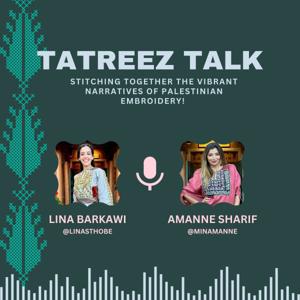
Follow Amanne @minamanne & Lina @linasthobe
Send us Fan Mail
WATFA IS A TATREEZ ARTIST, EDUCATOR/HIGH SCHOOL PRINCIPAL, FIBER ARTS TEACHER AND PHOTOGRAPHER (@stitched_by_foof). She shares her deep family connection to Palestine, tracing her father's journey from Dirar Al-Ba'ain near Ramallah to Brazil, where he met her mother, and eventually settling in the South Bronx. For her, growing up in a tight-knit Palestinian community that mirrored village life in Palestine created a cultural "little Deir Al-Ba'ain" in New York.
As a dedicated embroiderer, Watfa learned from her father's sister and preserved traditional motifs while also innovating. She shares fascinating stories about her photography work capturing tatreez in Gaza during the 1980s-90s, documenting patterns that may no longer exist today. She passes on these traditions, using butterfly motifs from her aunt's dresses for her daughter's projects, making her work a living bridge between generations and preserving cultural heritage that faces ongoing erasure.
Watfa shares her life lesson that "telling [her] story" through embroidery has been transformative, helping her embrace her dual identity and express herself authentically. Despite her busy life as an educator and mother, she finds precious moments to create, using train rides for crafting and keeping multiple projects underway. This episode is a reminder to share your stories, because tatreez serves as both personal expression and cultural resistance in the face of ongoing Palestinian displacement and erasure.
You’ll hear about:
>> 0:58: Watfa’s connection to Palestine
>> 6:32: Growing up Palestinian-Brazilian in the Bronx
>> 11:43: Learning tatreez and herself visiting Palestine
>> 19:36: Photographing tatreez at home and in Gaza
>> 22:30: Watfa’s art upon returning
>> 25:43: Embarking on a thobe
>> 36:07: Teaching fiber arts
>> 41:36: How engaging with tatreez has shifted
>> 44:50: Current projects
>> 48:36: Life lesson from tatreez
Rate, Review, & Follow on Your Favorite Podcast Platform
“I love Palestinian embroidery and Tatreez Talk.” <– If that sounds like you, please consider rating and reviewing our show! This helps us elevate the vibrant narratives of Palestinian embroiderers and support more tatreez-ers — just like you — in learning more about tatreez and connecting with each other. You can find us on Spotify, Apple Podcast, and others -- just scroll to the bottom, tap to rate with five stars, and select “Write a Review.” Then be sure to let us know what you loved most about the episode!
Also, if you haven’t done so already, follow the podcast. We’re adding a bunch of bonus episodes to the feed and, if you’re not following, there’s a good chance you’ll miss out. Follow now!
Boycott Resolute RGL. Click here for more information.
Boycott ZARA and all Inditex brands—Bershka, Massimo Dutti, Pull & Bear, Stradivarius, Oysho, ZARA Home. Click here for more information.
Follow us @tatreeztalk
Follow Amanne @minamanne & Lina @linasthobe
Send us Fan Mail
SARAH IS A MICROBIOLOGY STUDENT AND BEGINNER TATREEZ ARTIST FROM AUSTRALIA (@stitching.intifada). Originally from villages near Haifa and Safad that were ethnically cleansed in 1948, Sarah's parents grew up in Lebanese refugee camps before migrating to Australia where she and most siblings were born. Despite never having physically visited Palestine, Sarah has found the "perfect fusion" of her love for art and country through Tatreez.
Sarah's Tatreez journey began when she gifted materials to family members who wanted to learn, and after October 2023, she felt compelled to pick up the needle herself as another way to connect with Palestine amid the genocide. She quickly discovered how her public stitching sparked conversations with strangers about Palestinian culture, turning her art into a form of advocacy. Despite being a beginner, she has already hosted workshops and is hosting regular Tatreez Circles in Melbourne in 2026 (if you're Melbourne-based, reach out!).
Sarah shares how Tatreez has taught her to embrace imperfection, learning that mistakes in stitching—and in life—are part of the bigger narrative rather than something to be erased. As she works on her first tatreez dress (thobe), she envisions a lifelong commitment to the art, eventually passing it to her daughter while continuing to build community and use her needle as both a connection to heritage and a tool for cultural preservation and advocacy.
You’ll hear about:
>> 1:02: Sarah’s connection to Palestine
>> 4:08: Palestinian community in Australia
>> 5:25: Relationship to tatreez before and after beginning
>> 10:26: Finding community through tatreez
>> 13:36: Unlocking intergenerational connections
>> 22:01: What Sarah hopes the next generation gets through tatreez
>> 23:30: Sarah’s tatreez projects
>> 28:33: What’s next
>> 32:42: Sarah’s life lesson from tatreez
Rate, Review, & Follow on Your Favorite Podcast Platform
“I love Palestinian embroidery and Tatreez Talk.” <– If that sounds like you, please consider rating and reviewing our show! This helps us elevate the vibrant narratives of Palestinian embroiderers and support more tatreez-ers — just like you — in learning more about tatreez and connecting with each other. You can find us on Spotify, Apple Podcast, and others -- just scroll to the bottom, tap to rate with five stars, and select “Write a Review.” Then be sure to let us know what you loved most about the episode!
Also, if you haven’t done so already, follow the podcast. We’re adding a bunch of bonus episodes to the feed and, if you’re not following, there’s a good chance you’ll miss out. Follow now!
Boycott Resolute RGL. Click here for more information.
Boycott ZARA and all Inditex brands—Bershka, Massimo Dutti, Pull & Bear, Stradivarius, Oysho, ZARA Home. Click here for more information.
Follow us @tatreeztalk
Follow Amanne @minamanne & Lina @linasthobe
Send us Fan Mail
GIOVANNA (JO-VA-NA), A TATREEZ ARTIST, POET, AND STUDENT ACTIVIST (@giovanna_writes_poetry). She reflects on her grandparents’ displacement from Jerusalem and Yaffa in 1948 and her family’s movement through Lebanon, Jordan, and eventually the United States.
Giovanna’s journey into tatreez began relatively recently through a workshop in Seattle with Hala and Sabrene (both previous guests on Tatreez Talk!), marking a powerful moment of reconnection with her culture. Despite not growing up surrounded by tatreez practices, she recalls owning a traditional thobe as a child, which served as an early—though distant—touchpoint to the craft.
Throughout the conversation, Giovanna reflects on what it means to come to tatreez later in life, without prior exposure, and how that experience can feel both isolating and deeply meaningful. The discussion highlights themes of cultural rediscovery, intergenerational connection, and the role of art in identity and activism. Her story illustrates how tatreez can serve as a bridge between past and present, even for those who didn’t grow up immersed in the tradition.
You’ll hear about:
>> 00:41: Giovanna’s connection to Palestine
>> 2:18: How Giovanna began her tatreez journey
>> 5:18: Evolving tatreez practice and the Seattle tatreez community
>> 11:01: Conversations through tatreez
>> 12:53: Giovanna’s poetry
>> 16:25: Creative process through Palestinian identity
>> 19:27: Giovanna’s tatreez design approach
>> 21:36: Tatreez projects in 2026
>> 23:23: Major life lesson from tatreez
Rate, Review, & Follow on Your Favorite Podcast Platform
“I love Palestinian embroidery and Tatreez Talk.” <– If that sounds like you, please consider rating and reviewing our show! This helps us elevate the vibrant narratives of Palestinian embroiderers and support more tatreez-ers — just like you — in learning more about tatreez and connecting with each other. You can find us on Spotify, Apple Podcast, and others -- just scroll to the bottom, tap to rate with five stars, and select “Write a Review.” Then be sure to let us know what you loved most about the episode!
Also, if you haven’t done so already, follow the podcast. We’re adding a bunch of bonus episodes to the feed and, if you’re not following, there’s a good chance you’ll miss out. Follow now!
Boycott Resolute RGL. Click here for more information.
Follow us @tatreeztalk
Follow Amanne @minamanne & Lina @linasthobe
Send us Fan Mail
HAJJA HALEEMAH IS A PALESTINIAN GRANDMOTHER WHOSE LIFE HAS BEEN DEEPLY INTERTWINED WITH TATREEZ. She shares stories about her upbringing in Palestine, her family, and her enduring love for returning home. Through her reflections, we get a glimpse into everyday life, community connections, and how cultural traditions are passed down across generations.
Hajja Haleemah explains how she first learned tatreez and how embroidery was historically learned by observing others. She discusses how designs were often copied from what people saw around them rather than from formal patterns, highlighting the communal and organic nature of the craft.
Over the decades, Hajja has hand-embroidered 14 traditional Palestinian dresses and tapestries, each one carrying its own story. Among these pieces is her remarkable Intifada thobe, a dress she spent three years embroidering, inspired by a garment her sister brought from Ramallah. The thobe has since become a symbol of pride and resistance, even accompanying Hajja to protests where people from many backgrounds stopped to photograph and celebrate the piece.
You’ll hear about:
>> 1:31: Hajja Haleemah’s connection to Palestine
>> 3:04: How she started tatreez
>> 4:28: Beginning to make Palestinian dresses
>> 9:26: Tatreez when living in Palestine
>> 11:10: Hajja Haleemah’s intifada thobe
>> 13:54: Hajja’s current projects
>> 20:50: Her tatreez practice now
>> 22:14: Hajja’s advice for all of us!
Rate, Review, & Follow on Your Favorite Podcast Platform
“I love Palestinian embroidery and Tatreez Talk.” <– If that sounds like you, please consider rating and reviewing our show! This helps us elevate the vibrant narratives of Palestinian embroiderers and support more tatreez-ers — just like you — in learning more about tatreez and connecting with each other. You can find us on Spotify, Apple Podcast, and others -- just scroll to the bottom, tap to rate with five stars, and select “Write a Review.” Then be sure to let us know what you loved most about the episode!
Also, if you haven’t done so already, follow the podcast. We’re adding a bunch of bonus episodes to the feed and, if you’re not following, there’s a good chance you’ll miss out. Follow now!
Boycott Resolute RGL. Click here for more information.
Follow us @tatreeztalk
Follow Amanne @minamanne & Lina @linasthobe
Send us Fan Mail
IN THIS EPISODE OF TATREEZ TALK, we’re pulling back the curtain and sharing some exciting updates, plus a few heartfelt asks for our community.
We’re officially stepping into a new chapter for the podcast, starting with a refreshed brand identity inspired by Palestinian land, culture, and a forward-looking vision for tatreez. We talk about the colors, the meaning behind them, and why it felt important for Tatreez Talk to visually reflect where we’re headed.
We also share what’s been coming up again and again from you: VIDEO! We’re exploring the transition from audio-only to video podcasting and inviting community support: whether you have hands-on experience or just opinions about what makes a great video podcast.
Finally, we dream out loud about the future of in-person gatherings, live events, and what it could look like to bring Tatreez Talk into physical spaces beyond New York.
In this episode, we cover:
Links mentioned:
As always, thank you for being part of this community — Tatreez Talk exists because of you. 💛
Rate, Review, & Follow on Your Favorite Podcast Platform
“I love Palestinian embroidery and Tatreez Talk.” <– If that sounds like you, please consider rating and reviewing our show! This helps us elevate the vibrant narratives of Palestinian embroiderers and support more tatreez-ers — just like you — in learning more about tatreez and connecting with each other. You can find us on Spotify, Apple Podcast, and others -- just scroll to the bottom, tap to rate with five stars, and select “Write a Review.” Then be sure to let us know what you loved most about the episode!
Also, if you haven’t done so already, follow the podcast. We’re adding a bunch of bonus episodes to the feed and, if you’re not following, there’s a good chance you’ll miss out. Follow now!
Follow us @tatreeztalk
Follow Amanne @minamanne & Lina @linasthobe
Send us Fan Mail
IN THIS EPISODE, we kick off Season 6 by reflecting on our 2025 highlights and sharing what we’re excited about in 2026. From taking the Tatreez Retreat international to growing our teaching, community, and creative projects, this is a grounded check-in on what we’ve built and what’s coming next.
WHAT WE’VE BEEN UP TO (2025)
WHAT WE’RE EXCITED ABOUT (2026)
Links Mentioned:
Rate, Review, & Follow on Your Favorite Podcast Platform
“I love Palestinian embroidery and Tatreez Talk.” <– If that sounds like you, please consider rating and reviewing our show! This helps us elevate the vibrant narratives of Palestinian embroiderers and support more tatreez-ers — just like you — in learning more about tatreez and connecting with each other. You can find us on Spotify, Apple Podcast, and others -- just scroll to the bottom, tap to rate with five stars, and select “Write a Review.” Then be sure to let us know what you loved most about the episode!
Also, if you haven’t done so already, follow the podcast. We’re adding a bunch of bonus episodes to the feed and, if you’re not following, there’s a good chance you’ll miss out. Follow now!
Boycott Resolute RGL. Click here for more information.
Boycott ZARA and all Inditex brands—Bershka, Massimo Dutti, Pull & Bear, Stradivarius, Oysho, ZARA Home. Click here for more information.
Follow us @tatreeztalk
Follow Amanne @minamanne & Lina @linasthobe
Send us Fan Mail
SAMAR HUSSAINI IS A FINE ARTIST WHO HAS INCORPORATED TATREEZ INTO HER BEAUTIFUL WORK (@samardesignsandart). Samar shares her powerful family history rooted in Jerusalem, tracing her grandparents’ forced displacement in 1948, her grandfather’s scholarly work, and her parents’ lifelong political activism. Growing up between the U.S. and her Palestinian heritage, she reflects on the deep influence of her family—particularly the women—who preserved culture, education, and resilience across generations.
She describes how tatreez re-emerged in her life through inherited pieces, memories of her grandmother teaching her, and eventually through her work as a fine artist. Samar now creates sculptural thobes and layered paintings incorporating image transfers of tatreez, remnants of family embroidery, and even fragments of her father’s political writings. Her work centers on absence, memory, land, and the emotional experience of Palestinians in the diaspora.
Samar emphasizes how art allows her to humanize Palestinians and shift narratives in gallery spaces, often serving as her form of activism. She shares emotional stories of viewers who had never met a Palestinian before, and how her work creates openings for connection, empathy, and dialogue. She also discusses passing tatreez to her daughter and the life lessons—patience, calmness, embracing mistakes—that stitching helped instill.
You’ll hear about:
>> 00:52: Samar’s connection to Palestine
>> 08:11: Connection with tatreez
>> 12:28: Incorporating tatreez into Samar’s fine art
>> 15:56: What Samar hopes people takeaway from her art
>> 21:44: Interacting with visitors viewing her art
>> 27:25: The role of art in Palestinian liberation
>> 28:46: What’s next for Samar
>> 36:36: Samar’s major life lesson from tatreez
Rate, Review, & Follow on Your Favorite Podcast Platform
“I love Palestinian embroidery and Tatreez Talk.” <– If that sounds like you, please consider rating and reviewing our show! This helps us elevate the vibrant narratives of Palestinian embroiderers and support more tatreez-ers — just like you — in learning more about tatreez and connecting with each other. You can find us on Spotify, Apple Podcast, and others -- just scroll to the bottom, tap to rate with five stars, and select “Write a Review.” Then be sure to let us know what you loved most about the episode!
Also, if you haven’t done so already, follow the podcast. We’re adding a bunch of bonus episodes to the feed and, if you’re not following, there’s a good chance you’ll miss out. Follow now!
Links Mentioned
>> Samar Designs Website
>> Meredith Woolnough on Instagram (water soluble embroidery technique)
Boycott Resolute RGL. Click here for more information.
Boycott ZARA and all Inditex brands—Bershka, Massimo Dutti, Pull & Bear, Stradivarius, Oysho, ZARA Home. Click here for more information.
Follow us @tatreeztalk
Follow Amanne @minamanne & Lina @linasthobe
Send us Fan Mail
HADIL IS AN ACTIVIST AND CREATOR BEHIND THOUB TALE, ALONGSIDE HER VISIONARY MOTHER RABA (@thoub.tale). She shares her family’s displacement from Dayr Aban and how growing up near Al-Baqa’a refugee camp shaped her commitment to identity and struggle. Moving to New York revealed the repression of Palestinian identity in the U.S., clarifying her purpose: to speak intentionally about Palestine and her family’s history.
Raba is the original visionary behind Thoub Tale, which collects and preserves vintage Palestinian thobes. Hadil joined to support logistics and social media, but soon fell in love with tatreez itself—studying motifs as a coded language of women’s memory, carrying history, geography, emotion, and resistance.
Today, Hadil and Raba upcycle vintage embroidery into modern garments in ways that honor sustainability and protect ancestral work, prioritizing pieces returning to Palestinian hands. Hadil hopes future generations approach tatreez not just as aesthetics, but as a living practice of liberation, storytelling, and connection to land.
You’ll hear about:
>> 1:18: Hadil’s connection to Palestine
>> 2:47: Experience growing up in Jordan and then moving to the US
>> 6:59: Introduction to tatreez and the start of Thoub Tale
>> 13:10: A story of an orange vintage thobe
>> 16:03: The process of collecting and upcycling vintage athwab
>> 23:01: Customers and cultural appropriation conversations
>> 31:22: What Hadil hopes future generations will take from tatreez
>> 43:56: What’s next
>> 46:11: Major life lessons from tatreez
Rate, Review, & Follow on Your Favorite Podcast Platform
“I love Palestinian embroidery and Tatreez Talk.” <– If that sounds like you, please consider rating and reviewing our show! This helps us elevate the vibrant narratives of Palestinian embroiderers and support more tatreez-ers — just like you — in learning more about tatreez and connecting with each other. You can find us on Spotify, Apple Podcast, and others -- just scroll to the bottom, tap to rate with five stars, and select “Write a Review.” Then be sure to let us know what you loved most about the episode!
Also, if you haven’t done so already, follow the podcast. We’re adding a bunch of bonus episodes to the feed and, if you’re not following, there’s a good chance you’ll miss out. Follow now!
Links Mentioned
>> Thobe by 47SOUL
Boycott Resolute RGL. Click here for more information.
Boycott ZARA and all Inditex brands—Bershka, Massimo Dutti, Pull & Bear, Stradivarius, Oysho, ZARA Home. Click here for more information.
Follow us @tatreeztalk
Follow Amanne @minamanne & Lina @linasthobe
Send us Fan Mail
BELAL HERBAWI IS A PALESTINIAN GRAPHIC DESIGNER AND PHD RESEARCHER WHOSE WORK FOCUSES ON DIGITIZING AND REINTRODUCING TRADITIONAL TATREEZ MOTIFS INTO CONTEMPORARY DESIGN (@belalherbawi). He grew up in Hebron in a family deeply rooted in textile production—his family owns Hirbawi, the last keffiyeh factory—which shaped his early connection to Palestinian cultural identity and craft.
Over time, Belal began learning to stitch himself and immersed in workshops that explored tatreez as meditation, restoration, and creativity. Through his PhD project, he works to digitize motifs and develop a designer’s manual that helps graphic designers use tatreez patterns respectfully while keeping their cultural context intact. He also created Threads of Creativity, a collaborative initiative bringing together artisans and designers—locally and internationally—to reinterpret motifs and generate new compositions for posters, interiors, objects, and digital design.
Belal emphasizes that tatreez must remain rooted in its origins and stories, even as colors, formats, and applications evolve. For him, the goal is to make tatreez a living part of everyday Palestinian visual life—not only in fashion, but in branding, interiors, public design, and global creative dialogue. Throughout his journey, the practice has taught him patience, intentionality, and the value of giving time and care to one’s craft—the same values embodied by Palestinian women who carried this tradition forward for generations.
You’ll hear about:
>> 1:49: Belal’s connection to Palestine and Palestinian textiles
>> 5:42: Why and how Belal focuses on tatreez
>> 9:04: Tatreez (design) workshops in Palestine
>> 16:33: Belal’s tatreez design journey
>> 21:30: Innovating tatreez and making tatreez accessible, to non-Palestinians too
>> 26:40: The bigger vision of Belal’s project
>> 34:23: Evolution of Belal’s art after tatreez
>> 37:00: What’s next for Belal
>> 40:38: Major life lesson from tatreez
Rate, Review, & Follow on Your Favorite Podcast Platform
“I love Palestinian embroidery and Tatreez Talk.” <– If that sounds like you, please consider rating and reviewing our show! This helps us elevate the vibrant narratives of Palestinian embroiderers and support more tatreez-ers — just like you — in learning more about tatreez and connecting with each other. You can find us on Spotify, Apple Podcast, and others -- just scroll to the bottom, tap to rate with five stars, and select “Write a Review.” Then be sure to let us know what you loved most about the episode!
Also, if you haven’t done so already, follow the podcast. We’re adding a bunch of bonus episodes to the feed and, if you’re not following, there’s a good chance you’ll miss out. Follow now!
Boycott Resolute RGL. Click here for more information.
Boycott ZARA and all Inditex brands—Bershka, Massimo Dutti, Pull & Bear, Stradivarius, Oysho, ZARA Home. Click here for more information.
Follow us @tatreeztalk
Follow Amanne @minamanne & Lina @linasthobe
From the publisher's feed
Tatreez Talk is a the podcast that stitches together the vibrant narratives of Palestinian embroidery! Join us as we chat with talented embroiderers and artists, sharing their stories,…