
Sign up to save your podcasts
Or



Based on Podcast App listening data
This week we have an extended interview and discussion with David Krentz on the public perception of dinosaurs and especially in film. David is a palaeoartist, but also works as a storyboard artist and character designer for Hollywood productions like the Marvel movies and has also produced and directed dinosaur documentaries so has seen things from all sides. So he's the perfect person to bring in to chat about the creative processes and trade-offs between accuracy and realism and dramatic license, storytelling and spectacle.
Links:
An interview with David Krentz about his dinosaurian artwork by Dave https://archosaurmusings.wordpress.com/2012/07/09/interview-with-david-krentz/
David's Facebook page for his artwork https://www.facebook.com/davidkrentzart
Let's be honest, we've done quite well to have held off until half way through the third series before tackling this one, but there's been a Brachiosaurus in the room since the start of Terrible Lizards and it is very much Jurassic Park-shaped.
There's no point dissecting all the details about the film and its depiction of dinosaurs (though we look at a few) but we focus on its appearance at the time and the effect it had on shaping the public's perceptions of dinosaurs (for better and worse) and what that means for science educators. We also talk about other contemporary films and how things translated from books to screen and the difficulty of dealing with the blend of science and fiction.
Our guest this week is author, actor and screenwriter Emma Kennedy who wants to know just how (un)likely it is we could resurrect dinosaurs.
Links:
Emma Kennedy - https://www.emmakennedy.co.uk/ you can preorder her book Never Ending Summer now! Also her lego is amaze.
An old blog post by Dave on the problem of people assuming Jurassic Park is accurate: https://archosaurmusings.wordpress.com/2008/07/06/everything-people-ask-me-about-dinosaurs-they-learned-from-jurassic-park/
An article Dave wrote for the Telegraph years ago on the science of Jurassic Park and cloning: https://www.telegraph.co.uk/film/jurassic-world/truth-facts-science/
Finally, a normal episode that both has a guest an is actually on dinosaurs. This time out we are on to the second dinosaur ever named – Iguanodon. Despite being one of the absolute originals and being known from numerous good specimens, Iguanodon (and its relatives) really doesn't get much of a look in when it comes to artworks and documentaries and even books – it's not a carnivore, not huge like sauropods, and doesn't rock the funky headgear of so many other ornithischians. But it's an important animal, both historically and now and also (inevitably) has a complicated history that means it is well worth talking about. So we do.
This week artist, writer and cartoonist Andy Riley joins us and he wants to know specifically about the function of the famous spiky thumb of Iguanodon – just what did they do with it?
Links:
A piece from the Natural History Museum in London about the Maidstone slab and the initial discovery of Iguanodon - https://www.nhm.ac.uk/discover/the-discovery-of-iguanodon.html
And another by the NHM on the naming of Mantellisaurus and the work to put their skeleton on display - https://www.nhm.ac.uk/discover/search-for-the-real-iguanodon.html
A gallery view of the wonderful collection of Iguanodon in Belgium https://artsandculture.google.com/exhibit/the-bernissart-iguanodons/fQJiRgnsYJgwIA
Andy Riley has a new book in the works and you can find out more about him here: https://misterandyriley.com/
No dinosaurs this week! Shock, horror! It was always going to happen sooner or later as Dave does a lot of work on pterosaurs as well as on dinosaurs and we've had some specific requests for a pterosaur episode so here we go (and they'll return again soon we're sure). These flying reptiles are too often just window dressing in the background of pictures of dinosaurs but they are their own distinct evolutionary group with a fascinating array of weird features and produced the largest flying animals of all time with wingspans over 10 m. The week we make a delayed welcome to a first guest of the series and it is Dr Adam Rutherford, geneticist, author and presenter and general all round science nerd. He wants to know how the sex of dinosaur embryos was determined but mostly we end up talking about Star Wars Easter eggs.
Links:
This is a website Dave and a group of fellow pterosaur researchers set up as a one stop-shop for all things pterosaur. http://pterosaur.net
An essay on the giant azhdarchids by palaeontologist Mark Witton. It's a little old so some things have updated but it's fundamentally a great introduction to them https://www.google.com/url?sa=t&rct=j&q=&esrc=s&source=web&cd=&ved=2ahUKEwiM4Mr__rHuAhUSmVwKHaymCDoQFjACegQIAhAC&url=http%3A%2F%2Fwww.markwitton.com%2Fdownload%2Fi%2Fmark_dl%2Fu%2F4009119796%2F4549073080%2FWitton%25202007%2520-%2520Azhdarchids.pdf&usg=AOvVaw0WICVGKJd7VlGpFB3Uoanx
A link to Dave's recent paper suggesting baby pterosaurs were flying: https://onlinelibrary.wiley.com/doi/full/10.1111/let.12391
And here's the links for the Star Wars nerdery:
https://carnegiemnh.org/dippy-in-star-wars/
https://svpow.com/2013/01/21/confirmed-the-umbraran-starfighter-is-an-apatosaurus-cervical/
Adam Rutherford's new book (that Iszi got for Xmas) is called How To Argue With a Racist paperback out Feb 4th
No guest this week, just a lot of Dave talking. We've obviously mentioned his research at various times but never really focused on it before, but now a new and big paper has just come out on the famous giant fish-eating Spinosaurus so it was a great opportunity to kick off the new series with a special on it. Many people will know Spinosaurus from Jurassic Park III and it has become (in)famous for various interpretations of its biology which has been hampered by the fact that the fossils are so fragmentary and researchers disagree over the taxonomy of various bits that may or may not belong to it. New discoveries and research has ramped all of this up and now Dave is stepping in with a long paper and a revised idea about how this enigmatic giant might have lived.
Links:
Here's alink to the actual paper, assuming you really want to wade through it all:
https://palaeo-electronica.org/content/2021/3219-the-ecology-of-spinosaurus
And here's the first of a series of blogposts Dave is putting up about the research and its implications: https://wordpress.com/post/archosaurmusings.wordpress.com/8723
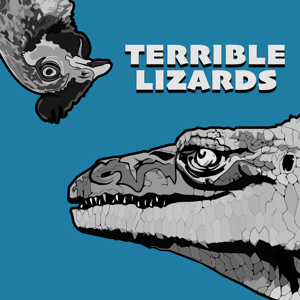
The new series of Terrible Lizards - a Podcast about Dinosaurs with Dr Dave Hone and Iszi Lawrence is starting on January 27th 2021. Guests include Emma Kennedy, Adam Rutherford, David Krentz, Andy Riley, Sophie Scott and Chris Jackson.
Thank you to everyone for spreading the word and supporting on Patreon. Visit www.terriblelizards.co.uk @iszi_lawrence @dave_hone
This is a between-series BONUS that was previous released to Patrons on Patreon. In it a palaeontologist makes up for Dave's inadequacies when dealing with the ornithischians. So welcome Dr Victoria Arbour of the Royal BC Museum of Victoria, Canada to talk with Dave and Iszi about the armoured dinosaurs, the ankylosaurs. She is a world expert on this amazing and unfairly overlooked group and joins us to talk through their origins, evolution and weird features – not just the famous armour and tail clubs, but also their convoluted noses too. Victoria has published numerous papers on these animals including naming several species, first and foremost among them for Terrible Lizards listeners being Zuul, the animal that guest Ralph Attanasia (S1, E4) turned into a life-sized cake.
Links:
Pseudoplocephalus is Victoria's blog https://pseudoplocephalus.com
Love in the Time of Chasmosaurs is a popular dinosaur website where Victoria is an occasional contributor https://chasmosaurs.com/about/
Some photos of the amazing Scleidosaurus specimen that is mentioned during the podcast https://archosaurmusings.wordpress.com/2011/01/28/a-super-scleidosaurus/
It the end of series questions episode. This time Iszi and Dave... well Dave mainly answer Patrons' Dinosaur questions. Including
How would dinosaur evolution panned out if the asteroid had missed?
Could sauropods swim?
Is the Blue Whale REALLY larger than dinosaurs?
Were there dinosaur KT extinction survivors in Antarctica?
The 'Friends' question...
Velociraptor toe functionality...
Bird Brains...
How do we differentiate species?
And if we know anything about how social dinosaurs were?
With massive thanks to all out patrons,and especially Geraint Lewis, Shala Howell, Eric Farenger, Gutza1, Joe McLachlan, Javaraptor (G Hancock), Andrew White, Aisling Spain and Richard Bald.
Iszi Lawrence's book The Unstoppable Letty Pegg is now available as an Audiobook on Audible www.iszi.com/book
Please fill in Dave's Impact Survery: https://www.davehone.co.uk/outreach/impact-survey/
The idea that birds evolved from dinosaurs has actually been around for a century now, though it has perhaps only become relatively common knowledge with the general public in the last couple of decades. Even so, while many people now know this, quite why we know the two groups are linked (aside from the plethora of feathered dinosaurs) is often not understood. There's only so much we can cover in one podcast, but this week we go through some of the features of birds that are seen in dinosaur fossils and so help show the evolutionary links between the two. Our special guest this time is Lucy Eckersley The Punk Biologist who makes the mistake of asking about sexual selection in dinosaurs about which Dave would happily talk for hours if allowed to.
A post on the recognition of the importance of Archaeopteryx for bird origins by Darwin: https://archosaurmusings.wordpress.com/2011/03/17/the-historical-impact-of-archaeopteryx/
A blogpost on the dinosaurian furcula: https://archosaurmusings.wordpress.com/2010/02/24/the-furcula/
A long post summarising Dave's work on sexual selection in dinosaurs - https://archosaurmusings.wordpress.com/2020/05/11/sexual-selection-in-dinosaurs-the-story-so-far/
There are a few animals that are basically motionless for part or even most of their lives (like barnacles) but the average animal is one that moves. Dinosaurs obviously did so, but things inevitably get complicated quickly when trying to work out exactly how well they could run, jump and climb, how fast they were and what they could and couldn't do to get around. This time out we tackle these issues and the information we have to work from, especially footprints. We are then joined by Dr Esther Odekunle who has a very pertinent question about dinosaurs in water.
A piece by Dr Pete Falkingham on sauropod hand prints https://archosaurmusings.wordpress.com/2010/06/30/guest-post-tracking-the-hand-prints-of-sauropods/
A piece on one of the rare tail drag marks for a dinosaur: https://archosaurmusings.wordpress.com/2010/01/04/sauropod-tails-up-or-down/#more-2946
A piece by Dr Darren Naish at Tetrapod Zoology on dinosaur climbing https://blogs.scientificamerican.com/tetrapod-zoology/claws-climbing-in-birds-other-dinosaurs/
From the publisher's feed
Ranked by our users in the last 21 days

5,520 Listeners

726 Listeners

157 Listeners

510 Listeners
539 Listeners

4,756 Listeners
740 Listeners
6,230 Listeners

327 Listeners

3,343 Listeners

159 Listeners

149 Listeners

15,558 Listeners

1,893 Listeners

487 Listeners