
Sign up to save your podcasts
Or

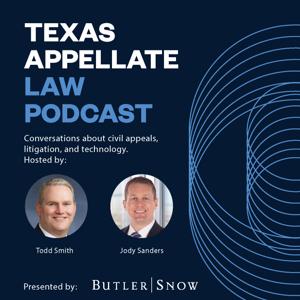


"I thought I knew what it was like to be a trial judge. And the truth is, I didn't," says Justice Scott Field of the Fifteenth Court of Appeals, back for his second visit to the show after first joining for Episode 6 in 2020. After leaving private practice to serve as the inaugural judge of the 480th District Court in Williamson County, he returned to the appellate bench as one of the Fifteenth Court's three original justices. In this episode, he joins Todd Smith and Jody Sanders to talk about ruling quickly on a docket of about 1,800 cases, why he stopped worrying about reversal, and how trial lawyers can make a judge's job easier, from proposed orders to workable jury charges. He also describes starting a statewide court with no chambers or courtroom, the ABCs (and Ds) of the Fifteenth Court's jurisdiction, and how docket equalization and a growing business court docket are changing the new appellate court's work.
Connect and Learn More
☑️ Todd Smith | LinkedIn | X
☑️ Jody Sanders | LinkedIn | X
☑️ Texas Appellate Law Podcast on LinkedIn | X | Instagram
☑️ Texas Appellate Counsel PLLC
☑️ Kelly Hart & Hallman, LLP | LinkedIn
☑️ Subscribe Apple Podcasts | Spotify | Amazon Music | YouTube
Produced and Powered by LawPods
Sponsored by Court Surety Bond Agency and Proceed.
"In a lot of respects, the legal system is a moral ordering system," says Jody Sanders—one built on competing interests and an outcomes-based way of measuring success that, he argues, rarely tells the whole story. In this episode, Jody and Todd Smith explore a concept most lawyers have felt but never had a word for: moral injury. Jody recently completed the ten-week Moral Injury Certificate Program at TCU's Brite Divinity School and walks Todd through his capstone slides. They connect it to earlier conversations on the show, including E154's look at the existential side of appellate work and E40's pandemic-era episode with TLAP's Chris Ritter, then dig into dehumanization in the legal system and the toll of wrongful convictions like Timothy Cole's. Hear why Jody says lawyers owe themselves more grace than they usually give.
Connect and Learn More
☑️ Todd Smith | LinkedIn | X
☑️ Jody Sanders | LinkedIn | X
☑️ Texas Appellate Law Podcast on LinkedIn | X | Instagram
☑️ Texas Appellate Counsel PLLC
☑️ Kelly Hart & Hallman, LLP | LinkedIn
☑️ Subscribe Apple Podcasts | Spotify | Amazon Music | YouTube
Produced and Powered by LawPods
Sponsored by Court Surety Bond Agency and Proceed.
An attorney-fee award can sometimes dwarf the underlying recovery—yet, as Amy Prueger says, a party's fee request is often an afterthought. Hosts Todd Smith and Jody Sanders talk with Amy, a litigation attorney at Clark Hill PLC in Austin, about her recent paper "Taming the Fee Dragon: Attorney's Fees Recovery" and her ongoing research on the topic. Amy walks through the Texas fundamentals—the American Rule, the Rohrmoos framework, the prevailing-party requirement, the Yowell standard for appellate fees—then the trap doors that most often reverse a fee award, including segregation and invoice redactions. The conversation then moves to how the lodestar survives contact with generative AI. While Todd declares "Rohrmoos must die," Amy predicts that it "survives by not surviving." Listen in for an attorney-fee war story and one piece of advice for your next fee application.
Connect and Learn More
☑️ Todd Smith | LinkedIn | X
☑️ Jody Sanders | LinkedIn | X
☑️ Texas Appellate Law Podcast on LinkedIn | X | Instagram
☑️ Texas Appellate Counsel PLLC
☑️ Kelly Hart & Hallman, LLP | LinkedIn
☑️ Subscribe Apple Podcasts | Spotify | Amazon Music | YouTube
Produced and Powered by LawPods
Sponsored by Court Surety Bond Agency and Proceed.
In this episode, hosts Todd Smith and Jody Sanders offer a mid-year check-in on the Texas Supreme Court's new petition-for-review rules. Building on Todd's Appellate Advocate article, A New Era in Texas Supreme Court Practice, they cover what changed between the preliminary and final rules, why the new 1,000-word introduction is "the most important thousand words you're going to draft," and how record-citation and no-more-unbriefed-issues requirements are reshaping petitions. They dig into whether the new structure will produce more per curiam dispositions, unpack the Court's first GVR in Noyes v. State ex rel. Voges, and trade practice tips on the accelerated clock, dead waiver letters, and vacation notices, with a look back at their preliminary-rules breakdown in Episode 157. Tune in for why Todd is now writing petitions that ask the Court to "PC reverse," and when a GVR may be the better ask.
Connect and Learn More
☑️ Todd Smith | LinkedIn | X
☑️ Jody Sanders | LinkedIn | X
☑️ Texas Appellate Law Podcast on LinkedIn | X | Instagram
☑️ Texas Appellate Counsel PLLC
☑️ Kelly Hart & Hallman, LLP | LinkedIn
☑️ Subscribe Apple Podcasts | Spotify | Amazon Music | YouTube
Produced and Powered by LawPods
Sponsored by Court Surety Bond Agency and Proceed.
"Give yourself time, give yourself options." That refrain runs through this conversation as hosts Jody Sanders and Todd Smith break down what has changed in Texas supersedeas, the procedure for suspending a judgment during appeal. Drawing on Jody's Appellate Advocate article, "The Name's Bonds, Supersedeas Bonds," they cover the four ways to supersede a Texas judgment, how the required amount gets calculated, and the proof a debtor needs to rely on net worth or substantial economic harm. They focus on two fresh developments: the new mandatory alternative security under Rule 24.2(e), which lets some lower-net-worth debtors post non-cash assets and keep the income they produce, and the Texas Supreme Court's decision in In re Greystar Development & Construction, L.P., holding that the $25 million cap applies per debtor while leaving the joint-bond question open. They also get practical about why a net worth affidavit can stop enforcement and keep the sheriff away from your door. Listen in for a working field guide to suspending a Texas judgment.
For more on supersedeas, revisit E35 with Daniel Huckabay, E123 on supersedeas and recent rule changes, and E158 with Arturo Ayala.
Connect and Learn More
☑️ Todd Smith | LinkedIn | X
☑️ Jody Sanders | LinkedIn | X
☑️ Texas Appellate Law Podcast on LinkedIn | X | Instagram
☑️ Texas Appellate Counsel PLLC
☑️ Kelly Hart & Hallman, LLP | LinkedIn
☑️ Subscribe Apple Podcasts | Spotify | Amazon Music | YouTube
Produced and Powered by LawPods
Sponsored by Court Surety Bond Agency and Proceed.
The real AI risk isn't hallucinations—it's not using AI at all. That's the counterintuitive argument from Ross Guberman, founder and CEO of BriefCatch, who tells hosts Todd Smith and Jody Sanders that lawyers ignoring AI may be approaching malpractice territory. BriefCatch now contains roughly 16,000 editing rules, up from about 10,000 in 2021. Ross introduces two new BriefCatch Next products: RealityCheck, an anti-hallucination tool that uses a red-yellow-green system to verify case citations and quotations against actual opinions; and CiteCheck, which identifies and corrects Bluebook citation errors. He also covers BriefCatch's early 2026 acquisition of WordRake and reveals that courts—despite their sanctions orders against lawyers—are quietly and actively deploying AI themselves.
Connect and Learn More
☑️ Ross Guberman | LinkedIn | X
☑️ BriefCatch | LinkedIn
☑️ Todd Smith | LinkedIn | X
☑️ Jody Sanders | LinkedIn | X
☑️ Texas Appellate Law Podcast on LinkedIn | X | Instagram
☑️ Texas Appellate Counsel PLLC
☑️ Kelly Hart & Hallman, LLP | LinkedIn
☑️ Subscribe Apple Podcasts | Spotify | Amazon Music | YouTube
Produced and Powered by LawPods
Sponsored by Court Surety Bond Agency and Proceed.
Wallace Jefferson, former Chief Justice of the Texas Supreme Court and newly installed President of the American Law Institute (ALI), joins Jody Sanders and Todd Smith for a wide-ranging conversation on appellate practice, judicial leadership, and legacy. Chief Justice Jefferson, a partner at Alexander Dubose & Jefferson LLP, discusses ALI's mission to modernize the law, the U.S. Supreme Court argument he made just eight years out of law school, and his discovery that an ancestor, Shedrick Willis, shod Sam Houston's horse while enslaved and served on the Waco City Council after gaining his freedom. "ALI," he says, "is a good model for how Americans can and should be talking to each other." Tune in for Chief Justice Jefferson's insights on cameras in courtrooms and the challenge facing ALI as artificial intelligence outpaces deliberate legal reform.
Connect and Learn More
☑️ Chief Justice Wallace Jefferson | ALI profile | LinkedIn
☑️ Alexander Dubose & Jefferson LLP | LinkedIn
☑️ American Law Institute | Facebook | X | LinkedIn | YouTube
☑️ Todd Smith | LinkedIn | X
☑️ Jody Sanders | LinkedIn | X
☑️ Texas Appellate Law Podcast on LinkedIn | X | Instagram
☑️ Texas Appellate Counsel PLLC
☑️ Kelly Hart & Hallman, LLP | LinkedIn
☑️ Subscribe Apple Podcasts | Spotify | Amazon Music | YouTube
Produced and Powered by LawPods
Sponsored by Court Surety Bond Agency and Proceed.
Opposing counsel once called Chris Schandevel a "brief-writing ninja." He took it as a compliment. Years later, as he considered ways to add value to attorneys coming up behind him, Chris channeled that nickname into a side job: Brief-Writing Ninja, his training platform to help lawyers improve their writing skills. Why? Because good writing is good writing—whether you’re writing for a court or a high school essay. In this conversation with hosts Todd Smith and Jody Sanders, Chris shares practical tips such as replacing “moreover” with “and”; “nevertheless” with “even still”; and “accordingly” or “however” with “but.” The panel deliberates over questions that should concern any writer. Can you start a sentence with a conjunction? Should lawyers master “styles” in Word? Is Century Schoolbook a worthy font? Tune in for the answers.
Download Chris's Brief-Writing Ninja Legal Style Guide here.
Connect and Learn More
☑️ Chris Schandevel | LinkedIn
☑️ Brief-Writing Ninja on LinkedIn
☑️ Alliance Defending Freedom on Facebook | Instagram | X | LinkedIn | YouTube
☑️ Todd Smith | LinkedIn | X
☑️ Jody Sanders | LinkedIn | X
☑️ Texas Appellate Law Podcast on LinkedIn | X | Instagram
☑️ Texas Appellate Counsel PLLC
☑️ Kelly Hart & Hallman, LLP | LinkedIn
☑️ Subscribe Apple Podcasts | Spotify | Amazon Music | YouTube
Produced and Powered by LawPods
Sponsored by Court Surety Bond Agency and Proceed.
“We have just anything you could think of,” Amy Small says of the Texas State Law Library, where she is executive director. Open to all—no attorney license required—the library serves everyday Texans and the Supreme Court alike. In this episode, hosts Jody Sanders and Todd Smith invite Amy to unpack the library’s often-overlooked resources: remote access to HeinOnline, historical statutes back to 1879, eBooks with persistent annotations, Westlaw and Lexis access on the library’s public computers, and several dictionary collections. If your online research skills need a refresher, watch on YouTube as Amy shares her screen and navigates a database in real time. Stay tuned in as Amy recalls fielding a seventh-grade classroom’s question about the weirdest law in Texas. Hint: It has something to do with astronauts and voting.
The Texas State Law Library accepts questions by phone from 8 a.m. to 4:45 p.m., Monday through Friday, and on its website.
Visual references are included in this episode. Watch on YouTube to follow along with Amy’s screen shares.
Connect and Learn More
☑️ Amy Small | LinkedIn
☑️ Texas State Law Library on LinkedIn | Instagram | Facebook | X | YouTube
☑️ Todd Smith | LinkedIn | X
☑️ Jody Sanders | LinkedIn | X
☑️ Texas Appellate Law Podcast on LinkedIn | X | Instagram
☑️ Texas Appellate Counsel PLLC
☑️ Kelly Hart & Hallman, LLP | LinkedIn
☑️ Subscribe Apple Podcasts | Spotify | Amazon Music | YouTube
Produced and Powered by LawPods
Sponsored by Court Surety Bond Agency and Proceed.
Election law in Texas is “very demanding” and “stressful because of the accelerated nature of the calendar,” says Elizabeth D. Alvarez. Elizabeth is head of civil litigation/election litigation at Guest & Gray and a 12-year election litigation practitioner who has represented state parties, national parties, and candidates on both sides of the aisle. She tells hosts Todd Smith and Jody Sanders that roughly 90% of Texas election litigation flows from the statutory writ of mandamus and injunction under Chapter 273 of the Election Code, and that fewer than 30 lawyers in the state have litigated a writ more than three times. She also tackles election integrity, calling voting machines "safer than paper." Tune in for her war story about winning an election contest that was so strange she felt like she was living in a John Grisham novel.
Connect and Learn More
☑️ Elizabeth D. Alvarez
☑️ Guest & Gray | Facebook | LinkedIn | Justicia | Instagram
☑️ Todd Smith | LinkedIn | X
☑️ Jody Sanders | LinkedIn | X
☑️ Texas Appellate Law Podcast on LinkedIn | X | Instagram
☑️ Texas Appellate Counsel PLLC
☑️ Kelly Hart & Hallman, LLP | LinkedIn
☑️ Subscribe Apple Podcasts | Spotify | Amazon Music | YouTube
Produced and Powered by LawPods
Sponsored by Court Surety Bond Agency and Proceed.
From the publisher's feed

31,996 Listeners

5,604 Listeners

24,711 Listeners

56,446 Listeners
5,773 Listeners
3,924 Listeners

15,653 Listeners
744 Listeners
34 Listeners