
Sign up to save your podcasts
Or



ADHD Time Blindness | The Leaving in 5 Lie
Have you ever said “I’m leaving in five minutes” and meant it with your whole heart — and then looked up and it was forty-five minutes later and you were still in your kitchen reading a Wikipedia page about people named Herb? Not Herbert. Herb. Named for the plant.
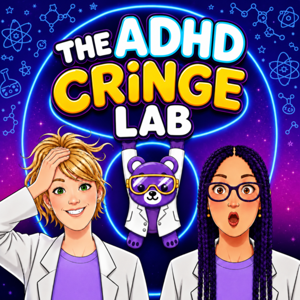
Welcome to The ADHD Cringe Lab, your ADHD comedy podcast hosted by two certified ADHD coaches.
We are putting ADHD time blindness under the microscope. First we act it out — watch one of your hosts arrive 45 minutes late to a Zoom call she was already home for. Then we break down the neuroscience: why the ADHD brain only has two time settings (Now and Not Now), why deciding to do something and actually starting it are not the same neurological moment, and why a rogue laundry basket can derail you.
We’re prescribing three Prescription Protocols for getting yourself out the door on time — without shame, without lying to yourself, and without setting 17 alarms you’ll sleep through.
Plus: Chief Cringe Officer The ADHD Spaghetti Bear, spin the Cringe’oMeter, and find out how to submit your own cringe to the Lab.
Because understanding why your brain does what it does — that’s where the shame stops and the strategy starts.
How to submit your cringe
Email: [email protected]
Or fill out the Cringe-fession Form — link in the episode description. Anonymous submissions welcome. No judgment. Only science.
Find us on Apple Podcasts, Spotify, YouTube, and Amazon Music
SHOW NOTESEpisode summary
We tackle one of the most universally relatable ADHD experiences: time blindness. We break down the neuroscience behind why ADHD brains genuinely cannot feel time passing — and why that has nothing to do with being inconsiderate or unreliable.
What we cover
Prescription Protocols
Validation Station moment
“You’ve probably been called unreliable your whole life for something your brain was doing completely without your permission.” — If you saw yourself in that skit, you are not a flake. You are not inconsiderate. You are not a liar. When you said “I’m on my way,” you meant it with every fiber of your being.
ADHD GAMING WORMHOLE | ONE MORE LEVEL, MOM!
Have you ever picked up your phone to unwind for just a few minutes before bed and looked up to discover it’s now three in the morning?
We tackle the ADHD gaming wormhole — what happens when your dopamine-hungry brain meets a system specifically engineered to keep you playing.
The doors of the The ADHD Cringe Lab are open and the gaming wormhole is under the microscope. Your hosts, Faelyne and Stephanie, 2 certified ADHD coaches, act it out — one of your hosts arrives to record visibly wrecked, wrapped in a blanket, coffee pot on desk, sunglasses on, zero notes, and zero regrets. She stayed up until 3am playing Castles & Trolls. For the science.
Then break it down. Why the ADHD brain is almost diabolically vulnerable to the “just one more level” trap. Why dopamine is actually the anticipation chemical, not the reward chemical — and why game designers figured that out long before we did. And why this has absolutely nothing to do with willpower.
Also: PokéStops. RoyalKevin, 3 protocols to escape the gaming wormhole.
Find us on Apple Podcasts, Spotify, YouTube, and Amazon Music. [email protected]
What we cover
Prescription Protocols
The dopamine trap explained simply
Dopamine spikes in anticipation of a reward — not when you receive it. That’s why the next level feels more urgent than the one you just finished. Your brain is already flooded with dopamine before you get there.
Game designers deliberately create dopamine triggers. The game is not designed to be fun. It is designed to be compelling.
For ADHD brains, which already run lower on dopamine, a game that delivers it on demand is not just entertaining — it is neurologically irresistible. Not a character flaw. It is a brain that found the thing that works and cannot let go of it.
Have you ever gotten ten compliments and one small piece of feedback and your brain just filed the compliments directly into the trash?
In this episode of The ADHD Cringe Lab, your ADHD comedy podcast hosted by two certified ADHD coaches, we put the ADHD shame spiral under the microscope. First we act it out: two people review their first podcast recording, exchange genuine enthusiasm and one completely reasonable comment about lighting, and both silently pack their bags and move to another country. Internally. Externally they are smiling and saying "totally, easy fix!"
Then we break it down. What Rejection Sensitive Dysphoria actually is and why the ADHD brain processes perceived criticism as a genuine threat. Why 10 compliments disappear and 1 small comment becomes the only thing that exists. Why the masking response, smiling perfectly normally while your brain is fully on fire, develops as a survival skill and what it actually costs you. And why your reaction is never just about today. It's about all of it. Every corrective message, every dismissal, every moment someone made you feel like too much or not enough.
We're prescribing 4 protocols for interrupting the spiral before it makes decisions on your behalf, because your spiral is not qualified to be your ADHD coach. It doesn't have the credentials. It has never even been to Canada.
Find us on Apple Podcasts, Spotify, YouTube, and Amazon Music. [email protected]
KEY CONCEPTS
Rejection Sensitive Dysphoria (RSD): the ADHD brain's tendency to process perceived criticism as a genuine threat, a real threat response, even when the criticism is minor, neutral, or imagined. The pain is neurologically real. "Just let it go" - not helpful advice when a threat response is already firing.
The Confirmation Bias Spiral: once the brain locks onto a negative interpretation, it filters everything through that lens, collecting evidence to confirm the threat and filing all contradicting evidence under "probably not true." It's not being dramatic. It's doing exactly what it was wired to do.
The Masking Response: the gap between what's happening internally during a spiral and what's visible externally. Developed young, when ADHD reactions got labeled too much or too sensitive. Keeps the peace. Takes enormous energy. Means nobody around you knows what's actually happening.
The Emotional Flashback: spirals are rarely just about the current moment. One lighting comment triggers every corrective message and dismissal going back years. Out of proportion from the outside. Completely logical from the inside.
We also dig into Dr. William Dodson's research: kids with ADHD receive roughly 20k more negative or corrective messages by age 10-12 than their peers, about 5-6 extra criticisms a day.
THE FOUR PROTOCOLS
Name It to Tame It: the moment you feel the spiral start, say it out loud or write it down: "This is RSD. This is not reality." Naming it moves you from the emotional brain to the logical brain. Give it a pet name. Take some power back.
The Evidence Locker: before you react, quit, or send something you'll regret, write down every positive thing from the interaction alongside the trigger. Make your brain look at the full picture, not just the threat file it compiled. It's a selective editor, not a liar.
The Story Audit: ask: is what I'm believing right now actually true? Or a story I've told myself so long it feels like fact? RSD builds a playlist your inner critic recorded without permission. The audit asks one question: is this true based on real evidence right now?
The 24 Hour Rule: make no decisions, send no messages, quit nothing within 24 hours of a spiral. Spirals peak fast and drop fast. What feels unsurvivable at 2pm often looks like a normal Tuesday by morning.
You know that moment when your brain replays a weird look someone gave you three weeks ago — at 2 AM — when you should absolutely be asleep? Yeah. This podcast is for you.
Welcome to the ADHD Cringe Lab, hosted by Faelyne and Stephanie — two certified ADHD coaches who are also living proof of everything they talk about. Every week, we take one cringy, chaotic, completely relatable ADHD moment, act it out, break down the science behind it, and hand you real tools for next time.
Because ADHD brains work differently. And yes, that sometimes means social cringe, time blindness, late replies, lost items, and showing up to the wrong place at the right time. But it also means you're capable of things a neurotypical brain could never imagine.
The cringe doesn't need to stay hidden. It needs a voice. And this lab is officially open.
What to expect from the ADHD Cringe Lab:New episodes drop every Wednesday. Find us on Apple Podcasts, Spotify, Amazon Music, YouTube, and wherever you listen to podcasts.
P.S. One of us will definitely be awake at 4 AM when the first episode drops. You know who you are.
Meet the Lab
How to submit your cringe
Email: [email protected]
Or fill out the Cringe-fession Form. Anonymous submissions welcome. No judgment. Only science.
ADHD Founders’ Quiz - July USA and Canada Birthday Episode:
Take the ADHD Founders' Quiz. Which founder are you?
From the publisher's feed
You know that feeling when someone describes an ADHD moment so accurately you want to laugh and cry at the same time? That's every episode of The ADHD Cringe Lab.
The ADHD Cringe Lab is the…
Every episode, hosts Stephanie and Faelyne perform a skit dramatizing a real ADHD experience — hyperfocus spirals, planner fails, time blindness disasters, shame spirals, task paralysis, and every flavor of neurodivergent cringe — then break down the science, validate the struggle, and offer real coaching perspective. No toxic positivity. No empty superpower talk. Just honest, funny, evidence-based ADHD content from people who live it and coach it.
Whether you're newly diagnosed, late-diagnosed, finally figuring out why your whole life suddenly makes sense, or just done pretending your brain works like everyone else's — you're going to hear yourself in every episode.
Featuring: the ADHD Spaghetti Bear, the Cringe Mailbag, the Validation Station, and Prescription Protocols that actually make sense for ADHD brains.
Because if you can laugh at it, you can learn from it.
Email us: [email protected]