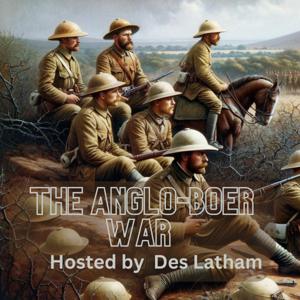
The Anglo-Boer War

The Anglo-Boer War

By Desmond LathamEducation
Download on the App Store

The Anglo-Boer War episodes

  • Episode 133 - Cecil John Rhodes dies and the Boers agree to Peace Talks
    As we heard last week, the Netherlands government had decided by January 1902 that the South Africa war was no longer viable for the Boers. Even the latest successes in March where General De la Rey and Jan Smuts had been victorious in battles in the western Transvaal and Northern Cape respectively had failed to really convince their closest ally in Europe that they were likely to defeat the British.
    The successes by Smuts around Okiep were more good news but all of these skirmishes were in the non-strategic parts of South Africa. The Boers could do nothing now about the increased production on the mines for one, which began producing gold and other commodities.
    While much of the country was still denuded, burnt, destroyed, the main cities were functioning and things were slowly returning to a version of normal.
    There were around 6000 gold mine stamps in South Africa at the start of the war. These are machines that crush rock, before the all-important metal within is extracted.
    Whether it is copper, gold, silver or any other precious mineral inside a rock, the mine stamp was used to pulverise the material, from where the ore would be removed. Most were steam or water driven and the vast majority had been mothballed at the start of the war as miners fled Johannesburg.
    But by January 1902 at least 1 075 of these mine stamps were functioning in the Transvaal. Gold output was surging. From a lowly 7 400 ounces in May 1901 to a much more productive 70 000 ounces in January 1902. The financiers were happier, the British Empire was getting some of its money back, things were looking up.
    February production climbed still further, to 81 000 ounces, and by March 1 700 mine stamps were online and 104 000 ounces of gold found its way onto the trains south to South Africa’s ports.
    That was still some way off the 300 000 ounces the mines were pumping out before the start of the Boer war, but you can imagine how each ounce was putting the bounce back in the bankers’ steps as they read weekly updates in their smoking rooms in London.
    Lord Kitchener had accepted a request by the Boers for their generals and political leadership to meet to discuss possible terms after he reached out to President Burgher of the Transvaal.
    In England, Rudyard Kipling was churning out his poems and stories and he wrote at this time that
    “Not by lust of peace or show,
    Not by peace herself betrayed,
    Peace herself must they forego,
    Til that peace be fitly made…”
    Like Milner, Kipling believed the Boers must be made to come to the peace table with cap in hand – not as equals but as a vanquished people.
    Meanwhile, that icon of empire, Cecil John Rhodes had died at the age of 48.
    The sudden announcement on March 26th 1902 was a shock to many, although the man who gave his name to an entire country was not exactly loved. Remember how he had bullied and mentally tortured the poor Kekewitch, commander of the British forces in Kimberley during the siege?
    His stint in Cape politics had also been a disaster. And he was arrested in September 1901 in an extremely unsavoury fraud case involving a promiscuous Russian princess. I don’t have the space to cover that here, but if you’re interested go Google princess Radziwill. She was one of a kind.

    20 min
  • Episode 132 -The Canadians last stand at Boschbult aka Harts River & the Hague suggests peace
    There are a few more skirmishes and one more big battle after this period with its frustrations for the British and determination by the Boer die-hards or Bitter einders to continue their war against an empire at its zenith. We will hear about General Christiaan de Wet and Lord Kitchener who are closer physically than at virtually any other time in the war.
    Kitchener arrived in the Transvaal town of Klerksdorp on the 26th March, de Wet has evaded Kitchener’s columns and blockhouses in the the Free State and is about to cross over the Vaal River to join General Koos de la Rey. More about that in a while.
    What these soldiers don’t know is that there have been peace moves afoot internationally for some time. The Dutch Prime Minister, Abraham Kuyper, had sent a coded message to Lord Landsdowne, the British Foreign Secretary, on January 21st 1902.
    As was the case in those days, the language used was French - the language of diplomacy. And in his forthright way, The Hague was offering “en traite de paix” – a peace treaty between the British and Boers.
    The Dutch went one step further. They had already worked out a scenario. First the three members of the Boer Delegation which we heard about last year were still in the Netherlands.
    They would return to South Africa to confer with Boer leaders then return with an authorisation to conduct peace talks somewhere in the Netherlands.
    On the 29th January, Lord Landsdowne replied bluntly that the British government appreciated the humanitarian considerations that inspired the offer, but on principle declined the intervention of foreign powers in the South African war.
    Leyds, who was Paul Kruger’s secretary in Holland, heard about Kuypers offer through the newspapers and was not amused.
    Why had the Dutch Prime Minister not bothered to confer with him or Kruger? What also angered the Boer emissaries in Europe was the tone adopted by the Netherlands missive.
    The letter which failed to call on the British to end an imperialist war nor did it mention the abuses being suffered by Boer women and children in the internment camps.
    The Dutch message implicitly urged the Boers to give up a hopeless cause. Worse, that response came at about the same time another arrived from America which was negative.
    President Roosevelt told the Boers that his predecessor, McKinley, had offered his services as a mediator and had been turned down flatly by the British. So Roosevelt said any attempt at intervention would be folly.
    19 min
  • Episode 131 -The Boers blow up a blockhouse & Lord Kitchener steams into Klerksdorp
    General Jan Smuts and his commando have seized the small town of Springbok in the far northern Cape.
    As we heard last week, the town fell after a few hours of fighting and the surrender of the three forts that dominated its defences.
    After the town was taken, our narrator Deneys Reitz had fallen into a deep sleep have had no rest for three full days and nights. Reitz slept for 24 hours – and when he awoke it was to a surprise.
    “I found my friend Nicolas Swart sitting on the bed beside me. He was almost recovered from his wounds, and had just arrived from the south.”
    An extraordinary man, this Nicolas Swart. He’d been shot through the hip while leaning over and the bullet had passed through his body ending exiting through his chest. Reitz believed he was probably not going to survive. And that was only a few weeks after Swart had been shot in the arm, shattering the ulna.
    Yet here he was, less than a month after appearing near death.
    Meanwhile, in Pretoria, Lord Kitchener was tearing at his characteristic moustache. Remember how he had collapsed upon hearing about Lord Methuen’s defeat at the hands of General Koos de La Rey. How were the British to capture this large and well-fed marauder?
    He had escaped certain capture to turn on his pursuers three times in the last six months. First at Moedwil on 30 September 1901 when he had mauled part of Kekewitch column, then at Yzer Spruit on 24 February 1902 when he had devoured most of von Donops wagon convoy protected by a large force of 700 men.
    He’d seized 150 wagons of food and ammunition there. Then at Tweebosch, he had swallowed Lord Methuen whole. The British now regarded de la Rey as their biggest problem – far more deadly than both General Smuts and Christiaan de Wet. AS well as looting British bully beef and .303 ammunition, he had also looted six field guns, and machine guns.
    De la Rey’s men were now at the peak of their military power and of course the British were sending half trained yeomen into battle.
    20 min
  • Episode 130 - Sniping and hand grenades in Springbok
    After the blood and guts we heard about last week, there is more of the same this time in the Northern Cape where General Smuts and his commando are sowing a certain degree of angst as he took control of large areas of the region.
    The only real problem was that capturing towns like van Rijnsdorp and Springbok were not going to win the war for the Boers. But the news of what Smuts was up in this harsh desert region had given the Boers a great deal of optimism.
    Those in the western Transvaal who had witnessed the battle of Tweebosch which we heard about last week were convinced the English were beatable – General Koos de la Rey particularly felt that they were on to something.
    After Lord Kitchener had recovered from his shock of losing Lord Methuen and an entire column in the battle, he was in depressed state of mind. He’d also heard that General Christiaan de Wet had burst through a cordon in the Northern Free State and this made matters worse.
    Was nothing going right in the Western Theatre? De Wet had led his men on a goose chase – except some of the geese had been caught by the New Zealanders who had trapped over 800 Boers on their all important Majuba Day. De Wet focused his remaining commando on the relatively quiet area of the north West Free State and set out at sunset from the town of Reitz on the 5th March.
    There were only two really active areas of the battlefront left – the Western Transvaal and the Northern Cape. Neither was of any real strategic significance. The gold mines were slowly returning to normal, the Johannesburg Stock Exchange was dealing and trading, electricity was burning in the Kimberley streets once more. Remember Kimberley, oddly enough, was the first place in the world to use electric street lights, courtesy of Rhodes’ De Beers company support.
    No-one had yet told Deneys Reitz, our intrepid narrator, who was General Jan Smut’s scout, and at this point, believed emphatically that the British would one day turn tail and flee his South Africa.
    As Tabitha Jackson writes in her fantastic book called the Boer War which she compiled after producing the documentary series on BBC channel Four, the English would win the war but the Boers were about the win the peace.
    That would do nothing for soldiers like Deneys Reitz. He was currently in the northern Cape, sitting close to Van Rijnsdorp with Jan Smuts. Top the north of where they rested, around 150 miles away, was the important copper mining centre of O-Kiep. As I explained in episode 128, Smuts was convinced that if he created enough trouble for the Briitsh here, they would send troops out by ship, and leave the way open to the South for him to attack – perhaps even as far as Cape Town.
    Rmember I explained how Smuts had broken up his force into smaller units for the trip as there was not enough water for all to travel together. Finding the terrible massacre at Leliefontein, Smuts had continued onwards after a few days.
    They were heading for Silverfountains where Commandant Bouwer and his men were waiting, along with Maritz who’d managed to gather around him a large group of local rebels. Missing however, was Van Deventer commando.
    24 min
  • Episode 129 - Lord Methuen breaks a leg before Koos de la Rey executes soldiers
    In this episode we will hear how General Koos de la Rey captures Lord Methuen in an act that will push Lord Kitchener over a psychological precipice.
    Remember when we ended last week I explained how Lord Methuen was particularly despised by both de la Rey and General Christiaan de Wet because the British commander had personally overseen the destruction of both of their farms.
    But de la Rey displays the kind of chivalry in victory last seen almost a hundred years before this war. He will also allow himself to be swayed by angry men to execute British troops in cold blood.
    As for Methuen, he was someone with whom the Boers had an axe to grind. And with the capture you would expect that the Boers may have played hard ball – do some kind of swap at dawn. A General for a general as historian Martin Bossenbroek writes.
    This is not to be.
    General Koos de la Rey had been itching for something significant in the western Transvaal as he was pushed hither and thither by the British, and in turn, pushed them back and forth.
    It all started on the 25 February 1902 at Ysterspruit which is around 10 miles from Klerksdorp in the Western Transvaal. De La Rey caught the English napping, swooping on a convoy of 150 wagons, most of which were empty. It was what was protecting that wagons that the General was after.
    A machine gun, two cannons and a huge cache of rifles, ammunition, 200 horses, 400 oxen and 1500 mules. This came at precisely the right point for the Boers, and exactly the wrong time for the English troops who were going to be shot up with their own weapons shortly.
    26 min
  • Episode 127 -A treacherous spy meets his Nemesis and Jan Smuts heads for the beach
    We’ll kick off where we left off last week – where Jan Smuts’ commando was near Calvinia in the northern Cape evading the English. But its also where commandant Bouwer was surprised by a mounted infantry unit of the British – killing or wounding 17 men who were mainly skewered by swords as they slept.
    Remember I explained how the colonial Lem Colyn had ingratiated himself with Bouwer’s commando, lying that he had been sentenced for treason and escaped. Deneys Reitz, who’s memoir I’ve used throughout this series, called him Lemuel Colyn, but his real name was Lambert Colyn. And he wasn’t English speaking, but a Cape Afrikander and the fact he was an Afrikander doomed him as we’ll see.
    Colyn was a British spy and playing a dangerous game. Remember he arrived at Bouwer’s unit claiming he’d escaped from a Clanwilliam prison where he was charged with treason by the British. That was a lie, he was being paid by the British.
    After he learned enough about the commando’s daily life, Colyn disappeared one day only to return with the British mounted infantry – leading them towards the men sleeping under the trees at Van Rijnsdorp at dawn in mid-February 1902.
    This incensed the Boers who swore revenge on him and his Nemesis would be Jan Smuts.
    After Commandant Bouwer’s force had been surprised, he was smarting from the setback. Not only had he lost good men, but the British were now following up their attack by advancing in force with the clear object to retake the town of van Rijnsdorp from the Boers.
    Smuts had moved further westwards towards the Atlantic Ocean, which was now only 25 miles from his camp on the Olifants river so he decided it was time for a bit of unusual Rest and Recuperation.
    Smuts called for Boers who had not set sight on the ocean to meet him.
    About 70 Boer burghers arrived from this part of the northern Cape within two days.
    First Smuts and his posse passed the famous Ebenezer Mission Station, and then towards afternoon, they glimpsed something remarkable. The glint of the sea through a gap in the dunes.
    This curious commando of beach goes topped the last dunes, and stopped their horses to stare in wonder. Of course, that was only for a second.
    In a moment they turned back into children, soon they were throwing their clothes off and that’s when Reitz and a handful of the others who had experience of the sea began to save their colleagues from their own zeal.
    20 min
  • Episode 126 - Jan Smuts makes a remarkable speech & we meet the treacherous colonial Lambert Colyn
    This week we’ll find out what happened to Jan Smuts and his commando as they combine forces with Kommandant van Deventer who is in the middle of a major skirmish with the British near Calvinia in the northern cape.
    The war is sputtering, the Boers are faltering, the British are escalating – all in all – it’s a bit like the end of the line for Smuts and his men.
    But they’re not beaten yet. Many believe that they can give the British at least one more bloody nose, then perhaps sue for peace and keep their independence.
    This was hoplessly naïve as the British wanted the Boer Republics in their ambit partly because of world diplomacy and nationalism and partly because of the enormous mineral resources of the Transvaal and Free State.
    These had been developed into mines, and these mines were owned by English financiers.
    There was no way that such treasure would be allowed to fall into German hands, and the Germans were very busy both in the Eastern African region, and in nearby German South West Africa. While local issues were driving the short term responses by London, its eyes were very much on its own local European enemies.
    While the ramifications of this pre-World War one diplomacy is beyond the scope of this podcast series, we must keep in mind what was going on throughout the globe at the same time.
    Smuts however, was trying to make contact with another of his leaders, Commandant Bouwer who had been told to remain down on the plains near the Olifants River near van Rijnsdorp. It was time for Reitz to head off once more, now the main messanger for General Smuts as he had an uncanny knack of finding distant Boer commandos.
    It took him three days of riding, through the high plains, then the mountain passes, and finally he located Bouwer near Van Rijnsdorp camped along the Trutro river. It is close to the western coast of South Africa, where the icy cold Atlantic flows past bringing dense fogs.
    The town is on the edge of the Nama Karoo region and has ancient San or Bushman paintings – some of the oldest in Africa. Reitz was too busy to take much notice of its history. You see Commandant Bouwer had suffered a major setback on the previous day – and it was all because of a Colonial called Lambert Colyn.
    This one moment in the Boer war would later sully General Smuts’ name as he sought to reunify South Africa – this English speaker who told the Boers he would fight for their liberty.
    21 min
  • Episode 125 - A sleepy blockhouse stymies Kitchener’s New Model Drive & Jan Smuts leaves Kakamas
    February 1902 is full of surprises, not least for Lord Kitchener who has designed his great Drives which are similar to hunting Grouse on the moors of England. Lines of men walk side by side, twenty yards apart, driving the Boers before them until they are squashed against the blockhouses and posts where they are forced to surrender in droves.
    Well that is the theory. Sometimes is worked, sometimes not. In the case we’ll hear today where Kitchener’s second major drive was launched in the Free State, the theory and the practice were out of kilter.
    Because Major Rawlinson and his superiors were after the crafty fox, General Christiaan de Wet and President Steyn. Should they capture these two, the Boer war would surely splutter to a halt. De Wet and General Jan Smuts, along with General de la Rey were the symbols of freedom for the Boers, and it was vital for the British to bring them to book.
    In the Eastern Transvaal, General Louis Botha had fought his last battle as we heard in January, and was now making preparations for a shift in strategy – and region. He had decided that his commando would serve no purpose remaining in the Transvaal and he was headed to Northern Natal where he believed he would have more success.
    Lord Kitchener had an epiphany. Rawlinson had had one too – but far earlier. Other British commanders had similar moments when the phrase Eureka surely must have escaped their lips. The British drives had been designed as day-time operations, at night the thousands of men would stop and make fires for supper, which is when the Boers would slip between the clearly demarcated fire areas of sleeping English and make their escape.
    The epiphany was a set of orders that altered how the British army would deal tactically with their enemy - which they pretty much use to this day. In fact, when I was a soldier, we used some of the tactics which the Americans also employed in Vietnam.
    In a nutshell, it is understanding that owning the night is essential in any war. You control the darkness, you control the coming battle. When walking patrol or moving a group of men of whatever size, one of the most important things to do before the sun sets is to confuse the enemy by pretending to be in a place you are not.
    19 min
  • Episode 124 -The incredible tale of the seven foot tall Coenraad de Buys and his independent clan
    This week we’ll concentrate on surely one of the more unique southern africans of the 18th Century, who’s descendents feature as a small independent people in modern South Africa, and who found themselves stuck in a British concentration camp in the northern Transvaal town of Pietersburg in 1901. I was going to return to General Smuts, but he’s still meeting with rebels in the far northern Cape.
    So this week its all about Coenraad de Buys, his long strange journey through southern Africa and how he and his vast family ended up close to the Limpopo river – far away from the Cape Colony.
    And how his descendants ended up in a British Concentration Camp.
    Pietersburg was the northernmost Concentration camp in the Transvaal system during the Boer war, isolated and difficult to access, with the road constantly under threat by Boers.
    By May 1901 the frontier territory was under threat from various directions. The British had secured the town, but Boer commandos continued raiding the region.
    Insecurity was rife, African societies around the town had never been fully subdued by the Boers when they expanded northwards from the Cape in the 1830s. The frontier area was considered a lawless region and few British troops operated there, except for the notorious Bushveld Carbineers who we’ve heard about already – remember the Breaker Morant sage.
    Yet, one of the families living here were the de Buys people who origin dated back to the 1700s. Now they were based near the Soutpansburg to the north, and were regarded as what at the time was called the “In Between people” – in other words, somewhat black, somewhat white, not quite coloured.
    That sounds mysterious, and the de Buys people are enigmas.
    I need to explain as their provinence is somewhat extraordinary and probably needs a Netflix series to do it justice.
    The de Buys people are descendents of a Cape colonial Boer renegade called Coenrad de Buys who escaped from British rule in the late 18th century. You’ll see why I need to go back that far in a moment. As with things South African, this story is not one of black and white, it has shades of pink, champagne, salmon, brown, mustard, burnt umber, chocolate and cocoa brown. Not to mention Khaki and smokey topaz. There are many shades of black and white, particularly when you realise the story of South Africa is actually a story of pink and brown.
    This tale also has shades of surprise for most who don’t know about Mr De Buys and his adventures.
    20 min

About The Anglo-Boer War

From the publisher's feed

The Anglo-Boer War 1899-1902 saw the British Empire at the height of its power facing a small band of highly mobile Boers in South Africa. The war introduced the world to the concentration camp and…

Best of The Anglo-Boer War

Ranked by our users in the last 21 days

More shows like The Anglo-Boer War

The History of WWII Podcast by Ray Harris Jr

The History of WWII Podcast

3,984 Listeners

No Such Thing As A Fish by No Such Thing As A Fish

No Such Thing As A Fish

4,819 Listeners

Dan Snow's History Hit by History Hit

Dan Snow's History Hit

4,772 Listeners

The Daily by The New York Times

The Daily

111,841 Listeners

The Battle of Stalingrad by Des Latham

The Battle of Stalingrad

123 Listeners

The Rest Is History by Goalhanger

The Rest Is History

15,605 Listeners

History of South Africa podcast by Desmond Latham

History of South Africa podcast

116 Listeners

British Scandal by Audible

British Scandal

2,504 Listeners

Short History Of... by NOISER

Short History Of...

2,837 Listeners

The Rest Is Politics by Goalhanger

The Rest Is Politics

3,031 Listeners

The Tucker Carlson Show by Tucker Carlson Network

The Tucker Carlson Show

15,919 Listeners

The Rest Is Classified by Goalhanger

The Rest Is Classified

1,099 Listeners

The Boer Wars by Inception Point AI

The Boer Wars

0 Listeners