The Anglo-Boer War

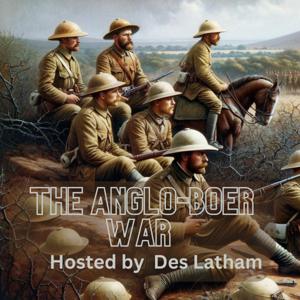
The Anglo-Boer War

By Desmond LathamEducation
Download on the App Store
  • Favorites

    41

    Followers

  • Typical duration

    19 min

    per episode

Based on Podcast App listening data

The Anglo-Boer War episodes

  • Episode 123 - Major Vallentin eats his last lunch & General Botha fights his last Transvaal battle
    This is episode 123 and its January 1902.
    The war has four months to run, and there are still a few big shocks. One would be Lord Methuen’s capture by General Koos de la Rey. More about that in just over a month.
    But in the Eastern Transvaal, the last major battle in the region took place in January, and as I’ve explained in episode 121, General Louis Botha was convinced that he could no longer fight effectively there because the British actions had been so successful.
    Before he left, there was one more piece of violent business to attend to – the Battle of Onverwacht which the British called the Battle of Bankkop.
    The action took place in the first week of January and I have used Robin Smith’s excellent report into the battle published in the SA Military Journal as my main source.
    So it was then that on the 4th January 1902, on a ridge overlooking a fertile valley on the farm Onverwacht, the advance guard of a British column sat down for their midday meal.
    The commander of the detachment of 110 men of the 5th Queensland Imperial Bushmen was Major John Maximilien Vallentin. He was also in charge of a company of mounted infantry of the Hampshire Regiment and some Imperial Yeomanry.
    Valentin was a major of the Somerset Light Infantry and had been in South Africa since before the Anglo-Boer war started in 1899. He had been recognised for conspicuous gallantry during the battle of Elandslaagte in October 1899.
    After contracting enteric fever, he rejoined Brigadier General Ian Hamilton in Bloemfontein in late 1900, and then had been the military commissioner in Heidelberg south of Johannesburg. His name was mentioned in despatches four times and he is described in the Times History as an 'officer of proven gallantry and capacity'.
    So on the 4th January, Vallentin had halted his men on a flat area on the summit of the Bankkop range of hills, 30km east of Ermelo. There are many small wetland depressions here called pans which were an excellent source of clean fresh water for the horses and the men, so they off-saddled and prepared a meal.
    In order to prevent being caught by surprise, Vallentin placed pickets along the ridge running a few hundred metres to their front in a line stretching about three kilometres. This was a very strong position, secure from attack in front by the steep ridge while behind them were the soldiers of the Hampshire Regiment and the rest of the 19th Company of Imperial Yeomanry, Scots from the Lothian and Berwickshire.
    Attack from behind across the flat ground was thus highly improbable – and he had the guards out just in case.
    Westwards, towards Ermelo, there was a column led by Brigadier General Herbert Plumer, nearly a thousand men with mounted infantry and artillery.
    Even closer, to the east of them, was another column of similar strength commanded by Scots Guardsman Colonel William Pulteney. So you could say that with so many British units around, Vallentin could be forgiven for believing that the Boers would not attack.
    19 min
  • Episode 122 - The dishonourable ex-fiancé Karel de Kock & the Witwatersrand Rifle Regiment
    This is episode 122 and we will take a close look at the love-life of a Boer spy – who’s tale is laced with an unusual irony that involves a regiment called the Witwatersrand Rifles.
    The nature of the war had shifted again by January 1902 with the British system of blockhouses and drives beginning to create a major problem for the Boers – pushing the small number of commandos left into areas of the country that could hardly be called strategic. The guerrilla tactic has morphed again from hit and run, to a lot more running and far less hitting.
    The policy of no-longer forcing women and children into the Concentration Camps had also begun to pose a problem for the Boers in a way. While they were used to tough conditions, drought and poor crops returns in lean years, the increasingly volatile regions on the frontiers meant they were isolated and in danger from other forces.
    Near Swaziland the kiSwati chiefs had made it clear that they felt the need to launch revenge attacks on the nearby Boer homestead, so too in the North Western Transvaal, in the northern Transvaal, and along the border with Zululand. The basutho had not actively entered the Free State but there were real fears by the Boers that vast tracts of empty farmland would entice their traditional foe who had made it clear their interests lay with the British.
    In Pretoria, sitting at her desk was Boer Spy Johanna van Warmelo. After the war she was married and was known as Johanna Brandt, but that was later. WE have heard many stories from her as she kept three diaries, a personal, a public, and a secret spying diary.
    The Historian Jackie Grobler published these in one volume in 2007 – it’s a great read because she wrote as a young woman – and her point of view was mixed. She wrote also in English, while despising the English.
    Its January 1902 and Johanna has applied for a permit to travel between Pretoria and Johannesburg. Small parties of Boers have repeatedly attacked the railwayline between these two cities which are 43 miles or 62 kilometers apart. In 1902 that was a whole day by slow moving train, now the Gautrain travels the route in 35 minutes.
    There is an unusual connection between van Warmelo and her ex-fiancé Karel de Kock which involves the Rand Rifles.
    The deserve a special mention because like with many things about the Anglo-Boer war, their importance resonates to this day.
    After the Boer war, the Rand Rifles were absorbed with members of the Railway Pioneer Regiment into The Witwatersrand Rifles in 1903. This new regiment was to play a major role in South Africa’s military history over the next century.
    It saw action during the the Bambata Rebellion of 1906, when it deployed a contingent to Zululand. In 1907 the regiment was strengthened when it absorbed the Transvaal Light Infantry Regiment and was mobilised again when World War I broke out.
    The first action that it took part in was the South African invasion of German South-West Africa (now Namibia). After the successful conclusion of this campaign, virtually all members volunteered for overseas service. Most of the volunteers were consequently assigned to the 3rd South African Infantry Battalion.
    Unfortunately for these men, they ended up in the terrible Battle of Delville Wood during the Somme offensive where 3433 men went in and only 750 came out alive.
    20 min
  • Episode 121 - – The Kenyan Trek Boers of Eldoret & Smuts goes swimming
    General Jan Smuts is making merry in the Cape, trying to stoke uprisings, while Lord Kitchener’s been more successful in clearing the Eastern Transvaal, forcing General Louis Botha to shift towards Vryheid and along the border between the Transvaal and Natal.
    General Christiaan de Wet is active in the Free State, while General Manie Maritz has continued his low level harassment of the British across the Free State and Cape.
    I haven’t spent much time on Maritz mainly because there is not a great deal of documentation about exactly what he got up to on a daily basis – unlike the other generals we’ve been following for two years. He is also one of the most bigoted, warped and psychotic men who held a weapon during this terrible war who tended to lie quite a bit in his memoirs.
    During the Anglo-Boer war he was the only Boer General we know about took a great deal of pleasure in killing blacks instead of British. He seemed inclined to shoot all blacks he found. His most heinous act was lining up all 35 men of a Khoi village at the end of the war and shooting them down in cold blood in what became known as the Leliefontein Massacre. I will have more detail about this in later podcasts.
    Maritz evaded execution at war’s end for what were really war crimes. After all, the Australian Breaker Morant the Australian was executed by the British for a similar spree as he went about executing at least a dozen Boers in cold blood.
    But back to 1902.
    General Koos de la Rey is also still free, roaming the veld in the far west of the Transvaal and he has been particularly successful around Rustenburg, Mafikeng, Marico, Zeerust and other smaller towns in the region.
    We will also hear about how Trek Boers ended up founding the Kenyan town of Eldoret.
    It was established by the Boers in the midst of the farms they created, and known by locals as Sisibo because of the main farm number 64 – or Sisibo in the local language.
    Sixty more Afrikaner families arrived in 1911, by then it had a post office and was officially named as Eldoret which continued to prosper. Eventually the railway line reached Eldoret in 1924 accelerating growth, then in 1933 electricity arrived along with an airport.
    By the 1950s the town was literally divided in two along the main street now called Uganda Road, with Afrikaners living in the north of the divide, and English speakers on the South.
    23 min
  • Episode 120 - Reitz meets a Swiss Family Robinson & Kitchener rethinks the Concentration Camp system
    Its new year – the first week of January 1902 and we continue to ride, or rather walk, with Deneys Reitz as he and seven other colleagues have been separated from General Jan Smuts who is on a mission to raid the Cape – and possibly – cause an uprising of Cape Afrikaners.
    By now Smuts has realised that the idea of Cape Afrikaners rising up is a pipe-dream, but wants to surprise the British close to Cape Town to prove to them that the Boers are still able to strike fear into British citizens.
    Remember last week we heard how Reitz and his fellow commando members had managed to give the English troops the slip over the Swartbergen somewhere in the Small Karoo to the north of Craddock.
    The eight had managed to cross the mountains but now had to make a difficult decision. Where the Swartbergen mountains had consisted of a single clearcut barrier …
    It was getting dark, and a heavy rain began to fall.
    They continued descending from the Swartbergen and needed to find shelter quickly. When the rain falls in highground, the temperature can slide from a balmy 30 degrees centigrade to a really chilly 12 degrees of less in a matter of half an hour.
    They found a overhanging rock and rested until daybreak, trying to sleep as the wind whipped rain into their faces.
    They scrambled down the whole day, until by around four in the afternoon they emerged from the mist and clouds and could see a long narrow canyon ahead. It’s sides were enclosed in perpendicular cliffs. Then they spotted huts around 1000 feet below and decided to go ask for directions out of these mountains.
    They were taking a chance, all eight together descending to the huts. Those with horses left them in a nearby ravine to look after themselves and scrambled down arriving at the huts as the sun sank below the western cliffs.
    They were faced with a number of huts designed in the Xhosa way but also featuring wattle and daub, the much fancied building technique of the early settlers in the Eastern Cape.
    “As we approached the huts, a shaggy giant in goatskins appeared and spoke to us in a strange outlandish Dutch…”
    The stranger was one of the oddest people Reitz had ever met.
    19 min
  • Episode 119 - A shoot out at Mr Guest’s farm after Deneys Reitz meets his English cousin
    Its summer – December 1901. General Jan Smuts is on the run in the Cape Colony being chased by tens of thousands of British troops who are fixating on the fact that they don’t seem to be able to pin down this mercurial general.
    With him is one of our war narrators, Deneys Reitz. Or rather was with him until he became separated in late November and since then has been following Smuts – and trying to stay alive.
    This week we will hear how he stumbles into another series of largely self-inflicted moments of terror. Reitz has a propensity for falling asleep at precisely the wrong time and as you’ll hear, his escapades in the Cape include another variant.
    It was close to the Kariega River in the now Eastern Cape where Reitz last rode with Smuts. Then he found himself with a rearguard unit of seven other men who failed to join up with the General after fighting a skirmish with the British. They were laid up at a friendly Boers farm in the district and the next day thought they’d rejoin the Boer commander. But it was not to be.
    He managed to change from his British khaki uniform which was a death sentence – remember that Lord Kitchener had issued orders any Boer found wearing British uniforms should be shot as spies.
    They began to ride north westerly and as they went, local farmers told them that a large British column was ahead, also following Smuts. Not for the first time, the small unit of Boers followed a British column following a commando.
    Then a bizarre moment for Reitz. He bumped into an Englishman who was a relative by the name of Rex. He couldn’t remember the man’s name when he wrote his memoirs in 1902 but recounts.
    “…a lineal descendent of George Rex, the morganatic son of King George III by Hannah Lightfoot, the Quakeress. George Rex had been sent out to South Africa in 1775 and given a large tract of land at Knysna, on condition that he did not again trouble his august parent..”
    His descendants lived there ever since and one of them had married Reitz’s mother’s brother. They were cousins.
    20 min
  • Episode 118 - Rawlinson surprises the Boers at Bethal & de Wet receives a Christmas present
    This episode takes us to Christmas 1901 and the battle of Groenkop near Bethlehem in the Free State where General Christiaan de Wet catches the British offguard on the top of a two hundred foot high kopje.
    We will also hear how the opposition party leader Lloyd George narrowly escapes being lynched as a pro-Boer Brit in a night of extreme violence as you’ll hear.
    The wobble that Chamberlain the Liberal Unionist leader and Sir Alfred Milner were most worried about had begun back in England. The Tax-payer was now fully aware that they were funding a war in South Africa that never seemed to end.
    The Times newspaper had led a revolt against the government as we heard in previous podcasts. Lord Kitchener was ignored as he complained asbout the fact that most of the new soldiers arriving in South Africa could neither ride nor shoot straight.
    That was nothing new in the eyes of the British public. They had heard that excuse since October 1899 and it was now wearing extremely thin. Parliament had been prorogued until after the New Year but mounting expenditure and public anger might force government to go into session again at such a late date in the year.
    Winston Churchill was pro-government, yet was also warning about what he called a disquietening situation which in his words was as “momentous as it was two year ago”.
    22 min
  • Episode 117 - General Kritzinger is captured and Marconi sends a radio message
    So its December 1901 Christmas is a fortnight away for the combatants and Christiaan de Wet was tracking his arch enemy, brother Piet.
    It was revenge he was after and as we all know – it’s a meal best eaten cold and unfortunately Christiaan was overheating.
    While he stewed on the information that his hated brother was instrumental in setting up the National Scouts, made up of Boer turncoats who now fought for the British, across the world the end of 1901 brought with it a number of fascinating events, incidents and issues.
    On December 1st : A crowd of 100,000 people turned out at London's Hyde Park to demonstrate in sympathy for recently fired British Army General Redvers Buller. He was now being blamed for the disasters at Colenso and Spioen Kop almost two years previously where the Boers had pulverised the British as they tried to relieve the siege of Ladysmith.
    But on matters more prosaic.
    On the 2nd December 1901 a man by the name of King C Gillette began selling his safety razors in the United States. He was inspired by something that could be used and then thrown away, thus ensuring future business. It’s a bit like Monsanto’s seed business these days, but that’s another story. Gillette applied for his US. Patent number 775 134 on December 2 1901. His American Safety Razor Company would become the multi-billion dollar behemoth Gillette Company. Bizarrely Following the commercial success of disposable razors, Gillette refocussed his attention on promoting his views on utopian socialism.
    Strange but true.
    On December 3rd 1901 the Australian parliament passed its Immigration Restriction Act primarily to restrict non-Europeans from permanently entering the country.
    Interesting.
    Then on December 7 1901 The United Kingdom and Germany delivered an ultimatum to the government of Venezuela, after the South American country reneged on bond payments.
    Venezuelan President Cipriano Castro was given 48 hours to agree to the terms, or to face a blockade of his nation's ports by the Royal Navy and the German Navy. Well some things never change.
    On December 9 1901 the first-ever Nobel Prizes were announced, with x-ray discoverer Wilhelm Roentgen receiving the first Nobel Prize in Physics, Emil von Behring being awarded the prize in medicine for his discovery of the first diphtheria antitoxin, Jacobus van't Hoff pioneering work in physical chemistry earning him the chemistry prize, Henry Dunant and Frédéric Passy sharing the peace prize, and Sully Prudhomme winning the prize in literature. The bestowal of the prizes came on the fifth anniversary of the death of Alfred Nobel who I mentioned in Episode 1 of this podcast series.
    The next day December 10 Joseph W. Jones was granted U.S. Patent No. 688,739 for his invention, "Production of sound-records", which was purchased immediately by the Columbia Phonograph Company for production of its disc-shaped Graphophone records. Jones was paid $25,000 – worth around 700 000 dollars in today’s moolah.
    Finally in this series of amazing things that happened in December 1901, Guglielmo Marconi received the first trans-Atlantic radio signal, sent 1,700 miles from Poldhu in Cornwall, England to Signal Hill, St. John's in Newfoundland in Canada on the 12th. December.
    It was the letter "S" ("..." in Morse code)., He is quoted as saying "there was no doubt that the principle of wireless communication had arrived on a transatlantic scale... This was a utility, and would prove itself beyond argument as a vital aid to shipping and military communication."
    And on the same momentous day, 12th December in South Africa’s Cape Colony, Lieutenant General French finally caught up to General Pieter H. Kritzinger, who had led the Boer incursions into the Cape on three occasion. Unfortunately for him, it was three strikes and he was out.

    19 min
  • Episode 116 -The Fawcett Commission reaches a chilling conclusion
    This week its all about the scandal of the Concentration Camps which breaks across Great Britain as the Fawcett Commission releases its initial report. We also continue to monitor General Christiaan de Wet who has a large commando of 700 men and is beginning the move towards the Cape once more. His plan is to increase the pressure on the English although his previous attempt a few months before ended in failure.
    But first, a reality check for Lord Kitchener who has led what has become known as the Drives across Southern Africa where tens of thousands of British troops have been mopping up the remnants of the guerrilla commandos, but at a cost. The Boer women and children have been herded into Concentration Camps along with their black workers and this has turned into a catastrophe.
    As Emily Hobhouse realised more than 9 months ago, squeezing civilians into camps without proper hygiene or sanitation is a disaster waiting to happen. The country didn’t have long to wait.
    The Fawcett Commission was made up of a fairly diverse group of women. It was a daring experiment, a women-only commission which would investigate conditions in the Concentration Camps and compile a report which would be given to the Government in December. Between August and December they steamed up and down the veld in their special train.
    They may have had diverse backgrounds but they were all united in one thing – they believed that the war against the Boers was just and that the civilians were part of the Boer support network and therefore should be punished.
    Led by Mrs Millicent Fawcett, a liberal unionist and feminist, she was also a leader of the women’s suffragette movement. Lady Knox was the wife of Major General General Sir William Knox, who was on Kitchener’s staff. The four other women included a nurse from Guy’s Hospital two doctors who were already living in South Africa.
    20 min
  • Episode 115 – Sarah Raal rides into a trap but the dormant General de Wet awakens
    This week General Christiaan De Wet who has been largely dormant for November awakens and begins to leer in the direction of the Cape once more while Sarah Raal continues to ride with Commandant Nieuwoudt and her three brothers but for how long?
    The presence of a woman fighting alongside the burghers in Nieuwoudt’s commando has become something of a problem for him.
    He’s worried that she’ll be killed while she simultaneously is creating propaganda for the Boers in her skirts and matching Lee Metford with a hat rimmed with gold, bandolier and serious attitude.
    The British are highly motivated to track her down so she has now attracting more columns to the Southern Free State. Nieuwoudt has tried already to suggest that she return to some kind of safety in a town – but Sarah refused to listen as she knew it will be straight to a Concentration Camp which she dreaded.
    Niewoudt was also threading his way through thousands of British troops and the going become increasingly difficult.
    18 min
  • Episode 114 - Sarah Raal "the lady who fought" is bloody but unbowed
    This week’s episode is dominated by a young woman who we heard about last week called Sarah Raal.
    While some of her exploits have been exaggerated for Nationalist reasons years after the Boer War, there’s no doubt that she was extraordinary by any measure.
    Remember she is in her early twenties and escaped from Springfontein Concentration Camp outside Bloemfontein heading to join her four brothers who were fighting with Commandant Nieuwoudt who was part of General Herzog’s commando in the Free State.
    It’s around November 1901 when she joins the commando, and immediately is thrown into the thick of action. Nieuwoudt and his men and one women head off to a place called Boomplaas.
    “I was apprehensive about going there as it was the scene of my previous capture” she writes in her biography published in English in 2000.
    The commando ended up in the small settlement of Excelsior which was only to become a town in 1910, well after the war ended. This is where Sarah caught sight of the mountains to the East which loomed in purple and grey tones, and appeared malignant.
    “The imposing mountains frightened me, they looked so mysterious and full of unknown danger that I felt as if some misfortune may befall us at any moment…” she writes.
    That was around 50 miles due east of Bloemfontein and the Sarah’s life became increasingly more desperate in the coming weeks. She was to face numerous skirmishes fighting alongside her Boer brothers, and as you’ll hear, Sarah became a target for the British who realised there was a woman fighting against them.
    21 min

About The Anglo-Boer War

From the publisher's feed

The Anglo-Boer War 1899-1902 saw the British Empire at the height of its power facing a small band of highly mobile Boers in South Africa. The war introduced the world to the concentration camp and…

Best of The Anglo-Boer War

Ranked by our users in the last 21 days

More shows like The Anglo-Boer War

The History of WWII Podcast by Ray Harris Jr

The History of WWII Podcast

3,982 Listeners

No Such Thing As A Fish by No Such Thing As A Fish

No Such Thing As A Fish

4,816 Listeners

Dan Snow's History Hit by History Hit

Dan Snow's History Hit

4,771 Listeners

The Daily by The New York Times

The Daily

111,829 Listeners

The Battle of Stalingrad by Des Latham

The Battle of Stalingrad

123 Listeners

The Rest Is History by Goalhanger

The Rest Is History

15,589 Listeners

History of South Africa podcast by Desmond Latham

History of South Africa podcast

116 Listeners

British Scandal by Audible

British Scandal

2,499 Listeners

Short History Of... by NOISER

Short History Of...

2,832 Listeners

The Rest Is Politics by Goalhanger

The Rest Is Politics

3,039 Listeners

The Tucker Carlson Show by Tucker Carlson Network

The Tucker Carlson Show

15,908 Listeners

The Rest Is Classified by Goalhanger

The Rest Is Classified

1,095 Listeners

The Boer Wars by Inception Point AI

The Boer Wars

0 Listeners