The Anglo-Boer War

The Anglo-Boer War

By Desmond LathamEducation
Download on the App Store
  • Favorites

    41

    Followers

  • Typical duration

    19 min

    per episode

Based on Podcast App listening data

The Anglo-Boer War episodes

  • Episode 93 - The ruinous war costs 1.25m pounds a week & Lord Kitchener receives a telegram
    The winds of war have been blowing cold across the veld, shrivelling the corpses that lie across hundreds of kilometres in all directions. It is the beginning of July 1901.
    Emily Hobhouse was so excited because finally, after weeks of cajoling, she would have an opportunity to put her report on the Concentration Camps setup by the British in South Africa to a proper public debate.
    It had taken a month, but she’d managed to keep her vow to those suffering in the Boer Camps where women and children were dying in large numbers. She was going to talk to a full audience at Queen’s Hall in London.
    There she would tell the British people about the suffering of the civilians both black and white as Lord Kitchener’s camps began to descend into a disease riddled hell. Winter meant temperatures below freezing, children were dying of measles and pneumonia at a rate of up to 30 a day per camp. And there were more than two dozen camps.
    Things would not work out as she planned, however.
    But the costs are also ratcheting up, now more than £1.25m a week which in 1901 was a huge amount.As we’ve seen, the election of 1900 saw the coalition under Conservative leader Lord Salisbury as Prime Minister and his nephew, Arthur Balfour, as Leader of the House of Commons, win a clear majority.
    While various major posts went to the Liberal Unionists, most notably the Leader of the House of Lords, the Liberal Unionist Duke of Devonshire, and Joseph Chamberlain, who became Colonial Secretary. It was partly Chamberlain’s actions behind the scenes that eventually led to a new policy being formulated about South Africa in 1901.
    The coalition government decided to send a cable to Lord Kitchener, commander in chief of British forces in South Africa on the 2nd July.
    “‘we must now face the possibility that your winter campaign, however successful, will not conclude the war. Indeed the very success in reducing the larger commandos to small unorganised guerrilla bands may render some change in method necessary by the end of August…”
    This must have come as a shock to Kitchener, who had carefully manipulated reports back home indicating that he was on the cusp of victory. But the British intelligence system for all its shortcomings, was better informed. The leadership knew that the Commander in Chief was suffering the effect of being too close to the coalface to have all the facts.
    “The government does not think its either possible or desirable to continue indefinitely to spend 1 million 250 thousands pounds a week and keep in South Africa 250 000 soldiers
    to deal with an enemy who cannot be crushed simply because they are too few and too scattered.. estimated not to exceed 18 000 men… ”
    20 min
  • Episode 92 - Methods of barbarism and Magistrate Kidwell signs an oath of neutrality
    This week we spend some time in England as the political fallout caused by the Anglo-Boer war grows, and meet an unusual man called Magistrate Kidwell.
    But first, Emily Hobhouse finally presented her report on the Concentration Camps to the English public - after government officials gave her the cold shoulder.
    While she was determined to be heard and for the government to act, the reality is the British political leadership was equally determined to force the Boers to surrender and believed that the deaths of civilians was part of what in modern discourse is called collateral damage. More importantly, they were censoring all news from South Africa in an effort to hide just how many civilians were dying.
    Hobhouses' fifteen page report to the Committee of the Distress Fund was first circulated amongst the members before being released to the public in early June 1901. Her conclusion about the camps was they were cruel and should be abolished. She also warned that the black population was beginning to take advantage of the ongoing chaos in South Africa and that would bode ill for any future British governor.
    This was the report coupled with her personal diary and testimony, that sent a shock wave through the pro-Boers in England. Lloyd George intensified his attack on the government in a debate on the 18th June. The report also dislodged Opposition leader Campbell-Bannerman from the tight-rope he’d been walking between two different liberal views in Britain at the time, forcing him into an increasingly radical position.
    On the 14th June Campbell-Bannerman had attended a liberal party dinner at the Holborn Restaurant where he publicly said he was sickened by the policy of sweeping women and children into concentration camps, as the Spaniards had done in Cuba. There were overtones of race here, how the white women were being treated like mulatoos and the blacks of Cuba, although he didn’t quite put it that way.
    He raged
    “A phrase is often used that war is war but when one comes to ask about it one is told that there is no war going on - that is not war…”
    The crowd in the restaurant laughed.
    “when is war not war?” he asked those assembled in Holborn. “When it is carried on by methods of barbarism in South Africa…”
    That phrase resonated throughout the world at the time.
    Also in this podcast, the curious tale of Magistrate Kidwell who surrendered after being attacked by the Boers in the village of Jamestown. He promptly took an oath of neutrality to save two black spies from being shot by the Boers. We'll also hear more from Johanna van Warmelo at Irene and have an update from the Boer leadership gathering at Waterval near Standerton which sets a new course, ordering Jan Smuts to launch an urgent invasion into the Cape Colony.
    20 min
  • Episode 91 - Women are caught in an artillery barrage and a deadly blizzard sweeps across the veld
    It’s mid June 1901. Winter in the Southern Hemisphere and in the Highveld or high plains of South Africa that means bitterly cold nights where the temperature can dip well below freezing. As I write, this, the temperature outside has dipped to 4 degrees centigrade in Johannesburg - or 39 degrees farenheit. Yes, its nothing like Siberia or Canada, but this is Africa and these kinds of temperatures catch the uniformed off-guard.
    It gets much colder in other parts of South Africa. In the Cape Province, the town of Sutherland is the coldest in the country with mid-winter lows that can drop to below -20 centigrade or -4 farenheit and where 3 feet of snow can fall.
    The British Army was not ready for these extremes, as the German army was not ready for the Russian Winter of 1941/2. While South Africa’s high plains winter is nothing like Russia’s, the point is the military underestimated the weather.
    The British were conducting what were known as Drives with columns of thousands of troops riding or marching across the veld rounding up small groups of Boers who were trying to continue the guerrilla war.
    While nights and early mornings can be bitterly cold, during the day temperatures rise to above 20 degrees Centigrade or 68 Fahrenheit, and it becomes extremely dry. Not quite the Atacama, but dry enough.
    Most of South Africa is a summer rainfall region, except for the Western Cape which has a Mediterranean climate, very similar to the San Francisco area of California.
    So Winter has come to the Anglo-Boer war and for many British soldiers its their second on the veld. The Boers meanwhile, have slowed their action with the lack of water for their horses and feed that has disappeared from the veld.
    General de la Rey for example has sent most of his men home and told them to wait out the winter for a renewal of guerrilla warfare in Spring. De la Rey heads off to join General Christiaan de Wet who is still fighting along with die hard followers of around one hundred burghers who had made it their mission to cause as much trouble as possible for the British in the Orange Free State.
    However, between 5th June and 20th June 1901 freezing weather had made their mission painful, and deadly. They were not alone. As I’ll explain, a blizzard that was about to sweep across the high veld would lead to deaths on all sides, not least the civilians cooped up in the Concentration Camps. That’s the contradiction that is South Africa. The dry winters are interspersed with icy cold fronts that are driven across the sub-continent all the way from the Antarctic, bringing frozen moisture that leaves high ground covered in snow.
    23 min
  • Episode 90 - Casualties, alcohol, prostitutes and a skirmish at an overgrazed Free State farm
    This week we’ll focus on the British troops and discuss how British army tactics had changed, and the role that alcohol and prostitution played in the three year war.
    There were more 65 000 English casualties during the war and its effects tore across the Southern African veld between 1899 and 1902.
    22 000 English soldiers died. To put this in perspective, 16 000 died in the Crimean War, fought ostensibly with muskets and canon, not smokeless magazine fed highly accurate rifles like the Mauser and Lee-Metford, nor the automatic canon called the pom pom, or the Maxim machine gun such as we’ve seen during this war.
    When conflict began English officers basically followed a system that they believed had been perfected over hundreds of years. What the military brains trust hadn’t taken into account was the effect of new technology.
    As I’ve explained since the start of this series, these men were caught between two continents, two eras and two worlds.
    Many grew up as the industrial revolution burst across England and Europe, but were also affected by the romantic era of battles that resonated for the entire 19th century. Admiral Nelson, the defeat of Napoleon, the charge of the light brigade, the suppression of the Indian subcontinent with its mysterious riches, the subjugation of the Sudan and India.
    Some of the fighting men had met veterans of the war on the Spanish Peninsular and had read or heard of the tales of heroism.
    But they were facing a 20th Century industrial war, where artillery had advanced and trenches were to become the preferred defensive method in order the escape the industrialised killing machines.
    The officers and men were steeped in tradition backed up by the narrative of an Empire in full flight, secure in its own history and positive about its future. Phalanx’s of infantry, steel and swords gleaming, marching in serried rows towards each other to fight a glorious battle, backed up by cavalry usually swinging around in some kind of flanking manoeuvre at speed.
    The Boer war was very different. It was fought at a distance at least between October 1899 through to December 1900. Then it morphed into a classic guerrilla campaign and the British troops came face to face with their enemy in an entirely different way.
    So this week we’re going to peek into the lives of some of these British soldiers. Its winter, early June 1901 and the war is stuttering. 240 000 British troops are now garrisoned and marching across South Africa mostly in Drives across the Transvaal and Free State, trying to mop up motley groups of Boers, the die-hards or bitter-einders, bitter-enders, as they’re known.
    Ordinary British soldiers in South Africa found life tedious, dreary and boring. Many wrote copiously about their experienced and as I’ve explained, this war was the first where rank-and-file men were educated through the development of the Victorian schooling system, so we have diaries, notes and letters from all classes.
    By June 1901 many Tommies began to display disorderly behaviour. As white colonials shied away from fraternising with blacks, Tommy Atkins created a huge hidden economy that ranged across the veld, following the columns of thousands of men. And they did fraternise with black South Africans directly. Often alcohol and prostitution played a part, but not always.

    24 min
  • Episode 89 - Emily Hobhouse pricks English consciousness & Reitz eats pork
    IT’s June 1901 and there’s trouble brewing like a north sea storm around the British Isles. The main force behind this political hurricane is a diminutive but loud woman called Emily Hobhouse.
    While the suffragette movement is in its infancy, there’s nothing about Hobhouse that is a wallflower. In fact, you could say that it was precisely because of courageous women like her that the entire suffragette movement gained momentum. Still, much of what was to happen in that social and political project emerged after the First World War, when women who’d been building artillery pieces and loading ammunition into crates suddenly were told that they needed to go home and put on curlers and become housewives again.
    After the freedom they’d experienced, and earning their own living, that was always going to be a tough sell as the soldiers marched back from the Western Front.
    But here we are, 13 years before the First World War, and tracking that truly fascinating person called Emily Hobhouse. Sir Alfred Milner, the Cape governor, referred to her as that screamer - always complaining.
    Milner ironically was on board the same ship that took Emily Hobhouse from Cape Town to Portsmouth in England - although the two gave each other a wide berth if you excuse the pun.
    So on the 8th May the Saxon set sail from Cape Town. As with the habit of those on these long journeys, Hobhouse sought out Milner in private but he avoided talking to her. Only after the Saxon had passed Madeira in Spain did an opportunity present itself. In the course of their conversation she found out whey Milner had been unwilling to meet her.
    In the preceding months he had received more than 60 reports all containing personal allegations against her. She was accused by the camp commanders of inciting unrest and playing politics. That was because Hobhouse was determined and had facts at her fingertips. So what better way to deflect her truths than accuse her of malicious political intent? I’m afraid this technique of dealing with uppity women continues to this day - and often ends in failure as it did in this case too.
    in Holland, President Paul Kruger was mulling over a coded letter sent by Jan Smuts and Louis Botha. Remember last week I explained how Botha and Smuts had begun to question Boer tactics and Smuts in particular was growing more certain that this war could not continue. He was aware of the reports of the death of women and children in concentration camps, and his men had run out of just about everything.
    Even their will to fight.
    Kruger had installed himself in the Hotel des Pays-Bas in Utrecht in January 1901, but by June he’d moved to a guest house called Casa Cara in Hilversum. That’s where he and his secretary Leyds met to discuss Smuts’ letter.
    19 min
  • Episode 88 - Reitz chases Mustangs on the plains and Jan Smuts becomes pessimistic
    Its the end of May and the guerrilla war has turned nasty as the coldest winter of living memory has started - bringing gusts of freezing wind which whipped through the Concentration Camps with their exposed bell tents a threadbare protection for the women and children.
    Also chilled to the bone was Deneys Reitz and his four German comrades who were riding south from the western Transvaal, heading for the Vaal River. Their plan was to cross in the Free State, then continue the four hundred kilometres further southwards in order to invade the Cape Colony.
    As we heard last week, the entire plan had a Quixotic flavour with Reitz the canny veld-wise Boer and his friends - two students, a businessman and a farm hand.
    It was the farm hand , Heinrich Wiese who had the first major problem. After the little group had bungled an attempt at capturing a spy the previous day, they set off before first light towards the Vaal River.
    The country-side was alive with British troops moving about on one of their drives ordered by commander in chief Lord Kitchener. They were burning farms and rolling up the Boer citizens forcing them into the internment camps.
    General Louis Botha, in command of the Boers in the Transvaal, was growing more concerned by the misery these people were suffering. His own private view now was that the Boers could not win, but he would carry on fighting based on his honour code. But he reached out to Lord Kitchener as we heard in podcast 86, asking for permission to send emissaries to Paul Kruger in Holland.
    Kitchener was also keen on ending the guerrilla war as fast as possible. The costs continue to rise, he now had almost a quarter of a million men in South Africa and the war that was supposed to last one to three months had now stretched to nineteen. While Free State President Steyn had sent a withering reply to Botha and Jan Smuts suggestion that a cease fire be negotiated, the Transvaal leadership stubbornly persisted in their plan and if an emissary was not permitted, they’d send messages.
    20 min
  • Episode 87 - The sad story of Gert Bezuidenhout (12)& Deneys Reitz starts his Quixotic Cape Quest
    This week we spend some time with Johanna van Warmelo and Deneys Reitz, the former who starts a new position as a nurse in a Concentration Camp at Irene outside Pretoria, and the the latter who has just convinced his German fellow travellers that an invasion into the Cape is feasible.
    Its mid-May 1901. President Steyn of the Free State and his Transvaal colleagues have had a disagreement about the possibility of a cease fire, but that has not stopped General Louis Botha who is in the Eastern Transvaal sending a note to British Army commander Lord Kitchener asking for permission to send an emissary to the Netherlands.
    Botha want’s to ask President Paul Kruger’s permission to embark on peace talks as he’s growing more certain that the Boers can’t defeat the British in South Africa. The Free State leadership are more intransigent and prefer to fight to the death, led by their fiery leader General Christiaan de Wet.
    The stage is set for more confrontations between the supposed allies, but as they grind their teeth, in Pretoria Johanna van Warmelo is now determined to assist her Boer sisters and their children who are squeezed into the nearby Concentration Camp. They are beginning to die in large numbers and with the temperature dropping, its bodes ill for the coming winter.
    Remember in Episode 83 I explained how Johanna and her mother were working as secret agents for the Boers from their strategic base at SunnySide farm on the outskirts of Pretoria. The British did not believe they were involved in spying, but that’s exactly what they were doing. We also heard how Johanna was keeping three separate diaries - one her open diary, the second her secret love diary, and the third her top secret war diary.
    Historian Jackie Grobler published a book in 2007 called "The war Diary of Johanna Brandt" which combined all three.
    She was still a van Warmelo during the war, and in May 1901 arrived at Irene Concentration Camp having volunteered as a nurse. Her initial job was to walk around the huge camp looking for sick Boer women and children and then bring these to the attention of the camp doctor. There were six Boer nurses in a camp of 5000 and by early May 3 people were dying a day.
    Far to the West, somewhere in the vicinity of Harts River, Deneys Reitz and his four German friends were holed up having been left behind by the Commando under the leadership of Mayer.
    General Koos de la Rey had ordered that the Boers return to their homes for the meantime as the cold weather drew in and the movement around the veld became more difficult. But Reitz was so isolated along with his colleagues that he had decided to take matters into his own hands.
    Remember last week I explained how Reitz had convinced his fellow travellers that instead of heading back to the north, they should try to enter the Cape Colony.
    “After I had explained my views…” he writes in his book Commando “…and had pictured the Cape to them as a land of beer for the taking at every wayside inn, they became eager converts, and we agreed to start without delay…”
    17 min
  • Episode 86 - General Louis Botha grows despondent while Reitz plays cat and mouse with the English
    We’ve reached May 1901 and surprisingly, General Louis Botha is trying to reach out to Lord Kitchener who is the British Army commander of the over 240 000 troops in South Africa.
    Botha wants special permission to send emissaries to Paul Kruger in the Netherlands to ask if a ceasefire could be arranged. But that only happened after Botha and Jan Smuts had collected as much information about the Boers position - and it was a depressing account.
    They were running out of weapons, ammunition, food, clothing, horses, money, everything as Historian Martin Bossenbroek writes.
    Could supplies be sent from Europe, through German South West Africa perhaps?
    Between the two countries was a significant desert, but was traversable - still this was indicative of just how desperate the Boer leadership was. While Generals Koos de la Rey and Christiaan de Wet and the other unconventional leaders were foraying back and forth, the echelon of senior leaders was growing more aware of an unsustainable situation.
    In the southeastern Transvaal reports emerged of British using Zulu warriors to loot cattle from Boers. There’s an allegation made that British officer Colonel Bottomley sent a letter to King Dinizulu suggesting he send his men into the region to grab cattle and around 6 000 warriors crossed to border between Natal and the Transvaal in May 1901.
    Meanwhile, far to the north west on the Transvaal border with Bechuanaland - modern day Botswana, Deneys Reitz and a small commando under the leadership of Commandant Jan Kemp were under orders to attack the railway line which was being used to ferry supplies into the Mafikeng.
    General de la Rey had divided his force into two parties, and took one of these south where he began to engage with British columns. Commandant Jan Kemp led his group westwards, and for two days in mid-May they rode through barren country until they reached a point on the Harts River.
    British troops could be seen along the River, watching for any Boer movement so they decided to make the crossing at night.
    Reitz was part of a German scouting unit led by the Johannesburg businessman called Mayer that was sent ahead of the main body, riding through the Cunana Native Reserve all night until four the next morning when they crossed the British border.
    19 min
  • Episode 85 - Emily Hobhouse mobilises against the "gigantic blunder" of the Concentration Camps
    It’s the first week of May 1901, and winter has come early in South Africa.
    As I mentioned last week, at this point social activist Emily Hobhouse was on board a ship heading for England after experiencing the South African Concentration Camps first hand and she was to mobilise parts of British society against the war by recounting her stories.
    She was British first, so when she disembarked later in May, she headed straight to the authorities. Emily Hobhouse believed that when they heard her stories about the conditions in the camps, and the rising death rate, government ministers would be so embarrassed they would institute changes.
    As we’ll hear at the end of the month - and through June - she was sorely mistaken.
    But she wasn’t alone. The attack on the camp system was also taken up by two other MPs CP Scott and John Ellis.
    IT was these two who first used in arch an ominous phrase - concentration camps - taking it from the notorious reconcentrado camps set up by the Spanish to deal with Cuban guerillas. AS we heard previously the use of Block Houses by the Americans in the Cuban war was also going to be perfected by the British in South Africa.
    It was Ellis who had sent his relative Joshua Rowntree to report on the camps. When Rowntree was refused entry into the two new colonies of the Transvaal and Free State by lord Kitchener, his instincts were aroused.
    British Secretary for War St John Brodrick insisted that these camps were voluntary, that the workers, women and children were all there on their own volition. They had arrived on their own free will as prisoners.
    How many lived in them, asked Ellis in March, and how many had died? It was only at the end of April that the house of Commons heard the first statistics.
    In the Transvaal, 21 thousand one hundred and three. By May they’d heard there were 19 thousand 680 prisoners in the now renamed Orange River Colony and 2 524 in the Natal Colony.
    It was also becoming apparent that St John Brodrick did not have all the information about what was really happening in these camps, at least that was the allegations by Ellis and the opposition leader, Lloyd George. He quoted for example that many of these refugees are what he called coloured people.
    20 min
  • Episode 84 - Captain Phillipps frets about Tommy Atkins & New Zealanders learn a Maori War Cry
    This week, we’ll track a Londoner who rode with Rimington’s Tigers then there’ll be a quick story about a Maori who arrived in South Africa during the war to fight, but also carried a Violin.
    At the same time, information began to circulate about the British Concentration Camps where tens of thousands of Boer women and children were interned. And the information was worrying.
    Slowly the numbers began to be squeezed out of the British Government.
    There were 21,105 people in Transvaal camps in April, 19,680 in Orange River Colony and 2,524 in Natal . The number of deaths was equally difficult to discover because of censorship. Yet these numbers were leaking and they were not good news for those who believed this war to be honourable.
    Nor was it clear if the figures included the black inmates. We now know they did not.
    A second strategy launched along with the Concentration Camps was Lord Kitchener’s policy of great drives some over 80 kilometres long. These were his strategy to cope with the guerrillas and finish the war. He understood that he could not catch or destroy the remaining commandos without placing strict limits on their freedom of movement before sweeping them from the veld.
    This policy was not as clinical in practice as it sounded in theory. The sweeps were often accompanied by looting as well as destruction. Some of the British officer which had been based in South Africa for more than 18 months fighting the Boers had run out of patience and used these drives as an excuse to loot. For some of the soldiers under their command it became a kind of sport.
    Writing at the time, Captain L March Phillipps who was an officer in the Rimington Guides or Rimington Tigers as they were known began to have serious doubts about the nature of these veld clearing operations.
    The Tigers had been created by Major Mike Rimington and they were known Rimington’s Tigers due to the leopard skin hatbands worn on their slouch hats.
    They were also known as the Night Cats because of their many night marches and stealth.
    In January 1901 the force was reorganised as Damant's Horse under Major Frederic Damant, Rimington's second-in-command, but many continued to call this feared unit the Rimington Tigers.
    Captain Phillipps looked on exasperated at times during the Great Drives period of this war, March through September 1901. In one of his letters he writes about the British Soldier who was now known as Tommy Atkins.
    This generic title Tommy Atkins was used from at least 1743. There’s a great deal of debate about the exact origin of the title has been used as a generic name for a common British soldier for many years. The origin of the term is a subject of debate, but a letter sent from Jamaica about a mutiny amongst the troops says in 1743 includes the line "except for those from N. America ye Marines and Tommy Atkins behaved splendidly”.
    However, our letter writing Captain Phillipps is not as enamoured by Tommy Atkins during the great Drives across the Veld in 1901.
    21 min

About The Anglo-Boer War

From the publisher's feed

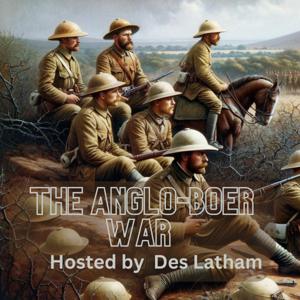
The Anglo-Boer War 1899-1902 saw the British Empire at the height of its power facing a small band of highly mobile Boers in South Africa. The war introduced the world to the concentration camp and…

Best of The Anglo-Boer War

Ranked by our users in the last 21 days

More shows like The Anglo-Boer War

The History of WWII Podcast by Ray Harris Jr

The History of WWII Podcast

3,982 Listeners

No Such Thing As A Fish by No Such Thing As A Fish

No Such Thing As A Fish

4,816 Listeners

Dan Snow's History Hit by History Hit

Dan Snow's History Hit

4,771 Listeners

The Daily by The New York Times

The Daily

111,829 Listeners

The Battle of Stalingrad by Des Latham

The Battle of Stalingrad

123 Listeners

The Rest Is History by Goalhanger

The Rest Is History

15,589 Listeners

History of South Africa podcast by Desmond Latham

History of South Africa podcast

116 Listeners

British Scandal by Audible

British Scandal

2,499 Listeners

Short History Of... by NOISER

Short History Of...

2,832 Listeners

The Rest Is Politics by Goalhanger

The Rest Is Politics

3,039 Listeners

The Tucker Carlson Show by Tucker Carlson Network

The Tucker Carlson Show

15,908 Listeners

The Rest Is Classified by Goalhanger

The Rest Is Classified

1,095 Listeners

The Boer Wars by Inception Point AI

The Boer Wars

0 Listeners