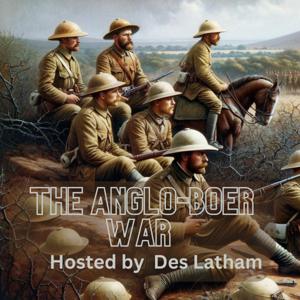
The Anglo-Boer War

The Anglo-Boer War

By Desmond LathamEducation
Download on the App Store
  • Favorites

    41

    Followers

  • Typical duration

    19 min

    per episode

Based on Podcast App listening data

The Anglo-Boer War episodes

  • Episode 83 - Boer Secret Service Spy Johanna van Warmelo and the Petticoat Commando
    In this episode Easter Sunday had come and gone on the 7th April and for most combatants stretched across the vastness of the South African veld, it was characterised by fear and loathing. The concentration Camps were filling and women and children were beginning to die of diseases like enteric and typhoid.
    The numbers were in the hundreds a week, by August 1901 more than 1,800 would be dying a month - and a similar number of black men, women and children who’d also been herded into camps to keep them from supplying the Boers with food and logistic support.
    So it was just over a week after Easter, on April 15th, that Johanna van Warmelo and her mother took a train to try and see her brother, Dietlof, who’d been captured by the British and was being sent to Ceylon.
    There was no freedom of movement because of the war, and after initially being rejected for not having the correct signatures and paperwork, they made it on board and then chugged off for the 40 kilometre journey to Johannesburg - which even then Johanna calls the Golden City.
    All along the line one sees the signs of the war, here a blown-up bridge, there, the ruins of a whole train of trucks and carriages.
    They also took note of the British defensive positions along the line, the plates of iron leading to trenches, covered with sand bags, all around the network of barbed wire.
    That laughter dried up as they passed Irene just beyond the station, where they saw the women’s concentration camp. Thousands of women and children were living there in tents, they were the families of the men still fighting. Remember Lord Kitchener had ordered that these camps be set up across the north of the country to incarcerate families of the guerrilla soldiers, in an attempt to hurry the end of the war.
    Johanna was 24 years old. What is remarkable about her, is that she was keeping three diaries. One was her secret military diary, the second her secret love diary, and her third which you could call her open diary.
    Johanna and her mother were collecting information and spying on the British then sending their intelligence gathering to colleagues across South Africa - and the world.
    21 min
  • Episode 82 - Aborigine trackers, the Great Comet Viscara and the case of Gideon Scheepers
    Deneys Reitz had broken his own leg in a freak accident and was still hobbling about, his compound fracture causing some pain. General de la Rey ordered him to a small medical camp behind the lines near Hartbeespoort which is west of Pretoria.
    There he was recovering when the British launched an attack on the Boers.
    Reitz saddled his horse and galloped to the ridge overlooking the British.
    But there was no much they could do - there were about 12 000 English versus 600 Boers.
    The casualties were light, although the British artillery were accurate enough and caused the Boers to fall back from ridge to ridge. By two in the afternoon the English gave up the chase.
    They rested their horses after the Generals’ ironic speech, and then under the cover of dark rode further away.
    An amazing sight greeted the men as they crested a rise that night - it was called the Great Comet of 1901, Comet Viscara.
    But as they rode, a boyish voice from the darkness called out
    Vlug means retreat, another example of the sense of humour of soldiers making the best of a bad situation.
    The Royal Observatory in Cape Town, the Argentine National Observatory and the Government observatory in Perth Australia shared their scientific evaluation which put the Comet at 79 million miles from Earth.
    While the comet caused the Prophet van Rensburg some excitement, there was more excitement in the Cape.
    Kritzinger was back in the Midlands and causing trouble, while Gideon Scheepers was about to commit a war crime. He shot dead two black troops who'd fired on his men from a farmhouse, saying "it was a white man's war". He was to pay for that act with this life after being captured.
    18 min
  • Episode 81 - Black participation in the Boer War and Reitz breaks a leg
    Deneys Reitz will experience a terrible wound to his leg and we will probe an issue that caused much gnashing of teeth - the role of Black South Africans in the war.
    A quick note for my American listeners, in South Africa people who are mixed race are known as coloured. I know the phrase is frowned on in the U.S., but here in Africa, it's accepted.
    I’ve tried to show how the myth that there were no black fighting men on both sides is just that - a myth - by using examples of how close black men and women were to the action throughout these podcasts over the last 18 months.
    Professor Bill Nasson published a book in the Anglo-Boer war series called Uyadela Wen’Osulapho - which is the cry of a fallen Zulu warrior, urging his comrades to carry on the fight.
    On the cover of his book is a black member of the British army in Mafikeng photographed alongside with lord Baden Powell. Inside the full photograph shows a group of black soldiers sitting with the famous general. All are stern faced, the soldiers holding their Lee-Metford Rifles and sporting large bandoliers around their shoulders. They were scouts and transport riders, armed to the teeth.
    When the war began in 1899, contemporary observers assumed that blacks would not be allowed to play any part in the coming hostilities but of course that was naive.
    A British commentator in the Fortnightly Review told readers that blacks in his words “would be impossible to control…” if they were armed.
    The risk of rebellion meant that the British in particular were petrified of stoking uprisings, considering what had happened to them in Zululand in 1879 where the Zulu had killed 1300 of their best troops at Isandhlwana.
    Jan Smuts too had written that this was to be a war between whites - saying that this was in the interests “of self-preservation” as he put it.
    Ironically, by the end of the war, Smuts was sending armed black men to fight in Namaqualand.
    21 min
  • Episode 80- A Boer Rodeo near Swart Ruggens & General Bindon Blood makes his dashing appearance
    When we ended last week, Deneys Reitz had rejoined General de la Rey along with his Dopper companions, and had been regaled by the prophet, van Rensburg in late March 1901.
    The General was aware that the British drives were beginning to pay off - that was Kitchener’s plan to encircle the renegade commandos while conducting a scorched earth policy while his notorious internment of women and children in the Concentration Camps continued apace.
    So at the end of March 1901, Deneys Reitz and the de la Rey commando moved to Tafel Kop from their natural lake called Rietpan in the western Transvaal. That came after de la Rey had suffered a defeat in a skirmish with British troops and lost around one hundred men. He knew they were in an untenable position in the lowland, and wanted to move into broken country which meant escape was more likely when attacked.
    Remember many of the Boers were now without their horses, 18 months of war and disease meant a shortage was growing of horses, food, clothing, ammunition.
    This didn’t stop Reitz from continuing to dream about being part of a large scale invasion into the Cape colony. It was this kind of wishful thinking that motivated him along with the core of the Boers.
    And yet, here, far away from his loved ones, Reitz was about to turn 18 years old.
    This old young man had been involved in nearly all major battles in Natal starting in October 1899, dozens of skirmishes and near misses, now he was looking forward to legally being able to consume alcohol as his birthday approached.
    Not that he had avoided the brandy and schnapps over the past year when offered. Still he was clearly excited about his birthday in most endearing way and wrote about it in his book Commando. That excitement was rapidly to turn to exasperation and even fear as they readied the feast early in the morning, a thick mist hanging over their camp because a British patrol was close by.
    In the Eastern Transvaal, General French’s cavalry and mounted infantry had recovered from some of their supply problems were heard about in previous episodes, the weather had improved. It lost much of its impetus as lack of a supplies hampered mobility and their horses were weakened by the wet weather and lack of forage. The sodden terrain had been miserable for the English troops who laughingly referred to the weather as somewhat like Scotland.
    We'll also be introduced to General Sir Bindon Blood who had a great deal of experience in Africa, building bridges and pontoons for the British expansion in Zululand in the 1860s, then fighting the Zulus in the infamous campaign of 1879. Eventually he ended up in India and was then drafted back to Africa to fight the Boers in early 1901.
    With his fine head of silver white hair and a moustache to match, he was easy to spot in a crowd. But more about General Blood, Ben Viljoen and the Sikukuniland warriors clashes later this month.
    18 min
  • Episode 79 - Reitz meets the Doppers and a wild-eyed prophet as the Gold Mines chug back to life
    Episode 79 is full of strange swirling tales where Deneys Reitz our intrepid Boer narrator has been separated from his brother near Rustenberg after riding to fetch his all important saddle bags.
    Then to make matters much worse, his only remaining horse died.
    This left the youngster in a pickle, adrift in the veld, alone, with his only plan now to reach General Koos de la Rey who’s operating somewhere in the west. Maybe he could obtain a couple of horses there he thought.
    Little did he know that de la Rey’s commando had been hit by the same horse sickness that had put paid to his favourite horse, Malperd, then his replacement animal a few weeks later. Across the region, the sickness was taking its toll on all commandos, as well as the British cavalry and mounted infantry units.
    Reitz meets a prophet by the name of Van Rensburg who believes he has powers of the occult and then witnesses an apparent miraculous event although remains sceptical of it all.
    Meanwhile, High commissioner Milner had relocated from Cape Town to Johannesburg. He was also planning to return to England for a short visit later in April but before then wanted to get the Gold Mines going to help pay for the war.
    19 min
  • Episode 78 - American blockhouses from Cuba and the enigma that was the pro-Boer John Tengo Jabavu
    The ides of March were upon the British in South Africa as they continued chasing the ghost generals, Smuts, de la Rey, Beyers, de Wet across a cooling landscape that had begun its Southern Hemisphere Autumn in 1901.
    This week we’ll probe an American invention in Cuba called the Blockhouse chain as well as details of how journalist John Tengo Jabavu was publishing pro-Boer commentary against the wishes of both the British and most black intellectuals.
    We’ll return to his experiences later.
    The tactic of building a chain of forts is ancient, but the most recent examples before the Boer War came from the American War in Cuba. But this campaign had demonstrated that forts by themselves could not prevent guerrilla action and Lord Kitchener who was beginning to build them in South Africa knew that full well.
    Kitchener’s strategy therefore was to integrate the function of the fixed defensive units in fortified blockhouses with mobile attacking units on the drives. These began in January 1901, I’ve spoken about them in previous podcasts as the British tried herding or hustling the Boers into smaller areas of veld so that they could be overcome.
    Kitchener believed if the country could be divided into small areas by fortified lines, the Boers in each might be prevented from crossing to the next. His chessboard of maps across his HQ walls featured these regions with the addition of mobile columns that would be moved quickly by train from chess block to chess block while the blockhouses and barbed wire began to string out across the wide-open plains.
    23 min
  • Episode 77- Kitchener’s peace talks fail and De Wet experiences a miracle
    Episode 77 and the Great de Wet hunt sees the English cornering their quarry in the North East Cape Colony, close to Hopetown. The mercurial Boer general Christiaan de Wet has given up the plan to invade the Cape Colony and he’s doing all he can to remain on the loose.
    He felt even more responsibility about the future of his commando because Free State President Steyn is traveling with him.
    Not that far away, in Bloemfontein the Free State capital, the British Commander Lord Kitchener and Transvaal Boer commander General Louis Botha met at the end of February, then a second time on 7th March to discuss possible peace terms. Kitchener presented Botha with a set of ten terms which the English say they’ll accept to make peace.
    It seems an incongruous position - the Boers technically defeated most of the towns and villages in English hands, the infrastructure out of their control - and yet - here they are negotiating their position as if they had a choice.
    A guerrilla campaign has left most of the west, north and eastern regions decimated. Boer property was being systematically destroyed in these areas in an attempt to force the men still roaming the countryside to accept defeat - but these actions were embittering the hard core fighters.
    Politically, this action was to leave a scar which would sometimes burst into violence in the coming century with uprisings during the First World War.
    In the Second World War, hardline Boers felt empathy with the Germans and some left the country to fight in Europe. Others trained with the Germans then returned to German South West Africa to continue the war.
    Much of the animosity emanates from this period - and specifically from the early 1901 to early 1902 period when Lord Kitchener set the veld ablaze and ordered women and children into internment camps which were ominously known as Concentration Camps.
    So General Louis Botha was not really interested in the British terms but his wife had asked him to meet and simultaneously he knew his people were suffering greatly so hoped that some way could be found out of this war which he knew he could not win.
    Botha was also aware of the role that Sir Alfred Milner, High commissioner of the Cape played. Milner was monitoring developments and was pressing for a resolution. While Milner was concerned by Kitchener’s destruction of Boer property - he was more worried about the Cape Afrikaners rising up in support of the Boers - and the British High Commissioner was influenced by investors in London.
    21 min
  • Episode 76 - Labram loses his head, darkness is De Wet’s salvation & Peace Talks begin
    This week we continue learning about Americans in the war and ride with Christiaan de Wet as he scurries back across the Orange River - his attempts at invading the Cape ending in failure.
    There are also unusual peace moves afoot and a meeting between Lord Kitchener and Boer General Louis Botha takes place.
    First, the small matter of George Labram, de Beers company mine engineer extraordinaire. Even by the standards of the day, his manufacturing ability and constant innovation must still rank as some of the most creative examples of how to use engineering skills in the midst of war.
    He of course wasn’t the first innovator to help a town under attack - for example Archimedes brilliant use of a crane and claw to overturn attackers boats during the siege of Syracuse in 212 BCE.
    Born into poverty in Detroit Michigan in 1859, George Labram’s education was spotty, but his sister remembered that “his spare time was taken up with books on machinery and engineering.”
    In his mid-teens he went to work for a local machinery manufacturer, and eventually secured a better job in Chicago. Then he moved to the Silver King Mining Company in Arizona. Later, and after a stint running a Copper mine, he was spotted at the famous Chicago World Fair in 1893 when De Beers Consolidated Mines hired him to build and operate a mill in Kimberley.
    23 min
  • Episode 75 - Cowboys, Theodore Roosevelt & Americans in the Anglo-Boer War
    This week I'm focusing on America and Americans who fought in the war.
    What made Americans travel half way around the world to fight for both the Boers and the English?
    The initial answer is obvious - given the Boer’s attempts at forging independence from the British Empire, something the Americans had done one hundred and 30 years before.
    “I have been absorbed in interest in the Boer War,” wrote Theodore Roosevelt to his friend Cecil Spring Rice in 1899.
    “The Boers are belated Cromwellians, with many fine traits. They deeply and earnestly believe in their cause, and they attract the sympathy which always goes to the small nation. … But it would be for the advantage of mankind to have English spoken south of the Zambesi just as in New York; and as I told one of my fellow Knickerbockers the other day, as we let the Uhlanders of old in here, I do not see why the same rule is not good enough in the Transvaal.”
    He was not alone. Most Americans took a keen interest in this remote conflict, many espoused the same belief in what they earnestly believed was the British civilising influence in Southern Africa.
    Two years later later, though the former Senator and now president Roosevelt wrote:
    “I am not an Anglomaniac any more than I am an Anglophobe … but I am keenly alive to the friendly countenance England gave us in 1898. … I have been uncomfortable about the Boer War, and notably in reference to certain details of the way it was brought on; but I have far too lively a knowledge of our national shortcomings to wish to say anything publicly that would hamper or excite feeling against a friendly nation for which I have a hearty admiration and respect.”
    That contradiction was played out across the USA.
    Leading newspapers sent their correspondents to the front; the war was debated in Congress and discussed in Cabinet meetings; private organisations sprang up to help one side or the other; a surprising number of Americans actually made their way to South Africa and joined the fight; and toy stores stocked up on two new games, one called “Boer and Briton” and the other “The War in South Africa”.
    In addition, the United States sold the British tens of thousands of tons of preserved meat, hay, and oats as well as horses, mules and oxen. Boers and their friends in America tried to prevent such sales, and the Chicago branch of the American Transvaal League and the Boer Legislative Committee of Philadelphia lodged formal protests with Washington.
    Although publishing legend and businessman William Randolph Hearst thought Britain should win—because as he put it “civilization and progress demand it”—most American publishers and their newspapers were pro-Boer.
    For Example, the man who gave us the Pulitzer prize, Joseph Pulitzer’s New York World sided with the Boers and favoured American mediation. It even worked up a petition to the President urging this which was signed by 19 bishops and archbishops, 104 out of 442 members of Congress, 89 college presidents, 13 mayors of important cities, and many distinguished judges, editors, and businessmen.

    20 min
  • Episode 74 - Louis Botha surprises the British near Ermelo & De Wet crosses a swamp in the Karoo.
    The guerrilla campaign is moving ahead swiftly, while in the northern Cape, the Great De Wet Hunt is in full swing.
    In the Eastern Transvaal, General Louis Botha had attacked the British in a surprise move on 10 February adding to the confusion the English troops were experiencing.
    Between Christiaan de Wet’s confident departure from the north-western reaches of the Orange Free State into the Cape Colony - it would take the entire month of February for his men to complete a dash back across the Orange River in defeat.
    In the Western Transvaal, General Koos de La Rey was stranded as many of his men were without their biggest asset - horses. Sickness and exhaustion had led to many dying and the general was biding his time. He was also waiting for word from Christiaan de Wet in the Cape who as we’ll hear later in this podcast, was actually desperately trying to avoid capture as a huge British force was hunting him down.
    Koos de la Rey had other problems. His men were becoming less enthusiastic by the day about joining de Wet in the Cape in their attempts to foment an uprising. The stirring memories of their December successes against the British were fading. de La Rey was hidden in the bushy hills west of Rustenburg where he was ensconced with a small group of hand picked men and the only fresh horses they had.
    Most of the western Transvaal burghers had gone home. British commander Methuen bumped into a large group of Boers on 18th February in the South West of the Transvaal, and defeated them in a hard-fought action. It was noticeable that the tables were turning. In that clash, Methuen had been outnumbered by the Boers and yet had defeated the once invincible commandos.
    21 min

About The Anglo-Boer War

From the publisher's feed

The Anglo-Boer War 1899-1902 saw the British Empire at the height of its power facing a small band of highly mobile Boers in South Africa. The war introduced the world to the concentration camp and…

Best of The Anglo-Boer War

Ranked by our users in the last 21 days

More shows like The Anglo-Boer War

The History of WWII Podcast by Ray Harris Jr

The History of WWII Podcast

3,982 Listeners

No Such Thing As A Fish by No Such Thing As A Fish

No Such Thing As A Fish

4,816 Listeners

Dan Snow's History Hit by History Hit

Dan Snow's History Hit

4,771 Listeners

The Daily by The New York Times

The Daily

111,829 Listeners

The Battle of Stalingrad by Des Latham

The Battle of Stalingrad

123 Listeners

The Rest Is History by Goalhanger

The Rest Is History

15,589 Listeners

History of South Africa podcast by Desmond Latham

History of South Africa podcast

116 Listeners

British Scandal by Audible

British Scandal

2,499 Listeners

Short History Of... by NOISER

Short History Of...

2,832 Listeners

The Rest Is Politics by Goalhanger

The Rest Is Politics

3,039 Listeners

The Tucker Carlson Show by Tucker Carlson Network

The Tucker Carlson Show

15,908 Listeners

The Rest Is Classified by Goalhanger

The Rest Is Classified

1,095 Listeners

The Boer Wars by Inception Point AI

The Boer Wars

0 Listeners