
Sign up to save your podcasts
Or

By Dr Jo Braid
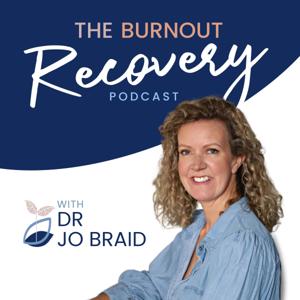
Welcome to The Burnout Recovery Podcast, where we're creating a global movement to keep healthcare professionals thriving in the careers they love.
I'm Dr Jo Braid, your host and The Burnout
... more
5
66 ratings


The podcast currently has 201 episodes available.
The most played episodes among Podcast App listeners.
Registrar to consultant, the job changes shape. Less doing, more being. So why do so many of us keep doing all of it anyway? A coaching story about chasing a patient's scan, a waiting room, and the guilt of asking someone else to help — and why that guilt is worth pushing through. THE SIGNAL 🩺 Patient sent back to the waiting room while the scan gets tracked down — laborious, repeated, patient after patient 🎯 "Top of registration": Sinsky & Bodenheimer on redistributing tasks to reduce burnout 🧠 The real cost of task-switching between admin and clinical thinking 😬 Why delegating can feel like guilt, not relief — and what that guilt is actually protecting THE RESET ✅ Sort your task list: "only I can do this" vs "this just always defaulted to me" ✅ Name the guilt out loud when you hand something off ✅ Run a Top of Registration Audit for one day ✅ Delegate one task this week, guilt and all The doing crowds out the being. Hand some of the doing back. 🔗 Get the words for the moment: No Is a Full Sentence, at drjobraid.com/store 📩 The Sunday Long Game, my weekly newsletter: drjobraid.com/subscribe 📱 Instagram/Facebook: @burnoutrecoverydr 💼 LinkedIn: Dr Jo Braid This episode is supported by MIGA www.miga.com.au See omnystudio.com/listener for privacy information.

If you're still contactable, are you actually on leave? A watched moment on a family holiday — one work email, and the mood shifted for everyone. This episode looks at why accessibility during leave costs more than we think, and what to actually put in place before you go. THE SIGNAL 📧 One out-of-hours email, and the holiday brain switches off 🧠 Allostatic load: your body doesn't always know "quick" from "urgent" 🔬 Sinsky et al, JAMA Network Open 2024: inbox coverage predicts real detachment 🏥 Stanford Medicine wellbeing data: 100% found an Out of Office best-practice doc helpful; 77% found a "life outside work" grand rounds moment helpful THE RESET ✅ Name one delegate before you leave, not as you're walking out the door ✅ Update your out-of-office with their contact, not just "I'll reply when I'm back" ✅ Separate work email/phone — a physical barrier beats willpower ✅ Bring the culture piece to your team, not just yourself Hope is not a boundary. A named delegate is. 🔗 Get the words for the moment: No Is a Full Sentence, at drjobraid.com/store 📩 The Sunday Long Game, my weekly newsletter: drjobraid.com/subscribe 📱 Instagram/Facebook: @burnoutrecoverydr 💼 LinkedIn: Dr Jo Braid This episode is supported by MIGA. www.miga.com.au See omnystudio.com/listener for privacy information.
In tennis, the ball is either in or out. No apology required. So why does saying no in real life feel so much harder? This episode kicks off a new 10-part series on boundaries — why they're so hard to hold, and how to actually do it, at work and at home. THE SIGNAL 🎾 In or out: clear, certain, no apology needed 🧠 Why ambiguity drains your prefrontal cortex 💭 The Zeigarnik effect: unset boundaries = active cognitive load 😬 The apology loop, and why it's a threat response, not politeness THE RESET ✅ Notice the apology loop before you try to change it ✅ The Line Audit: find where the rule is actually unclear ✅ One breath, one pause, before you answer a request ✅ Practise one boundary this week — no apology attached No is a full sentence. In or out. That's it. 🔗 Grab the boundary scripts you need in the moment: No Is a Full Sentence, at drjobraid.com/store 📩 Get The Sunday Long Game, my weekly newsletter: drjobraid.com/subscribe 📱 Instagram/Facebook: @burnoutrecoverydr 💼 LinkedIn: Dr Jo Braid This episode is supported by MIGA. www.miga.com.au See omnystudio.com/listener for privacy information.
Why does the same boundary tool work brilliantly for one person and fall flat for the next? In this episode Dr Jo Braid unpacks why recovery strategies aren't one-size-fits-all, and how to stop forcing yourself into someone else's system. Prompted by a recent workshop with a room of physios and occupational therapists, where one manager's search for focus time revealed just how differently people respond to the same list of tools: a closed door, a sign, headphones, do not disturb. All valid. None universal. Jo breaks down why strategy adherence depends on fit, not discipline, drawing on implementation science, occupational context across academic, clinical and business roles, and stress neuroscience from Dr Amy Arnsten's work at Yale. Then she runs the four pillars, Mindset, Support, Movement, Sleep, through a personality lens so you can find the version that's actually yours. This episode closes out The High Performer's Paradox series. You'll learn: – Why a recovery tool you've abandoned might be wrong for you, not a discipline failure – How academic, clinical and business burnout profiles differ – The neuroscience of why unfamiliar strategies are harder to sustain under stress – How to adapt one pillar this week to actually fit your wiring Connect with Jo: IG/FB: @burnoutrecoverydr LinkedIn: Dr Jo Braid Newsletter, The Sunday Long Game: https://drjobraid.com/subscribe New: 12 Boundary Scripts — real language for the moments you know you should say no. $47, or upgrade to the video masterclass for $97. drjobraid.com/store Produced by Propodcaststudio. Supported by MIGA. See omnystudio.com/listener for privacy information.
Your team can't help how they feel walking into an uncertain situation. But you have enormous influence over what you bring into the room. In this episode, Jo shares a real story from ward cover — a complex new patient, a team already bracing for the next few weeks, and the deliberate choice to show up supported rather than depleted. She unpacks why leader regulation is contagious (literally, neurologically), and gives you a practical way to lead through uncertainty without performing false confidence. You'll learn: Why emotional contagion means your mood shapes your team before you say a word The neuroscience of co-regulation and why a steady leader calms an uncertain room A four pillars approach to protecting your own wellbeing before a known hard stretch, not after A simple way to name uncertainty out loud that builds trust instead of eroding it Leaders need to be well to lead well. This episode shows you what that actually looks like. Resources mentioned: No Is a Full Sentence — 12 boundary scripts for clinicians, $47 (video masterclass upgrade $97): drjobraid.com/store The Sunday Long Game newsletter: drjobraid.com/subscribe Connect with Jo: Instagram/Facebook: @burnoutrecoverydr LinkedIn: Dr Jo Braid This episode is supported by MIGA. See omnystudio.com/listener for privacy information.
The podcast currently has 201 episodes available.

158 Listeners
625 Listeners
23 Listeners

18 Listeners

19,066 Listeners
69 Listeners