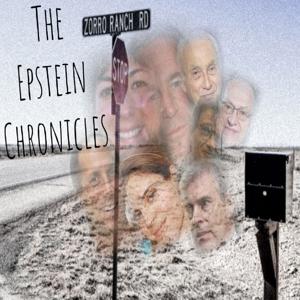
The Epstein Chronicles

The Epstein Chronicles

Download on the App Store
  • Favorites

    64

    Followers

  • Typical duration

    14 min

    per episode

Based on Podcast App listening data

The Epstein Chronicles episodes

  • Kathryn Ruemmler Resigns After Epstein Documents Surface New Details (2/13/26)
    Kathryn “Kathy” Ruemmler — the Chief Legal Officer and General Counsel at Goldman Sachs and a former White House counsel — announced her resignation effective June 30, 2026 after newly released Department of Justice documents made public details of her relationship with convicted sex offender Jeffrey Epstein. The disclosures included emails showing she exchanged friendly messages with Epstein over several years, accepted expensive gifts from him, and at times referred to him with personal nicknames, which sparked intense media and public backlash and raised questions about her judgment and ties to him. Facing mounting scrutiny over those connections, Ruemmler concluded the attention had become too distracting for the firm, and she chose to step down.


    Goldman Sachs CEO David Solomon said he respected her decision and praised her contributions, but the controversy surrounding her Epstein-related correspondence made her position untenable. The resignation followed weeks of reporting after the DOJ’s release of more than 3 million pages of Epstein-related records that flagged Ruemmler’s communications and gifts — a relationship she previously described as professional — and ultimately intensified internal and external pressure for her departure.


    to  contact me:

    [email protected]


    source:

    Jeffrey Epstein gave her a $9,350 handbag, but did Goldman Sachs' departing top lawyer violate any rules? | Reuters


    Become a supporter of this podcast: https://www.spreaker.com/podcast/the-epstein-chronicles--5003294/support.

    16 min
  • The Special Counsel Moment: Why the Epstein Files Demand Independence (2/13/26)
    The unfolding failure to fully release and comply with the law surrounding the Jeffrey Epstein files has exposed a deeper institutional problem inside the Department of Justice and the Administration. Congress passed a transparency measure through extraordinary means, it became law, and a clear deadline was set. That deadline was missed, and even after partial production, significant questions remain about withheld documents, redactions, and the true scope of what has not been released. When an agency effectively grades its own compliance in a matter involving powerful elites, political exposure, and decades of institutional embarrassment, public trust collapses. The issue is no longer simply about Epstein’s crimes, but about whether the government can credibly investigate and disclose information that may implicate influential figures or reveal internal failures.


    Because DOJ leadership operates within the same political structure potentially affected by the fallout, an independent special counsel is the only mechanism capable of restoring legitimacy. A special counsel would have the authority to audit compliance, compel production, investigate obstruction, examine redaction decisions, and pursue any broader criminal enterprise or facilitation network that remains unaddressed. This would shift the process from managed transparency to enforceable accountability, protecting both victims and the integrity of the investigation. Without structural independence, every delay, redaction, or narrowed scope will appear self-protective. Appointing a special counsel is not about politics; it is about ensuring that the law is enforced impartially and that no institution is allowed to police itself in a case of this magnitude.


    to contact me:


    [email protected]


    Become a supporter of this podcast: https://www.spreaker.com/podcast/the-epstein-chronicles--5003294/support.
    23 min
  • Mega Edition: Les Wexner's Best Friend Was Jeffrey Epstein...Until He Forgot Who He Was (2/13/26)
    Les Wexner’s relationship with Jeffrey Epstein was not casual, fleeting, or peripheral. It was foundational. Wexner, the billionaire founder of L Brands and longtime head of Victoria’s Secret, handed Epstein extraordinary financial authority in the late 1980s, granting him sweeping power of attorney over his fortune—an almost unheard-of concession for a man with no formal wealth management credentials and a murky background. Epstein was not just an adviser; he was embedded. He controlled Wexner’s money, managed properties, and reportedly inserted himself into the culture of Wexner’s corporate empire, particularly as it related to the Victoria’s Secret modeling world that conveniently overlapped with Epstein’s trafficking pipeline. The transfer of a Manhattan townhouse—one of the largest private residences in the city—to Epstein for a nominal sum remains one of the most glaring symbols of that patronage. For years, Wexner allowed Epstein to operate under his name and prestige, giving Epstein the legitimacy that opened doors in finance, academia, politics, and philanthropy. Epstein’s entire aura of elite credibility can be traced in large part to the halo effect of Wexner’s wealth and status.


    After Epstein’s 2006 arrest and especially following the 2019 federal charges, Wexner abruptly attempted to recast himself as a victim—claiming Epstein had betrayed him, stolen from him, and misled him. He publicly severed ties, issued statements of regret, and emphasized that Epstein had been removed from his financial role years earlier. But that narrative strains credibility. Wexner was not an unsophisticated investor duped by a charming con man; he was one of the most powerful retail magnates in America with access to the best legal and financial minds in the world. The idea that Epstein could operate for years under his authority without scrutiny reflects either willful blindness or a level of negligence that borders on complicity. Wexner’s late-stage distancing felt less like moral clarity and more like reputational triage once the full scope of Epstein’s crimes became undeniable. His patronage built Epstein’s empire. His disavowal came only after the empire collapsed in public view.


    to contact me:

    [email protected]

    Become a supporter of this podcast: https://www.spreaker.com/podcast/the-epstein-chronicles--5003294/support.
    43 min
  • Mega Edition: Les Wexner, The Epstein Accusations And The Built In Escape Hatch (2/13/26)
    Leslie Wexner, the billionaire founder of L Brands (which once included Victoria’s Secret), has publicly claimed that Jeffrey Epstein betrayed his trust by misappropriating vast sums of money and engaging in unauthorized financial dealings on his behalf. According to Wexner’s account, Epstein was given broad authority over parts of his financial and personal affairs in the 1990s and early 2000s, which he later said Epstein exploited for personal gain. Wexner has suggested that Epstein used that trust to essentially enrich himself—reportedly diverting assets and profiting from deals without clear documentation or approval. This purported betrayal, in Wexner’s telling, was one of the factors that ultimately ended Epstein’s professional relationship with him. Wexner has characterized the financial conduct as deceitful and exploitative, suggesting Epstein’s financial acumen was a smokescreen for self-enrichment at Wexner’s expense.

    However, a skeptical reading of this narrative raises several unresolved questions and inconsistencies. For one, some details about the scope and mechanics of the alleged financial misconduct remain vague or unverified in public records, leading observers to wonder whether the claims reflect specific documented thefts or a broader, more generalized sense of “being cheated.” Epstein today is often portrayed as having inflated his financial expertise; this has led some analysts to speculate that any discrepancies in Wexner’s accounts might stem less from theft and more from sloppy bookkeeping, mutual misunderstanding, or projection after the relationship soured. Additionally, because Wexner’s statements have sometimes appeared defensive or self-serving—emphasizing his own victimization—the possibility arises that the narrative simplifies or amplifies elements of the relationship to deflect scrutiny from his judgment in empowering Epstein in the first place. Until more concrete evidence is produced, the precise nature and extent of any alleged financial misconduct by Epstein toward Wexner remains a subject of debate rather than settled fact.


    to contact me:

    [email protected]

    Become a supporter of this podcast: https://www.spreaker.com/podcast/the-epstein-chronicles--5003294/support.

    38 min
  • Mega Edition: Bill Gates And The Public Relations Tour After The Epstein Revelations (2/12/26)
    Over the past several years, Bill Gates has embarked on a media tour of sorts, sitting down with outlets like PBS, CNN, and other major networks in an effort to explain why he maintained contact with Jeffrey Epstein even after Epstein’s 2008 conviction for soliciting sex from a minor. In interview after interview, Gates acknowledged that meeting with Epstein was a “mistake,” often repeating that he regretted the association and that there was no philanthropic outcome from their discussions. Yet the explanations consistently raised more questions than they answered. Gates initially suggested the meetings were centered around global health and charitable ambitions, but reporting later revealed multiple in-person visits to Epstein’s townhouse in New York, including at least one after his divorce announcement. The narrative that Epstein was simply a misguided gateway to philanthropic networking strained credibility, particularly given Epstein’s well-known status as a convicted sex offender by the time many of these meetings occurred.


    What ultimately undermined Gates’ attempts to contain the fallout was the shifting tone and evolving details across his public statements. In some interviews, he minimized the frequency of contact; in others, he admitted the meetings occurred several times. He framed the relationship as purely professional, yet he could not convincingly articulate what tangible benefit came from engaging Epstein at all. The repeated refrain of “it was a mistake” began to sound less like transparency and more like damage control. For critics, the issue was not simply that Gates met Epstein—it was that a billionaire with vast resources and global influence could not provide a clear, consistent account of why he chose to align, even briefly, with a man whose crimes were already public knowledge. The interviews, rather than resolving the controversy, reinforced a perception that the full story remains incomplete.


    to contact me:

    [email protected]

    Become a supporter of this podcast: https://www.spreaker.com/podcast/the-epstein-chronicles--5003294/support.

    1 hr 9 min
  • Jeffrey Epstein And His Depraved Behavior Even While Under State Supervision
    When Jeffrey Epstein was released from jail, he was forced to register as a sex offender. This should mean that he would have to check in before going overseas. As usual, the rules didn't apply to Jeffrey Epstein. One of the more concerning things we have heard about Epstein's time under the 'watchful' eye of the authorities, was that he was still traveling around, even abroad with young girls. He never reported these movements as he status as a predator demanded, according to the same reports. Why was he not arrested for violating the conditions of his release?


    To contact me:

    [email protected]


    source:

    https://www.theguardian.com/us-news/2019/sep/11/jeffrey-epstein-underage-girls-2018-investigation

    Become a supporter of this podcast: https://www.spreaker.com/podcast/the-epstein-chronicles--5003294/support.
    11 min
  • Ghislaine Maxwell And Jeffrey Epstein Didn't Work Alone
    Ghislaine Maxwell and Jeffrey Epstein did not operate in isolation—they relied on a network. Their crimes were made possible by a web of enablers, facilitators, fixers, and bystanders who either helped directly or looked the other way. From private pilots to personal assistants, house managers to recruiters, there were people in their orbit who scheduled, transported, housed, and in some cases, groomed young girls for abuse. These weren’t random helpers—they were staff, associates, and colleagues who made Epstein and Maxwell’s operation function like a well-oiled machine. Yet, most of them have never faced a single charge. Their silence, compliance, and active participation were just as essential as the actions of Epstein and Maxwell themselves.


    Equally complicit were the institutions that protected them. Wealth managers, elite schools, banks, law firms, and even prosecutors played roles—some by omission, others by design. Doors opened for Epstein and Maxwell that would have slammed shut on anyone without money and connections. Social circles embraced them long after rumors had become accusations, and long after accusations had become evidence. And still, they were given platforms, invitations, and cover. This wasn’t a case of two people fooling the world—it was a case of the world choosing not to care. The myth of the “lone predator” serves power well, but the truth is always more uncomfortable: predators thrive in systems that help them.


    to contact me:

    [email protected]


    source:

    https://www.dailymail.co.uk/news/article-10332169/Underage-orgies-possible-pregnancy-key-moments-Ghislaine-Maxwells-sensational-trial.html

    Become a supporter of this podcast: https://www.spreaker.com/podcast/the-epstein-chronicles--5003294/support.
    28 min
  • Jeffrey Epstein Was Abusing Girls In The USVI Until At Least 2019 According To Authorities
    Even after his 2008 conviction and infamous plea deal, Jeffrey Epstein remained undeterred—continuing to lure minors to his private island in the U.S. Virgin Islands. Lawsuits filed by the U.S. Virgin Islands Attorney General allege that Epstein trafficked girls as young as 12 to Little Saint James as recently as 2018, using deceptive promises of jobs, education, and money to ensnare them. This wasn’t a residual crime—it was active, methodical exploitation that spanned well into the era when he was a registered sex offender and should have been cut off entirely.


    What’s more infuriating is how systemic this was—despite being a known predator, Epstein’s abuses persisted up to the brink of his arrest. Surveillance data later revealed that nearly 200 mobile devices visited his so‑called “pedophile island” between 2016 and 2019, underscoring that his elite network, and the trafficking operation on his island, remained in full swing. These weren't the isolated misdeeds of an untouchable man—they were the consequences of unchecked power and corruption that allowed an incarcerated predator to keep committing atrocities until he was finally arrested.


    to contact me:

    [email protected]


    source:

    https://www.independent.co.uk/news/world/americas/jeffrey-epstein-suicide-victims-girls-virgin-islands-lawsuit-trafficking-a9285536.html

    Become a supporter of this podcast: https://www.spreaker.com/podcast/the-epstein-chronicles--5003294/support.

    13 min
  • Jeffrey Epstein...The King Of Slime
    Jeffrey Epstein earned the reputation as the proverbial king of slime because he thrived in the moral runoff of elite power, operating where money, secrecy, and exploitation overlapped. He attached himself to institutions, governments, financiers, academics, and royalty not through merit, but through usefulness, insinuation, and leverage. Epstein cultivated access by positioning himself as a fixer, a gatekeeper, and a discreet problem-solver for powerful people who wanted favors without fingerprints. He trafficked in secrets, introductions, and kompromat, making himself indispensable to those who feared exposure or craved influence. His wealth was opaque, his credentials dubious, yet doors opened for him everywhere because he knew how to flatter egos and exploit appetites. Epstein did not need legitimacy in the traditional sense; he borrowed it from the people and institutions willing to stand next to him. Like slime, he spread quietly, coating everything he touched while remaining difficult to fully grasp or contain. His power came not from respect, but from proximity to those who had everything to lose.


    What made Epstein especially corrosive was that he survived precisely because so many respectable systems absorbed and normalized him. Banks overlooked red flags, universities accepted donations, politicians took meetings, and law enforcement deferred when pressure was applied. Even after his criminality was publicly exposed, Epstein continued to move freely among elites, protected by legal deals, professional enablers, and a culture that treated him as an inconvenience rather than a threat. He embodied a kind of moral decay where exploitation was tolerated so long as it was profitable or politically inconvenient to confront. Epstein was not an aberration at the edge of society; he was a product of its worst incentives, thriving in spaces where accountability dissolved on contact with power. Like slime, he did not create the rot, but he fed on it and accelerated it. His story endures because it reveals how easily entire systems will debase themselves to protect the powerful, even when the cost is measured in human lives.


    to contact me:


    [email protected]


    Become a supporter of this podcast: https://www.spreaker.com/podcast/the-epstein-chronicles--5003294/support.
    22 min
  • Epstein Files Unsealed: Paul Cassell's Deposition In Cassell/Edwards V. Dershowitz (Part 9) (2/12/26)
    In the Broward County defamation litigation CACE 15-000072, the deposition at issue is sworn testimony from Paul Cassell, one of the attorneys representing Epstein survivors and a former federal judge. Cassell’s deposition focuses on his role in challenging the 2008 federal Non-Prosecution Agreement granted to Jeffrey Epstein, and on statements he made publicly about Alan Dershowitz that later became the basis for Dershowitz’s defamation claims. Cassell explains the factual foundation for his remarks, emphasizing that they were rooted in court filings, sworn victim testimony, investigative reporting, and contemporaneous evidence. He details how survivors’ allegations against Dershowitz emerged, how they were evaluated by legal teams, and why he believed it was appropriate and accurate to reference them in public advocacy surrounding Epstein’s secret plea deal. Cassell consistently frames his conduct as part of his duty to represent victims and expose prosecutorial misconduct, not as a personal attack.


    The deposition also addresses Dershowitz’s accusation that Cassell acted recklessly or with malice, which Cassell firmly rejects. He testifies that he never fabricated claims, never coached witnesses to lie, and never acted outside ethical or professional boundaries. Cassell underscores that his statements reflected allegations already made under oath by victims and contained in legal records, and that suppressing discussion of those allegations would further harm survivors. Throughout the testimony, Cassell situates the dispute within the larger Epstein cover-up, arguing that the real issue is not reputational discomfort among the powerful but the systemic failure to protect exploited minors. The deposition ultimately functions as a defense of victim-centered advocacy and transparency, directly countering Dershowitz’s narrative that survivor allegations were invented, coerced, or irresponsibly amplified.


    to contact me:

    EFTA00594390.pdf

    Become a supporter of this podcast: https://www.spreaker.com/podcast/the-epstein-chronicles--5003294/support.

    14 min

About The Epstein Chronicles

From the publisher's feed

Jeffrey Epstein was a multi millionaire who had political and business ties to some of the most rich and powerful people in the world. From businessmen to politicians at the highest levels, Epstein…

Best of The Epstein Chronicles

Ranked by our users in the last 21 days

More shows like The Epstein Chronicles

Crime Talk with Scott Reisch by R. Scott Reisch

Crime Talk with Scott Reisch

507 Listeners

The Bulwark Daily by The Bulwark

The Bulwark Daily

12,552 Listeners

BROKEN: Jeffrey Epstein by Hyperobject Industries / Sony Music Entertainment

BROKEN: Jeffrey Epstein

3,070 Listeners

EPSTEIN: Devil in the Darkness by a360media

EPSTEIN: Devil in the Darkness

1,218 Listeners

The Mysterious Mr. Epstein by Audible

The Mysterious Mr. Epstein

7,584 Listeners

The Daily Beast Podcast by The Daily Beast, Joanna Coles

The Daily Beast Podcast

8,317 Listeners

The MeidasTouch Podcast by MeidasTouch Network

The MeidasTouch Podcast

50,430 Listeners

The Lincoln Project by The Lincoln Project

The Lincoln Project

9,194 Listeners

Law&Crime Sidebar by Law&Crime

Law&Crime Sidebar

491 Listeners

When You Know You Know by Podcast WABCRadio

When You Know You Know

1,876 Listeners

Inside Trump's Head by The Daily Beast, Michael Wolff and Joanna Coles

Inside Trump's Head

647 Listeners

The Mary Trump Podcast by Mary Trump Media

The Mary Trump Podcast

791 Listeners

The Jim Acosta Show by Jim Acosta

The Jim Acosta Show

1,003 Listeners

Jeffrey Epstein:  The Coverup Chronicles by Bobby Capucci

Jeffrey Epstein: The Coverup Chronicles

13 Listeners

The Tara Palmeri Show by Tara Palmeri

The Tara Palmeri Show

256 Listeners