
Sign up to save your podcasts
Or

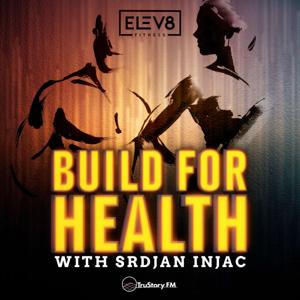

A few weeks ago, ELEV8's Srdjan Injac went on a bike ride. He came home with an oblique fracture of his radius, a Saturday-night ER trip, and a Tuesday surgery that left a plate and eight screws in his forearm. This week, the strength coach who teaches people not to get hurt sits down to explain how he got hurt — and what he's doing about it.
Then we get into the comeback. Srdjan walked out of surgery with a six-week timeline for the bone to heal and three months before he could lift heavy. He's quietly trying to cut that to two, and he's running a one-man clinical experiment on his own arm to do it: red light therapy two to three times a day, weekly IV cocktails of B vitamins, vitamin C, magnesium, amino acids, and NAD, a hyperbaric oxygen chamber that nearly broke him at sixty feet of simulated depth, an electro-muscle-stimulation suit, and a strange-but-real protocol called the cross-education effect — training one arm to keep both strong. Pete walks Srdjan through what each of these actually does, what the evidence says, and what it feels like from the inside. (Spoiler: the chamber is a lot.)
But here's the part that matters whether or not you've ever broken a bone. Srdjan is recovering ahead of schedule, and the doctors and PTs are crediting muscle memory — the plate and screws stayed put, the bones snapped back into place, and the rehab is moving fast. Not because of any single therapy. Because there was something to come back to. This is the case for muscle as insurance made visible. If you've been waiting for a sign that strength training is worth the effort, watching your strength coach come back from a plated forearm surgery ahead of schedule is probably it.
Links & Notes
 View all episodes
 By TruStory FM
5
22 ratings
A few weeks ago, ELEV8's Srdjan Injac went on a bike ride. He came home with an oblique fracture of his radius, a Saturday-night ER trip, and a Tuesday surgery that left a plate and eight screws in his forearm. This week, the strength coach who teaches people not to get hurt sits down to explain how he got hurt — and what he's doing about it.
Then we get into the comeback. Srdjan walked out of surgery with a six-week timeline for the bone to heal and three months before he could lift heavy. He's quietly trying to cut that to two, and he's running a one-man clinical experiment on his own arm to do it: red light therapy two to three times a day, weekly IV cocktails of B vitamins, vitamin C, magnesium, amino acids, and NAD, a hyperbaric oxygen chamber that nearly broke him at sixty feet of simulated depth, an electro-muscle-stimulation suit, and a strange-but-real protocol called the cross-education effect — training one arm to keep both strong. Pete walks Srdjan through what each of these actually does, what the evidence says, and what it feels like from the inside. (Spoiler: the chamber is a lot.)
But here's the part that matters whether or not you've ever broken a bone. Srdjan is recovering ahead of schedule, and the doctors and PTs are crediting muscle memory — the plate and screws stayed put, the bones snapped back into place, and the rehab is moving fast. Not because of any single therapy. Because there was something to come back to. This is the case for muscle as insurance made visible. If you've been waiting for a sign that strength training is worth the effort, watching your strength coach come back from a plated forearm surgery ahead of schedule is probably it.
Links & Notes
445 Listeners
8 Listeners
21 Listeners

37 Listeners
38 Listeners

29 Listeners
12 Listeners
104 Listeners
4 Listeners
2 Listeners
8 Listeners
0 Listeners

69 Listeners

6 Listeners

0 Listeners

5 Listeners

8 Listeners

0 Listeners
0 Listeners