
Sign up to save your podcasts
Or



Based on Podcast App listening data
His people have turned against him in the streets but Belarus's dictator Alexander Lukashenko is still in power and his security forces are still following his orders. So where do the anti-Lukashenko activists go from here? Stephen Sackur speaks to Natalia Kaliada, one of the founders of the Belarus Free Theatre, an artist dissident in exile. Will Belarus's summer rebellion be blown away with the autumn leaves?
Zeinab Badawi speaks to the American politician Katie Hill. She was a star of the US mid-term elections in 2018, but barely a year after winning a Congressional seat, she resigned, after reports of an inappropriate relationship with a staff member and after nude photographs of her were published. What does her case tell us about American politics in the MeToo era?
Increasing tensions between the US and China have plunged relations to the lowest level for decades. This comes at a time when the world is facing its worst recession in living memory due to the coronavirus. Could this lead to a reshaping of the global order? Zeinab Badawi speaks to former Singaporean diplomat Kishore Mahbubani, who believes that Covid-19 has fundamentally weakened the west. Is he right that this is now Asia's century?
It is exactly a year since a historic power-sharing agreement was signed between the military and civilians in Sudan, after the fall of President Omar al-Bashir. In an exclusive interview, Zeinab Badawi speaks to the civilian Prime Minister Abdalla Hamdok, who heads a transitional government charged with steering Sudan to democratic elections in 2022. Has the euphoria that followed last year's revolution given way to harsh realities and unfulfilled expectations?
China goes to extraordinary lengths to monitor and mould the lives of its citizens. The most extreme example can be seen in Xinjiang, home to more than 10 million muslim Uighur people; but the principle of stability through authoritarian control applies across the country. Stephen Sackur speaks to Wu'er Kaixi, a Chinese political dissident in exile since the Tiananmen uprising and himself a Uighur. Has China found a way of successfully suppressing dissent?
One of the worlds most strategically sensitive conflict zones heated up dramatically last month when Armenian and Azerbaijani forces engaged in fighting which cost 17 lives. It is the latest twist in the long struggle over the disputed territory of Nagorno Karabakh and it prompted warnings from Moscow and Washington. Stephen Sackur speaks to Armenia’s Prime Minister Nikol Pashinyan. He swept to power promising reform, so how come Armenia seems preoccupied with fighting old battles?
After the unimaginable horror of the mega blast which devastated Beirut the people of Lebanon are now forced to live with a zombie government - dead in all but name, not yet replaced. Stephen Sackur speaks to Raoul Nehme, still Lebanon's Minister of Economy and Trade until a new government can be formed. The outgoing Prime Minister blamed the catastrophic situation on deep rooted corruption. Is Lebanon a country beyond rescue?
The Covid-19 pandemic has inflicted huge economic damage, but it has also offered the natural world a little bit of respite – room to breathe. What will come next? Will it be a return to the old ways of resource exploitation and consumption? HARDtalk’s Stephen Sackur speaks to Chris Packham, one of the UK’s best-known naturalists and environmental campaigners. Are we humans capable of fundamentally changing our priorities?
Photo: Chris Packham Credit: BBC
Eighteen months ago, Venezuela seemed to be on the brink of political upheaval. The leader of the National Assembly declared himself president, and 50 countries offered him official recognition. But the ruling party has not been toppled. Nicolás Maduro is still in the presidential palace, overseeing a country deep in economic and healthcare crisis. HARDtalk’s Stephen Sackur speaks to Vanessa Neumann, London envoy of the would-be president Juan Guaidó. Did the Venezuelan opposition blow their chance?
Amid the talk of spikes and second waves one thing is clear – people predicting an early end to the coronavirus pandemic are indulging in wishful thinking. Can we find a way of living with Covid-19 that respects the science while mitigating the damage being done to our economic and social lives? Stephen Sackur speaks to Sir Jeremy Farrar, director of the Wellcome Trust and a key scientific adviser to the UK government. How dangerous is the moment we’re in?
(Photo: Sir Jeremy Farrar, director of the Wellcome Trust)
From the publisher's feed
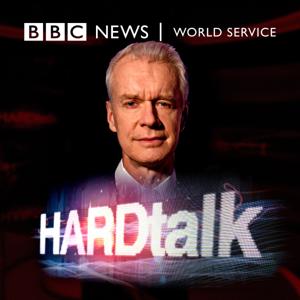
Conversations with people shaping our world, from all around the globe. Listen to The Interview for the best conversations from the BBC, the world's most trusted international news provider.
Ranked by our users in the last 21 days

7,601 Listeners

4,111 Listeners

371 Listeners

519 Listeners

1,046 Listeners

284 Listeners

1,793 Listeners

959 Listeners

724 Listeners

53 Listeners

838 Listeners

63 Listeners

974 Listeners
0 Listeners

0 Listeners
0 Listeners
6 Listeners

13 Listeners
4 Listeners

1 Listeners

37 Listeners
0 Listeners

143 Listeners

382 Listeners

2 Listeners