
Sign up to save your podcasts
Or



Isaac Hand talks to Jonathan Conlin about his current research into inter-war Turkish urbanism, particularly the contested role of the muhtar.
Isaac is Core Curriculum Post-Doctoral Lecturer at NYU.
Originally established in 1829, the office of muhtar together with its associated council of elders was originally intended to shoulder burdens of urban administration previously carried by the Janissaries. The muhtarlık performed a wide variety of functions, from monitoring population shifts and infectious disease to acting as matchmaker. Unfortunately there was no equivalent among those allegedly “modern” states which Late Ottoman and Republican-era regimes sought to emulate, which led to the office being seen as “backward”, as an obstacle to urban planning and improvement. In this conversation, recorded on 7 February 2023, Isaac explains how he came to tackle this topic for his recently-defended doctoral thesis. He considers the Young Turks’ 1913 attempt to abolish the muhtarlık, an episode which foreshadows Republican-era municipal reforms, which saw the office abolished in 1933, only to be reinstated in 1944 – itself the focus of Isaac’s recent contribution to the Journal of Urban History. Isaac discusses how he used newspapers to recover the story of an office which has left little by way of archival deposits, and notes some signficant ways in which his findings, based on study of Izmir, Istanbul and Ankara, differed from those of Zeynep Kezer’s 2015 book on municipalities in eastern Anatolia.
Podcasts are published by TLP for the purpose of encouraging informed debate on the legacies of the events surrounding the Lausanne Conference. The views expressed by participants do not necessarily represent the views or opinions of TLP, its partners, convenors or members.
Mari Firkatian tells Ozan Ozavci how she discovered the lost archives of the Stancioff family, uncovering the secrets of Nadejda Stancioff, the only woman diplomat at Lausanne.
Mari is Professor of History at the University of Hartford.
Sometimes great stories from the past seem to find their historian, rather than the other way round. That was certainly the case for Mari Firkatian: a play date arranged for her children brought Firkatian completely by chance into contact with descendants of the Stancioff family, cosmopolitans in the service of the Bulgarian crown, specifically the Bulgarian Foreign Ministry. In a conversation recorded on 16 January 2023 Mari shares her insights into the early life and character of Nadejda Stancioff, the only female diplomat at Lausanne and, indeed, one of the first woman diplomats in history. Whether acting as a quick-witted simultaneous translator, toning down Stambolyski’s language to Curzon, or dining tête-à-tête with Ismet, Stancioff proved a highly effective representative for Bulgaria – a country she lost touch with shortly after Lausanne, when she found a new life as Lady Muir, chatelaine of a vast Scottish estate.
Podcasts are published by TLP for the purpose of encouraging informed debate on the legacies of the events surrounding the Lausanne Conference. The views expressed by participants do not necessarily represent the views or opinions of TLP, its partners, convenors or members.
Smyrna/İzmir was in ruins in September 1922. Philip Mansel explains to Ozan Ozavci how that unique entrepot changed from a Greek-cosmopolitan to a Turkish port town, and the devastating consequences of the Great Fire.
Philip is affiliated with the Institute of Historical Research in London and the Levantine Heritage Foundation.
Once known as ‘the Pearl of Levant’, Smyrna/İzmir was in ruins in September 1922. An eyewitness of the town Hortence Woods wrote in her diaries that the town centre was “a most melancholy sight, sad as sad could be.” Recorded on 7 December 2022, in this podcast episode the author of the widely acclaimed Levant: Splendour and Catastrophe on the Mediterranean (2010), Philip Mansel tells Ozan Ozavci how that unique entrepot changed from a Greek-cosmopolitan to a Turkish port town within a space of a few years. The two discuss the repercussions of the Balkan wars, the Great War of 1914-1918 and the Turkish War of Independence in 1919-22.
What happened to the town after the landing of the Greek army in May 1919 and then the return of the Turkish forces? How did the Great Fire of September 1922 begin and ruin the Greek and Armenian quarters? And what did the Turkish authorities, including the general in command of the city Gazi Mustafa Kemal, do at the time of the disaster?
Podcasts are published by TLP for the purpose of encouraging informed debate on the legacies of the events surrounding the Lausanne Conference. The views expressed by participants do not necessarily represent the views or opinions of TLP, its partners, convenors or members.
MAIN IMAGE: OVID KURTOVICH, THE GREAT FIRE OF SMYRNA (1922), OIL ON CANVAS. BENAKI MUSEUM 38238.
Howard Eissenstat shares with Ozan Ozavci his concerns around the language of post-post-Kemalism, before a lively discussion on Turgut Özal, the 1990s, and whether this might be Recep Tayyib Erdoğan’s last year in power.
Howard is an Associate Professor of Middle East history at St. Lawrence University.
Recorded on 21 November 2022, in this podcast episode Howard Eissenstat and Ozan Ozavci talk post-post-Kemalism and the last three decades of Turkish politics: the 1980s, when Turgut Özal emerged as a colourful if corrupt political leader; the 1990s, when Howard experienced at first hand the boom in Turkish civil society (and political Islam); and the 2000s, when Recep Tayyip Erdoğan came into office, What might Turkey look like today if the Annan Plan had been implemented, if Turkey’s drive to join the EU had not been frustrated? Was Turkey’s authoritarian turn inevitable?
According to Howard, President Erdoğan harboured authoritarian instincts from the beginning, even if he didn’t always pursue authoritarian goals during his time in office, The podcast concludes by considering whether this might be Erdoğan’s last year in power. Howard shares with us his critical observations on the opposition’s election strategy.
Podcasts are published by TLP for the purpose of encouraging informed debate on the legacies of the events surrounding the Lausanne Conference. The views expressed by participants do not necessarily represent the views or opinions of TLP, its partners, convenors or members.
MAIN IMAGE: ‘TURGUT ÖZAL AT A GAME CENTRE’, COURTESY OF HOWARD EISSENSTAT.
Martin van Bruinessen explains to Ozan Ozavci how Kurdish political movements in Turkey took hold from the 1960s onward, evolving from far-leftist activism and violence to demands for inclusive democracy.
Martin is Emeritus Professor of the Comparative Study of Contemporary Muslim Societies at Utrecht University.
With the 1960 coup and the relatively liberal constitution of 1961, Kurdish political activism gained new momentum in Turkey. Kurdish leftist deputies took seats in the parliament from the newly formed Turkish Workers’ Party. Diverse factions of the far-left in Turkey, both Kurds and Turks sympathized with the situation of the Kurdish region, which they considered to be colonised by the ruling Turkish class. According to Martin van Bruinessen, post-1960 politics represented much more than a revival of Kurdish political movements.
Recorded on 30 September 2022, in the second part of this episode Martin tells us about the evolution of Kurdish activism after the 1960s : from the tribes and student activists to the Kurdistan Workers’ Party’s (PKK) links to Syrian and Turkish intelligence, its violent fight, as well as its present-day relationship with the People’s Democratic Party (HDP). The episode concludes with a note on the potential role of the Kurds in the 2023 elections and the future of Turkey.
Podcasts are published by TLP for the purpose of encouraging informed debate on the legacies of the events surrounding the Lausanne Conference. The views expressed by participants do not necessarily represent the views or opinions of TLP, its partners, convenors or members.
MAIN IMAGE: ‘BATMAN, THE TOWN, IN 1976’, COURTESY OF MARTIN VAN BRUINESSEN.
Martin van Bruinessen explains to Ozan Ozavci how travels around the Middle East in the 1970s led him to devote his career to tracing the hopes and disappointments faced by the Kurds.
Martin is Emeritus Professor of the Comparative Study of Contemporary Muslim Societies at Utrecht University.
After the 1971 military coup Turkey became a doubly intriguing place for many politically curious young people in Europe. Martin van Bruinessen was one of them. He travelled widely in the Middle East in the 1970s, met local intellectuals, and learned Turkish, Persian and Kurdish at teahouses, before writing his doctoral thesis on the Kurds of Turkey, which is now one of the seminal books in the field: Agha, Shaikh, and State: The Social and Political Structures of Kurdistan.
Recorded on 30 September 2022, in this episode Ozan talks to Martin about his story as a scholar specialising in the Kurds and their early twentieth-century expectations and disappointments. The second part of the podcast, focusing on developments since 1960 will be published next week.
Podcasts are published by TLP for the purpose of encouraging informed debate on the legacies of the events surrounding the Lausanne Conference. The views expressed by participants do not necessarily represent the views or opinions of TLP, its partners, convenors or members.
MAIN IMAGE: ‘DOLMUŞ’ (MINIBUS), COURTESY OF MARTIN VAN BRUINESSEN.
Julia Secklehner talks to Jamie Walters about her plans to bring the irrepressible American reporter Clare Sheridan back to life, and back to the streets of Lausanne.
Jamie is a writer currently on the MFA programme at Virginia Commonwealth University.
The only woman journalist at Lausanne, Sheridan’s reputation preceded her to the Swiss resort, partly thanks to her personal connections to the likes of Winston Churchill and Lenin, partly thanks to the skill with which she immortalized her subjects, in both word and in the portrait busts she produced. While tight deadlines and telegrams necessarily constrained her to some extent in the reports she sent back to her employers, Sheridan’s wit and aptitude for securing the apparently impossible interview made her the envy of her peers – none more so, perhaps, than Ernest Hemingway.
At Lausanne each nationality gave out its own official story from its individual national point of view. One could glean at least five different stories on the same session. It reminded me of an artist class all painting the same subject, and no two artists seeing it the same way!
Happily Sheridan produced two books alongside her more ephemeral reports, East and West (1923) and The Naked Truth (1928) allowing readers to study her insights into the characters of Mussolini, Curzon and other leading political and diplomatic figures. In this podcast recorded on the 22 September 2022 TLP convenor Julia Secklehner discusses Sheridan with Jamie Walters, who is writing a series of scripts in which Sheridan’s older and younger selves maintain a dialogue with history and each other. This work in progress will hopefully be completed in time for 2023, and contribute to a planned audio trail to Lausanne.
Podcasts are published by TLP for the purpose of encouraging informed debate on the legacies of the events surrounding the Lausanne Conference. The views expressed by participants do not necessarily represent the views or opinions of TLP, its partners, convenors or members.
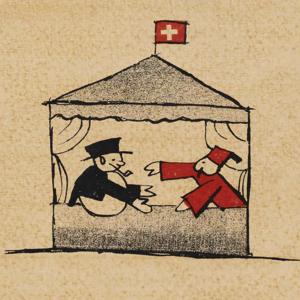
MAIN IMAGE: SHERIDAN (CENTRE LEFT, DANCING WITH GEORGY CHICHERIN, FIRING GUN). UNE SOIRÉE CHEZ TCHITCHERIN FROM ALOÏS DERSO AND EMERY KELÈN, GUIGNOL À LAUSANNE (1923). OTHER IMAGES: LE PETIT ÉCHO DE LA MODE, 19 JAN. 1972. PORTRAIT PHOTOGRAPH BY BERTRAM PARK, FRONTIS. TO RUSSIAN PORTRAITS (1921).
Jonathan Conlin talks agency, emplotment and subjectivity with Laura Almagor and Haakon Ikonomou, editors of a new volume addressing global biography.
Laura is Lecturer in Twentieth-Century European History at the University of Sheffield. Haakon is Associate Professor at The Saxo Institute, University of Copenhagen.
For too long global history has seemed oddly impersonal: where present, individuals have functioned as little more than placeholders illustrating global trends. This despite the obvious ways in which all of us experience apparent historical “ruptures” and emplot our own life narratives across and through them. In their recent volume, co-edited with Gunvor Simonsen, Laura and Haakon present a set of case studies, including several figures drawn from the (Post) Ottoman world: the barrister-turned-diplomat Thanassis Aghnides, Albanian leader Fan Noli and Young Turk Finance Minister Cavid Bey. In this podcast, recorded on 23 September 2022 they reflect on the status of biography as scholarly “output” and the ways in which concepts of the “exceptional normal” and Ricoeurian “emplotment” shaped their approach.
Podcasts are published by TLP for the purpose of encouraging informed debate on the legacies of the events surrounding the Lausanne Conference. The views expressed by participants do not necessarily represent the views or opinions of TLP, its partners, convenors or members.
MAIN IMAGE: SIGNATURES FROM A PETITION OF WOOL EXPORTERS (BAGHDAD) TO THE US AMBASSADOR IN ISTANBUL, 21 MAY 1891. NARA RG84 TURKEY VOL. 109 (1889-94). BOOK COVER ART: Amanda Shingirai Mushate, Inkanyezi, 2020.
In the second half of their conversation Djene Rhys Bajalan and Ozan Ozavci consider the Kurds’ relationship with Russia and Britain, the Kurdish perception of Lausanne, and the 1925 Sheikh Said rebellion.
Djene is Associate Professor of Middle Eastern History at Missouri State University
For Djene Rhys Bajalan, the Turkish nationalist belief that the Kurds were a “puppet” of Russian and British imperial ambitions and intrigues is an over-exaggeration. Djene argues that what we see is a convergence of interests. He draws our attention to Kurdish agency and ambitions, and shows how a logic of “the enemy of my enemy is my friend” loomed large in their calculations. Djene and Ozan open this second part with a discussion on Kurdish relations with Russia and Britain, before moving on to address the Kurdish perception of Lausanne and the Sheikh Said rebellion of 1925, which, Djene argues, was not simply reactionary but also had a modernist element.
Podcasts are published by TLP for the purpose of encouraging informed debate on the legacies of the events surrounding the Lausanne Conference. The views expressed by participants do not necessarily represent the views or opinions of TLP, its partners, convenors or members.
MAIN IMAGE: Sheikh Said by Rebwar K. Tahir.
Djene Rhys Bajalan explains to Ozan Ozavci why we need to challenge traditional accounts of Kurdish political (in)activity around the Paris Peace Conference.
Djene is Associate Professor of Middle Eastern History at Missouri State University
For Djene Rhys Bajalan, the mainstream narrative about Kurdish political activism in the 1920s needs to be revised. The Kurdish pathway to statehood was blocked, we are told, mainly because they didn’t unite or lobby sufficiently in the aftermath of World War I. Djene argues that the Kurds actually lobbied “pretty effectively”: they secured a clause in the Treaty of Sèvres which delineated the path to an independent Kurdistan after the disintegration of the Ottoman Empire.
In the first part of this episode, Djene and Ozan Ozavci discuss the leading Kurdish political organisations and figures such as Abdürrezzak Bedirhan, Mehmed Şerif Paşa and Said Nursi, their agendas and reception of Sèvres.
Podcasts are published by TLP for the purpose of encouraging informed debate on the legacies of the events surrounding the Lausanne Conference. The views expressed by participants do not necessarily represent the views or opinions of TLP, its partners, convenors or members.
MAIN IMAGE: Mehmed Şerif Paşa, SOURCE: SALT RESEARCH ARCHIVE
From the publisher's feed