
Sign up to save your podcasts
Or



Jamie Walters and David Roessel introduce Jonathan Conlin to the American journalist Lincoln Steffens, whose Lausanne reports they dramatized, with the help of Eva Leaverton and Roniña Borja.
Jamie is an MFA student at Virginia Commonwealth University. David, Jamie, Eva and Roniña are all associates of the Text Center at Stockton University.
Although less familiar today than his colleague Ernest Hemingway, in 1922 Lincoln Steffens was by far the best known American journalist covering the Lausanne Conference. This podcast includes clips from a performance project developed by Jamie Walters, based closely on Steffens letters. It complements Walters’ previous project centred on another journalist, Clare Sheridan, that featured in a previous TLP podcast, and which was also performed at TLP’s Thessaloniki conference in November 2023. In between clips Jamie is joined by David Roessel, Deputy Director of the Interdisciplinary Center for Hellenic Studies at Stockton University. Recorded on 18 December 2023, our discussion considered Steffens’ troubled relationship with democracy, and his admiration for strong leaders such as Lenin, Mussolini and Steffens’ good friend Theodore Roosevelt. As far as Steffens was concerned the people “wanted to follow, not to lead, to be governed, not to govern themselves.”
LINCOLN STEFFENS (LEFT) AND ERNEST HEMINGWAY AT LAUSANNE, 1922.
Steffens’ view of diplomacy was shaped by his experience at McClure’s Magazine, where muckrakers like Ida Tarbell had been busy exposing the Rockefellers and other wirepullers – powerful men of business who had politicians on a string. For Steffens and his colleague, former crime reporter Sam Spewack, who spent most of his time at Lausanne playing the violin in his hotel room, it was oil men like Rockefeller who controlled the diplomats gathered at Lausanne. When the oil men decided it was time to make peace, so their thinking ran, world leaders would make peace. If the oil men were not ready, there was nothing to be done.
This conference is clear enough to me. I see through it. I don’t care for the details, the daily news. So long as I have the key to it, have seen it at work, I can visualize and correct the newspaper reports. I am free to leave, therefore. And I may still do that or stay in Paris.
Podcasts are published by TLP for the purpose of encouraging informed debate on the legacies of the events surrounding the Lausanne Conference. The views expressed by participants do not necessarily represent the views or opinions of TLP, its partners, convenors or members.
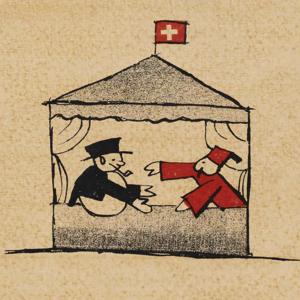
MAIN IMAGE: DETAIL OF CERCLE DE LA PRESSE, FROM ALOÏS DERSO AND EMERY KELÈN, GUIGNOL À LAUSANNE, 1923.
Sibel Karakoc and Jonathan Conlin explore how the American tobacco industry responded to the existential threat posed by Lausanne and the population exchange.
Sibel is Lecturer in History at the University of Binghamton SUNY.
By 1919 the American tobacco industry was producing 50 billion cigarettes a year. 20% of the average cigarette consisted of tobacco grown in Anatolia, prized for its aromatic qualities, that compensated for the bland taste of domestic American tobacco. Whereas the role played at Lausanne by American lobbyists acting on behalf of missionaries, Armenian-Americans and big oil is relatively well known, the American tobacco interest’s role has been overlooked. This is surprising, given that tobacco represented not only a source of profit for American private enterprise, but a major source of revenue (through taxation) for the US government.
In 1919 American tobacco companies called on the US Navy to defend their interests in an unstable and politically-divided Anatolia: the Bureau of Navy Intelligence reported that “one destroyer is kept continually at Samsun, Turkey, to look after the American tobacco interests at that port. American tobacco companies represented there depend practically entirely on the moral effect of having a man-of-war in port to have their tobacco released for shipment.” The importance of this cash crop to the new Turkish Republic was even more evident. When it came to the Lausanne population exchange, therefore, policies prioritized the resettlement of incoming tobacco cultivators to tobacco-producing areas for the express purpose of fostering the tobacco trade.
Since the arrival in Anatolia of immigrants from Kavala, Seres, and Macedonia, a new era of tobacco culture is anticipated, considering the fact that these people are now settling down in the Samsun-Bafra region, where the tobacco is considered the best in Turkey.
In this conversation, recorded on 29 November 2023, Sibel Karagoc shares some of the discoveries she made over the course of her doctoral research, which forms the basis of a forthcoming book. Sibel and Jon discuss the importance of Ottoman/Turkish tobacco for the American economy and the relative influence of the American tobacco lobby, before reflecting on how Sibel’s research challenges familiar accounts of exchangee settlement in Turkey in the early 1920s, suggesting that the picture was less chaotic than we thought.
Podcasts are published by TLP for the purpose of encouraging informed debate on the legacies of the events surrounding the Lausanne Conference. The views expressed by participants do not necessarily represent the views or opinions of TLP, its partners, convenors or members.
MAIN IMAGE: DETAIL OF ADVERTISEMENT FOR MURAD CIGARETTES.
Paolo Girardelli and Enno Maessen discuss one of the most iconic diplomatic landmarks of Istanbul, the Palazzo Venezia.
Paolo is Professor of Art and Architectural History at Boğaziçi University.
Today the Palazzo Venezia serves as the residence of the Italian ambassador. The building and its site represent a rich palimpsest, on which centuries of diplomatic relations between a variety of Mediterranean states have left their mark: not just the Venetian republic, but also the Ottoman and Austro-Hungarian Empires, Italy and Turkey. After two and half centuries of existence as a substantially Ottoman, wooden house, a remarkable Bailo to Constantinople, Andrea Memmo (1729-1793), decided to transform this landmark into a Palladian villa. While construction followed a local vernacular based on timber frames, Memmo also drew on Venetian expertise in maritime woodcraft.
ENNO AND PAOLO IN THE PALAZZO VENEZIA
In this conversation, recorded on 20 October 2023, Paolo Girardelli guides us along a rich historical seam, following the palazzo’s construction, renovation, destruction and rebirth as the vehicle for invented traditions of Italianità, as architectural pomp and geopolitical power gradually began to intersect in late Ottoman Constantinople.
VIEW OF AYAZ PASA AND THE WOODEN RESIDENCE CONSTRUCTED BY ITALIAN AMBASSADOR ALBERTO BLANC AROUND 1890 (LATER PARK OTEL), INSPIRED BY THE OLD, LATE EIGHTEENTH-CENTURY PALAZZO VENEZIA.
After 1815 the building became a Habsburg embassy, and when the Italian state reacquired the building in 1919 it encountered a building essentially Austrian. To stress a continuity between the Italian nation-state and the Venetian empire, relief sculptures featuring the Lion of St. Mark as well as portraits of former bailos were introduced to the building, once again known as the Palazzo Venezia. Paolo weaves the story of the Palazzo’s evolution with that of the development of Constantinople and especially Pera, the bulwark of culture, economy and diplomacy in the late Ottoman Empire, and shifting geopolitical configurations in Europe and the Mediterranean region.
DETAIL OF PALAZZO VENEZIA FROM JACQUES PERVITCH’S INSURANCE MAP.
Podcasts are published by TLP for the purpose of encouraging informed debate on the legacies of the events surrounding the Lausanne Conference. The views expressed by participants do not necessarily represent the views or opinions of TLP, its partners, convenors or members.
MAIN IMAGE: VENETIAN LION AT PALAZZO VENEZIA, ACQUIRED BY CARLO SFORZA FROM VENETIAN ARCHAEOLOGIST LUIGI CONTON.
Kent Schull and Jonathan Conlin talk textbooks: how can they do more to acknowledge forced migration as a recurring pattern in the history of the modern Middle East and the wider world?
Kent is Associate Professor of Ottoman and Modern Middle East History at Binghamton University SUNY.
Viewed in the UK as dangerously retardataire, survey courses remain mainstays of history teaching at American universities. The textbooks that serve this market, such as the late William L. Cleveland’s A History of the Modern Middle East (1994) represent the capstone of distinguished scholarly careers, and have passed through multiple editions. For Kent Schull these tomes perform a useful service, but fail to acknowledge how forced migrations and the “unmixing of populations” form a counterpoint to the themes of “transformation” and nation-building which structure their metanarratives of Middle East history. Redressing this affords a way of recovering histories of Kurds, Yazidis and the many other communities invisible to Area Studies, owing to their lack of a nation-state. It is not just a question of doing history better, but of equipping ourselves to move beyond “crisis management” in the region, to resolve conflicts rather than simply explaining them, in a way which recognizes analogies between Middle Eastern history and that of the rest of the world, and hence avoids essentializing the region as destined to lurch from crisis to crisis.
Podcasts are published by TLP for the purpose of encouraging informed debate on the legacies of the events surrounding the Lausanne Conference. The views expressed by participants do not necessarily represent the views or opinions of TLP, its partners, convenors or members.
MAIN IMAGE: AFRICAN AND MIDDLE EASTERN READING ROOM (AREA STUDIES), LIBRARY OF CONGRESS, THOMAS JEFFERSON BUILDING, WASHINGTON D.C.
Davide Rodogno and Ozan Ozavci consider how ideas of civilisation, race, and religion shaped humanitarianism in the interwar Near East.
Davide is Professor in International History & Politics, and Head of Interdisciplinary Programmes at the Geneva Graduate Institute.
“Similar to a cloud, the contours of humanitarianism are often unclear,” wrote historian Daniel Laqua in 2014. “It is difficult to delineate humanitarian concerns from Christian charity, or from political expressions of solidarity. On some occasions, the humanitarian cloud can obscure other objects and objectives – including self-interest.” The cloud metaphor is one Davide Rodogno invokes in the introduction to his book Night on Earth: A History of International Humanitarianism in the Near East, 1918-1930, published by Cambridge University Press in 2021. “Like a cloud,” Rodogno wrote, “humanitarian aid was an intense but ephemeral phenomenon”.
The humanitarians who staffed Near East Relief, the American Red Cross and other aid organisations addressed in the book were usually missionaries steeped in the Christian Holy Book. But their “clouds” behaved very differently from the divine clouds described in the bible, which “rain on the just and the unjust”. When it came to deciding who to rain on, by contrast, these NGO clouds were “very selective”. In a conversation with Ozan Ozavci recorded on 19 October 2023 Davide begins by explaining how Night on Earth relates to his earlier book Against Massacre: Humanitarian Interventions in the Ottoman Empire (1815-1914), before turning to the motivations driving humanitarians in his period, as well as the ways in which their activities and networks could expand in the post-WWI “vacuum of sovereignty” in the Near East.
As well as working out their own salvation, these individuals (many of them women) felt a duty to “civilize”, a mission that the League of Nations mandates were explicitly intended to pursue. These were, Davide explains, “converging, concomitant, yet conflicting missions”. The arrival of salaried “experts” brought new pressures on unpaid humanitarians. Previous experience of working with Ottoman Armenians meant that they tended to prioritize that community, and struggled to work with the Orthodox community. With the exception of the International Committee of the Red Cross in Geneva, they had little access to Muslim communities, which in any case had their own philanthropic organisations. A relatively small cadre of humanitarians was dwarfed by the hundreds of thousands of refugees and internally displaced people on the move, and their logistical reach rarely extended beyond railheads and seaports. Their field of operation was “very fragmented”, therefore, one “where bias, selection and choices were made constantly.”
Podcasts are published by TLP for the purpose of encouraging informed debate on the legacies of the events surrounding the Lausanne Conference. The views expressed by participants do not necessarily represent the views or opinions of TLP, its partners, convenors or members.
MAIN IMAGE: COVER OF NEAR EAST MAGAZINE, APRIL 1923.
Nermin Elsherif and Enno Maessen explore the nostalgic world of “al-zaman al-gamil”: an online fantasy that Egypt’s “dispossessed” middle-class calls home.
Nermin is Lecturer in the Television and Cross-Media Team at the University of Amsterdam.
When Nermin Elsherif announced her plan to devote her doctoral thesis to a study of “al-zaman al-gamil” (“the good old days”) in Egypt, many of those around her scoffed, including her mother. “Everyone thinks it’s nonsensical, irrelevant…a lot of scholars don’t take this seriously.” In this podcast, recorded on 28 July 2023, Nermin explains how she researched this nostalgic fantasy of a lost Egyptian idyll: a “monolithic notion of the good nation,” imagined and inhabited by middle-class Egyptian men. This patchwork was stitched together from grainy archival images and old newsreel footage shared in online communities: “orphan images”, in Sheila Yasanoff’s sense of the term, repurposed by white-collar workers whose heteronormative vision of a strong nation and strong family stood in stark contrast to the vision of those caught up in the 2011 Revolution. Here was one of the four utopias of 2011: the “Utopia of the Couch Party”, of those who “in the midst of a revolution…decided to sit on a couch and not participate”, to place alongside the utopias of the Muslim Brotherhood, Salafis and, of course, the utopia of Tahrir Square. The devotees of “al-zaman al-gamil” were a “chorus of people speaking to the present as much as to the past,” engaged in a monologue with an invented, anti-temporal and anti-spatial past.
AN “ORPHANED IMAGE”: UMM KULTHUM IN 1958
The “co-creators” of this Past That Never Was were, surprisingly, relatively unversed in the world of email, the internet and social media – and even claimed to be entirely “apolitical”. As Nermin explains, that presented a challenge to ethnographic research, in so far as her interlocutors denied themselves both an ideological stance as well as agency. Covid and tightening restrictions on academic freedom compounded these challenges. Nor did it help when fellow scholars pigeonholed her interlocutors as “digital fascists”, “Islamists” or members of a “silent majority”. Feeling herself torn between the demands of “here” (European academia) and “there” (her interlocutors in Egypt), in the end Nermin realized she had to blaze her own trail.
Podcasts are published by TLP for the purpose of encouraging informed debate on the legacies of the events surrounding the Lausanne Conference. The views expressed by participants do not necessarily represent the views or opinions of TLP, its partners, convenors or members.
MAIN IMAGE: OM KALTHOUM CAFE, CAIRO.
Nilay Özlü and Enno Maessen discuss the changing roles of Topkapı Palace, from Abdulaziz to the Allied Occupation.
Nilay is Associate Professor at Istanbul Technical University’s Department of Landscape Architecture.
When Nilay Özlü began researching the history of Topkapı Palace in the years after it was abandoned by the Sultan, she expected to find a complex stripped of its functions. Instead her decade-long investigations have uncovered a tale of transformation, as the Palace became “an agency in the modernisation of the late Ottoman Empire.” In a conversation with Enno Maessen, recorded on July 10 2023, Nilay explains how it continued to host enthronement, sword-girding and other ceremonies for select groups of western visitors. After the 1908 Revolution and in particular under the Allied Occupation of 1919-1923, it was opened up to the general public, as well as becoming a stage for struggles over imperial collections and artefacts – some recently uncovered by French archaeologists, others translated from the tomb of the Prophet in Medina by Fahreddin Pasha. While French officials sought to claim items such as the so-called Virgin of Gülhane for the Louvre in Paris, British officials at Lausanne in 1922-3 demanded (in the name of their Muslim imperial subjects) the return of tomb treasures to Medina.
IMPERIAL GATE, TOPKAPI PALACE, C. 1890. LIBRARY OF CONGRESS LOT 14184, no. 626
Podcasts are published by TLP for the purpose of encouraging informed debate on the legacies of the events surrounding the Lausanne Conference. The views expressed by participants do not necessarily represent the views or opinions of TLP, its partners, convenors or members.
MAIN IMAGE: INTERIOR OF BAGHDAD KIOSK in TOPKAPI PALACE. ISTANBUL UNIVERSITY, RARE BOOKS COLLECTION 90815-0049.
Arie Dubnov and Jonathan Conlin discuss the founding father of “World History”.
Arie is Associate Professor of History at the George Washington University.
“Toynbee’s life intersected with the climactic events that signified the end of the Ottoman Empire,” writes Arie Dubnov in his forthcoming article in the journal Histories entitled “The Toynbee Affair at 100: the birth of ‘World History’ and the long shadow of the interwar liberal imaginaire.” Oxford-trained Classicist, member of the British Foreign Office’s Political Intelligence Department, compiler of Lord Bryce’s “Blue Book” on the Armenian Genocide, war correspondent for the Manchester Guardian, inaugural holder of the Koraes Chair of Modern Greek and Byzantine History at King’s College London, Toynbee embodies that intertwining of “past politics” and “present history” which Regius Professor of History E. A. Freeman placed at the heart of the Oxford historian’s mission to make history as well as write it. This process by which, to quote the subtitle of Priya Satia’s 2020 book Time’s Monster, “history makes history” is one of the topics addressed in this podcast, recorded on 3 August 2023.
Jon begins by asking Arie how he became interested in this most unfashionable of “big historians”. After addressing the ways in which Toynbee influenced American and Israeli university teaching, Arie and Jon explore some of the earlier historians and classicists who influenced Toynbee: these include Freeman as well as Alfred Zimmern and Gilbert Murray, who became Toynbee’s father-in-law. They then discuss the role played by analogy and federation in early Toynbee, before the conversation turns to the void in Toynbee’s historical vision where one might expect to find consideration of fiscal imperialism and other economic forces, concluding with some reflections on what the recent revival of interest in Toynbee says about the current state of academe and the world at large.
Toynbee directed a production of knowledge in the direction that takes the fundamental hybridity and intermingling of human groups as a problem that needs to be overcome. The disastrous implications of this mode of thinking take us back to the time and place where it was born, a century ago, in the violence of the Greco-Turkish war and in the compulsory “exchange” of minorities.
Podcasts are published by TLP for the purpose of encouraging informed debate on the legacies of the events surrounding the Lausanne Conference. The views expressed by participants do not necessarily represent the views or opinions of TLP, its partners, convenors or members.
MAIN IMAGE: JEAN BINOT (1867-1909), ISTANBUL. RUE. (SEPTEMBER 1906). SILVER BROMIDE GELATIN STEREOSCOPIC PRINT ON GLASS. MUSÉE NATIONALE DES ARTS D’AFRIQUE ET D’OCÉANIE. PV0052223.
Mostafa Minawi and Ozan Ozavci discuss the stories of Sadik and Shafiq al-Mu’ayyad Azmzade, two İstanbullu imperialists from Syria, who experienced the loss of the very empire that defined them.
Mostafa is Associate Professor of History and Director of Critical Ottoman & Post-Ottoman Studies at Cornell.
The Azmzade clan of Damascus loyally served Sultan Abdülhamid II and the Ottoman Empire for decades, on missions to Africa, the Hejaz and Russia, as well as in Istanbul, Beirut and Damascus. Whether stringing a new telegraph line in the Hejaz, administering the Ottoman Debt, or supervising public health, service to the Empire and service to family were impossible to tease apart. The Young Turk Revolution of 1908 shook this world to its foundations, in ways which Sadik and his uncle Shafiq Azmzade struggled to accommodate.
Mostafa Minawi seemed doomed to become a banker when he began taking evening classes in history. This led to him taking an MA, then a PhD. The rest is (Ottoman) history, beginning with his 2016 book The Ottoman Scramble for Africa. It was while researching that book that Mostafa kept coming across references to the Azmzades. He began collecting information on Shafiq and Sadik as a side project, including recording interviews with their descendants. Having lived through the Beirut port explosion of 4 August 2020, it became clear to Mostafa that “history for everyday people is about understanding experiences, particularly big experiences. How did it feel? Why were you there? How did it change you?” He decided to write about the Azmzades, not to study their characters in a biographical fashion, but as a means of recovering the big experience of the end of Empire. Whereas the collapse of the British, Austro-Hungarian and Russian empires has spawned a raft of memoirs, histories and films, there was no equivalent for the Ottoman Empire.
We don’t have that feel, that taste of what it felt like, for what I think of as our ancestors, to have gone through this traumatic experience of an empire that fell apart in their lifetime.
In the second half of their conversation, Ozan asks Mostafa about how the clan conceptualized “empire”, as well as “Arab”. Mostafa shares his delight and surprise at finding sources in which the Azmzades and their contemporaries began debating questions of identity, race and assimilation. Whereas essentialized racial categories had previously been deployed beyond the fringes of the Ottoman Empire, now they were being deployed within it, for the first time. For some of the Azmzades, the rapid reinvention this process demanded proved a step too far.
SADIK PASHA’S SIGNATURE SAMPLE, IMPERIAL OTTOMAN BANK. COURTESY SALT.
Podcasts are published by TLP for the purpose of encouraging informed debate on the legacies of the events surrounding the Lausanne Conference. The views expressed by participants do not necessarily represent the views or opinions of TLP, its partners, convenors or members.
MAIN IMAGE SOURCE: LE PETIT JOURNAL, 24 NOV. 1895, COURTESY MOSTAFA MINAWI
In the second part of their conversation, Edhem Eldem tells Enno Maessen that Ottoman historians need to get a life.
Edhem is Professor of History at Boğaziçi University and International Chair of Ottoman and Turkish Studies at the Collège de France.
“The questions that you ask in history come from a documentation,” Edhem Eldem notes in this continuation of his conversation with Enno Maessen, recorded on 7 July 2023. In the case of the Annales and other schools of European historiography, he notes, that documentation consisted of parish registers and other local sources which antiquarians had tilled for decades, if not centuries. But there are no parish registers in the Ottoman space. Edhem is tired of historians who fail to recognize the implications of that, who lack the curiosity (and the language and palaeographic skills) to engage with Ottoman sources and explore the questions that emerge from them. Instead they treat history as some kind of “knowledge transfer”, plugging “readymade” questions lifted from a very different European context into the Ottoman historical space. Can we even speak of an “Ottoman society”, Edhem wonders? Can we presume to study the history of a non-colonial Ottoman Empire? To render Ottoman history feasible, Edhem proposes that we “fraction” it into chunks. As a historian drawn more to documents than theory, Edhem believes we need to be open to seeing where the sources take us, rather than trying to perform a set of historical enquiries that provide Ottoman equivalents to those found in the west:
There will never be a bona fide demographic history of the Ottoman Empire done in the way that it has been done in Europe. Fine. Get a life! Accept that! The challenge is not to be able to have a check-list of what was done in the West, and try to do the same. Things can be done differently here, on the basis of curiosity, exposed to local documentation.
Edhem also reflects on how history is taught at Boğaziçi University, three years after “occupation and conquest”, which constituted a “systematic attack on the production of knowledge as we know it”. He also volunteers some thoughts on the place humour has in history: both in the disciplinary discourse and as a subject for historical research in its own right.
Podcasts are published by TLP for the purpose of encouraging informed debate on the legacies of the events surrounding the Lausanne Conference. The views expressed by participants do not necessarily represent the views or opinions of TLP, its partners, convenors or members.
MAIN IMAGE SOURCE: WORLD4.EU
From the publisher's feed