
Sign up to save your podcasts
Or



Amir Moghadam talks to Jonathan Conlin about his ongoing research into Iranian parliamentary discourse, which is shedding new light on the transition from Qajar to Pahlavi regimes.
e-mail: [email protected]
Amir is a researcher at the University of Newcastle in New South Wales.
Whether one considers how Iranian history is taught in Iranian schools, or the way it has been addressed by scholars, the same yawning gulf appears: a void bookended by the Constitutional Revolution (1905-1911) and the 1930s, in which the new Pahlavi regime entrenched itself. For Amir Moghadam this neglect of Iranian parliamentarism in the intervening period, one marked by the Great War and the post-war settlements, is something of more than academic interest. “We forget about Iranian parliamentarism as a brief moment in Iranian history which presented a potentially different future.”
We forget about Iranian parliamentarism as a brief moment in Iranian history which presented a potentially different future.
In this conversation, recorded on 11 July 2024, Amir begins by introducing the newspapers upon which his research draws. Contributors to these newspapers, as well as leading statesmen such as Mohammad Ali Foroughi (1877-1942), dwelt on the failure of Iran to secure any kind of hearing at the Lausanne conference, as well as the perceived success of Kemalist Turkey. Having been fobbed off at Versailles with promises that Iranian diplomats would have their opportunity to participate at a future conference to be devoted to Near and Middle Eastern matters, those same diplomats were deeply disillusioned to discover that, when that conference finally materialized at Lausanne in late 1922, Iranian voices continued to be ignored. Amir and Jon discuss the “lessons” Lausanne was felt to teach, as well as the tensions between Iranians’ admiration for Turkey’s achievement and their revulsion at the genocidal violence that Iranian officials had observed at first hand. That respect for the rights of minorities, which Foroughi grounded in ancient Iranian values, stood in stark contrast to such violence. The discussion then considers how Iranian observers responded to Kemal’s abolition of the caliphate in 1924.
Podcasts are published by TLP for the purpose of encouraging informed debate on the legacies of the events surrounding the Lausanne Conference. The views expressed by participants do not necessarily represent the views or opinions of TLP, its partners, convenors or members.
Sara Brihttps://www.linkedin.com/in/sara-brinegar-80b16b99/negar introduces Ozan Ozavci to her new book on the politics of oil in the post-WWI south Caucasus.
Sara is an independent scholar based in the Washington, DC area.
Historians of the oil industry in the Caucasus have tended to focus on the years of upheaval and collapse prior to World War I, or else on a period several decades further on, when the industry was back on its feet. Having first visited Baku as a grad student intent on improving her languages, Sara’s interest was drawn to the untold story of the industry’s reconstruction in the period in between, the focus of her new book, Power and the Politics of Oil in the Soviet South Caucasus: Periphery Unbound, 1920-29. In this conversation, recorded on 12 June 2024, Sara begins by describing the rocky early years of recovery, characterized by equipment shortages and the use of forced labour. For Moscow the region’s oil was both an opportunity to gain hard currency (with Britain as the main foreign market), as well as something that might attract the wrong kind of attention from British forces further south. Although Russian commissars failed to secure international diplomatic recognition at the 1922 Genoa Conference, they certainly got the attention of leading British and American oil companies, fueling rumours of oily side-deals that would also swirl around the Lausanne conference the following year.
Rather than focusing exclusively on Moscow’s plans for the region, however, Sara’s book pays particular attention to Armenian, Georgian and Azeri actors, including Nariman Narimanov, who saw the region’s frontier with Persia in very different terms to Moscow. Narimanov welcomed the Red Army’s entry to Baku, even as he asserted the claims of local communities to participate in profits deriving from their oil.
Nariman Narimanov was important because he spoke to the Muslim population, to the Azeri population, and also to the migrant Iranian population. He saw an emancipatory vision in Bolshevism that he thought could overturn Russian imperial rule and allow for a more robust local rule, that would lift people up, provide education and make sure that the Muslim population was benefitting from the massive proceeds from the oil industry. He saw very quickly that the promises were not the reality.
Podcasts are published by TLP for the purpose of encouraging informed debate on the legacies of the events surrounding the Lausanne Conference. The views expressed by participants do not necessarily represent the views or opinions of TLP, its partners, convenors or members.
FEATURE IMAGE: S. FEINTUCH, OILFIELD AT TCHELEKEN, 1911. ARCHIVES NATIONALES DU MONDE DU TRAVAIL, ROUBAIX. ROTHSCHILD FRÈRES/BNITO 132AQ 248.
Demetra Tzanaki and Ozan Ozavci discuss eugenics, a pseudo-science that informed how the Greek state treated displaced fellow Greeks a century ago, and that lies behind our concept of meritocracy.
e-mail: [email protected]
Demetra is a teaching fellow at the National and Kapodistrian University of Athens.
The history of eugenics is usually seen as a “Darwin to Deathcamps” tale. A dark chapter in the history of humanity, certainly–a chapter that is now supposed to be closed and behind us. For Demetra Tzanaki, however, any comfort we might take from this is woefully premature. “Eugenics is among us. We did not escape from it.” In this conversation, recorded on 13 May 2024, Demetra begins by sketching out the origins of “eugenics” in Victorian Britain, particularly the role of Francis Galton in developing a concept of “moral intelligence”, which became internationalized in the years around Lausanne. With the help of the Social Hygiene Office of the Rockefeller Foundation, founded a decade before the Lausanne Treaty, a Protestant, capitalist, competitive morality was adopted as an international norm, one the League of Nations sought to instil in all its member states.
‘Coloniality’ does not mean that Greece was just a victim. The Greek state after the Treaty of Lausanne became an actor in this coloniality. ‘The rights of mankind’ mean that we can sacrifice the ‘inferior race’, even if we have the same blood, as they are not equal to us, because they are ‘morally feeble-minded’. People learn that there is an ‘internal enemy’.
The League became “the metropolis of coloniality”. In Greece a Ministry of Social Hygiene used a new network of asylums as part of a broader campaign of “internal cannibalism”. The so-called Catastrophe of 1922 was blamed on allegedly “feeble-minded” Anatolian Greeks, forcibly displaced by the Catastrophe and the subsequent Lausanne population exchange, and now living within Greece’s borders. Demetra recovered the voices of these Greeks in the archive of Dafni and other asylums. The refugees “wrote their pain” through the “experts” that staffed these institutions. For Demetra, concepts of meritocracy that encourage us to compete and to view the state as a necessary bastion against the “chaos” of human nature both need to be seen as part of eugenics’ ongoing history, a part of our present, and of our visions of an AI-driven future, not merely of the past.
Podcasts are published by TLP for the purpose of encouraging informed debate on the legacies of the events surrounding the Lausanne Conference. The views expressed by participants do not necessarily represent the views or opinions of TLP, its partners, convenors or members.
FEATURE IMAGE: PABLO PICASSO, “GUERNICA”, 1937. SOURCE: UN.ORG
Vladimir Hamed-Troyansky speaks to Ozan Ozavci about his new book on North Caucasian Muslim refugees, and reveals how the Ottoman Empire developed a refugee regime half a century before the League of Nations.
e-mail: [email protected]
Vladimir is Assistant Professor of Global Studies at the University of California, Santa Barbara.
Between 1860 and the First World War over a million refugees from the north Caucasus moved to the Ottoman Empire, violently evicted by an expanding Russian Empire. They included around 90% of the Circassian population, as well as large numbers of Chechens, Ossetians, Ingush, Abkhazians and others. As Vladimir explained in this conversation, recorded on 20 May 2024, he stumbled across this overlooked exodus while living in Damascus, where he met members of the Circassian diaspora, who are calling for recognition of this expulsion as genocide. The means adopted by the Russian military and civil authorities varied from the violent (burning of villages in 1863-4) to the legalistic (land reforms). The Ottoman Empire was unprepared for the scale of the influx to ports such as Trabzon and Istanbul, which rapidly filled with refugees already weakened by forced marches, hunger and disease. An Ottoman Refugee Commission was formed in 1860, but its budget was insufficient to the task, leading to squabbles between it and provincial Ottoman authorities over burden sharing. Relations with their Russian colleagues, by contrast, were surprisingly warm. A landmark 1865 Russo-Ottoman refugee agreement that represented “one of the origin points of population transfer as a tool of population management” was hailed as a great success: in celebration each side’s officials awarded medals to their counterparts.
My book shows that, in the second half of the nineteenth century a Muslim country, the Ottoman Empire, was offering a package of protections remarkably similar to one we could expect today. So that extends the timeline of modern refugee regimes in global history.
As Vladimir explains, caring for coreligionists displaced from another empire (muhajirs) was recognized as a religious duty by the Sultan Caliph, in contrast to the secular refugee regimes of the following century. But the Ottoman state also saw the muhajirs as an opportunity, to extend their sovereignty in border regions, particularly those populated by nomads. Settled in over 1,000 new villages in eastern Anatolia and the Levant/Syria, the muhajirs took pains to establish title to their new lands, many of which had been appropriated by the imperial authorities from the aforementioned nomadic as well as non-Muslim communities. By choosing to do so via the Ottoman Land Registry under the terms of the 1858 Ottoman Land Code, they and the many other, non-muhajirs who followed their example increased the Ottoman regime’s tax base.
In the Balkans, by contrast, the failure to establish economically-viable communities in the 1860s reaped a bitter harvest a decade later: displaced Circassian refugees turned in desperation to paramilitary activity, joining başıbozuk gangs that terrorized their Christian neighbours, contributing to the unravelling of Ottoman rule in the Balkans. The conversation ends by considering the phenomenon of “return migration”, in which Chechens and Abkhazians returned to their homelands, in defiance of a Russian ban in force since 1861. Vladimir concludes by noting the ways in which the Ottoman Empire’s pioneering refugee regime anticipated many of the traits found in much more familiar League of Nations regimes introduced at an international level in the interwar period.
Podcasts are published by TLP for the purpose of encouraging informed debate on the legacies of the events surrounding the Lausanne Conference. The views expressed by participants do not necessarily represent the views or opinions of TLP, its partners, convenors or members.
FEATURE IMAGE: GROUP PORTRAIT OF EIGHT CIRCASSIAN MEN IN UNIFORM, WITH ANOTHER MAN, POSSIBLY AN OTTOMAN OFFICIAL (BETWEEN 1880 AND 1900), SOURCE: LIBRARY OF CONGRESS, COURTESY VLADIMIR HAMED-TROYANSKY
Fiona Adamson and Kelly Greenhill discuss their new project on organised forced migration.
e-mails: [email protected] [email protected]
Fiona (Professor of International Relations at SOAS) and Kelly (Associate Professor at Tufts and Senior Researcher at MIT) have known each other for over twenty years, thanks to a shared interest in migration issues and International Relations. A few years ago the two decided to start a collaborative project that will build a dataset of organised forced migration from a comparative and historical perspective. Their project introduces a new typology of forced migration that considers it from an IR and geopolitical perspective, rather than the familiar approach that considers cases in isolation, focusing exclusively on dynamics on the ground and ethnic hatred. A comparative and historical perspective allows us to see great commonalities amongst different cases, they argue. In this conversation, recorded on 24 April 2024, Ozan Ozavci asks Fiona and Kelly about their project; how it originated and what its goals are, as well as how they situate the ‘Lausanne Moment’ in their analysis of forced migration. Was Lausanne just another case in the long history of organised forced migration and population transfers?
Fiona and Kelly have published their preliminary findings on how forced migration was used as a diplomatic transactional tool, how migration deals prioritize political self-interest over refugee protection, and how its defining logics factor in Palestine, where almost two million people have been forcibly displaced, and more than 35,000 reportedly killed since October 7, 2023.
Podcasts are published by TLP for the purpose of encouraging informed debate on the legacies of the events surrounding the Lausanne Conference. The views expressed by participants do not necessarily represent the views or opinions of TLP, its partners, convenors or members.
COVER IMAGE: PYOTR NIKOLAYEVICH GRUZINSKY, THE ABANDONMENT OF THE VILLAGE BY THE MOUNTAINEERS AS THE RUSSIAN TROOPS APPROACHED, C. 1872
Canan Balan and Jonathan Conlin discuss the emergence of early film culture in Istanbul.
e-mail: [email protected]
Canan is a Research Fellow in Film Studies at the University of Southampton.
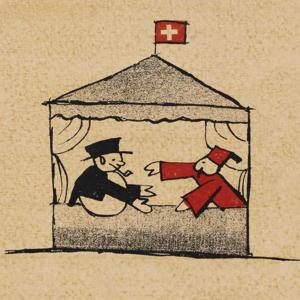
Between the arrival of the cinematograph in Istanbul in 1896 and the institutionalization of film culture in the 1930s, cinema attracted growing audiences, audiences that were themselves experiencing radical change, as a multi-confessional, multi-lingual Ottoman Empire gave way to a secular nation state. These intertwined narratives formed the focus of Canan Balan’s doctoral thesis, undertaken at the University of St. Andrews, and will shortly form the focus of her first book: Torn Is The Curtain: Early Film Culture In Istanbul, to be published in 2025 by Berghahn Books. In this conversation, recorded on 25 April 2024, Jon invites Canan to explain how the “curtain” operated as barrier, screen and metaphor. In Turkish, the word is still used to refer to the cinema screen. In traditional Ottoman shadow-theatre this curtain was a semi-transparent screen, made of white cloth and lit from behind by candles, rather than (as with cinema) a surface onto which images were projected from the front. In Istanbul cinemas the curtain could also serve as an opaque barrier, separating men and women spectators.
Early cinema in Istanbul was met with resistance, negotiation, appropriation and finally institutionalization, all in less than four decades. Yet it is the spectators’ state of ambivalence that lies at the core of the Istanbulite relationship with cinema during this process.
Early Turkish cinema is a challenging research topic, given that the vast majority of footage has been incinerated, while those fragments that do survive in the archive of state broadcasters are sometimes inaccessible, owing to familiar political restrictions and suspicions. Only recently have scholars begun mining the rich vein of film reviews and other printed sources, previously neglected on account of being written in Ottoman Turkish. As Canan explains, early Istanbul film culture can help us gain new insights into both familiar figures such as Halide Edip Adivar (illuminating the use of cinematic metaphors in her writing) as well as less familiar figures, such as Sebahat Filmer, whose long career saw a young intern in the Ottoman Army’s film studios become one of the Turkish film industry’s leading producers and directors. It is these and other pioneer women film professionals which will form the focus of Canan’s next book.
Podcasts are published by TLP for the purpose of encouraging informed debate on the legacies of the events surrounding the Lausanne Conference. The views expressed by participants do not necessarily represent the views or opinions of TLP, its partners, convenors or members.
FEATURE IMAGE: PLAN OF ISTANBUL’S FIRST PERMANENT MOVIE THEATRE, TEPEBASI MUNICIPALITY (PATHÉ FRÈRES BRANCH). FROM THE ANNUAIRE ORIENTAL DU COMMERCE DE L’INDUSTRIE, DE L’ADMINISTRATION ET DE LA MAGISTRATURE, VOL. 28 (ISTANBUL, 1908).
Jeremy Walton and Julia Secklehner discuss the ERC-project Revenant: Revivals Of Empire: Nostalgia, Amnesia, Tribulation, which grapples with the complex, overlapping post-imperial memories and legacies of the Habsburg, Ottoman and Romanov Empires.
e-mail: [email protected]
Jeremy is a cultural anthropologist at the University of Rijeka.
What are the collective memories of the Ottoman, Habsburg and Romanov Empires, and where do they overlap? Jeremy Walton introduces his ERC Project “Revenant: Revivals Of Empire: Nostalgia, Amnesia, Tribulation,” which is a comparative study of empires and imperialism at the intersection of memory studies and urban studies. Introducing sites such as Ada Kaleh, the island in the Danube which was flooded under Ceausescu (also discussed in our podcast with Pinar Odabasi Tasci), inter-imperial relics like a golden dagger in Topkapi Palace, and mythologized figures such as Nikola Tesla, he explores a shared vocabulary that allows new conversations across different post-imperial domains.
If you spend time in these post-imperial capitals it’s clear that those spaces curate and enforce a very sanitized image of the empire that as scholars it’s our obligation to de-centre. It’s the semi-peripheral spaces and places that offer us the ability to do that.
The Revenant Project’s conference, “Postcolonial, Decolonial, Post-imperial, De-imperial” will take place 15-17 May 2024 in Rijeka. Keynote speakers include Priyamvada Gopal, Madina Tlostanova and Maria Todorova. More information can be found here.
Podcasts are published by TLP for the purpose of encouraging informed debate on the legacies of the events surrounding the Lausanne Conference. The views expressed by participants do not necessarily represent the views or opinions of TLP, its partners, convenors or members.
PODCAST EDITING BY JAN ALBRECHT. PHOTO: NINETEENTH-CENTURY BOSNIAN HEADDRESS FEATURING OTTOMAN KURUS AND HABSBURG THALERS.
Hélène Maloigne and Julia Secklehner explore the role of archaeology in nation-building after the First World War and the discipline’s popularization in the early twentieth century.
e-mail: [email protected]
Hélène is Assistant Director of Artefacts and Collections, Tell Atchana, Alalakh Excavations and lecturer in history at the University of Greenwich.
The Eastern Mediterranean, Palestine, Iraq, and Mesopotamia were all important places for the construction of Western European Judeo-Christian identities at the turn of the twentieth century. Hélène Maloigne talks about the importance of archaeology in this context, introducing figures such as Charles Stenard Bulley, a British archaeologist who was also one of the most successful popularisers of the discipline. Through changes in the press in the 1920s and 30s, phenomena such as ‘Egyptomania’ took hold in Europe after the discovery of the tomb of Tutankhamun in 1922, showing how the professionalisation of archaeology as a discipline went hand in hand with its high visibility in the media. Maloigne also points out how Western archaeologists’ extraction of knowledge and material culture was perceived very critically in the Middle East, leading to concerted efforts to control who had access to this material past.
All across the eastern Mediterranean and west Asia, archaeologists played a very important role in creating new nations. Such communities need things or ideas or founding myths in common. Archaeologists provide the stories, we provide the objects.
HÉLÈNE AT TELL ATCHANA, HATAY PROVINCE, TURKEY.
Hélène Maloigne is a historian of archaeology, science and popular culture and an archaeologist with over ten years of fieldwork experience. They are Assistant Director of Artefacts and Collections, Tell Atchana, Alalakh Excavations and lecturer in history at Greenwich University
Podcasts are published by TLP for the purpose of encouraging informed debate on the legacies of the events surrounding the Lausanne Conference. The views expressed by participants do not necessarily represent the views or opinions of TLP, its partners, convenors or members.
PODCAST EDITING BY JAN ALBRECHT. IMAGES © MURAT AKAR, 2023.
Fokke Gerritsen talks to Enno Maessen about the Water Heritage for Sustainable Cities project, an initiative by the Netherlands Institute in Turkey and partners.
Fokke is director of the Netherlands Institute in Turkey.
Can appreciation for urban water heritage and awareness of the present-day water crisis be connected in mutually beneficial ways? What are the contributions that heritage specialists, historians, archaeologists, conservation architects, urban planners, designers and policy makers can make towards developing integrated solutions? In the autumn of 2022, the Netherlands Institute in Turkey (NIT) offered a graduate-level course program entitled “NIT Urban Heritage Lab: Water Heritage for Sustainable Cities”. It explored innovative ways to develop informed strategies to promote urban sustainability in times of climate crisis through the use of tangible and intangible water heritage. Fokke talks us through the significance of water heritage in Istanbul to understand the intricate connections between water and the city, both in history and the present-day.
Podcasts are published by TLP for the purpose of encouraging informed debate on the legacies of the events surrounding the Lausanne Conference. The views expressed by participants do not necessarily represent the views or opinions of TLP, its partners, convenors or members.
MAIN IMAGE COURTESY FOKKE GERRITSEN.
Pinar Odabasi Tasci and Jonathan Conlin discuss the contested borderlands of the late Ottoman Empire, from Edirne to the submerged exclave of Ada Kaleh.
e-mail: [email protected]
Pinar is a PhD student in History at the University of Akron.
As a Phd student studying the history of Edirne during the Balkan Wars, Pinar Odabasi Tasci finds herself in “an academically unwieldy space”, and not just in the sense of having to master bodies of scholarship, on Balkan, Ottoman as well as Middle Eastern history, that may not always play nice with each other. But this sensation of unwieldiness would not have been unfamiliar to residents of Edirne. “Edirne was already experiencing this in the nineteenth century,” Pinar notes, “and this unwieldiness carries on, into the twentieth century.” A historian of war and violence, Pinar’s research has benefited from renewed interest in the Balkan Wars, inspired both by the centennial as well as by a focus on the so-called “Greater War”, which began with the Italian invasion of Libya in 1911 and continued until the Treaty of Lausanne twelve years later. It reflects new histories of war that address social groups and cultures of defeat. As if this was not challenging enough, Pinar is also interested in borderlands. In this conversation, recorded on 25 January 2024, Jonathan asks Pinar to share her insights into how the residents of the Edirne region understood and expressed their own identity and allegiances, as border lines shifted back and forth between the first and second Balkan Wars. The discussion then turns to the global publicity campaign mounted by the Ottoman authorities, in which they endeavoured to draw on different forms of data collected by army officers, as evidence of alleged Bulgarian atrocities. Finally Pinar tells us something of her side interest in the remarkable Ottoman exclave of Ada Kaleh: an island in the Danube three hundred kilometers west of the Romanian capital Bucharest that somehow remained Ottoman (at least de jure) until 1923. Having sunk below the waves in 1970, today this Ottoman Atlantis can only be visited in the imagination.
ADA KALEH, CIRCA 1900.
Podcasts are published by TLP for the purpose of encouraging informed debate on the legacies of the events surrounding the Lausanne Conference. The views expressed by participants do not necessarily represent the views or opinions of TLP, its partners, convenors or members.
MAIN IMAGE: TABYAS (BRICK INFANTRY EMPLACEMENTS) AT THE BALKAN WAR MUSEUM, EDIRNE.
From the publisher's feed