
Sign up to save your podcasts
Or



Edhem Eldem and Enno Maessen on why it isn’t always easy being a historian of Ottoman and Turkish history.
Edhem is Professor of History at Boğaziçi University and International Chair of Ottoman and Turkish Studies at the Collège de France.
In a recent article entitled ‘Rescuing Ottoman History from the Turks‘, Edhem Eldem has argued that Ottoman history has, until very recently, been written either by Turks or with a focus on Turks. For Edhem, this emphasis has come with a heavy ideological burden, yet he is encouraged by the questions now being asked in Ottoman historiography. In this conversation, recorded on 7 July 2023, Edhem salutes these recent developments: micro- and local histories as well as the reconsideration of Ottoman histories through different languages mean that the Ottoman Empire is no longer treated as if it was a monolith. Slowly but surely, we are coming out from under “the very heavy historiography that dominated until now”.
Podcasts are published by TLP for the purpose of encouraging informed debate on the legacies of the events surrounding the Lausanne Conference. The views expressed by participants do not necessarily represent the views or opinions of TLP, its partners, convenors or members.
MAIN IMAGE COURTESY EDHEM ELDEM.
Mehdi Sajid tells Ozan Ozavci the story of Shakib Arslan, a member of the Syrian-Palestinian delegation at Lausanne who sought to keep the Ottoman dream alive.
Mehdi is Assistant Professor of Arabic and Islamic Studies at Utrecht University.
Born to an aristocratic Lebanese family in 1869, Shakib Arslan’s journalism and books established him as one of the twentieth-century’s leading Arab public intellectuals. For Mehdi Sajid, author of a recent study of Arslan’s contributions to the Cairo newspaper al-Fath, Arslan is “not only a person, but a transnational network of relations”, his long career affording “a summary of the transformation of Muslim-majority societies and Middle Eastern societies in the nineteenth and twentieth centuries.” In this conversation, recorded on 20 June 2023, Mehdi focuses on Arslan’s role in helping fellow Muslims navigate the many options on the table in the early 1920s, not least nationalism.
Arslan acknowledged the region’s gravitational pull towards “Europe”, and spent much of his life living in Switzerland, as the “eyes and ears of the Arabs” at the League of Nations, He sought to help the global community of Muslims recognize that “Europe” was neither a monolith (the German model, for example, was different from the Anglo-French one), nor internally consistent: despite the identification of “the West” with secularisation, Arslan noted, Christianity remained powerful in western societies. Indeed, he contended that Western calls for secularisation were part of a broader plan to convert the Muslim world. A keen Ottomanist, in the years immediately following World War One Arslan urged those attending the 1921 Syrian-Palestinian Congress in Geneva to ally with Turkey, or perhaps Russia. When this failed, Mehdi notes, Arslan “tried to channel all his dreams and all his political aspirations into what would become Pan-Arabism and Pan-Islamism – he tried to combine the two.” Although Arslan would become the ideological father of Moroccan nationalism and shape debates over Egyptian identity, the “Ottoman Dream” never quite left him.
Podcasts are published by TLP for the purpose of encouraging informed debate on the legacies of the events surrounding the Lausanne Conference. The views expressed by participants do not necessarily represent the views or opinions of TLP, its partners, convenors or members.
MAIN IMAGE: SHAKIB ARSLAN, SECOND FROM THE RIGHT, COURTESY MEHDI SAJID.
The artist Spyros Aggelopoulos talks to Julia Secklehner about the importance of the folk hero Karagiozis in his work.
Spyros is a Greek visual artist and actor.
What role can jokes and folk traditions have in contemporary art? Over the past fifteen years Spyros Aggelopoulos has explored different elements of folk culture in his work as an artist and performer. In a conversation with Julia Secklehner, recorded on 20 May 2023, he discusses the role of the jester in truth-telling and the freedom we can all find in theatricality. As Spyros notes, in 1922-3 hundreds of thousands of individuals caught up in the Greco-Turkish War and population exchange experienced a disorientating palimpsest of identities: Turks who found themselves on the “wrong” side of a border were forced to move to the “right” side, sent “home” as Turks, yet ostracized by their new community as “Greeks”. The same happened in reverse to those on the other side.
In his current project Karagiozis in Asia Minor the (Greek) Karagiozis goes off to war, never to return. Instead the (Turkish) Karagöz “returns”, disguised as Karagiozis. It is only on Halloween, when everyone is disguised, that “Karagiozis” can appear as himself, revealed and yet disguised. “It’s a double, triple identity game, ” Spyros observes, “It’s a trick, it’s a joke. The play itself is a trick.” This is a story without resolution: nothing comes to a neat and tidy end. “It’s really important for this specific play not to have a resolution. At the end nothing changes. Time is not linear, especially for [Karagöz/Karagiozis]. It has a lot of humourous sketches, but the play is a tragedy.” An ardent admirer of Buster Keaton, Spyros is fascinated with Holy Fools, con-artists, scammers and jesters. Karagiozis in Asia Minor exploits this figure’s privileged position as truth-teller:
A jester can tell you the truth that you don’t want to hear about yourself, about your soldiers, about the things that you did. When a puppet says it, you will hear it. You will laugh when you hear it, but when you go home, you will think about it.
Spyros Aggelopoulos (b.1979, Greece) is a graduate of the Athens School of Fine Art, the Arts Academy in Venice and Studio4 in Los Angeles. His work has been exhibited in the ‘Mind the Fact Festival’ (online, 2020), ‘Friends Non-Show’ (Dio Horia Gallery, Athens, 2020), ‘Pai o Palios o Chronos’ (online, 2020), Art Fair EXPO Chicago (2019) and Donut Factory (Dio Horia Gallery, Mykonos, 2019). His work has been featured in ArtForum, The Guardian, Chicago Tribune and Art News among other cultural media. He lives and works in Athens, Greece.
Podcasts are published by TLP for the purpose of encouraging informed debate on the legacies of the events surrounding the Lausanne Conference. The views expressed by participants do not necessarily represent the views or opinions of TLP, its partners, convenors or members.
MAIN IMAGE COURTESY SPYROS AGGELOPOULOS
Laura Robson explains to Ozan Ozavci how international refugee policies of the early 1920s put the “enterprise” in “humanitarian enterprise.”
Laura is Oliver-McCourntey Professor of History at Penn State University.
Humanitarian and capitalist motives were entangled during the development and implementation of international refugee policies in the 1920s. In this discussion, Laura Robson considers how Fridtjof Nansen came to deploy practices he developed while repatriating POWs in the different context of displaced Russians, shaping the League of Nations’ policy as it carved out a role for itself around refugees. Bonds issued by the Bank of England and Greek State to fund settlement of those Ottoman Greeks displaced under the terms of the Lausanne population exchange established the principle that private capital had a part to play in this project, understood as “making displaced people into productive workers”.
In the mandatory states of the Middle East, displaced people were deployed as soldiers and agriculturalists. Even as the Lausanne population exchange was hailed as a “success”, behind the scenes officials recognized its many shortcomings, including the ways in which that logic which held that ethnic nation-states were the only basis for a stable polity within a global economic order was deployed in ways which challenged mandatory regimes – notably in Palestine, where some Zionists embraced Lausanne-style forced displacement as a solution to a “Palestinian Problem”. Recorded on 10 May 2023, the interview draws on an essay entitled “A Capitalist Peace? Money, Labor, and Refugee Resettlement,” which appeared in the TLP volume They All Made Peace – What is Peace? The 1923 Treaty of Lausanne and the New Imperial Order.
Podcasts are published by TLP for the purpose of encouraging informed debate on the legacies of the events surrounding the Lausanne Conference. The views expressed by participants do not necessarily represent the views or opinions of TLP, its partners, convenors or members.
MAIN IMAGE SOURCE: NEAR EAST RELIEF ARCHIVES, COURTESY OF LAURA ROBSON
Olga Lafazani uses the contrasts between 1922-4 and 2015 to ask hard questions about whose interests are behind the conceptualization and management of “refugee crises”.
Olga is a researcher at the National Hellenic Research Foundation.
As a student in the 1990s, Olga began to participate in grassroots initiatives to address injustice and racism. Two decades and three degrees later, she is the principal investigator of a new project entitled 1 Century, 2 Refugee Crises. Olga’s project asks a deceptively simple question: ‘What makes an event a crisis?’ As she notes, “it’s not about numbers”: the refugees of 1922-4 represented a far larger body, as a share of the population of Greece at that time, than the refugees of 2015, who work out as equivalent to less than one per cent of Europe’s population.
We want to understand how in history some events are framed as “crises”, and what does this framing mean for governing these “crises”?
While the first crisis of 1922-4 has come to be romanticized in centenary commemorations, the 2015 crisis saw refugees cast as “subjects and objects of fear”, denied the vote – again, in stark contrast to a century ago, when migrants got the franchise within just two years. Whereas the 1922-4 refugees often carried the means of supporting themselves on their journey, today we see a vastly expensive relief effort focused on the provision of services, rather than development. Finally, Olga points to the contrast between the spatial integration of these “foreigners” in the heart of Athens or other centres a century ago, and today’s assumption that isolated camps are “the common-sense solution”. We need to “follow the money” and question our assumption that “migration” represents a “cultural phenomenon.”
Podcasts are published by TLP for the purpose of encouraging informed debate on the legacies of the events surrounding the Lausanne Conference. The views expressed by participants do not necessarily represent the views or opinions of TLP, its partners, convenors or members.
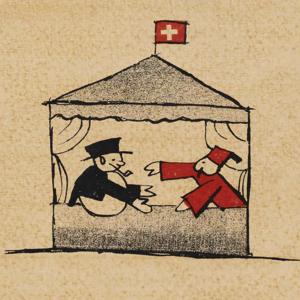
Stefan Slater and David Macfadyen talk to Julia Secklehner about the how they are reviving interest in Aloïs Derso and Emery Kelèn, whose career as caricaturists to the League and United Nations was launched by a chance meeting at Lausanne.
Events in and around the negotiations as Lausanne regularly featured in the popular press around the world, attracting some of the period’s finest journalists to the Swiss resort – including, of course, Ernest Hemingway and Clare Sheridan. Yet no-one brought the negotiations to life in quite the same way as Aloïs Derso and Emery Kelèn, whose output in 1922-3 ranged from the limited edition album Guignol à Lausanne to individual caricatures carried in major French, Egyptian, British and other newspapers. In this podcast, recorded on February 2, 2023, Stefan and David introduce the two Hungarian caricaturists and explain why their take on political cartooning was so unusual – and how it helped set them on a life-long career as “picture journalists” to the United Nations.
Following distinguished careers in medicine, Stefan Slater and David Macfadyen have pursued independent historical research on the inter-war period, particularly the work of the League of Nations and the foundation of the United Nations. This naturally led them to Derso and Kelèn, who form the focus of their new book The Political Cartoons of Derso and Kelen: Years of Hope and Despair (Lund Humphries). To purchase a copy at 20% off, please click on the link and quote the code Derso20 at checkout.
Podcasts are published by TLP for the purpose of encouraging informed debate on the legacies of the events surrounding the Lausanne Conference. The views expressed by participants do not necessarily represent the views or opinions of TLP, its partners, convenors or members.
FEATURE IMAGE:: ON FERME (DETAIL), FROM ALOÏS DERSO AND EMERY KELÈN, GUIGNOL À LAUSANNE (LAUSANNE: “LITHOS” A. MARSENS, 1923).
Ilkim Büke Okyar and Konstantinos Travlos talk to Julia Secklehner about Greek and Turkish caricatures, a neglected resource for historians of identity and conflict in the decades around the Great War.
Caricatures and satirical magazines were a popular medium to circulate images of internal and external political opponents to a wider (and largely illiterate) population at the beginning of the twentieth century, especially during times of conflict. In this conversation, recorded on 31 March 2023, Ilkim and Konstantinos survey the wide gamut of Greek and Turkish magazines that circulated in the early 1920s, including publications such as Akbaba and Karagöz, and explain why soup-making, weddings and firemen provided recurring tropes.
PEACE-MAKING AS LOVE AFFAIR: ISMET AND PEACE WALK DOWN THE AISLE
İlkim Büke Okyar is assistant professor in the Department of Political Science and International Relations at Yeditepe University in Istanbul. Her book, Arabs in Turkish Political Cartoons, 1876-1950: National Self and Non-National Other is forthcoming with Syracuse University Press. Her research interests include nationalism and national identities in the Middle East, emphasizing the Levant. She is also interested in the political history of early republican Turkey.
AFTER THE ANGLO-FRENCH SPLIT: “DO NOT WEEP BUDALA ERIF, IT WILL BE FIXED BY BUYAN EFFENDI [FRANKLIN-BOUILLON]
Konstantinos specialises in international relations and international conflict and is currently working on an EU-funded research project on the Greco-Ottoman and Greco-Turkish arms race. His most recent publication is “Caricaturing the enemy: caricatures and the Greek-Turkish War 1919-1922”, which appeared in the European Journal of Humour Research.
Podcasts are published by TLP for the purpose of encouraging informed debate on the legacies of the events surrounding the Lausanne Conference. The views expressed by participants do not necessarily represent the views or opinions of TLP, its partners, convenors or members.
FEATURE IMAGE: SOUP TUREEN, SÈVRES MANUFACTORY C. 1758. METROPOLITAN MUSEUM OF ART 2004.361.5a, b
Kristina Gedgaudaite talks to Julia Secklehner about her research on cultural memory, migration, and graphic novels in contemporary Greek culture.
Kristina is a Marie Skłodowska-Curie postdoctoral fellow at the University of Amsterdam.
Graphic novels have become a popular vehicle for public memory in Greek culture. Kristina’s recent book Memories of Asia Minor in Contemporary Greek Culture: An Itinerary (Palgrave Macmillan Memory Studies, 2021) explores how graphic novels, films and school textbooks offer accessible forms of memory about the Greco-Turkish War (1919-1922) and the Population Exchange. Kristina explains how the making of history in graphic novels such as Soloup’s Aivali: A Story of Greeks and Turks in 1922 (2019) has the potential to frame wider social debates surrounding belonging and migration, and outlines the links of such historical projects to contemporary concerns such as the 2015 “Refugee crisis”.
Kristina’s wider research interests fall within the fields of cultural memory, migration, comics and graphic novels. Kristina holds a DPhil from the University of Oxford, and is a former Marilena Laskaridis Visiting Research Fellow at the University of Amsterdam and Mary Seeger O’Boyle Postdoctoral Fellow at Princeton University. Alongside her monograph Memories of Asia Minor in Contemporary Greek Culture: An Itinerary, Kristina recently co-edited (with William Stroebel) a special issue of the Journal of Modern Greek Studies marking the centenary of the Greco-Turkish War.
Podcasts are published by TLP for the purpose of encouraging informed debate on the legacies of the events surrounding the Lausanne Conference. The views expressed by participants do not necessarily represent the views or opinions of TLP, its partners, convenors or members.
FEATURE IMAGE COURTESY OLEKSIY KUSTO
Enno Maessen takes Jonathan Conlin on a tour of Beyoğlus past, present and future, from the Deutsche Schule to Emek Sineması.
Enno is a Lecturer in the Department of History and Art History at Utrecht University.
“Each generation has a Beyoğlu of its past to yearn for,” observed Enno Maessen in his recent book Representing Modern Istanbul: Urban History and International Institutions in Twentieth-Century Beyoğlu. The most cosmopolitan and fabled neighbourhood of a cosmopolitan and fabled city, since the mid-nineteenth-century Beyoğlu has played host to a range of European communities: German, French and British societies, clubs and schools have served as beach-heads, refuges and places of encounter. In this conversation, recorded on 16 February 2023, Enno and Jonathan discuss the shifting associations of the Teutonia Club and the post-WW2 appeal of German and other foreign High Schools to the city’s Turkish elite, which led the latter to bend some of the restrictions imposed on those institutions by the Treaty of Lausanne. Finally Enno turns to Emek Cinema, ground-zero for any discussion of how modernisation and gentrification interact in twenty first-century Istanbul: sometimes erasing traces of a neighbourhood’s multi-ethnic heritage, sometimes repackaging them as kitsch.
Podcasts are published by TLP for the purpose of encouraging informed debate on the legacies of the events surrounding the Lausanne Conference. The views expressed by participants do not necessarily represent the views or opinions of TLP, its partners, convenors or members.
Aslı Iğsız and Jonathan Conlin discuss how a concept of civilisation has been represented and exploited, from the age of Ismet and Toynbee to that of Erdoğan, Samuel Huntington and Krishan Kumar.
Aslı is Associate Professor of Middle Eastern and Islamic Studies at NYU.
In her 2018 book Humanism in Ruins: Entangled Legacies of the Greek-Turkish Population Exchange, Aslı Iğsız presented a critique of liberalism from the angle of the management of difference, investigating the underpinning racialized logics of population transfers, partitions and segregation. In this conversation, recorded on 9 February 2023, Aslı considers the (ab)uses of “civilisation” as a concept and discourse in the Lausanne era, as well as in our own era of ethno-nationalism. Aslı questions whether A. J. Toynbee’s exploration of “the contact of civilisations” offered anything more than nationalism writ large: with civilisations viewed as equally “incommensurate”, indeed almost as discrete organisms, each following their own life-cycle. Turning to more recent, neoliberal cultural discourses, Aslı explains how the 1990s “cultural turn” fostered a return to civilisational thinking. Alongside Samuel Huntington and the 2005 UN “Alliance of Civilisations,” the discussion also considers the ways in which Erdoğan and the AKP represented “Ottoman civilisation” in the 2000s and 2010s.
While each “civilizational” proponent accuses the other of being fascist or racist, without any hint of acknowledging their own participation in these discourses and their structural manifestations, they project a false binary onto the world stage that feeds into, and is fed by, discourses of civilizational conflict.
Podcasts are published by TLP for the purpose of encouraging informed debate on the legacies of the events surrounding the Lausanne Conference. The views expressed by participants do not necessarily represent the views or opinions of TLP, its partners, convenors or members.
From the publisher's feed