Listening Time: 18:30 minutesReading Time: 14 minutes
TL;DR—
* Dictators don’t just seize power; they reshape everyday space: maps, buildings, names, and symbols; until the nation itself reflects them.
* From Stalin to Mao to Mussolini to Trujillo, cults of personality turned cities and landscapes into tools of loyalty and permanence.
* These monuments aren’t vanity; they are strategies to outlive accountability and make removal feel unnatural.
* Trump’s first year follows the same pattern: banners on federal buildings, the White House altered, institutions renamed, his face on the parks pass, and a battleship class bearing his name.
* This is fascism taking form in real time, and it demands refusal, not patience.
I. When Dictators Try to Become the Nation
There is a moment in the life of a country when the symbols begin to shift. It doesn’t arrive with tanks or decrees. It comes quietly, in names, in portraits, in banners and buildings. The dictator’s face appears where a flag once was. His name replaces a place that used to belong to everyone. At first, it feels like vanity. Then it starts to feel like something much more.
History shows us this moment clearly.
It is the moment when a man stops wanting simply to govern a nation and begins trying to stand in for it. When his image, his name, his presence start to substitute for the country’s own symbols, institutions, and story.
I have been thinking about that moment a lot lately, because I have watched it arrive here, in the world’s oldest continuous democracy, and it’s weighed heavily upon me.
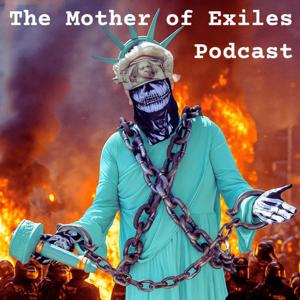
In the summer of 2025, standing as my street performance character, The Mother of Exiles, I stared in disbelief at the Department of Labor and the massive banner of Donald Trump’s face hanging from its façade. A federal building meant to represent workers and public service had become, at least for a time, another surface for a single man’s image. The photograph of that moment, captured by Geoff Livingston, still captures what it felt like: something shared amongst the American people being quietly overwritten.
At the time, it might have been dismissed as branding. A provocation. A spectacle.
Six months later, that same man was announcing a new class of battleships to bear his name.
This is how it begins. Not all at once, but step by step.
The question is not whether any single act is unprecedented. The question is what it means when they start to form a pattern, one that history has taught us how to recognize.
II. The Old Pattern: Power That Demands a Face
Long before banners and buildings, before maps and monuments, there is a simpler instinct at work. Power wants to be seen. It resists remaining abstract. It wants a face.
Across history, when dictators slide from governing into self-myth, they do not just issue orders. They insert themselves into the world people can see: onto walls and gates, coins and posters, plazas and street names. The state stops being an idea and starts being a person.
Historians have a name for this: the cult of personality. Hannah Arendt warned that such regimes seek not only obedience, but emotional identification: a bond in which the dictator comes to stand in for the meaning of the state itself.
What unites these cases is not just vanity, but a strategy of legitimacy. When authority begins to wobble, dictators respond not by strengthening institutions, but by making themselves unavoidable.
This is the ground self-monument grows from, before statues rise, before cities are renamed, before the country is carved into a mirror. Here’s seven quick examples from history.
Stalin: Writing Himself Onto the Map
After Lenin’s death, Joseph Stalin (b: 1878; d: 1953) rewrote the Soviet Union’s geography in his own image.
In 1925, Tsaritsyn became Stalingrad, and it was only the beginning. Cities, streets, factories, and entire regions across the USSR took his name, turning the map itself into a ledger of loyalty.
Portraits and statues filled offices, schools, and public squares. His face followed citizens through daily life, fixed in stone and paint.
By attaching himself to places people lived and worked, Stalin made his rule feel rooted in the land itself. The revolution was taught to look like one man.
Long before terror consumed millions, the country had already been trained to see him as part of its landscape.
Mao: The Face on the Wall
In China, Mao Zedong (b: 1893; d: 1976) carried his image into the most intimate spaces of life.
His portrait hung in classrooms, factories, village halls, and private homes. In Tiananmen Square, his face loomed over the political heart of the nation.
Power moved into kitchens and classrooms, into places where daily life was supposed to be private.
Children recited his quotations. Families were expected to display his image as proof of loyalty.
The revolution became presence. To doubt Mao meant doubting the world you lived in.
By the time the Cultural Revolution tore through society, Mao’s face had already been woven into homes and habits across China.
The Kim Dynasty: The Capital as Shrine
In North Korea, under Kim Il-sung (b: 1912; d: 1994) and his successors, Pyongyang was rebuilt into a shrine to the ruling family.
Wide boulevards and vast plazas organized the city around monuments to the Kims. At the Mansudae Grand Monument, citizens bowed before towering bronze statues.
Mandatory portraits hung in every home. Inspectors ensured they were clean and displayed.
The city was designed to direct how people moved, gathered, and looked.
Parades and mass games turned human bodies into choreography for the regime.
To live in the capital was to move through a landscape that taught permanence, training citizens to see the Kim family as inseparable from the nation itself.
Saddam: Writing Himself into Antiquity
In Iraq, Saddam Hussein (b: 1937; d: 2006) tied his rule to the country’s ancient past.
At the ruins of Babylon, he rebuilt walls stamped with inscriptions bearing his name, pressing a modern dictator into stone thousands of years old.
Palaces rose above Baghdad, dominating skylines and sightlines.
Murals cast him as a warrior and heir to ancient kings.
Saddam recruited history into his rule, framing himself as the continuation of Iraq’s story.
By the time war hollowed out the state, his image had already fused modern streets with ancient stone.
Mussolini: Remaking Rome
In Italy, Benito Mussolini (b: 1883; d: 1945) reshaped Rome to claim imperial inheritance.
Medieval neighborhoods were demolished to frame the Colosseum and Roman Forum as backdrops for fascist spectacle.
The Via dei Fori Imperiali cut a parade route through the city, binding marches to imperial ruins.
New marble districts like EUR projected order and destiny.
Power embedded itself in streets and movement.
Rome was forced to tell a story in which fascism appeared as the return of empire.
Trujillo: Renaming a Capital
In the Dominican Republic, Rafael Trujillo (b: 1891; d: 1961) turned the nation’s capital into his monument.
In 1936, Santo Domingo became Ciudad Trujillo.
Street signs, maps, documents, and passports carried his name. Saying where you lived meant repeating it.
Portraits filled public buildings. Schools taught loyalty to the man whose name marked the city.
Power replaced space itself.
For twenty-five years, the country’s political heart beat under his name.
Napoleon: When a Republic Crowns a Man
In France, Napoleon Bonaparte (b: 1769; d: 1821) rose from revolution through popular acclaim.
He presented himself as defender of the republic, won plebiscites confirming his authority, and promised stability after chaos.
Only later did he crown himself emperor.
Triumphal arches, columns, coins, and portraits reshaped Paris into a monument to his victories.
The rituals of empire followed the rituals of consent.
Napoleon absorbed the revolution into himself, presenting personal rule as its fulfillment.
He showed how easily a people who overthrow kings can still be taught to accept one.
III. Turning Home
I used to read about these places and feel the comfort of distance.
That was there. That was then.
I told myself those stories belonged to other countries, other histories, warnings meant to be studied, not relived.
Then I watched the White House itself begin to come apart.
Trump came promising to “drain the swamp.” He cast himself as a right-wing populist; the man who would tear down a corrupt order and return the country to its people. Like Napoleon, he did not present himself as the enemy of the system, but as its savior.
It began with a promise of renewal and rescue.
Instead of dismantling power, he rebuilt it in his own image, binding his rise not to institutions, but to private loyalty and oligarch money.
That recognition settled in when the East Wing was torn down to make way for a ballroom built to his taste.
It marked a commitment to remaking the seat of government in his own image.
The distance collapsed.
It stopped feeling like history.It started feeling like home.
IV. The Pattern
Once you start looking, the pattern becomes impossible to unsee.
It shows up as a timeline.
As the slow realization that what you learned to recognize in other countries is now being written into your own. Here’s the current tally of Trump making America him.
June 14, 2025 — A military parade.On his birthday, which also marked the 250th anniversary of the U.S. Army, tanks rolled and troops marched in the streets of Washington, D.C., folding military ritual into personal celebration.
August 26, 2025 — A portrait banner hung from the Department of Labor.That summer, Trump’s face stretched across the façade of the Department of Labor, a federal building meant to stand for workers, labor rights, and public service to the American people.
October 20, 2025 — Demolition of the East Wing begins.The White House started to come apart as crews tore down the East Wing to clear space for a new ballroom—paid for largely by private donations from major tech companies, defense contractors, cryptocurrency firms, and wealthy patrons. Trump also pledged personal funds, shaping the project to suit his own taste.
November 25, 2025 — The redesign of the America the Beautiful National Parks Pass.Images of sweeping landscapes and wildlife of our National Parks were replaced by Trump’s scowling face beside iconic statesman, George Washington, breaking a long tradition of honoring the nation’s shared natural inheritance.
December 3, 2025 — The Institute of Peace is renamed.The United States Institute of Peace became the Donald J. Trump Institute of Peace.
December 18, 2025 — The Kennedy Center is renamed.The John F. Kennedy Center for the Performing Arts became the Donald J. Trump and John F. Kennedy Memorial Center for the Performing Arts.
December 22, 2025 — A battleship class is named.Trump announced a new class of U.S. Navy battleships to be named after himself, referred to as the “Trump-class” with the lead ship designated as the USS Defiant. Secretary of the Navy John Phelan described the USS Defiant as the largest, deadliest, and most versatile warship ever conceived.
Each of these can be defended. Each can be explained away.
Together, they stop feeling like coincidence.
From banner,to building,to institution,to monument,to fleet.
From using the symbols of the nation to claiming them as his own.
You have already seen this story. The only difference now is that it is happening here.
And it is only the first year.
V. Naming It
At a certain point, the pattern stops being subtle.
When a dictator’s face hangs on buildings, replaces landscapes, reshapes the people’s house, and brands institutions and steel, history gives us a name.
This is how cults of personality are built.
What Stalin did with cities.What Mao did with walls.What the Kims did with a capital.What Saddam did with antiquity.What Mussolini did with Rome.What Trujillo did with a capital’s name.What Napoleon did with a republic.
And now, in the world’s oldest constitutional democracy, a president is inscribing himself onto its most visible institutions.
The materials are different. The language is American. But the impulse is the same.
This is not just self-love. It is appropriation: the quiet conversion of shared institutions into personal monuments, converting public inheritance into private legacy.
Because once your name is on buildings and ships, once your vision has altered the White House, you are no longer just governing the present. You are trying to pre-write the future.
This is how dictators try to outlive accountability.
Impeachment, elections, and revolutions can remove a man from office, but stone and steel are harder to undo.
We like to believe that voting is enough, but history is full of dictators who kept elections while emptying them of risk.
Stalin staged votes that offered confirmation, not choice.Saddam ran referendums that returned near-unanimous approval.The Kims preserved rituals of acclamation.Napoleon wrapped the empire in plebiscites that made domination look like consent.
They did not abolish elections. They hollowed them out.
Max Weber, a German Sociologist, called this charismatic authority—power justified not by law or tradition, but by the supposed exceptional nature of the man himself. When that authority is carved into buildings and steel, it becomes an environment.
Self-monument is preparation. It teaches people that the dictator is permanent. And that is what makes watching it unfold so unsettling. Because this is a man who has already shown his willingness to reject an election he lost. So, when he begins inscribing himself onto the nation, history tells us to treat it as architecture for a future where ordinary remedies may no longer apply.
VI. Anger and Unease
There is anger in seeing this happen.
Anger at the brazenness of it. Anger at the casual way buildings, symbols, and public spaces are taken.
There is also unease.
Because this doesn’t just threaten laws. It threatens the sense that the country you live in will still recognize itself tomorrow.
Dictators do not only seek loyalty. They seek resignation.
Unease comes from recognizing that this works.
Each step feels survivable on its own, until one day you realize you are living inside something you would have sworn could never happen here.
Anger says: this is wrong. Unease says: this is working.
Holding both at once is what it feels like to watch a democracy tested from the inside.
VII. Refuse the Mirror
Every dictator who tries to carve himself into a nation is chasing the same illusion: that stone and steel can make him permanent.
History shows how fragile that hope really is. None of them escaped history. They only delayed it.
What does not fade on its own has to be confronted.
Because the mirror they build is not just about how they want to be seen. It is about how they want the country to see itself.
To accept that mirror is to accept that the nation and the dictator are the same thing.
Refusing it is an act of citizenship, and also an act of resistance.
It means saying this ends. Here. Now.
It means naming what is happening while it is still happening; and here, right now, it’s fascism.
It is fascism that personalizes power.It is fascism that demands loyalty over law.It is fascism that replaces institutions with a man.It is fascism that converts public inheritance into private legacy.It is fascism that teaches people to stop imagining removal.
If the people who can see it will not say it, who will?
Refusal is not symbolic. Refusal is what keeps this from becoming permanent. Because once maps change and rituals harden, undoing them becomes generational.
That is what is being decided now.
This is why anger matters. Why unease matters.
They are alarms.
History recognizes its own shapes.
And so should we.
This is not a suggestion.It is a line.
Refuse the mirror.Refuse fascism.Join the resistance.
In defiance, and in solidarity,
I am, Robin Liberte’, The Mother of Exiles.
Activist. Artist. Author.
If this piece shook something in you, please subscribe and share, but also talk to your family, friends, and neighbors. This fight to save democracy ends when people stop engaging.
This is a public episode. If you would like to discuss this with other subscribers or get access to bonus episodes, visit robinliberte.substack.com