
Sign up to save your podcasts
Or

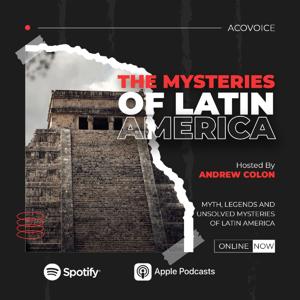


Did the ancestors of the Mexica—the people we often call Aztecs—come from the red rock canyons of Utah?
For years, legends have placed the Aztecs’ origin in a mythical homelandcalled Aztlán. But according to some researchers, Aztlán may not bemythical—or even Mexican. In this episode, I explore one of the mostcontroversial and fascinating theories in Latin American history: Was Aztlánactually in the American Southwest?
We'll look at:
🎧 With sources. With citations. With respect for the culture.
And in the end—you decide.
Check out the first episode on Aztlan here:
Spotify: https://open.spotify.com/episode/2TS2B9D3bwXjRTEUYbxrYL?si=ak55sQZNRQat5HhX07OEUw
Apple Podcasts: https://apple.co/3IauAWo
🔔 If you enjoy thoughtful storytelling about myth, migration, andidentity, follow the show for new episodes every week.
🛍️ Support the project + grab gear inspired by these stories: https://www.andycancun.com/
📲 Follow on Instagram: @andycolonvo
📩 Email: [email protected]
🎙️ YouTube channel: The Mysteries of Latin America
🛒 Amazon Storefront: https://www.amazon.com/shop/themysteriesoflatinamericawithandrewcolon
#AztecOrigins #Aztlán #Mexica #LatinAmericanHistory #MOLA #hispanichistorymonth#latinhistorymonth
Homework Sources:
· Campbell,L. (1997). American Indian languages: The historicallinguistics of Native America. Oxford University Press.
· DeseretNews. (1990, March 24). Researchers say Aztec homeland was inUtah. Deseret News Publishing Company.
· Durán,D. (1581). Historia de las Indias de Nueva España eIslas de Tierra Firme. (English version often cited in secondarysources; original Spanish text widely published in Mesoamerican studies.)
· Gillespie,S. D. (1998). Codex Boturini and migration traditionsof the Mexica. In Carrasco, D. (Ed.), The Oxford Encyclopediaof Mesoamerican Cultures. Oxford University Press.
· Hill,J. H. (2001). Proto-Uto-Aztecan: A community of cultivators in central Mexico? AmericanAnthropologist, 103(4), 913–934.
· Ixtlilxóchitl,F. de A. (17th century). Relaciones históricas.(Compiled in various editions; specific references vary by edition.)
· León-Portilla,M. (1959). La visión de los vencidos: Relacionesindígenas de la conquista. UNAM / Universidad Nacional Autónoma deMéxico.
(English edition: León-Portilla, M. (1962). The Broken Spears: TheAztec Account of the Conquest of Mexico. Beacon Press.)
· LópezAustin, A. (1980). Cuerpo humano e ideología: Lasconcepciones de los antiguos nahuas. UNAM / Instituto deInvestigaciones Antropológicas.
· NationalPark Service. (n.d.). Archaeological resources of thesouthwestern United States. U.S. Department of the Interior.
· Rivas-Salmon,A., & Orosco, C. (1990). Aztec homeland theory and Utah.Interviewed and profiled in Deseret News (March 24, 1990).
· Shaul,D. (2014). The prehistory of the Uto-Aztecan languages. AnthropologicalLinguistics, 56(3–4), 255–302.
· Townsend,C. (2019). Fifth sun: A new history of the Aztecs.Oxford University Press.
· UtahRock Art Research Association (URARA). (n.d.). Rock art styles of theSouthwest. Retrieved from urara.wildapricot.org
· Whitley,D. S. (2005). Introduction to rock art research(2nd ed.). Left Coast Press.
Did the ancestors of the Mexica—the people we often call Aztecs—come from the red rock canyons of Utah?
For years, legends have placed the Aztecs’ origin in a mythical homeland called Aztlán. But according to some researchers, Aztlán may not be mythical—or even Mexican. In this episode, I explore one of the most controversial and fascinating theories in Latin American history: Was Aztlán actually in the American Southwest?
We'll look at:
🎧 With sources. With citations. With respect for the culture.
Check out the first episode on Aztlan here:
Apple Podcasts: https://apple.co/3IauAWo
🔔 If you enjoy thoughtful storytelling about myth, migration, and identity, follow the show for new episodes every week.
🛍️ Support the project + grab gear inspired by these stories: https://www.andycancun.com/
📲 Follow on Instagram: @andycolonvo
#AztecOrigins #Aztlán #Mexica #UtahMysteries #LatinAmericanHistory #MOLA #IndigenousHistory #MythAndMigration
Homework Sources:
Top 5 Myths About Mexican Independence — and the Truth Behind Them
Hosted by Andrew Colón | The Mysteries of Latin America
If you're Mexican-American — or just fascinated by Mexico’s history — you’ve probably heard some creative versions of how Independence really happened.
Think Mexico’s Independence Day is Cinco de Mayo? Think Father Hidalgo shouted “¡Viva México!” and the next day everyone woke up free? Did Mexican Independence come after the Mexican Revolution?
Think again.
In this episode, we bust the top five myths about Mexican Independence — and reveal the messy, surprising, and often misunderstood truth behind each one. From important figures like Leona Vicario and Vicente Guerrero to the real timeline of independence (hint: it wasn’t overnight), this is the version of history you didn’t get in school or from your grandparents.
What you’ll hear:
If you’ve ever been curious about what really happened on September 16, 1810 — and why it matters today — this episode is for you.
History meets myth-busting. Culture meets truth.
Follow the podcast for more myths, legends, and mysteries from across Latin America!
A MYSTERIES OF LATIN AMERICA SPECIAL PRESENTATION PODCAST INTERVIEW
Tequila isn’t just a drink—it’s the story of revolutions, betrayals, the Cuervo family empire, along with the Sauza family and other prominent names in the tequila industry. In this exclusive interview, author Ted Genoways reveals the hidden history of tequila and Mexico, and what they mean to each other and us today.
What if everything you thought you knew about tequila’s origins was only half the story?
In this episode of The Mysteries of Latin America, Andrew Colón sits down with two-time James Beard Award-winning journalist Ted Genoways, author of Tequila Wars: José Cuervo and the Bloody Struggle for the Spirit of Mexico.
We uncover the erased history of tequila from about 1880–1930—a period wiped from memory during and after the Mexican Revolution. This isn’t just about a brand. It’s about power, survival, identity, and the fight for Mexico’s soul.
From José Cuervo’s beginnings in the tequila business, to the rivalry with the Sauza family, to exile, backroom deals, cartels, and the Cuervo women who worked beding the scenes and on the main stage, this story has it all—Succession meets Narcos, with agave.
What You’ll Learn in This Interview
Here's a link to the book on Amazon: https://www.amazon.com/Tequila-Wars-Cuervo-Bloody-Struggle/dp/0393292592/
Note: I am not compensated in any way from book sales, the author or any brands mentioned in this interview
About The Mysteries of Latin America
I’m Andrew Colón. Every week, I share the myths, legends, histories, and mysteries of Mexico, Central America, South America, and the Caribbean—so that Latinos in the U.S. know their stories, and everyone else learns ours.
If you enjoyed this video, hit like, drop your thoughts in the comments, and subscribe for more powerful stories from across this region.
📲 Follow me on Instagram: https://www.instagram.com/andycolonvo/
#TequilaWars #JoseCuervo #MexicanHistory #TequilaHistory #MysteriesOfLatinAmerica
A little squiggle over the letter n has been around for more than 800 years — and its story involves medieval monks, a Spanish king, and tech companies that once tried to erase it from keyboards. Without it, “Happy New Year” in Spanish flips into something you definitely don’t want to wish your grandma.
In this episode of The Mysteries of Latin America, Andrew uncovers the journey of the letter Ñ — from Roman scribes to medieval Spain, from typewriters to computer keyboards, and from linguistic quirk to a global symbol of culture, identity, and pride.
If you’d like to dig deeper into the history of the Ñ:
Real Academia Española (RAE) – Ortografía de la lengua española (1741 and later editions)
Penny, Ralph. A History of the Spanish Language (Cambridge University Press, 2002)
Lapesa, Rafael. Historia de la lengua española (Gredos, 1981)
García Márquez, Gabriel – various essays and speeches on the defense of the Ñ (notably after Spain’s EEC debates in the 1980s)
Vergne, Aida. “¿Se va la Ñ?” Metro Puerto Rico (2013, April Fool’s prank article)
Hualde, José Ignacio. The Sounds of Spanish (Cambridge University Press, 2005)
Puente, Manuel Alvar. El español: orígenes y evolución (Espasa-Calpe, 1992)
📚 Sources & Further Reading
A little squiggle over the letter n has been around for more than 800 years — and its story involves medieval monks, a Spanish king, and tech companies that once tried to erase it from keyboards. Without it, “Happy New Year” in Spanish flips into something you definitely don’t want to wish your grandma.
In this episode of The Mysteries of Latin America, Andrew uncovers the journey of the letter Ñ — from Roman scribes to medieval Spain, from typewriters to computer keyboards, and from linguistic quirk to a global symbol of culture, identity, and pride.
If you’d like to dig deeper into the history of the Ñ:
Real Academia Española (RAE) – Ortografía de la lengua española (1741 and later editions)
Penny, Ralph. A History of the Spanish Language (Cambridge University Press, 2002)
Lapesa, Rafael. Historia de la lengua española (Gredos, 1981)
García Márquez, Gabriel – various essays and speeches on the defense of the Ñ (notably after Spain’s EEC debates in the 1980s)
Vergne, Aida. “¿Se va la Ñ?” Metro Puerto Rico (2013, April Fool’s prank article)
Hualde, José Ignacio. The Sounds of Spanish (Cambridge University Press, 2005)
Puente, Manuel Alvar. El español: orígenes y evolución (Espasa-Calpe, 1992)
The Lost City & the Monkey God Curse
Hidden deep in the Honduran jungle lies one of the greatest archaeological mysteries of the Americas: a lost city whispered about for centuries... and a terrifying curse that followed those who found it.
In this episode of The Mysteries of Latin America, we explore the real-life search for the so-called White City—also known as the City of the Monkey God. From Indigenous legends and Spanish chronicles to a modern expedition using LiDAR technology, this is a story filled with obsession, discovery, and a string of chilling events that some say were no coincidence.
🎙️ Join host Andrew Colón as he unpacks the curse that struck researchers, the truth behind the Monkey God, and the sacred land at the heart of this mystery.
If you’ve ever been fascinated by lost civilizations, ancient ruins, or the eerie line between myth and reality—this is one you won’t forget.
Sources for Further Research:
The Lost City & the Monkey God Curse
In this episode of The Mysteries of Latin America, we explore the real-life search for the so-called White City—also known as the City of the Monkey God. From Indigenous legends and Spanish chronicles to a modern expedition using LiDAR technology, this is a story filled with obsession, discovery, and a string of chilling events that some say were no coincidence.
🎙️ Join host Andrew Colón as he unpacks the curse that struck researchers, the truth behind the Monkey God, and the sacred land at the heart of this mystery.
If you’ve ever been fascinated by lost civilizations, ancient ruins, or the eerie line between myth and reality—this is one you won’t forget.
Sources for Further Research:
If you’re from Latin America—or from a Latino family—you’ve heard stories like these. I definitely did growing up.
In this episode, I’m sharing 5 of the wildest beasts from across the region: monsters that howl, vanish into rivers, drag chains through the night… and one with a mouth where no mouth should ever be.
Some are ancient. Some are modern. But all of them have left people shaken—and some of these stories come straight from real reports.
Stick around to the end. The last one? Absolutely unreal.
– Andrew
The Mysteries of Latin America
From the publisher's feed

171,951 Listeners
6,995 Listeners
16,706 Listeners

99,663 Listeners

18,907 Listeners