
Sign up to save your podcasts
Or



Are you actively working on your personal development? What techniques do you use?
Many people shy away from the idea of personal development.
Strangely enough, the idea of becoming a better person and being happier is seen as some silly activity. But, in reality, we all want this, and we resist it because we shy away from personal responsibility. Also, the idea of actually facing all our internal junk kind of scares us, and we would rather not.
No matter what type of person you are, you will clearly benefit from working on yourself.
If you are a coach, consultant or entrepreneur, in particular, you really need to devote time to bettering yourself, because if you want to be successful in your endeavour, you will likely need to make some changes to your belief system as well as how you think and act.
If you look at the most successful entrepreneurs of our time, it is clear that personal development was a huge part of their life.
Coincidence?
I think not.
Take a step back from your marketing strategy for a minute and think deeply about your customers.
It’s likely that every customer you engage with has a primary business or life that’s not focused on coaching, consulting or the service you provide.
Some might understand how to make a website, meditate or workout and might even be extraordinarily tech-savvy, patient or fit, but their main focus is still their own business or life.
For instance, a lot of my clients are coaches.
They don’t care about how a website is made, what technology is used, or where it’s hosted.
Instead, they care about the utility of their website. It solves business needs like showcasing their courses and hours of operation, representing their brand, and serving as the landing zone for their social media marketing and paid advertising efforts.
They just want it to work well and look great.
You’re an awesome coach or consultant; now it’s time to leverage your knowledge and reputation to land more business.
You can level up by marketing your expertise through education.
The goal for every coach, consultant and small business owner is to get more clients and customers, generate more revenue, and grow their online business.
I assume that is also a goal that you want to achieve for your business. That’s probably why you’re here.
But how can you achieve that goal?
Far too often, coaches, consultants and small business owners think that consumer buying is randomised.
That certain products appeal to certain customers and that a purchase either happens or it doesn’t.
They approach product and service marketing in the same way, based on trial and error.
The good news?
It does exist.
The actual purchase is just one step. In fact, there are six stages to the consumer buying process, and as a marketer, you can market to them effectively.
Let's dig in...
The goal for every coach, consultant and small business owner is to get more clients and customers, generate more revenue, and grow their online business.
I assume that is also a goal that you want to achieve for your business.
That’s probably why you’re here.
But how can you achieve that goal?
What is it that you should do in order to scale and grow your online business?
What you need – above all else – is an actionable content marketing strategy that actually works and is proven to get great results.
You need a good and detailed-content plan with the right steps that should be taken to get you from point A (where you are right now) to point B (where you want to be).
You need to have a powerful system that you can use and that will guarantee success.
One of the key activities of any content marketing strategy is to create content.
You need to produce fresh and relevant posts, articles, videos, and more on a regular basis.
It’s important to do so to bring more traffic to your site, to get more subscribers, and to win customers.
Creating a large amount of good quality content can be very challenging.
Creating content is not easy; you can run out of ideas or just get burnt out.
Not to worry, there’s a simple way to solve your content creation woes, and that is to repurpose content.
Repurposing content is where you reuse content that already exists on your site or on other platforms.
You can opt to repost content that you published on one platform to another.
For example, if you created a video for your social media, you can add it as a post on your blog. You can also convert one content format into another. We’ll go into further detail on ways you can do this.
It’s important to start planning to repurpose content.
Doing so will enable you to take a few pieces of content that you can use several times over.
Let’s look at some ideas on how you can repurpose content that will help you get customers.
Best practices can be helpful, but they are just a starting point. We have to adjust them to fit our specific situation.
Thousands of blogs, books, articles, video’s, and podcasts talk about “best practices.” They cover every topic imaginable. Every nuance of marketing, sales, customer experience, business, dating (oops) talk about best practices.
As consumers of information about how to improve, we devour best practices. The thought is, “If I know what’s best practice, and apply it in my organisation, we will be doing the very best things we can and should see huge performance improvements.”
The problem with best practices is that they are only “best” in a specific context. That is, what is best for others, may not be the best for us for a whole number of reasons. The organisations may have very different strategies and goals. The products and services offered may be very different and target different types of customers. The customers may be very different.
In reality, best practices, at best, can be only very general.
Nothing can ever address our specific situation or the context of what we face right now. Even best practices within our own companies have limitations because they cannot address every context/situation we face.
So should we abandon best practices?
Dear Coach, Consultant and Service Business Owner,
I know that growing your own business is tough.
Sometimes it can feel like NO ONE wants to buy what you’re selling. And when you rely on your business to pay the rent and put food on the table…
It can put an enormous strain on your emotions. You’re terrified of having to give up on your dreams…
And return to a ‘safe’ 9-5 job with your tail tucked between your legs. If you can’t bring in new clients
That's why you need to build a sales process.
Management consultant W. Edwards Deming once said, “If you can’t describe what you’re doing as a process, you don’t know what you’re doing.”
Deming’s statement rings especially true in the chaotic world of sales.
In a single workday, the average coach, consultant or sales rep can make up to 60+ cold calls a day, in addition to being responsible for following up with dozens of prospects in the sales pipeline.
Without a sales process, trying to build a business that's profitable and enjoyable would feel like throwing mud at a wall and hoping some of it sticks.
A well-defined and repeatable sales process will ensure you and your sales team have a clear road map for turning potential leads into customers quickly and efficiently.
To help you get started building your own sales process, we’ve
We’ll also share free downloadable resources and templates to help you run your sales process efficiently.
Let’s dive in!
Virtual meetings are here to stay.
The technology for holding virtual meetings has been around for a long time.
If you compare the last 18 months to the previous decade, the increase is phenomenal.
The pandemic triggered an instant shift to remote working.
Overnight, businesses all over the world were compelled to switch to something many had been resisting for years; working from home.
Here are the 5 biggest mistakes when running virtual meetings and what you can do to avoid them.
Which one of these happened in your last Zoom/Meet/Teams meeting?
There’s not much you can do for the person who ran the meeting, but you can make sure that never happens to you. And, let’s be honest, at least one of those things has happened to all of us over the past 20 months.
Here are the 5 biggest mistakes when running virtual meetings and what you can do to avoid them.
Seth Godin is a world-class author and marketing expert.
His blog is one of the few that I read every day when it arrives at my inbox. His ideas are worth paying attention to and offer enough inspiration to be profoundly valuable.
He frequently blogs about building a tribe, a group of people who support what you do and who are invested in your success – they are part of your personal team.
“This is great, we all know that,” you may say, “But how do I devote the time and attention – among the myriad things that take my attention every day – to building that tribe? Shouldn’t people just fall in love with my product? Isn’t that enough?”
No, it’s not enough.
Even if your product is absolutely superior in every way, another suitor for your customer’s attention is always in the wings.
Even the legendary Odysseus had to fight off Penelope’s 108 suitors after his absence. And if Odysseus was forgotten, it is a guarantee that you will be as well.
What have I learned from Seth Godin’s blog posts which, like Twitter, are so short and concise yet full of such deep insight?
I went through my favourite blog posts from Seth over the last 12 months and chose those which I felt were gems in this respect.
People influence people. Nothing influences people more than a recommendation from a trusted friend. A trusted referral is the holy grail of advertising – Mark Zuckerberg
Referral marketing is known to be one of the best and most trusted marketing approaches applied by both small and large businesses globally.
This type of marketing aims at encouraging and increasing the number of new clients through word of mouth referrals. And is usually done by offering incentives, rewards and encouraging customers to recommend the business’ products and services to other people.
But we’re not talking just about referral marketing in this podcast. Today we will take a look at why having a referral program is important.
Having a program in place helps your customers recommend your products or service with ease.
Identifying ways, channels, and incentives will help you achieve the success you need.
It’s not about once you build it, they will come. It’s about having that foundation and the tools to help bridge gaps.
There is an economic theory that says this:
Our capitalist system relies on the ability to continue to expand. We can no longer expand without wars or unethical trade agreements with underprivileged societies. Therefore, we will fail.
Those who subscribe to this theory point out that we on planet earth live in a “closed system.”
They believe there are only so many resources.
And, as our population grows, this means that the increasing population will have less and less.
This economic idea has some truth to it.
We do, indeed, live on a planet with limited resources.
As a nation, we can no longer expand our borders across the continent - we ran out of continent a while back.
As children, we heard about the “boom times.” Men with adventurous spirits were told, “Go West, young man!” Those with fortitude and brains could make a fortune. They could pan for gold or farm cheap land.
However, these opportunities are done, right?
Prices for limited resources will now spiral upwards until no one can afford necessities.
And, global warming will kill us all.
From virtual museum tours to five-star curbside pickup of a steak and lobster dinner, some tremendously innovative ideas emerged out of the pandemic of 2020.
With the help of application development, normal in-person business operations quickly pivoted during March 2020 to combat the tremendous loss they were facing as the world shut down in response to the pandemic. While some companies are moving into the “New Normal,” or “Next Normal” as some prefer, just as many companies are hoping to return to their pre-pandemic status quo.
However, the reality is that our world is forever changed.
The pre-pandemic world is not where we are heading, and I’m aware that scares many in all walks of life and all generations.
Yet it shouldn’t!
The post-pandemic new normal is whatever we make it, and the innovative apps and more that have emerged can and will aid in business growth if you continue to apply them.
From the publisher's feed
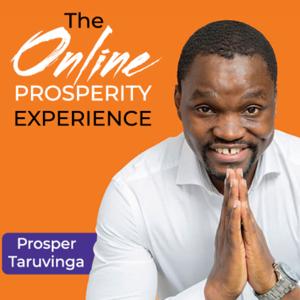
Unlock the secrets to explosive growth in your business with Prosper Taruvinga's game-changing Digital Marketing Strategies and actionable tactics that you can implement today.
Don't miss out on this exclusive opportunity to take your marketing game to the next level - subscribe to the podcast now!
Prosper has helped more than 50 000 people from over 10 countries to create meaningful businesses that are profitable and enjoyable.
Are you looking for more customers? Are you looking to take your business to the next level, develop stronger relationships with your employees, clients or suppliers, improve your finances or get people liking you before you try to sell them something?
The Online Prosperity Experience gives you access to Prosper’s proven Online Prosperity Blueprint. This is a 4 Step Marketing Strategy designed to help you accomplish your goals.
Whether you’re looking for insight into how to build a bigger business or position yourself as the go-to person in your category, you have access to all the tactics used by celebrities like David Hughes as well as (literally) over 450 small businesses and counting.
With an extensive selection of episodes featuring insightful lessons from Prosper, interviews with some of the most successful people in the world and never-before-released audio content from deep within the archives, you’ll find you can learn a great deal while listening during your morning commute or daily workout.
As Prosper says, “I am the guy you call when you are tired of thinking small”
Get started today by choosing an episode that resonates with where you are right now and enables you to take your business to the next level.