
Sign up to save your podcasts
Or

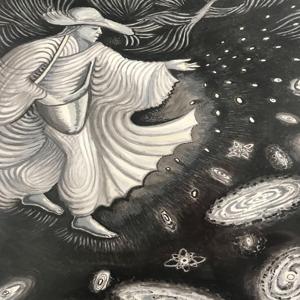


No matter what the crises of the collective the individual has the opportunity of realising the inner light that lies in us all. This episode explores the Taoist text The Secret of the Golden Flower which describes in an extraordinary manner how to access this light through the meditation process.
The episode ends with a beautiful song The Turning of the Year by Mark Dunn of The Bringers of Change whose music albums can be found on Spotify etc. and as CDs at www.fallingarecords.com
The free meditation programme following the Secret of the Golden Flower starts Jan 23rd.
The Quest Lecture series (as distinct from these podcasts) starts Jan.28th.
There will be no podcast episode in January. The next one will be Feb.15th 2023.
In this last episode of this miniseries I give Jung’s main argument and its pros and cons.
My feelings about the difficulties of the work are as follows:
Firstly, relevance. How much can it offer the modern world?
Secondly, isolationism - its removal from the other analytic disciplines.
Thirdly, certain inconsistencies which may confuse the reader.
Fourthly, contradiction - whether the archetype of the Self is the totality or a specific archetype.
Fifthly, the inherent difficulty of the text.
Some of its strengths are as follows:
1: Its passion and tremendous personal conviction.
2: Its roots in childhood experiences (visions, dreams).
3: Jung speaks with many voices, as it were out of the depth of many esoteric traditions.
4: The audacity of the text
5: Jung uses a new voice – that of archetypal psychology combined with mythology and gnosticism.
6: Answer to Job reinforces Jung’s impact on the practice of psychotherapy.
7: Answer to Job has a deep theological critique of Christian and Judaic civilizations.
8: Jung insisted on the dangers of an apocalypse in our times.
9: Jung insists on the overarching metaphysical dimension to human existence.
Este es el episodio final de la miniserie sobre la Respuesta a Job de Carl Jung. Aqui presento un resumen de su argumento y doy dos ejemplos de la relevancia para el mundo moderno. En primer lugar, su temor de un apocalipsis moderno. Sin embargo, el vio la posibilidad de un proceso de individuación al traer esto a la conciencia. En segundo lugar, la relación de este texto con la práctica actual del análisis junguiano.
The penultimate episode in this miniseries on Jung's Answer to Job asks the following questions of this text:
Q. Why is there no "real" history, sociology, or political science in the Answer to Job and indeed in Jung’s work in general?
Q. Are there other interpretations of the Answer to Job.
Q. How unusual is Jung’s interpretation?
Q. Does Jung speak of God in different ways?
Q. Does the theory of evolution change all bible studies including the Answer to Job?
Q. How can God be the totality and at the same time be a specific component of the unconscious?
Q. What impact has Answer to Job had on the practice of Jungian psychotherapy?
Este es el penúltimo episodio de esta miniserie. Examinamos las dificultades y fortalezas del Respuesta a Job.
Las dificultades incluyen:
Su relevancia; su alejamiento de las demás disciplinas analíticas; ciertas inconsistencias que pueden confundir al lector; una contradicción - si el arquetipo del Self es la totalidad o un arquetipo específico; la dificultad inherente del texto.
Algunas de sus fortalezas incluyen:
Su pasión y tremenda convicción personal; una profundidad adicional debido a la cantidad de tradiciones esotéricas a las que está vinculada; Jung habla con muchas voces, como si saliera de muchas tradiciones; la audacia del texto; Jung usa una nueva voz - la de la psicología arquetípica; impacto en la práctica de la psicoterapia; una profunda crítica teológica de las civilizaciones cristiana y judaica; advertencia de los peligros de un apocalipsis en nuestros tiempos; inclusión de la dimensión metafísica global de la existencia humana.
A resume is given of the episodes so far. Responses to the following questions are given:
Q. Is God separate from us?
Q. How can God be a personality as he mostly appears to be in the bible?
Q. If the dualism of good and evil is contained in God then what is the point of the individuation process in human beings?
Q. How can God be the archetype of the Self?
Q. Jung speaks of the God in different ways in Answer to Job. Is he inconsistent?
Q. How is it possible that God can be equated with the unconscious?
Q. What does Jung mean by God wants to create man but not quite?
En este episodio queremos responder a las siguientes preguntas
¿Por qué no hay historia 'real', sociología o ciencia política en el libro?
¿Qué explicación histórica podría ofrecerse para la literatura apocalíptica?
¿Por qué la interpretación de Jung es atípica?
Como la teoría de la evolución cambia todos los estudios bíblicos, incluido la Respuesta a Job.
¿Cómo puede Dios ser la totalidad y al mismo tiempo ser un componente específico del inconsciente?
Además, en el episodio de hoy contamos un sueño notable que Jung tuvo en 1920 en su visita al norte de África. Su interpretación del sueño es fascinante e ilustra material importante en la Respuesta a Job.
In this episode we arrive at the last part of the Answer to Job, chapters 15-20. Three of Jung’s arguments stand out.
1. The actual dangers of an apocalypse in our own time.
2. The importance of a uniting symbol such as that of a child-hero or the Virgin Mary that is an attempt to heal the opposites and their terrible danger to humanity.
3. Reflections on the nature of God.
This episode covers chapters 11-14 of Answer to Job. Jung argues that the emergence of Christianity was an attempt to create a totally good God subsequent to the injury done to Job (i.e. mankind) by Yahweh. He focuses on the weakest part of the Christian argument, that which most reveals the dark side of god which cannot be repressed despite the best efforts of Christianity. This is the subject of the Book of Revelation otherwise known as the Apocalypse of John.
Jung presenta el último libro de la biblia donde los cristianos presentan a su Dios con todas sus contradicciones. Detalla los eventos del Apocalipsis enfatizando el lado oscuro de Dios. Pero lo que perseguía a Jung era la posibilidad de un apocalipsis real. Jung pasó del Libro de Job al Apocalipsis y ahora avanza rápidamente a su propia época. Insinúa que la humanidad está pasando por un proceso de individuación colectiva.
“Respuestas” a los siguientes puntos siguen.
¿Está Dios separado de nosotros?
¿Cómo puede Dios ser una personalidad como parece serlo en la Biblia?
Si el dualismo del bien y el mal está contenido en Dios, entonces ¿cuál es el sentido del proceso de individuación en los seres humanos?
¿Cómo puede Dios ser el arquetipo del Self?
Jung habla de Dios de diferentes maneras en el Libro de Job. ¿Es inconsistente?
¿Cómo es posible que se pueda equiparar a Dios con el inconsciente?
Qué quiere decir Jung cuando dice “Dios quiere crear al hombre pero no del todo”?
From the publisher's feed
Season Two - The Quest. With special focus on the evolving crises of the 21st century.
Season One - Psychotherapy: Jungian approach to healing.
Season Three - En Español: la…

206 Listeners

26,238 Listeners
1,469 Listeners

1,030 Listeners

1,655 Listeners

16,026 Listeners