
Sign up to save your podcasts
Or


Send us a text
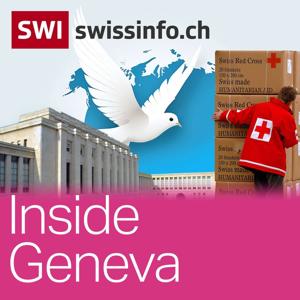
The world is marking 30 years since the Rwandan genocide. Inside Geneva talks to those who witnessed it.
“We came to one village where there were a few survivors and a man came to me with a list and said ‘look, the names have been crossed out one by one, entire families, they were killing everybody from those families,’” says Christopher Stokes, from Médecins Sans Frontières (Doctors Without Borders).
Charles Petrie, former United Nations (UN) humanitarian coordinator, recalls: “She thought there was a good chance that the Interahamwe [militia] would find the kids, the children, and she said, ‘pray that they don’t hack them to death, pray that they shoot them’”.
Why was it not prevented?
“The paralysis of the UN system, the paralysis of all the major players to respond to what was pretty clearly a massive genocidal operation,” says Gareth Evans, former Australian foreign minister.
Senior diplomats worked to make the UN stronger in the face of atrocities.
“Instead of talking about the right to intervene, we talked about the responsibility to protect. There are some kinds of behaviour which are just inconceivably beyond the pale, whatever country we live in, and just do demand this response,” says Evans.
Has “responsibility to protect”, or R2P, worked?
“I don’t think there’s been significant progress. I would say actually that we went from perhaps a hope, an illusion that something would be done to actually not expecting anything at all now,” says Stokes.
Join host Imogen Foulkes on the Inside Geneva podcast.
Get in touch!
Thank you for listening! If you like what we do, please leave a review or subscribe to our newsletter.
For more stories on the international Geneva please visit www.swissinfo.ch/
Host: Imogen Foulkes
Production assitant: Claire-Marie Germain
Distribution: Sara Pasino
Marketing: Xin Zhang
 View all episodes
 By SWI swissinfo.ch

4.4
1414 ratings
Send us a text
The world is marking 30 years since the Rwandan genocide. Inside Geneva talks to those who witnessed it.
“We came to one village where there were a few survivors and a man came to me with a list and said ‘look, the names have been crossed out one by one, entire families, they were killing everybody from those families,’” says Christopher Stokes, from Médecins Sans Frontières (Doctors Without Borders).
Charles Petrie, former United Nations (UN) humanitarian coordinator, recalls: “She thought there was a good chance that the Interahamwe [militia] would find the kids, the children, and she said, ‘pray that they don’t hack them to death, pray that they shoot them’”.
Why was it not prevented?
“The paralysis of the UN system, the paralysis of all the major players to respond to what was pretty clearly a massive genocidal operation,” says Gareth Evans, former Australian foreign minister.
Senior diplomats worked to make the UN stronger in the face of atrocities.
“Instead of talking about the right to intervene, we talked about the responsibility to protect. There are some kinds of behaviour which are just inconceivably beyond the pale, whatever country we live in, and just do demand this response,” says Evans.
Has “responsibility to protect”, or R2P, worked?
“I don’t think there’s been significant progress. I would say actually that we went from perhaps a hope, an illusion that something would be done to actually not expecting anything at all now,” says Stokes.
Join host Imogen Foulkes on the Inside Geneva podcast.
Get in touch!
Thank you for listening! If you like what we do, please leave a review or subscribe to our newsletter.
For more stories on the international Geneva please visit www.swissinfo.ch/
Host: Imogen Foulkes
Production assitant: Claire-Marie Germain
Distribution: Sara Pasino
Marketing: Xin Zhang

4,150 Listeners

1,802 Listeners
97 Listeners

306 Listeners
744 Listeners
319 Listeners

13 Listeners

97 Listeners

226 Listeners

2,545 Listeners

1,076 Listeners

64 Listeners
1,870 Listeners
455 Listeners
330 Listeners

2,121 Listeners

0 Listeners

3 Listeners

0 Listeners

7 Listeners