
Sign up to save your podcasts
Or

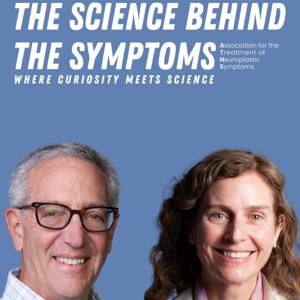
By Association for the Treatment of Neuroplastic Symptoms


4.9
1919 ratings


The podcast currently has 13 episodes available.
The most played episodes among Podcast App listeners.
Becca Kennedy MD and Howard Schubiner MD discuss the role that the brain can play in our everyday life. Do we see with our eyes or with our brain? Do we hear with our ears? Can pain be caused by the brain in the absence of tissue injury? Find these answers in The Science Behind the Symptoms.Books and Articles:Barrett, Lisa Feldman. How Emotions Are Made: The Secret Life of the Brain. Mariner Books, 2017.Barrett, Lisa Feldman. “Why Your Brain Creates Trauma”. Big Think, YouTube, 2023. https://www.youtube.com/watch?v=-ewfP4BC7RA.Barrett, Lisa Feldman, and W. Kyle Simmons. “Interoceptive Predictions in the Brain.” Nature Reviews Neuroscience 16, no. 7 (2015): 7. https://doi.org/10.1038/nrn3950.Botvinick, Matthew, and Jonathan Cohen. “Rubber Hands ‘feel’ Touch That Eyes See.” Nature 391, no. 6669 (1998): 756. https://doi.org/10.1038/35784.Clark, Andy. The Experience Machine: How Our Minds Predict and Shape Reality. Pantheon, 2023.Eagleman, David. Livewired: The Inside Story of the Ever-Changing Brain. Pantheon, 2020.Robson, David. The Expectation Effect: How Your Mindset Can Change Your World. Reprint edition. Holt Paperbacks, 2023.Van den Bergh, Omer, Michael Witthöft, Sibylle Petersen, and Richard J. Brown. “Symptoms and the Body: Taking the Inferential Leap.” Neuroscience & Biobehavioral Reviews 74 (2017): 185–203. https://doi.org/10.1016/j.neubiorev.2017.01.015.Willman, Justin. Magic for Humans: The Rubber Hand Illusion. https://www.youtube.com/watch?v=xdxlT68ygt8🛜 Visit our website www.symptomatic.me🧑💻 Experiencing chronic pain or illness?Learn more from the 12-Question Self Assessment. https://www.symptomatic.me/quiz🧠 Knowledge becomes healingExplore common conditions: https://www.symptomatic.me/commonconditions📚 Start your recoveryFree public resources: https://www.symptomatic.me/treatment-plan🧑⚕️ For practitioners and studentsClinical tools and guidance: https://www.symptomatic.me/learningprogram🎤 Share your storyBe featured on the podcast: https://form.jotform.com/243224080632043👩🏻🏫 Advantages of Membership in theATNS Community: https://www.symptomatic.me/membership💵 Support the missionDonate to expand awareness: https://givebutter.com/XJtTyC💡About ATNSThe Association for the Treatment of Neuroplastic Symptoms is a 501(c)(3) nonprofit advancing the science of chronic pain and illness. Led by volunteer clinicians, researchers, and advocates, ATNS provides education, tools, and support for the diagnosis and treatment of neuroplastic conditions. We bridge research with real-world care—helping people reclaim their lives.

Laura tells her 4 year story of what started as urethral pain. As her many diagnoses to explain this accumulated, eventually she also developed bladder and pelvic pain.Her main symptom was an usual one and little talked about - 'persistent genital arousal disorder (PGAD)'. In order to explain her symptoms however, she was given many different diagnoses including: Interstitial cystitis, endometriosis, Tarlov's cysts, pudendal neuralgia, pelvic congestion syndrome and more. We appreciate Laura sharing her story with us of her path through the medical system of many different doctors, diagnoses, medicines and treatments. Despite all of this, she continued suffering until she found the neuroplastic work and was able to heal.
Dr. Howard Schubiner and Dr. Becca Kennedy sit down with Gigi Cockell to discuss her experience living with EDS and hypermobility and the chronic symptoms she experienced. Gigi shares her journey of searching for answers and how learning about neuroplastic symptoms helped her understand the role the brain can play in generating real physical pain and other conditions. Her story offers a hopeful perspective for others with EDS and hypermobility who may feel stuck in ongoing symptoms and are looking for a new way to approach recovery.Fransiska Malfait et al., “Classic Ehlers-Danlos Syndrome,” in GeneReviews®, ed. Margaret P.Adam et al. (University of Washington, Seattle, 1993), http://www.ncbi.nlm.nih.gov/books/NBK1244/.Anne De Paepe and Fransiska Malfait, “The Ehlers–Danlos Syndrome, a Disorder with ManyFaces,” Clinical Genetics 82, no. 1 (2012): 1, https://doi.org/10.1111/j.1399-0004.2012.01858.x.Mark Scheper et al., “The Association between Muscle Strength and Activity Limitations in Patientswith the Hypermobility Type of Ehlers-Danlos Syndrome: The Impact of Proprioception,”Disability and Rehabilitation 39, no. 14 (2017): 1391–97, https://doi.org/10.1080/09638288.2016.1196396.Cortney Gensemer et al., “Hypermobile Ehlers-Danlos Syndromes: Complex Phenotypes, ChallengingDiagnoses, and Poorly Understood Causes,” Developmental Dynamics: An Official Publication of theAmerican Association of Anatomists 250, no. 3 (2021): 318–44, https://doi.org/10.1002/dvdy.220;Sabeeha Malek et al., “The Beighton Score as a Measure of Generalised Joint Hypermobility,”Rheumatology International 41, no. 10 (2021): 1707–16, https://doi.org/10.1007/s00296-021- 04832-4.Able Lawrence, “Benign Joint Hypermobility Syndrome,” Indian Journal of Rheumatology, SoftTissue Rheumatism, vol. 9 (2014): S33–36, https://doi.org/10.1016/j.injr.2014.09.009.Gere Luder et al., “THU0622-HPR Discriminating Conditional and Functional Factors for WomenWith and Without Hypermobility—an Observational Study,” Poster Presentations, Annals of theRheumatic Diseases 74, no. Suppl. 2 (2015): Suppl 2, https://doi.org/10.1136/annrheumdis-2015- eular.1742.Peter R. Reuter and Kaylee R. Fichthorn, “Prevalence of Generalized Joint Hypermobility, MusculoskeletalInjuries, and Chronic Musculoskeletal Pain among American University Students,”PeerJ 7 (2019): e7625, https://doi.org/10.7717/peerj.7625.Leslie N. Russek and Deanna M. Errico, “Prevalence, Injury Rate and, Symptom Frequency inGeneralized Joint Laxity and Joint Hypermobility Syndrome in a ‘Healthy’ College Population,”Clinical Rheumatology 35, no. 4 (2016): 1029–39, https://doi.org/10.1007/s10067-015-2951-9.Darcisio Hortelan Antonio and Claudia Saad Magalhaes, “Survey Joint Hypermobility inUniversity Students Aged 18-25 Years Old,” Advances in Rheumatology 58, no. 1 (2018): 3,https://doi.org/10.1186/s42358- 018- 0008-x.
In this episode, Dr. Howard Schubiner and Dr. Becca Kennedy examine POTS through the framework of neuroplastic symptoms. They explore the science behind how symptoms can develop and persist, and why approaching POTS with curiosity can create new possibilities for healing. The conversation offers clarity, hope, and insight into emerging research and neuroplastic recovery therapies for those living with POTS.
In this episode, Dr. Howard Schubiner and Dr. Becca Kennedy unpack the science behind Rebecca Tolin’s recovery from 13 years of chronic fatigue syndrome/myalgic encephalitis. Although she was told that Epstein–Barr virus (among many other diagnoses) was the reason for her CFS/ME, she actually recovered through neuroplastic recovery therapies. Dr. Schubiner and Dr. Kennedy describe the scientific studies that break down why EBV is not a valid explanation for persistent symptoms. Together, they illustrate how Rebecca fully healed by addressing the learned patterns in her brain—and what her story reveals about the true mechanisms behind many chronic symptoms.🛜 Visit our website www.symptomatic.me🧑💻 Experiencing chronic pain or illness?Learn more from the 12-Question Self Assessment. https://www.symptomatic.me/quiz🧠 Knowledge becomes healingExplore common conditions: https://www.symptomatic.me/commonconditions📚 Start your recoveryFree public resources: https://www.symptomatic.me/treatment-plan🧑⚕️ For practitioners and studentsClinical tools and guidance: https://www.symptomatic.me/learningprogram🎤 Share your storyBe featured on the podcast: https://form.jotform.com/243224080632043👩🏻🏫 Advantages of Membership in theATNS Community: https://www.symptomatic.me/membership💵 Support the missionDonate to expand awareness: https://givebutter.com/XJtTyC💡About ATNSThe Association for the Treatment of Neuroplastic Symptoms is a 501(c)(3) nonprofit advancing the science of chronic pain and illness. Led by volunteer clinicians, researchers, and advocates, ATNS provides education, tools, and support for the diagnosis and treatment of neuroplastic conditions. We bridge research with real-world care—helping people reclaim their lives.
The podcast currently has 13 episodes available.

43,889 Listeners
659 Listeners

3,578 Listeners

69,584 Listeners
4,115 Listeners
8,009 Listeners
2,503 Listeners

762 Listeners
83 Listeners

19,266 Listeners
55 Listeners
23 Listeners