The Visual Past

The Visual Past

By Ottoman History Podcast
Download on the App Store

The Visual Past episodes

  • Armenian Photography in Ottoman Anatolia
    with Armen T. Marsoobian

    hosted by Zoe Griffith

    Download the podcast
    Feed | iTunes | GooglePlay | SoundCloud

    Interest in Ottoman photography has tended to focus on the orientalist gaze or the view from the imperial center. In this episode, Armen T. Marsoobian offers us the unique lens of the Dildilian family of Armenian photographers in provincial Anatolia. Around the turn of the twentieth century, the Dildilians worked to memorialize portraits of fragmenting families and to document everyday scenes in provincial cities such as Sivas, Samsun, and Merzifon. Marsoobian, himself a descendant of the Dildilians, has woven together the family's remarkable photographic archive along with their memoirs and oral histories, to describe how  through ingenuity and professional connections, the family and with them much of their art survived the genocide in 1915-16.

    « Click for More »
    0 min
  • The Life and Art of Ceramicist David Ohannessian
    with Sato Moughalian hosted by Chris Gratien and Seçil Yılmaz Download the podcastFeed | iTunes | GooglePlay | SoundCloud The styles of Iznik and Kütahya porcelain, which have become synonymous with excellence in Ottoman-Turkish ceramics, adorned and renovated buildings in a radius extending beyond the Anatolian heartland and including Damascus, Mecca, and Cairo. They bear a striking resemblance to the colorful and ornate tiles on many buildings in the city of Jerusalem today, including the Dome of the Rock. This is due to the fact that the iconic ceramics industry of Jerusalem was founded after the First World War by Armenian ceramists who had gotten their start in the resurgent tile industry of late Ottoman Kütahya. As we learn from our guest in this episode, Sato Moughalian, the transfer of this celebrated ceramics tradition from Kütahya to Jerusalem was largely through the figure of David Ohannessian (1884-1953), a master ceramist who came up in the local ceramic arts of the western Anatolian region and received commissions from the likes of Ottoman governors, revivalist architects, and European notables, including Sir Mark Sykes. He survived the travails of deportation to the Syrian desert during WWI only to recreate his art and business in Mandate Palestine. In the podcast, we trace the material history of Ottoman Armenians through the life and journeys of Ohannessian and reflect on the history of Armenian music through some pieces recorded by Moughalian and her colleagues.  « Click for More »
    0 min
  • The German Imperial Fountain in Istanbul
    with Lorenz Korn

    hosted by Emily Neumeier and Sotirios Dimitriadis

    Download the podcast
    Feed | iTunes | GooglePlay | SoundCloud

    The fountain standing in the Hippodrome (At Meydanı) in Istanbul, located just a few steps away from some of Turkey’s most famous tourist attractions like Hagia Sophia and the Blue Mosque, doesn’t attract much notice these days. But wrapped up in this monument, gifted to the people of the city by the German Emperor Wilhelm II, is a story that sheds some light on the bilateral relations between the Ottoman Empire and their European neighbors before WWI. What is the role that the arts play in this diplomatic relationship? Under what conditions could such an object be inserted in the topography of Istanbul’s historic monuments? In this episode, Emily Neumeier and Sotirios Dimitriadis speak with Lorenz Korn about his research on the imperial fountain, tracing the process of its design, construction and reception.

    « Click for More »
    0 min
  • Landscapes of the Eastern Question
    with Paolo Girardelli

    hosted by Emily Neumeier

    Download the podcast
    Feed | iTunes | GooglePlay | SoundCloud

    In the classical Ottoman period, European embassies in Istanbul pretty much looked like any other residential building. At the end of the eighteenth century, however, a period of dramatic geo-political and social change, official foreign residences likewise underwent a process of transformation. Architectural designs shifted from Ottoman to Western styles, and these landmarks became increasingly prominent and visible in the urban landscape. In this episode, Emily Neumeier speaks with Paolo Girardelli about how Pera became the “district of diplomacy” in the Ottoman capital, the subject of his forthcoming book project, Landscapes of the Eastern Question: Architecture and Identity in Galata, Pera, and the Bosphorus, 1774-1919.

    « Click for More »
    0 min
  • Neo-Ottoman Architecture and the Transnational Mosque
    with Kishwar Rizvi

    hosted by Chris Gratien

    Download the podcast
    Feed | iTunes | GooglePlay | SoundCloud

    As spaces fundamental to Muslim religious and communal life, mosques have historically served as sites of not just architectural but also ideological construction. As our guest Kishwar Rizvi argues in her latest book entitled The Transnational Mosque (UNC Press 2015), states operating in transnational contexts have taken a leading role in the building of mosques and in doing so, they forge political, economic, and architectural networks that span the globe. In this episode, we discuss the architectural exports of the four states covered in Prof. Rizvi's monograph: Saudi Arabia, Turkey, Iran, and the United Arab Emirates. In addition to situating and comparing transnational mosques of different states, we give special attention to the rise of Neo-Ottoman architecture in modern Turkey and its role in re-branding Turkey's image on the global stage.

    « Click for More »
    0 min
  • Ecevit, Art, and Politics in 1950s Turkey
    with Sarah-Neel Smith

    hosted by Nicholas Danforth

    Download the podcast
    Feed | iTunes | Soundcloud

    Although artistic production occurs in a political context, art and politics are often studied as separate fields of historical inquiry. Our guest in this episode, Dr. Sarah-Neel Smith, offers a reflection on the close relationship between art and politics in Turkey through a discussion of her research on the figure of Bülent Ecevit. As a politician, Ecevit is remembered for his four stints as Prime Minister of Turkey and his prominent positions in the Republican People's Party (CHP) and later in the Democratic Left Party (DSP). Yet during the early years of his career, Ecevit was also extremely active in intellectual pursuits as a writer and art critic. In this episode, Dr. Smith explores the intellectual life of Bülent Ecevit and the link between debates about art and culture and the development of democratic politics in Turkey during the 1950s.

    « Click for More »
    0 min
  • Picturing History at the Ottoman Court
    with Emine Fetvacı

    hosted by Emily Neumeier and Nir Shafir

    Emine Fetvacı discusses her research for Picturing History at the Ottoman Court (Indiana University Press) with Emily Neumeier and Nir Shafir.
    Download the episode
    Podcast Feed | iTunes | Soundcloud

    In the second half of the sixteenth century, the Ottoman court became particularly invested in writing its own history. This initiative primarily took the form of official chronicles, and the court historian (şehnameci), a new position established in the 1550s, set to work producing manuscripts accompanied by lavish illustrations. However, the paintings in these texts should not be understood merely as passive descriptions of historical events. Rather, these images served as complex conveyors of meaning in their own right, designed by teams of artists to satisfy the aspirations of their patrons, which included not only the sultan but also other members of the court. In this episode, Emily Neumeier and Nir Shafir speak with Emine Fetvacı about these illustrated histories, the subject of her 2013 volume Picturing History at the Ottoman Court. 

    « Click for More »

    0 min
  • Mapping the Ottomans
    with Palmira Brummett hosted by Chris Gratien In a new episode, we speak to Palmira Brummett about her new book, which examines the mapping and representation of Ottoman space in early modern Europe.This episode is part of an ongoing series entitled History of Science, Ottoman or Otherwise.  Download the series Podcast Feed | iTunes | Hipcast | Soundcloud Where did the Ottomans fit within the geographical understandings of Christian kingdoms in early modern Europe? How did Europeans reconcile the notion of "the Turk" as other with the reality of an Ottoman presence in the Balkans and Eastern Europe? What was the relationship between the maps and representations of Ottoman space in Europe and the self-mapping carried out by the Ottomans in maps and miniatures? These are some of the major questions addressed by our guest Palmira Brummett in her new book Mapping the Ottomans, which uses maps to study early modern space and time, travel, the flow of information, claims to sovereignty, and cross-cultural encounters between the Ottomans neighboring Christian polities. « Click for More »
    0 min
  • Mapping the Medieval World in Islamic Cartography
    with Karen Pinto hosted by Nir Shafir In the latest addition to our series on history of science, Nir Shafir talks to Karen Pinto about her research on Islamic cartography and mapping.This episode is part of an ongoing series entitled History of Science, Ottoman or Otherwise.  Download the series Podcast Feed | iTunes | Hipcast | Soundcloud Hundreds of cartographic images of the world and its regions exist scattered throughout collections of medieval and early modern Arabic, Persian, and Turkish manuscripts. The sheer number of these extant maps tells us that from the thirteenth century onward, when these map-manuscripts began to proliferate, visually depicting the world became a major preoccupation of medieval Muslim scholars. However, these cartographers did not strive for mimesis, that is, representation or imitation of the real world. These schematic, geometric, and often symmetrical images of the world are iconographic representations—‘carto-ideographs’—of how medieval Muslim cartographic artists and their patrons perceived their world and chose to represent and disseminate this perception. In this podcast, we sit down with Karen Pinto to discuss the maps found in the cartographically illustrated Kitāb al-Masālik wa-al-Mamālik (Book of Routes and Realms) tradition, which is the first known geographic atlas of maps, its influence on Ottoman cartography, and how basic versions of these carto-ideographs were transported back to villages and far-flung areas of the Islamic empire. « Click for More »
    0 min
  • The Ottoman Empire's Sonic Past
    with Nina Ergin hosted by Chris Gratien Download the episodePodcast Feed | iTunes | Soundcloud When employing textual sources for history, it is easy to lose track of the fact that experiences of the past were immersed in rich sensory environments in which "the word" was only a small component of daily life. How can we restore the sights, sounds, and sensations of the Ottoman past? In this episode, Nina Ergin presents some of her research involving the sonic history of the Ottoman Empire, exploring topics such as architecture, gender, and politics through different sources that offer clues about Ottoman soundscapes. « Click for More »
    0 min

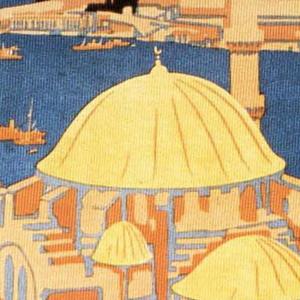
About The Visual Past

From the publisher's feed

"The Visual Past” showcases the latest research by scholars who explore the visual, spatial, and material culture that shaped the Ottoman world. The series will address not only objects, images, and…