
Sign up to save your podcasts
Or



Based on Podcast App listening data
During the Second World War, the people of Leningrad endured a brutal 900-day siege, facing relentless bombing, shelling, and starvation. In early 1943, the Red Army broke through the blockade, marking a crucial turning point. Despite setbacks, the Soviet forces and civilians held firm, and by late 1943, the Germans, weakened by harsh conditions, began to retreat.
In episode 202, we discussed the siege up until 1942. I'm joined once more by Prit Butar to pick up the story of the siege being lifted, which is covered in his latest book 'Hero City: Leningrad 1943–44'
patreon.com/ww2podcast
In April 1942, the Imperial Japanese Navy's Combined Fleet was at the height of its power, having delivered a crushing blow to the US Navy at Pearl Harbor just months earlier. This fleet spearheaded Japan's aggressive expansion through Southeast Asia and unleashed havoc across the South Pacific. However, the tides of war were soon to change. By June 1942, the US Navy achieved a decisive victory over this formidable force at the Battle of Midway, shifting the strategic momentum in the Pacific Theater to the Allies.
Midway stands as the most renowned naval battle of the Pacific War and one of the most storied in military history. The traditional narrative, shaped immediately after the conflict and enduring to this day, portrays an outnumbered American fleet snatching victory against overwhelming odds. While this depiction has become deeply ingrained, it oversimplifies the true nature of the battle.
Joining me is Pacific War expert Mark Stille, whose new book is Midway: The Pacific War's Most Famous Battle, where he contends that a Japanese defeat was not only possible but likely. This perspective redefines the engagement not as a miraculous American triumph or a mere stroke of luck but as a complex confrontation where the factors at play heavily favoured the United States.
Support the podcast:patreon.com/ww2podcast
Released in 1977, A Bridge Too Far stands as the last grand-scale WWII film produced by the Hollywood studio system. The film ambitiously sought to bring to life Operation Market-Garden, the bold but ultimately doomed Allied campaign of September 1944, culminating in the failed attempt to capture the Arnhem bridge.
Producer Joseph E. Levine gathered an incredible ensemble cast, featuring legends like Anthony Hopkins, Robert Redford, Sean Connery, James Caan, Michael Caine, Elliott Gould, Dirk Bogarde, and Laurence Olivier. The movie was shot on location in Holland, with the town of Deventer doubling as Arnhem to recreate the intense and chaotic battle scenes.
In this episode of the WW2 Podcast, I'm joined by Simon Lewis, author of Making 'A Bridge Too Far.'
patreon.com/ww2podcast
In this episode, we'll examine the 6th Airborne Division and its combat effectiveness, focusing on how its commanding officer, Richard Gale, meticulously trained and developed the unit. The 6th Airborne was the second British airborne division to be formed, and it would first see action during the Normandy invasion. Gale's leadership and the culture he instilled were crucial in shaping the airborne soldier's capabilities and forging the division's cohesive fighting force.
Joining me is Andrew Wheale.
Andrew is the author of 'Ham & Jam: 6th Airborne Division in Normandy - Generating Combat Effectiveness: November 1942 - September 1944'.
patreon.com/ww2podcast
When Germany invaded Poland in 1939, it wasn't the Germans who first uprooted Stanislaw Kulik and his family—it was the Russians. Deported to a Siberian Gulag, Stanislaw's fate took a dramatic turn in 1941 when the Germans launched their invasion of the Soviet Union. Suddenly, the Russians released their Polish captives, and Stanislaw embarked on an arduous journey across thousands of miles. He eventually joined the Polish army in Uzbekistan, a path that would lead him to Britain and ultimately to the frontlines in Holland, where he fought with the Polish Parachute Brigade at Arnhem.
Joining me is Nicholas Kinloch, the grandson of Stanislaw Kulik. Nicholas has chronicled his grandfather's extraordinary wartime experience in his book, From the Soviet Gulag to Arnhem: A Polish Paratrooper's Epic Wartime Journey.
patreon.com/ww2podcast
When we think of the fighting in the Far East between Britain, her allies, and the Japanese, we often picture thick jungles, impossibly steep hills, and dense terrain. This has led to the common perception of it being an infantryman's war.
However, armour played a crucial and often overlooked role in this theatre of war.
In this episode, I'm joined by Jack Bowsher, author of Forgotten Armour. His book begins with the interwar Indian Army's struggle to fully mechanise, then traces the evolution of armoured training, logistics, and tactics.
We explore how, once tanks arrived and bunker-busting methods were developed, armoured units became decisive in their encounters against the Japanese, saving countless Allied lives.
patreon.com/ww2podcast
I recently attended the We Have Ways Fest, where I ran into Séan Scullion, a friend of the podcast. You might remember him from episode 135, where we discussed Spaniards in the British army. His book, "Churchill's Spaniards," is about to be released.
At this year's We Have Ways Fest, Sean was scheduled to speak about the British Middle East Commandos. We found a supposedly quiet corner to chat, though it turned out to be less quiet than anticipated.
Patreonpatreon.com/ww2podcast
It was only as Harry S. Truman was sworn in as the 33rd president of the United States that he was told of the Manhattan Project. In this episode, we embark on a journey through one of the most controversial and consequential decisions in modern history: Truman's choice to drop atomic bombs on Hiroshima and Nagasaki during World War II.
The story of this decision is complex, marked by intense debates, ethical dilemmas, and immense geopolitical stakes. As the war in Europe concluded with the defeat of Nazi Germany, the Pacific Theater continued to rage with brutal intensity. American forces faced fierce resistance from Japanese troops, and the prospect of a prolonged and bloody invasion of Japan loomed large.
In this episode, we'll explore the multifaceted considerations that influenced Truman's decision. We'll examine the military strategies, the political pressures, and the moral questions that weighed on the shoulders of the 33rd President of the United States.
I'm joined by Edward Aldrich, the author of The Partnership: George Marshall, Henry Stimson, and the Extraordinary Collaboration That Won World War II. To learn more about Marshall and Stimson, go back to episode 164.
Patreonpatreon.com/ww2podcast
In this episode of the WW2 podcast, we'll explore the Royal Navy from 1918 to the end of the Second World War and one man's career. Not an officer, but a regular sailor: Herbert Leeder, who chalk up 27 years of service. Following the career of one sailor is an interesting way to view the Royal Navy. It gives us a slightly potted history, but Herbert took part in a number of major actions during the Second World War, and it brings home how one man can be a witness to many great events.
I'm joined by James Carter. After working as a volunteer researcher for a local history project during the centenary of the First World War, James was inspired to seek out the history of his own great-grandfather when his mother handed him a four-page summary of Herbert Leeders's career. The outcome of that research is Hearts of Steel, which tracks Herbert's career and the Royal Navy in which he served.
Patreonpatreon.com/ww2podcast
In March 1941, 40,000 Australian and New Zealand troops were rushed to Greece in a desperate attempt to support the Greeks against the looming threat of a German attack. Although the operation was ultimately doomed to fail, the Aussies and Kiwis managed to hold up the German advance long enough to evacuate thousands to Crete, where Hitler then set his sights.
Joining me today is Craig Collie, author of 'Where the Flaming Hell Are We? The Story of Young Australians and New Zealanders Fighting the Nazis in Greece and Crete'. We'll be delving into these often-overlooked, disastrous operations in the Mediterranean.
I want to extend a big thank you to David Phillipson from the History Guild, who suggested our guest today and connected me with Craig. The History Guild has a project focusing on Australians in the Mediterranean theatre during WWII. For more articles and posts on this topic, visit historyguild.org.
Patreonpatreon.com/ww2podcast
From the publisher's feed
Ranked by our users in the last 21 days

3,980 Listeners
4,762 Listeners
4,001 Listeners
466 Listeners
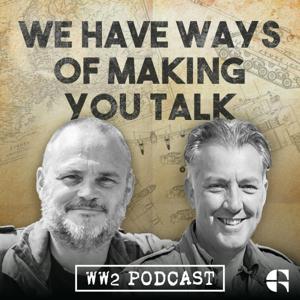
1,437 Listeners
578 Listeners
5,255 Listeners
528 Listeners
931 Listeners
347 Listeners

1,597 Listeners
795 Listeners
137 Listeners
357 Listeners
101 Listeners