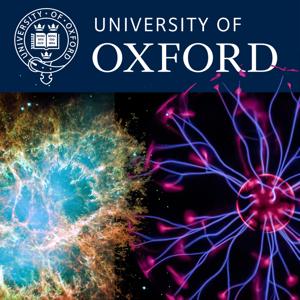
Theoretical Physics - From Outer Space to Plasma

Theoretical Physics - From Outer Space to Plasma

By Oxford UniversityEducation
Download on the App Store

Theoretical Physics - From Outer Space to Plasma episodes

  • The spaghettification of stars by supermassive black holes: understanding one of nature’s most extreme events
    The spaghettification of stars by supermassive black holes: understanding one of nature’s most extreme events - Andrew Mummery On a rare occasion an unfortunate star will be perturbed onto a near-radial orbit about the supermassive black hole in its galactic centre. Upon venturing too close to the black hole the star is destroyed, in its entirety, by the black hole’s gravitational tidal force, a process known as “spaghettification”. Some of the stellar debris subsequently accretes onto the black hole, powering bright flares which are observable at cosmological distances. In this talk I will discuss recent theoretical developments which allow us to describe the observed emission from these extreme events in detail, allowing them to be used as probes of the black holes at their centre. I am a Leverhulme-Peierls Fellow in the Department of Physics and Merton College. I completed both my undergraduate degree and DPhil at Oxford, working for my DPhil in the astrophysics department under the supervision of Steven Balbus. I work on astrophysical fluid dynamics, with a particular focus on the behaviour of fluids when they are very close to black holes.
    40 min
  • Extreme value statistics and the theory of rare events
    Extreme value statistics and the theory of rare events - Francesco Mori Rare extreme events tend to play a major role in a wide range of contexts, from finance to climate. Hence, understanding their statistical properties is a relevant task, which opens the way to many applications. In this talk, I will first introduce extreme value statistics and how this theory allows to identify universal features of rare events. I will then present recent results on the extreme values of stochastic processes, including Brownian motion and active particles. I moved to Oxford in October 2022 to take the position of Leverhulme-Peierls Fellow at the Department of Physics and New College. Previously, I was a PhD student at Paris-Saclay University, working with Satya Majumdar. During my PhD, I worked on extreme value statistics of stochastic processes. I am interested in out-of-equilibrium physics, extreme value theory, and large-deviation theory. In particular, I am currently applying ideas from statistical physics to study living systems.
    40 min
  • Inflation and the Very Early Universe
    Inflation and the Very Early Universe - Georges Obied The universe we observe seems to have come from surprisingly fine-tuned initial conditions. This observation is at the heart of two of the most important puzzles in cosmology, called the horizon and flatness problems. To explain these puzzles, cosmologists invoke a period of accelerated expansion in the early universe (called inflation). As a bonus inflation, when considered with quantum mechanics, produces fluctuations in the energy density that become the galaxies, planets and other structures we see around us. In this talk, I will explain the motivation and physics of the inflationary paradigm. I am Leverhulme-Peierls Fellow at New College. Before coming to Oxford, I completed my PhD at Harvard University under the supervision of Prof. Cumrun Vafa. My research interests lie at the interface of particle physics, string theory and cosmology. At this junction, I work on various aspects of dark energy, dark matter and early universe cosmology from a fundamental physics point of view.
    43 min
  • Axion Searches from Black Holes to the Basement
    Professor John March-Russell talks about the search possibilities for axions including many current and near future ultra-precise quantum `table top' experiments in the Beecroft basement. The QCD-axion, and its `axion-like-particle' generalisations, lead to new physical effects in an extraordinarily diverse range of settings including cosmology, astrophysical objects like stars and black holes, electromagnetic systems, atoms, molecules, and nuclei. He outlines how this leads to a correspondingly huge range of search possibilities for axions (and even axion dark matter) varying from those involving observations of solar-mass and supermassive black holes and a form of `gravitational atom’, to many current and near future ultra-precise quantum `table top' experiments in the Beecroft basement and others worldwide.
    46 min
  • Axion Electrodynamics in Solid-State Materials
    Professor Siddharth Parameswaran gives the second talk on Axions. Over the past decade, topological ideas have played an increasingly important role in a surprising setting: the problem of understanding the properties of insulating crystals. This has led to the identification of “topological insulators”, bulk insulating materials which are characterised by unusual surface phenomena, unconventional responses to applied electric and magnetic fields, or both. In particular, the motion of electrons in some three-dimensional solids can generate axion-like electrodynamics in the solid state. He explains how the ideas leading to the prediction of this “axion insulator” flow naturally from a deeper understanding of the electrodynamics of dielectric media and their link to topological ideas, and survey some of their unusual consequences for experiment.
    43 min
  • The Axion: How Angles Become Particles
    Professor Joseph Conlon introduces the general idea of axions: particles associated to fields which are valued on a circle rather than a real line. He describes the still unresolved strong CP problem of the Standard Model, for which the so-called QCD axion provides the most plausible solution. He explains the typical coupling of particle physics axions to electromagnetism and how this leads to axion-photon conversion in magnetic fields and potential search strategies for axions.
    49 min
  • Fluid-gravity duality and hydrodynamics of black holes
    Holography explains why black hole horizons have thermodynamic and hydrodynamic properties and inspires researchers to re-visit foundations and explore limits of relativistic hydrodynamics Since the work of Bekenstein, Hawking and others in the early 1970s, it was known that the laws of black hole mechanics are closely related if not identical to the laws of thermodynamics. A natural question to ask, then, is whether this analogy or the correspondence extends beyond the equilibrium state. The affirmative answer, given by various authors during the 1980s and 90s, became known as the "black hole membrane paradigm". It was shown that black hole horizons can be viewed as being endowed with fluid-like properties such as viscosity, thermal conductivity and so on, whose values remained mysterious. The development of holography 15-20 years ago clarified many of these issues and has led to the quantitative correspondence between Navier-Stokes and Einstein equations. It became possible to study the long-standing problems such as thermalization and turbulence by re-casting them in the dual gravity language. We review those developments focusing, in particular, on the issue of the "unreasonable effectiveness" of hydrodynamic description in strongly interacting quantum systems.
    Final remarks, Prof Julia Yeomans FRS, Head of Rudolf Peierls Centre for Theoretical Physics

    44 min
  • Why Hydrodynamics?
    What is hydrodynamics and why does it apply over 20 orders of magnitude in energy and length. Welcome, Prof Julia Yeomans FRS, Head of Rudolf Peierls Centre for Theoretical Physics
    Why Hydrodynamics? Prof Steve Simon
    47 min

About Theoretical Physics - From Outer Space to Plasma

From the publisher's feed

Learn about quantum mechanics, black holes, dark matter, plasma, particle accelerators, the Large Hadron Collider and other key Theoretical Physics topics. The Rudolf Peierls Centre for Theoretical…

Best of Theoretical Physics - From Outer Space to Plasma

Ranked by our users in the last 21 days

  1. Number 3: The Hubble Tension
    49 min

More shows like Theoretical Physics - From Outer Space to Plasma

StarTalk with Neil deGrasse Tyson by Neil deGrasse Tyson

StarTalk with Neil deGrasse Tyson

14,352 Listeners

Big Picture Science by Big Picture Science

Big Picture Science

939 Listeners

Universe Today Podcast by Fraser Cain

Universe Today Podcast

565 Listeners

The Quanta Podcast by Quanta Magazine

The Quanta Podcast

544 Listeners

Space Nuts: Astronomy Insights & Cosmic Discoveries by Professor Fred Watson and Andrew Dunkley

Space Nuts: Astronomy Insights & Cosmic Discoveries

233 Listeners

BBC Inside Science by BBC Radio 4

BBC Inside Science

404 Listeners

Philosophy for Beginners by Oxford University

Philosophy for Beginners

329 Listeners

Approaching Shakespeare by Oxford University

Approaching Shakespeare

328 Listeners

General Philosophy by Oxford University

General Philosophy

70 Listeners

Anthropology by Oxford University

Anthropology

73 Listeners

Aesthetics and Philosophy of Art lectures by Oxford University

Aesthetics and Philosophy of Art lectures

77 Listeners

Critical Reasoning: A Romp Through the Foothills of Logic by Oxford University

Critical Reasoning: A Romp Through the Foothills of Logic

37 Listeners

The Secrets of Mathematics by Oxford University

The Secrets of Mathematics

41 Listeners

Physics World Weekly Podcast by Physics World

Physics World Weekly Podcast

84 Listeners

Sean Carroll's Mindscape: Science, Society, Philosophy, Culture, Arts, and Ideas by Sean Carroll

Sean Carroll's Mindscape: Science, Society, Philosophy, Culture, Arts, and Ideas

4,171 Listeners

Daniel and Kelly’s Extraordinary Universe by iHeartPodcasts

Daniel and Kelly’s Extraordinary Universe

2,360 Listeners

Critical Reasoning for Beginners by Oxford University

Critical Reasoning for Beginners

30 Listeners

CortexCast - A Neuroscience Podcast by Oxford University

CortexCast - A Neuroscience Podcast

4 Listeners

The Origins Podcast with Lawrence Krauss by Lawrence M. Krauss

The Origins Podcast with Lawrence Krauss

503 Listeners

The Supermassive Podcast by The Royal Astronomical Society

The Supermassive Podcast

325 Listeners

NASA's Curious Universe by National Aeronautics and Space Administration (NASA)

NASA's Curious Universe

884 Listeners

Why This Universe? by Dan Hooper, Shalma Wegsman

Why This Universe?

384 Listeners

The Astrophysics Podcast by Paul Duffell

The Astrophysics Podcast

71 Listeners

Crash Course Pods: The Universe by Crash Course Pods, Complexly

Crash Course Pods: The Universe

571 Listeners