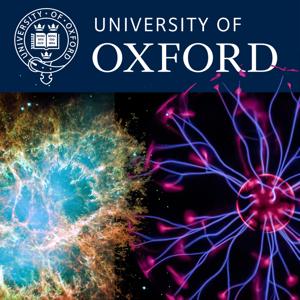
Theoretical Physics - From Outer Space to Plasma

Theoretical Physics - From Outer Space to Plasma

By Oxford UniversityEducation
Download on the App Store

Theoretical Physics - From Outer Space to Plasma episodes

  • The ultimate limits of privacy and randomness...for the paranoid ones
    This talk explains how qubits are used to represent numbers in a way that permits 'quantum-mechanical parallel' computing. We show how this can used to achieve fast factorisation of large numbers, and hence the breaking of current codes. We end by explaining how entangled pairs of particles can be used to provide an alternative and entirely secure cryptographic system.
    55 min
  • “Open” Quantum Systems
    This talk reviews how to deal with quantum systems that are coupled to the outside world, as in reality all systems are. We first introduce density operators and explain how quantum states give rise to them. We then turn to measures of entanglement that can be computed from a density operator, and show that entanglement grows with time. Finally, we show how the interaction with the environment gives rise to the phenomenon of decoherence.
    48 min
  • Quantum Systems from Group up
    This talk reviews the modern formulation of the basic ideas of quantum mechanics. We start by explaining what quantum amplitudes are, how they lead to the idea of a quantum state and how these states evolve in time. We then discuss what happens when a measurement is made before describing correlated ('entangled') systems. Applying these ideas to two-state systems ('qubits') we point out that the complexity of computing the evolution of an N qubit system grows like exp(N)
    41 min
  • Galaxy Dynamics: The chemical evolution side
    Dr Ralph Schoenrich will talk about the chemical evolution side Spiral density waves patterns re-distribute stars throughout the entire system, making it impossible to know a star's origin from just its kinematics. However, stars are more than just points in phase space: every star is labelled with the elemental abundances of the gas cloud from which it was formed. Over the last few years a number of observational campaigns have started to measure these labels for millions of stars in our own Galaxy's disc. Ralph Schoenrich will describe how chemodynamical models are being used to piece together the evolution of our Galactic environment from presolar times to the present.
    40 min
  • Galaxy Dynamics: The dynamics of galaxy discs
    Dr John Magorrian will talk about the dynamics of galaxy discs In galaxy discs it is energetically favourable for angular momentum to move outwards and mass to move inwards. This transportation is effected by spiral arms, but what causes them? Simple linear response calculations demonstrate that even the smallest perturbation is amplified manyfold, while the differential rotation of the disc means that the response is stretched out into a spiral-like pattern. John Magorrian will introduce the notion of the disc as a resonant cavity, within which spiral density perturbations rattle back and forth.
    45 min
  • Galaxy Dynamics: Stellar systems: a new state of matter
    Prof James Binney FRS will talk about stellar systems: a new state of matter The long range of gravity means that many concepts from undergraduate statistical mechanics do not apply: energy is not extensive; there is no microcanonical or canonical ensemble. Stars and dark matter particles have long mean free paths, which means that to a very good approximation their motion is determined by the mean-field gravitational potential. James Binney will identify a hierarchy of timescales, explaining how the Boltzmann equation for the full 6N-dimensional many-particle phase space distribution function can be reduced to an evolutionary equation of a function of a mere 3 variables that is governed by the resonances among the particles' orbital frequencies.
    52 min
  • Superfluids in Flatland: Topology, Defects, and the 2016 Nobel Prize
    In this talk, Siddharth Parameswaran discusses how a topological approach to 2D systems reveal that they can indeed become superfluid, and lead to surprising and beautiful universal results whose implications continue to resonate today. Superfluids spontaneously break a continuous symmetry linked to the conservation of particle number in a many-body system. Standard lore holds that such symmetries must remain unbroken at any temperature above absolute zero in a two-dimensional material, such as a thin sheet or film, apparently precluding superfluidity in such systems.
    44 min
  • Quantum mechanics on the human scale
    Stephen Blundell reviews a theory of superconductivity that was developed in Oxford in the 1930’s by Fritz London. The idea is that under certain conditions quantum coherent effects can become manifest on a large scale. In an effect such as superconductivity, this idea can be put to use in such applications as magnetic resonance imaging, in which a living human patient is inserted inside a quantum coherent wave function. He will explain how coherent effects can be measured in real superconductors.
    36 min
  • From Identical Particles to Frictionless Flow
    John Chalker discusses how the laws of quantum mechanics lead us from the microscopic world to macroscopic phenomena. The notion that atoms of a given isotope are indistinguishable has profound consequences in the quantum world. For liquids made of identical bosons, indistinguishability forces the particles into a quantum condensate at low temperature, where they all dance in perfect synchrony. Treated gently, such a condensate has no viscosity: once it is set in motion --say around a circular pipe -- flow will persist indefinitely (so long as the fluid is kept sufficiently cold!).
    47 min

About Theoretical Physics - From Outer Space to Plasma

From the publisher's feed

Learn about quantum mechanics, black holes, dark matter, plasma, particle accelerators, the Large Hadron Collider and other key Theoretical Physics topics. The Rudolf Peierls Centre for Theoretical…

Best of Theoretical Physics - From Outer Space to Plasma

Ranked by our users in the last 21 days

  1. Number 3: The Hubble Tension
    49 min

More shows like Theoretical Physics - From Outer Space to Plasma

StarTalk with Neil deGrasse Tyson by Neil deGrasse Tyson

StarTalk with Neil deGrasse Tyson

14,352 Listeners

Big Picture Science by Big Picture Science

Big Picture Science

939 Listeners

Universe Today Podcast by Fraser Cain

Universe Today Podcast

565 Listeners

The Quanta Podcast by Quanta Magazine

The Quanta Podcast

544 Listeners

Space Nuts: Astronomy Insights & Cosmic Discoveries by Professor Fred Watson and Andrew Dunkley

Space Nuts: Astronomy Insights & Cosmic Discoveries

233 Listeners

BBC Inside Science by BBC Radio 4

BBC Inside Science

404 Listeners

Philosophy for Beginners by Oxford University

Philosophy for Beginners

329 Listeners

Approaching Shakespeare by Oxford University

Approaching Shakespeare

328 Listeners

General Philosophy by Oxford University

General Philosophy

70 Listeners

Anthropology by Oxford University

Anthropology

73 Listeners

Aesthetics and Philosophy of Art lectures by Oxford University

Aesthetics and Philosophy of Art lectures

77 Listeners

Critical Reasoning: A Romp Through the Foothills of Logic by Oxford University

Critical Reasoning: A Romp Through the Foothills of Logic

37 Listeners

The Secrets of Mathematics by Oxford University

The Secrets of Mathematics

41 Listeners

Physics World Weekly Podcast by Physics World

Physics World Weekly Podcast

84 Listeners

Sean Carroll's Mindscape: Science, Society, Philosophy, Culture, Arts, and Ideas by Sean Carroll

Sean Carroll's Mindscape: Science, Society, Philosophy, Culture, Arts, and Ideas

4,171 Listeners

Daniel and Kelly’s Extraordinary Universe by iHeartPodcasts

Daniel and Kelly’s Extraordinary Universe

2,360 Listeners

Critical Reasoning for Beginners by Oxford University

Critical Reasoning for Beginners

30 Listeners

CortexCast - A Neuroscience Podcast by Oxford University

CortexCast - A Neuroscience Podcast

4 Listeners

The Origins Podcast with Lawrence Krauss by Lawrence M. Krauss

The Origins Podcast with Lawrence Krauss

503 Listeners

The Supermassive Podcast by The Royal Astronomical Society

The Supermassive Podcast

325 Listeners

NASA's Curious Universe by National Aeronautics and Space Administration (NASA)

NASA's Curious Universe

884 Listeners

Why This Universe? by Dan Hooper, Shalma Wegsman

Why This Universe?

384 Listeners

The Astrophysics Podcast by Paul Duffell

The Astrophysics Podcast

71 Listeners

Crash Course Pods: The Universe by Crash Course Pods, Complexly

Crash Course Pods: The Universe

571 Listeners