Think Like A Nobel Prize Winner

Think Like A Nobel Prize Winner

Download on the App Store

Think Like A Nobel Prize Winner episodes

  • A Brief History of Time Nobel Prizewinner Bill Phillips
    NIST Fellow William D. Phillips received the 1997 Nobel Prize in Physics “for development of methods to cool and trap atoms with laser light.” He shared the honor with Steven Chu and Claude Cohen-Tannoudji. Their work combined to create some of the most important technologies of modern atomic physics, which thousands of researchers worldwide employ today for a wide variety of applications. Today, he joins us to discuss time keeping throughout history and breakthroughs on the way to the best clocks ever made!
    Phillips began his experiments with laser trapping and cooling shortly after he arrived in 1978 at the National Bureau of Standards (the agency that became NIST), with the intent of creating a more accurate atomic clock. Several of his innovations in the following years became landmarks in the field. These included a device using a laser along with a magnetic field to decelerate and cool an atomic beam (the “Zeeman slower”); demonstrating the first device that trapped electrically neutral atoms (a magnetic trap); and measuring a temperature far below that predicted by the accepted theory of laser cooling at the time (known as sub-Doppler cooling).
    Watch the video with slides here: https://youtu.be/q1cPyE9rAD4
    Connect with me:
    🏄‍♂️ Twitter: https://twitter.com/DrBrianKeating
    📸 Instagram: https://instagram.com/DrBrianKeating 
    🔔 Subscribe https://www.youtube.com/DrBrianKeating?sub_confirmation=1
    📝 Join my mailing list; just click here http://briankeating.com/list
    ✍️ Detailed Blog posts here: https://briankeating.com/blog.php
    🎙️ Listen on audio-only platforms: https://briankeating.com/podcast
    Subscribe to the Jordan Harbinger Show for amazing content from Apple’s best podcast of 2018!
    Can you do me a favor? Please leave a rating and review of my Podcast: 
    🎧 On Apple devices, click here, scroll down to the ratings and leave a 5 star rating and review The INTO THE IMPOSSIBLE Podcast.
    🎙️On Spotify it’s here  
    🎧 On Audible it’s here
    Other ways to rate here: https://briankeating.com/podcast 
    Support the podcast on Patreon or become a Member on YouTube
    1 hr 31 min
  • Part 2: Sir Roger Penrose & Stuart Hameroff: What is Consciousness?
    A conversation with Nobel Prize Winner and renowned mathematical physicist Sir Roger Penrose and anesthesiologist Dr. Stuart Hameroff about consciousness and quantum mechanics.
    Sir Roger Penrose and Dr. Stuart Hameroff have tackled one of the most vexing problems in science -- how does consciousness work? Their theories of consciousness were selected by the Templeton Foundation for study. We will discuss Is the brain a sophisticated computer or an intuitive thinking device? Following on from their conference in Tucson which pitted Integrated Information Theory (IIT) against Orchestrated Objective Reduction (Orch-OR), Sir Roger Penrose OM and Stuart Hameroff discuss the current state of theories that might explain human consciousness and objections to them from FQXI and others.
    Sir Roger Penrose describe examples of ‘non-computability’ in human consciousness, thoughts and actions such as the way we evaluate particular chess positions which cast doubt on ‘Turing’ computation as a complete explanation of brain function. As a source of non-computability, Roger discuss his ‘objective reduction’ (‘OR’) self-collapse of the quantum wavefunction which is a potential resolution for the ‘measurement problem’ in quantum mechanics, and a mechanism for non-computable physics.
    Dr. Stuart Hameroff reviews neuronal and biophysical aspects of Orch OR, in which ‘orchestrated’ quantum vibrations occur among entangled brain microtubules and evolve toward Orch OR threshold and consciousness. The nature, feasibility, decoherence times and evidence for quantum vibrations in microtubules, their role and correlation with consciousness, effects upon them of anesthetic gases and psychedelic drug molecules will be discussed, along with Orch OR criticisms and predictions of microtubule quantum vibrations as therapeutic targets for mental and cognitive disorders.
    Be my friend:
    🏄‍♂️ Twitter: https://twitter.com/DrBrianKeating
    🔔 Subscribe https://www.youtube.com/DrBrianKeating?sub_confirmation=1
    📝 Join my mailing list http://briankeating.com/mailing_list.php
    🎙️ Listen on audio-only platforms: https://briankeating.com/podcast.php
    Support the podcast: https://www.patreon.com/drbriankeating
    1 hr 17 min
  • Part 1: Sir Roger Penrose & Stuart Hameroff: What is Consciousness?
    A conversation with Nobel Prize Winner and renowned mathematical physicist Sir Roger Penrose and anesthesiologist Dr. Stuart Hameroff about consciousness and quantum mechanics.
    Sir Roger Penrose and Dr. Stuart Hameroff have tackled one of the most vexing problems in science -- how does consciousness work? Their theories of consciousness were selected by the Templeton Foundation for study. We will discuss Is the brain a sophisticated computer or an intuitive thinking device? Following on from their conference in Tucson which pitted Integrated Information Theory (IIT) against Orchestrated Objective Reduction (Orch-OR), Sir Roger Penrose OM and Stuart Hameroff discuss the current state of theories that might explain human consciousness and objections to them from FQXI and others.
    Sir Roger Penrose describe examples of ‘non-computability’ in human consciousness, thoughts and actions such as the way we evaluate particular chess positions which cast doubt on ‘Turing’ computation as a complete explanation of brain function. As a source of non-computability, Roger discuss his ‘objective reduction’ (‘OR’) self-collapse of the quantum wavefunction which is a potential resolution for the ‘measurement problem’ in quantum mechanics, and a mechanism for non-computable physics.
    Dr. Stuart Hameroff reviews neuronal and biophysical aspects of Orch OR, in which ‘orchestrated’ quantum vibrations occur among entangled brain microtubules and evolve toward Orch OR threshold and consciousness. The nature, feasibility, decoherence times and evidence for quantum vibrations in microtubules, their role and correlation with consciousness, effects upon them of anesthetic gases and psychedelic drug molecules will be discussed, along with Orch OR criticisms and predictions of microtubule quantum vibrations as therapeutic targets for mental and cognitive disorders.
    Be my friend:
    🏄‍♂️ Twitter: https://twitter.com/DrBrianKeating
    🔔 Subscribe https://www.youtube.com/DrBrianKeating?sub_confirmation=1
    📝 Join my mailing list http://briankeating.com/mailing_list.php
    🎙️ Listen on audio-only platforms: https://briankeating.com/podcast.php
    Support the podcast: https://www.patreon.com/drbriankeating
    32 min
  • James Webb Space Telescope First Results Q & A with Project Scientist John Mather, Nobel Prizewinner
    @NASAWebb Senior Project Scientist, and @NobelPrize winner, John Mather answers questions about the JWST from listeners of Into The Impossible.
    📺 Watch my #JWST explainer here https://youtu.be/1MjR_A5oDyI
    Please join my mailing list; for your chance to win 4 billion year old space dust click here 👉 briankeating.com/list 📝
    Get your copy of Think Like a Nobel Prize Winner here: https://urlgeni.us/amzn/TLANPW 
    Please join my mailing list to win cool prizes; click here 👉 briankeating.com/list 📝 
    Please subscribe to my YouTube Channel to watch these interviews and other cool content https://www.youtube.com/DrBrianKeating?sub_confirmation=1 
    Be my friend:
    🏄‍♂️ Twitter: https://twitter.com/DrBrianKeating
    🔔 Subscribe https://www.youtube.com/DrBrianKeating?sub_confirmation=1
    📝 Join my mailing list; just click here http://briankeating.com/mailing_list.php
    ✍️ Detailed Blog posts here: https://briankeating.com/blog.php
    🎙️ Listen on audio-only platforms: https://briankeating.com/podcast.php
    A production of http://imagination.ucsd.edu/
    Support the podcast: https://www.patreon.com/drbriankeating
    36 min
  • The Elusive Higgs Boson: Frank Close
    Elusive: How Peter Higgs Solved the Mystery of Mass marks the 10th anniversary of the discovery of the Higgs Boson. On July 4, 2012, the announcement came that one of the longest-running mysteries in physics had been solved: the Higgs boson, the missing piece in understanding why particles have mass, had finally been discovered. On the rostrum, surrounded by jostling physicists and media, was the particle’s retiring namesake—the only person in history to have an existing single-particle named for them. Why Peter Higgs? Drawing on years of conversations with Higgs and others, Close illuminates how an unprolific man became one of the world’s most famous scientists. Close finds that scientific competition between people, institutions, and states played as much of a role in making Higgs famous as Higgs’s work did.
    Author of 20 books about science, Frank Close is Professor Emeritus of Theoretical Physics and Fellow Emeritus at Exeter College. He was formerly Head of the Theoretical Physics Division at the Rutherford Appleton Laboratory, vice President of the British Science Association, and Head of Communications and Public Understanding at CERN. He was awarded the Kelvin Medal of the Institute of Physics for his 'outstanding contributions to the public understanding of physics' in 1996, an OBE for 'services to research and the public understanding of science' in 2000, and the Royal Society Michael Faraday Prize for communicating science in 2013. He is the only professional physicist to have won a British Science Writers Prize on three occasions.
    1 hr 13 min
  • Nobel Prize Winner Adam Riess: The Hubble Tension is Getting WORSE!
    Chat with Nobel Prize winner Adam Riess about his team's newest measurements of the 'most important number in cosmology' the Hubble Constant. Using the Hubble Space Telescope for what it was meant to do, Adam's team continues to make ultra-precise measurements. We'll also explore the Hubble Tension, the future of Hubble now that the James Webb Space Telescope has deployed, and other cosmic conundrums. Adam is a brilliant teacher and a wonderful raconteur. Don't miss your chance to chat with a brilliant scientist about the most important topic in cosmology today!
    From the team: https://hubblesite.org/contents/news-releases/2022/news-2022-005
    From CNN:
    Measuring the expansion rate of the universe was one of the Hubble Space Telescope’s main goals when it was launched in 1990. Over the past 30 years, the space observatory has helped scientists discover and refine that accelerating rate – as well as uncover a mysterious wrinkle that only brand-new physics may solve.
    Hubble has observed more than 40 galaxies that include pulsating stars as well as exploding stars called supernovae to measure even greater cosmic distances. Both of these phenomena help astronomers to mark astronomical distances like mile markers, which have pointed to the expansion rate.
    In the quest to understand how quickly our universe expands, astronomers already made one unexpected discovery in 1998: “dark energy.” This phenomenon acts as a mysterious repulsive force that accelerates the expansion rate.
    And there is another twist: an unexplained difference between the expansion rate of the local universe versus that of the distant universe right after the big bang.
    Scientists don’t understand the discrepancy but acknowledge that it’s weird and could require new physics.
    “You are getting the most precise measure of the expansion rate for the universe from the gold standard of telescopes and cosmic mile markers,” said Nobel Laureate Adam Riess at the Space Telescope Science Institute and a distinguished professor at the Johns Hopkins University in Baltimore, in a statement.
    “This is what the Hubble Space Telescope was built to do, using the best techniques we know to do it. This is likely Hubble’s magnum opus, because it would take another 30 years of Hubble’s life to even double this sample size.”
    Adam Guy Riess (born December 16, 1969) is an American astrophysicist and Bloomberg Distinguished Professor at Johns Hopkins University and the Space Telescope Science Institute. He is known for his research in using supernovae as cosmological probes. Riess shared both the 2006 Shaw Prize in Astronomy and the 2011 Nobel Prize in Physics with Saul Perlmutter and Brian P. Schmidt for providing evidence that the expansion of the universe is accelerating.
    Connect with Brian:
    https://twitter.com/DrBrianKeating 
    https://facebook.com/losingthenobelprize 
    https://instagram.com/DrBrianKeating 
    Please join my mailing list; just click here http://briankeating.com/mailing_list.php 
    Produced by Stuart Volkow (P.G.A) and Brian Keating
    Edited by Stuart Volkow
    Music: 
    Yeti Tears Miguel Tully - www.facebook.com/yetitears/
    Theo Ryan - http://the-omusic.com/
    1 hr 4 min
  • Jocelyn Bell Burnell: Mentors, Pulsars & Prizes
    In 1967, Jocelyn Bell Burnell made an astounding discovery. On 28 November 1967, she detected a "bit of scruff" on her chart-recorder papers that tracked across the sky with the stars. The signal had been visible in data taken in August, but as the papers had to be checked by hand, it took her three months to find it. She established that the signal was pulsing with great regularity, at a rate of about one pulse every one and a third seconds. Temporarily dubbed "Little Green Man 1" (LGM-1) the source (now known as PSR B1919+21) was identified after several years as a rapidly rotating neutron star.
    But as a young woman in science, her role was overlooked. Today's discussion is with one of the foremost astronomers of our time in a deep and revealing interview that shares a more personal side of her than ever before. In addition to describing her experimental research, we describe the surprising initial reaction to what was initially thought to be aliens, or Little Green Men.
    Since then we reveal what we've learned about fascinating pulsars as well as what that may reveal about life in the universe. We also chat about her religion (Quaker) and mine (Jewish) and how her view of God has evolved. We discuss her book "A Quaker Astronomer Reflects: Can a Scientist also be Religious? ", the Multiverse and Quakers: influence of mentors like Sir Fred Hoyle, the Nobel Prize and answer audience questions.
    Dame Susan Jocelyn Bell Burnell DBE FRS FRSE FRAS FInstP is an astrophysicist from Northern Ireland who was president of the Royal Astronomical Society from 2002 to 2004, president of the Institute of Physics from October 2008 until October 2010, and interim president of the Institute following the death of her successor, Marshall Stoneham, in early 2011.
    In 2018, she was awarded the Special Breakthrough Prize in Fundamental Physics. Following the announcement of the award, she decided to use the £2.3 million prize money to establish the Bell Burnell Graduate Scholarship Fund, to help female, minority and refugee students become physics researchers. The fund is administered by the Institute of Physics.
    Bell on God "Recognising that there was not going to be any proof of the existence of God, I decided many years ago to adopt as a ‘working hypothesis’ the assumption that there was a God, a God that I will describe below, and to see how I got on with this picture of God. Perhaps evidence would accumulate that would lead me to decide that the hypothesis was wrong, that there was no God, or that God was very different from what I had imagined."
    1 hr 5 min
  • Nobel Prizewinner Reinhard Genzel: The Monster Black Hole at the Heart of our Galaxy!
    #BlackHole #Singularity #AdaptiveOptics
    Reinhard Genzel studied physics at Bonn Univ., and received his doctorate at the Max Planck Institute for Radioastronomy Bonn (1978), He was a Postdoctoral Fellow, Harvard-Smithsonian Center for Astrophysics (1978-1980), Cambridge, MA, was Associate Professor of Physics and Associate Research Astronomer, Space Sciences Laboratory, University of California, Berkeley (1981- 1985), Full Professor of Physics, University of California, Berkeley (1985-1986).
    He is Director and Scientific Member at the Max Planck Institute for Extraterrestrial Physics (since 1986), Honorary Professor Munich Univ. (since 1988), Full Professor of Physics University of California Berkeley (since 1999).
    Professor Reinhard was awarded the Nobel Prize for Physics 2020 together with Roger Penrose and Andrea Ghez "for the discovery of a supermassive compact object at the center of our galaxy."
    Since nothing, not even light, can escape black holes, they can only be observed by the radiation and the movement of nearby objects. Since the 1990s, Reinhard and Andrea Ghez, with their respective research teams, have developed and refined techniques for studying the movement of stars. Observations of stars in the area around Sagittarius A* in the middle of our galaxy, the Milky Way, revealed a supermassive black hole.
    https://www.mpe.mpg.de/ir/gravity
    https://www.eso.org/sci/facilities/paranal/instruments/gravity/overview.html
    1 hr 39 min
  • The Best Guest I Never Had | An Elegy for Steven Weinberg
    This episode is sort of "fan fiction" conversation with a dead man who will cast a shadow over physics, philosophy, and theology for decades to come: Steven Weinberg, co-recipient of the 1979 Nobel Prize. Long before audiobooks and podcasts were a thing, in 1992 I took a night train from Cleveland to Buffalo to Binghamton to meet my girlfriend. To while away the hours, I brought with me Weingberg's epochal popular science book, "The First Three Minutes". A few months later, as a graduation present, I received from Lawrence Krauss, CWRU's incoming physics department chairman, "Dreams of a Final Theory".
    “Weinberg” is the most mentioned name in my The INTO THE IMPOSSIBLE Podcast notebook where I keep thoughts on possible/upcoming guests. I never got to host him on my show. I did try, most recently in February 2021. For a long time, I held off, insecure in my ability to bring anything new to the table.
    Weinberg was a brilliant scientist but as I show, had overly simplistic thoughts on religion and practitioners. Often he claimed science, at its best, SHOULD make religion less plausible.
    Using quotes drawn from his many interviews and lectures, including one in his own voice, I bring you this slightly combative interview with a very complex individual.
    For the record, Stephen Weinberg, Sheldon Glashow, and Abdus Salam shared the 1979 Nobel Prize for his work on Electroweak Symmetry Breaking or the, so-called, ‘Standard Model for particle physics’. He also made many contributions to both particle physics and cosmology. With respect to the latter, the question addressed is whether or why our universe is fine-tuned for our existence. Past guest, Lenny Susskind explained that Weinberg calculated that if the cosmological constant was just a little different, our universe would cease to exist. This paper is behind a paywall, but see a public lecture (with advanced math): https://ned.ipac.caltech.edu/level5/Weinberg/Weinberg3.html.
    Weinberg believed the Anthropic Principle may be appropriated by cosmologists committed to nontheism, and refers to that Principle as a "turning point" in modern science because applying it to the string landscape "may explain how the constants of nature that we observe can take values suitable for life without being fine-tuned by a benevolent creator". 
    I cover some of Steven’s ‘greatest hits’ including:
    "I can hope that this long sad story, this progression of priests and ministers and rabbis and ulamas and imams and bonzes and bodhisattvas, will come to an end. I hope this is something to which science can contribute … it may be the most important contribution that we can make." 
    "With or without religion, you would have good people doing good things and evil people doing evil things. But for good people to do evil things, that takes religion."
    "In our universe we are tuned into the frequency that corresponds to physical reality. But there are an infinite number of parallel realities coexisting with us in the same room, although we cannot tune into them." 
    And my personal ‘favorite’:"It seems a bit unfair to my relatives to be murdered in order to provide an opportunity for free will for Germans, but even putting that aside, how does free will account for cancer? Is it an opportunity of free will for tumors?"
    So, let me know what you think of this episode. Should I do more solo episodes like this, or make this my one and only 😀?
    Resources: 
    Stephen C. Meyer “Weinberg and the Twilight of the Godless Universe”
    Dan Falk: “Learning to Live in Weinberg’s ‘Pointless Universe’ “
    Find more quotes from Weinberg here:
    Please leave a rating and review of The INTO THE IMPOSSIBLE Podcast: Simply click here, scroll down to the ratings and leave a rating and review: 👉
    Please subscribe to my YouTube Channel, just click here 👉 
    Please join my mailing list; just click here http://briankeating.com/mailing_list.php

    1 hr 22 min
  • Brian Schmidt:Nobel Prizewinner: Cosmic Acceleration and Collaboration
    Brian Schmidt, is an astronomer at the Research School of Astronomy and Astrophysics at the Australian National University, formerly known as Mount Stromlo and Siding Spring Observatories. He works in several areas of astronomy, most notably with exploding stars called supernovae. He also chases Gamma-Ray Bursts, and is heading a project to build a new Telescope that will map the Southern Sky called SkyMapper.
    Brian was awarded The Nobel Prize in Physics 2011 for the discovery of the accelerating expansion of the Universe through observations of distant supernovae.
    Please join my mailing list; just click here: http://briankeating.com/mailing_list.php
    📺 Watch my most popular videos:📺
    A New Contender is Here! https://www.youtube.com/watch?v=-6A6myur--c
    Frank Wilczek https://youtu.be/3z8RqKMQHe0?sub_confirmation=1
    Weinstein and Wolfram https://www.youtube.com/watch?v=OI0AZ4Y4Ip4?sub_confirmation=1
    Sheldon Glashow: https://youtu.be/a0_iaWgxQtA?sub_confirmation=1
    Neil deGrasse Tyson https://youtu.be/1kxgK6J4S5Y
    Michio Kaku: https://youtu.be/3to9ymn-XKI
    Michael Saylor: https://youtu.be/CaN_CDKqXOg?sub_confirmation=1
    Sir Roger Penrose: https://youtu.be/AMuqyAvX7Wo
    Jill Tarter https://youtu.be/O9K9OBd3vHk?sub_confirmation=1
    Sara Seager Venus LIfe: https://youtu.be/QPsEDoOTU6k?sub_confirmation=1
    Noam Chomsky: https://youtu.be/Iaz6JIxDh6Y?sub_confirmation=1
    Sabine Hossenfelder: https://youtu.be/sh98cwRkzAA
    Sarah Rugheimer: https://youtu.be/w5DxU-lPYK4
    Stephen Wolfram: https://youtu.be/nSAemRxzmXM
    Avi Loeb: https://youtu.be/N9lUceHsLRw
    Jim Simons: https://youtu.be/6fr8XOtbPqM
    Be my friend:
    🏄‍♂️ Twitter: https://twitter.com/DrBrianKeating
    🔔 Subscribe https://www.youtube.com/DrBrianKeating?sub_confirmation=1
    📝 Join my mailing list; just click here http://briankeating.com/mailing_list.php
    ✍️ Detailed Blog posts here: https://briankeating.com/blog.php
    🎙️ Listen on audio-only platforms: https://briankeating.com/podcast.php
    A production of http://imagination.ucsd.edu/
    Support the podcast: https://www.patreon.com/drbriankeating
    1 hr 3 min

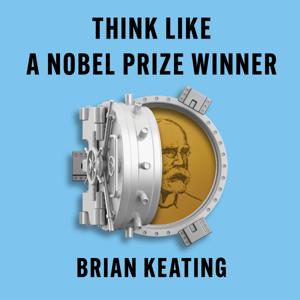
About Think Like A Nobel Prize Winner

From the publisher's feed

How can you unlock creativity and imagination to inspire, teach and lead? What mental models do some of the world’s brightest minds use to supercharge their creativity, and strengthen their most precious collaborations? Along the way you’ll discover that achieving greatness doesn’t require genius. Instead, dedication to a simple set of principles—habits and tools -- can boost your creativity, stoke your imagination, and unlock your full potential for out-of-this-universe success.

