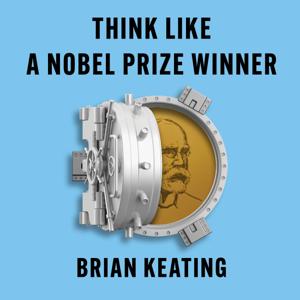
Think Like A Nobel Prize Winner

Think Like A Nobel Prize Winner

Download on the App Store

Think Like A Nobel Prize Winner episodes

  • Barry Barish Interviews Brian Keating: Part 2
    In February 2021 Dr. Barry Barish, co-recipient of the 2017 Nobel Prize in Physics for the LIGO experiment, interviewed me at his home in Los Angeles. The topic was his thoughts and reactions to my book, Losing the Nobel Prize (http://amzn.to/2sa5UpA). We discussed scientific leadership, academic stress, burnout, the role of mentors and managers in science and a lot about my book too.
    Losing The Nobel Prize By Brian Keating
    The inside story of a quest to unlock one of cosmology’s biggest mysteries, derailed by the lure of the Nobel Prize.
    What would it have been like to be an eyewitness to the Big Bang? In 2014, astronomers wielding BICEP2, the most powerful cosmology telescope ever made, revealed that they’d glimpsed the spark that ignited the Big Bang. Millions around the world tuned in to the announcement broadcast live from Harvard University, immediately igniting rumors of an imminent Nobel Prize. But had these cosmologists truly read the cosmic prologue or, swept up in Nobel dreams, had they been deceived by a galactic mirage?
    In Losing the Nobel Prize, cosmologist and inventor of the BICEP (Background Imaging of Cosmic Extragalactic Polarization) experiment Brian Keating tells the inside story of BICEP2’s mesmerizing discovery and the scientific drama that ensued. In an adventure story that spans the globe from Rhode Island to the South Pole, from California to Chile, Keating takes us on a personal journey of revelation and discovery, bringing to vivid life the highly competitive, take-no-prisoners, publish-or-perish world of modern science. Along the way, he provocatively argues that the Nobel Prize, instead of advancing scientific progress, may actually hamper it, encouraging speed and greed while punishing collaboration and bold innovation. In a thoughtful reappraisal of the wishes of Alfred Nobel, Keating offers practical solutions for reforming the prize, providing a vision of a scientific future in which cosmologists may, finally, be able to see all the way back to the very beginning.

    46 min
  • Barry Barish Interviews Brian Keating: Part 1
    In February 2021 Dr. Barry Barish, co-recipient of the 2017 Nobel Prize in Physics for the LIGO experiment, interviewed me at his home in Los Angeles. The topic was his thoughts and reactions to my book, Losing the Nobel Prize (http://amzn.to/2sa5UpA). We discussed scientific leadership, academic stress, burnout, the role of mentors and managers in science and a lot about my book too.
    Losing The Nobel Prize By Brian Keating
    The inside story of a quest to unlock one of cosmology’s biggest mysteries, derailed by the lure of the Nobel Prize.
    What would it have been like to be an eyewitness to the Big Bang? In 2014, astronomers wielding BICEP2, the most powerful cosmology telescope ever made, revealed that they’d glimpsed the spark that ignited the Big Bang. Millions around the world tuned in to the announcement broadcast live from Harvard University, immediately igniting rumors of an imminent Nobel Prize. But had these cosmologists truly read the cosmic prologue or, swept up in Nobel dreams, had they been deceived by a galactic mirage?
    In Losing the Nobel Prize, cosmologist and inventor of the BICEP (Background Imaging of Cosmic Extragalactic Polarization) experiment Brian Keating tells the inside story of BICEP2’s mesmerizing discovery and the scientific drama that ensued. In an adventure story that spans the globe from Rhode Island to the South Pole, from California to Chile, Keating takes us on a personal journey of revelation and discovery, bringing to vivid life the highly competitive, take-no-prisoners, publish-or-perish world of modern science. Along the way, he provocatively argues that the Nobel Prize, instead of advancing scientific progress, may actually hamper it, encouraging speed and greed while punishing collaboration and bold innovation. In a thoughtful reappraisal of the wishes of Alfred Nobel, Keating offers practical solutions for reforming the prize, providing a vision of a scientific future in which cosmologists may, finally, be able to see all the way back to the very beginning.
    55 min
  • James Altucher Interviews Brian Keating About Think Like A Nobel Prize Winner
    Dr. Brian Keating talks about his new book Think Like a Nobel Prize Winner. James and Brian discussed the traits of the Nobel Prize Winners, and what it means for them!
    James Altucher interviews the world’s leading peak performers in every area of life. But instead of giving you the typical success story, James digs deeper to find the “Choose Yourself” story—these are the moments we relate to… when someone rises up from personal struggle to reinvent themselves.
    https://jamesaltucher.com/
    Available on Amazon: Think Like a Nobel Prize Winner 
    About Professor Brian Keating:
    https://www.youtube.com/drbriankeating
    Podcast in iTunes
    https://simonsobservatory.org/
    https://briankeating.com/
    https://bkeating.physics.ucsd.edu/
    https://www.linkedin.com/in/drbriankeating/
    1 hr 36 min
  • Barry Barish: The Avuncular Avatar
    Barry Barish is the Linde Professor of Physics, Emeritus, at Caltech and faculty member at UC Riverside. He became director of the LIGO (Laser Interferometer Gravitational-Wave Observatory) project in 1997. In 2017, he was awarded the Nobel Prize in Physics along with Rai Weiss and Kip Thorne and their teams “for decisive contributions to the LIGO detector and the observation of gravitational waves.” Before joining the LIGO experiment, he worked on the Superconducting Super Collider, the high-profile particle accelerator that was canceled by Congress in 1993. He has many other awards, is a member of the National Academy of Sciences, and served as president of the American Physical Society in 2011. Barry is a consummate scientist. He has the hands-on technical expertise, the interpersonal skills to motivate and lead, and the scientific discipline to know when to quit and went to double down. 
    Available on Amazon: Think Like a Nobel Prize Winner 
    About Professor Brian Keating:
    https://www.youtube.com/drbriankeating
    Podcast in iTunes
    https://simonsobservatory.org/
    https://briankeating.com/
    https://bkeating.physics.ucsd.edu/
    https://www.linkedin.com/in/drbriankeating/
    1 hr 23 min
  • Brian Keating: Author Hour Interview on Think Like A Nobel Prize Winner
    Brian Keating: Author Hour Interview on Think Like A Nobel Prize Winner.
    Available on Amazon: Think Like a Nobel Prize Winner 
    About Professor Brian Keating:
    https://www.youtube.com/drbriankeating
    Podcast in iTunes
    https://simonsobservatory.org/
    https://briankeating.com/
    https://bkeating.physics.ucsd.edu/
    https://www.linkedin.com/in/drbriankeating/
    38 min
  • John Mather: The Collaborator
    John Mather is a senior astrophysicist at NASA’s Goddard Space Flight Center and a professor of physics at the University of Maryland’s College of Computer, Mathematical, and Natural Sciences. In 2006, he and George Smoot were awarded the Nobel Prize in Physics “for their discovery of the blackbody form and anisotropy of the cosmic microwave background radiation.” The work, completed along with their teams, used the COBE satellite to all but confirm the Big Bang theory—and elevated cosmologists, individuals previously derided by “real” physicists as being “always in error, but never in doubt,” into proper practitioners of precision science. 
    Available on Amazon: Think Like a Nobel Prize Winner 
    About Professor Brian Keating:
    https://www.youtube.com/drbriankeating
    Podcast in iTunes
    https://simonsobservatory.org/
    https://briankeating.com/
    https://bkeating.physics.ucsd.edu/
    https://www.linkedin.com/in/drbriankeating/
    1 hr 12 min
  • Rainer Weiss: The Tinkerer
    Rai Weiss is a professor emeritus at MIT, where he also earned his undergraduate degree and PhD. He, along with Barry Barish and Kip Thorne, won the 2017 Nobel Prize in Physics “for decisive contributions to the LIGO detector and the observation of gravitational waves,” work that was completed with the rest of their team of more than a thousand scientists, engineers, technicians, and managers. He has won numerous awards for his pioneering work on both the COBE (NASA’s Cosmic Background Explorer) and LIGO (Laser Interferometer Gravitational-Wave Observatory) projects. He is a member of the National Academy of Sciences, the American Physical Society, and many other professional societies.
    Weiss is a charming and consummate storyteller. His playful exuberance is incandescent. And I appreciate how forthright he is, as I think it is important to talk about the business of large projects and admit to the shortcomings rather than only discussing them with reverent worshipful praise. I admire that Weiss is relentlessly passionate even into his eighties. Just as a black hole shakes up space-time every few years, Weiss continues to pivot and switch direc- tion himself. It’s impossible not to think that this tendency has been responsible for his continued fertility of mind. He is a big-picture thinker that loves to keep things fresh by shaking himself out of complacency. 
    Available on Amazon: Think Like a Nobel Prize Winner
    About Professor Brian Keating:
    https://www.youtube.com/drbriankeating
    Podcast in iTunes
    https://simonsobservatory.org/
    https://briankeating.com/
    https://bkeating.physics.ucsd.edu/
    https://www.linkedin.com/in/drbriankeating/
    59 min
  • Sheldon Glashow: The Nucleator
    In 1979, Sheldon Glashow, Abdus Salam, and Steven Wein- berg were awarded the Nobel Prize in Physics “for their contributions to the theory of the unified weak and elec- tromagnetic interaction between elementary particles....” Born in Manhattan in 1932 to Russian immigrant parents, he is now a professor emeritus of physics at Harvard University and professor emeritus of mathematics and physics at Boston University. Like a nexus, he’s seemingly connected in one way or another to almost all of the amaz- ing physicists of the twentieth century, and as such has both created nucleation sites for ideas to flourish and also catalyzed other interactions whose effects are still being felt today.
    He is the classic figure of an American physicist and is allegedly the inspiration for the television character Shel- don Cooper on The Big Bang Theory. To be sure, Glashow is a bookish intellectual with a mischievous sense of humor. I admire that he is intellectually honest and rigorous but also playful and avuncular. He’s cherished not least for his ability to describe the mysterious aspects of nature in a playful, delightful way. And all of his writings about science—including the wonderful book Interactions, published in 1988, which provided a pathway for the future of physics as he perceived it at the time—make room for the role of serendipity and luck in those discoveries that could never have been forecasted, no matter how many prizes a scientist might have won. He still has a sense of wonder in his late eighties. 
    Available on Amazon: Think Like a Nobel Prize Winner 
    About Professor Brian Keating:
    https://www.youtube.com/drbriankeating
    Podcast in iTunes
    https://simonsobservatory.org/
    https://briankeating.com/
    https://bkeating.physics.ucsd.edu/
    https://www.linkedin.com/in/drbriankeating/
    1 hr 32 min
  • Adam Riess: The Star Gazer
    Adam Riess is a distinguished professor of physics at Johns Hopkins University and an astronomer at the Space Tele- scope Science Institute. In 2011, he shared the Nobel Prize in Physics with Brian Schmidt and Saul Perlmutter “for the discovery of the accelerating expansion of the universe through observations of distant supernovae.”  The work— done by a team—was recognized almost immediately (in Nobel years, at least), making Adam one of the youngest winners ever of the physics prize at age 41.
    Though we are contemporaries, I consider Adam Riess a role model. His relentless pursuit of topics of great meaning is inspirational. In 2005, he and I competed in a worldwide competition to determine who is a worthy successor to the great physicist Charles Townsend, winner of the 1963 Nobel Prize in Physics. I won first prize for my concept for the BICEP experiment—spoiler alert: I did not succeed in replicating Charlie Townsend’s renown—and third place went to Adam Riess. On the day he won the Nobel Prize, my brother Kevin said, “Brian, you won the battle, but he won the war”—something only a big brother would say. 
    Available on Amazon: Think Like a Nobel Prize Winner
    About Professor Brian Keating:
    https://www.youtube.com/drbriankeating
    Podcast in iTunes
    https://simonsobservatory.org/
    https://briankeating.com/
    https://bkeating.physics.ucsd.edu/
    https://www.linkedin.com/in/drbriankeating/
    1 hr 2 min

About Think Like A Nobel Prize Winner

From the publisher's feed

How can you unlock creativity and imagination to inspire, teach and lead? What mental models do some of the world’s brightest minds use to supercharge their creativity, and strengthen their most precious collaborations? Along the way you’ll discover that achieving greatness doesn’t require genius. Instead, dedication to a simple set of principles—habits and tools -- can boost your creativity, stoke your imagination, and unlock your full potential for out-of-this-universe success.