
Sign up to save your podcasts
Or



I want to close this Business Unusual season with communication.
But not presentation skills.
Not executive presence.
Not storytelling.
Not how to sound confident while saying very little in a meeting.
I want to talk about ethical communication.
The deeper question is not: “Did the communication work?”
The deeper question is: “What did the communication construct?”
That is where ethics begins.
If we want to understand the awareness available across an organisation, what exactly are we looking for?
Can an organisation be aware?
Strictly speaking, no.
An organisation does not have one mind.
It does not wake up in the morning.
It does not possess a single consciousness that can be given an AQ score.
When I use the phrase Organisational AQ, I am using shorthand.
I mean the demonstrated capacity of a system to make relevant awareness available, mobile, permissible and consequential — and then to learn from what follows.
In this episode, I want to introduce you to the concept of talking yourself out of a job.
A board cannot easily observe the frame through which it is observing.
So, who helps senior authority see its participation in the pattern?
Enter the consultant.
Consultancy has become one of the great rituals of organisational life.
The problem is, Something is not working.
The consultant arrives... and 6 months later, the organisation is using new language to reconstruct the old problem.
Let's change this!
In this episode, we move from the individual to the organisation.
Because even excellent coaching encounters a rather inconvenient fact.
A leader may expand their awareness in the coaching room, then return to an environment that rewards the old construction.
The culture contracts the choice that coaching helped make visible.
So today we are talking about culture, change, and the Cognitive Intentions that shape what an organisation repeatedly notices, permits and rewards.
From a Constructed Development Theory perspective, culture is construction repeated until it becomes normal.
Today, I want to move into coaching.
Because if leadership is constructed, the obvious question is:
How does a leader develop awareness of the person doing the constructing?
And here is the answer the coaching industry may not enjoy.
Most coaching is stagnant.
There are exceptional coaches doing careful, ethical, developmental work.
But much of what gets called coaching helps people move without helping them see the construction from which they are moving.
In other words, it's not developmental. Let's check out Next Level Coaching.
Today, we begin a new season.
Business Unusual.
And I want to start with Leadership.
Not leadership as inspiration.
Not leadership as style.
Not leadership as personality.
I want to talk about leadership as construction.
Today I want to finish this season with what I think is some very good news.
Because here’s something the self-development industry probably doesn’t want you to hear.
You’re probably not one breakthrough away from becoming a better person.
You’re one moment of awareness away.
Those aren’t the same thing.
Real development is usually much quieter than that.
It happens…
…five seconds earlier.
Let me start with something that every teacher should hear.
You never teach just one subject.
If you teach leadership…
you’re teaching what power looks like.
If you teach psychology…
you’re teaching what thinking is.
And if you teach adults…
you’re teaching adulthood itself.
Every teacher teaches two subjects.
The curriculum…
…and themselves.
But beneath all of that sits a much bigger question.
What kind of thinking environment am I constructing?
That’s the question I want to explore today.
Let me begin with something that may annoy a few universities.
Most higher education is not really adult education.
It is childhood education with older students.
We change the vocabulary.
And add coffee.
But underneath, the model often stays the same.
The teacher knows.
The learner receives.
The content is delivered.
The assessment checks whether the learner can reproduce it.
And the institution decides what counts as knowledge.
That is pedagogy.
Adult learning is not simply about content.
It is about construction.
And this is where the distinction between pedagogy and andragogy becomes important.
Pedagogy is traditionally associated with the education of children.
My new Phd will be exploring the content of this podcast on Andragogy next year. Enjoy and feel free to subscribe.
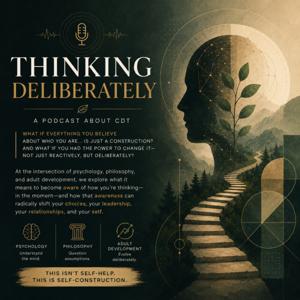
Welcome to Season 3 of Thinking Deliberately.
Welcome back to Thinking Deliberately.
Let me start with something that sounds outrageous.
Most adults don’t think like adults.
They have adult bodies.
Adult jobs. Some have PhDs.
Some run companies.
Some lead governments.
But psychologically?
Many are still waiting for somebody else to tell them who they are.
Let's get into it...