
Sign up to save your podcasts
Or



Today, we end the season with three of the great modern myths.
Motivation.
Manifestation.
And the belief that wanting a different life is the same as constructing one.
You may not need more motivation.
You may not need to manifest harder.
You may not need another myth to make your current self feel meaningful.
You may need the awareness to ask whether the self doing the wanting is developed enough to be trusted.
In this episode, I want to take on a model that many people know, many people like, and many people have found useful.
The Chimp Paradox.
Now, let me say this carefully.
I understand why The Chimp Paradox became popular.
It gives people a simple way to think about emotional reactivity.
It externalises the part of us that lashes out, panics, sulks, competes, becomes territorial, feels threatened, craves approval, or behaves irrationally.
It says, in effect:
“That was your chimp.”
But from a Constructed Development Theory perspective, it does not go far enough.
In this episode, I want to look at another idea that has become almost sacred in self-development, coaching, education, therapy, leadership, and popular psychology.
Neuroplasticity.
Now, neuroplasticity is a real and important idea.
The brain can change.
Experience shapes neural pathways.
But here is the problem.
The self-development world took the phrase “the brain can change” and turned it into a motivational slogan.
That is the problem.
Neuroplasticity tells us the brain can change.
It does not tell us what kind of self is doing the changing.
It does not tell us what level of awareness is organising the change.
And this is why I want to introduce a different idea.
Neuroconstruction.
A person constructs self, context, and response under pressure — and then everyone else has to live in the environment that construction creates.
Today, I want to look at something closely related.
Impostor syndrome.
And its much more dangerous opposite.
False authority confidence.
Now, impostor syndrome is everywhere.
Many competent people do feel like impostors.
But I think we have allowed the phrase to become too broad, too sentimental, and too flattering.
Today, we move into leadership.
And I want to start with a statement that will annoy trainers, consultants, business schools, HR departments, leadership coaches, and probably half of LinkedIn.
Leadership styles are nonsense.
The idea that leadership can be meaningfully understood as a set of fixed styles is one of the great comforting simplifications of organisational life.
This is the third episode in the short series on WHY ARE YOU USING CDT. Jeff is new to the game and his perspective at this stage will be interesting. He is at the stage now where he is capable of applying it in situ with his manages and employees, and says it's helping define behaviours as he understands their THINKING CONSTRUCTION.Jeff's transitional period between unaware to aware is key here, and he will be writing a paper on this soon.In the meantime, check out why Jeff is USING CDT and how it has massively helped GROW HIS THINKING!
Here is another episode in our series on how colleagues and practitioners use CDT and NLC in their work.Louise is an exceptional thinker and is more than capable of applying developmental thinking to her every-day tasks, choosing the best outcome in the moment. Especially where others might not see it.It doesn't matter if you're not a COACH, you can still use the developmental principles of CDT in your daily life. How are you CONSTRUCTING your thinking right now?Like and subscribe should you wish to.
In this new series of interviews, Dr DARREN STEVENS will interview those people and colleagues who are using Constructed Development Theory and Next Level Coaching in their businesses and determine why they do so.SEAN ELLIS COACHING is using CDT and Next Level Coaching in their approach to developing clients and it's paying dividends, according to the excellent Sean Ellis.There are many systems out there, and other organisations we could belong to, but why the IAD and why CDT? SEAN gives his views on this.This is a great interview so enjoy and keep your eyes peeled for the next ones. Remember to Like and Subscribe.
In the last episode, we took a swing at Emotional Intelligence, because it often fails to measure the thing that matters most:
Awareness of construction.
Today, I want to continue the demolition. And this time, I want to talk about personality types. People love them.
They love them because they feel seen.
They love them because they offer language.
They love them because they turn the chaos of being human into something tidy enough to put on a slide.
But that's not enough. Constructed Development Theory offers more...
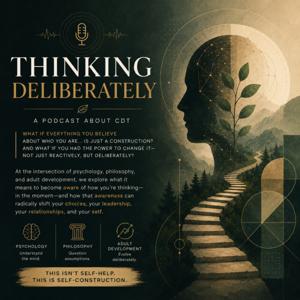
Welcome back to Thinking Deliberately.
We have now finished the first foundation arc.
We have looked at thinking as the problem.
We have looked at the self as a construction.
We have explored Dynamic Intelligence.
We have introduced the Awareness Quotient.
We have challenged the myth of personality.
And in the last episode, we brought together the Four Pillars of conscious construction:
Intention. Awareness. Choice. Response.
Now we move into more dangerous territory.
Because for the next few episodes, I want to start pulling apart some of the ideas that have become strangely sacred in psychology, coaching, leadership, education, and self-development.
And I want to start with one of the big ones.
Emotional Intelligence.
Let's dive in and see (hear) how Constructed Development Theory deals with it.