
Sign up to save your podcasts
Or

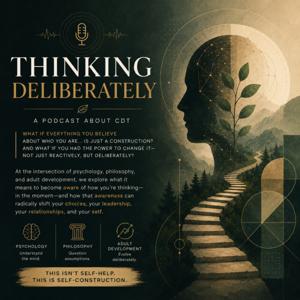


Today, we bring the first arc together.
Because if the self is constructed, and if response is constructed, then we need a way of understanding how that construction happens.
In Constructed Development Theory, this process can be understood through four pillars:
Intention.
Awareness.
Choice.
Response.
I call these the Four Pillars of conscious construction.
You are not simply reacting to life.
You are constructing responses from intentions you may not have examined, through awareness you may not yet have developed, into choices you may not fully possess.
Today, I want to offend one of the most popular ideas in modern psychology and self-development.
Personality.
Or more precisely, the way we worship personality.
Because somewhere along the way, we started treating personality labels as if they were explanations.
Your personality may not be who you are.
It may simply be the pattern you have not yet become aware enough to choose beyond.
Today, we need to talk about awareness.
Because awareness is one of those words people use as if everyone knows what it means.
They do not.
In fact, I think awareness has been softened, spiritualised, commercialised, and quietly ruined.
They talk about awareness as if it means being mindful, compassionate, present, balanced, enlightened, or good at posting inspirational quotes over pictures of mountains.
It does not.
Awareness is proven by what becomes available to you while the construction is happening.
I begin this episode by saying something that clever people may find irritating.
Being clever is not enough.
In fact, being clever can be a developmental problem. A clever person can build a beautiful argument around an unconscious reaction. They can explain why they were right, why they had no choice, why the other person misunderstood them.
And underneath all that intelligence, the same old construction remains untouched.
Listen to find out more!
In this episode, I introduce Constructed Development Theory, or CDT, and explain how it's not simply another personality model. It is not a new set of labels to stick on yourself. It is not a typology.
CDT asks a different kind of question.
Not: “What type of person are you?”
But: “How are you constructing yourself, your context, and your response right now?”
In this first episode of The Thinking Deliberately podcast, we begin by explaining why you are the problem. To be clear, I mean the way you think you are thinking is the problem.
This episode sets the scene for the rest of the podcast by introducing the concepts and thinking behind it: Constructed Development Theory.