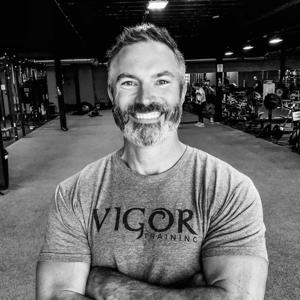
Tom Nikkola | VIGOR Training

Tom Nikkola | VIGOR Training

By Tom Nikkola | VIGOR TrainingHealth & FitnessNutritionMental HealthFitness
Download on the App Store

Tom Nikkola | VIGOR Training episodes

  • My 30-Second (Accidental) Meditation Experiment
    I hardly notice the guy behind me, grunting like he's having an orgasm.
    Instead, I'm zoned in on the second hand of my stopwatch. It’s like a one-direction metronome. Tick, tick, tick.
    A text notification pops up on my phone screen and I quickly wipe it away without looking at who it's from.
    Tick, tick, tick.
    From the corner of my eye I catch a lady doing some movement she must have seen from a Jane Fonda video. “That’s not going to do anything. Eyes on the clock,” I think. 
    Tick, tick, tick.
    Whenever my mind wanders, I draw it back to the stopwatch.
    I programmed this block of VIGOR Strength Athlete with 30 second rest periods, and lots and lots of sets. 
    I find myself cherishing every second of my rest periods, never feeling like they're long enough.
    Though I don't often include such short rest periods in the training program, I did so in this training block for a few reasons:
    To increase muscular stress by keeping rest periods short enough that you don't fully recover before the next setTo use lighter training loads light enough to give joints and the nervous system a break (we worked them pretty hard in previous training blocks)To improve physical stamina and “staying power” by doing much more work in each session than usual 
    I planned these short rest periods specifically for the phyical benefits.
    I wasn’t expecting the mental effects, including better focus, reduced stress, and mental refreshment.
    Multitasking My Training Sessions
    Several years ago, I developed a bad workout habit. It isn’t as dumb as drinking beer before a workout, or smoking cigarettes after. But, it’s dumb nonetheless.
    In an attempt to be more productive during my rest periods between sets, I’d answer emails, respond to comments on Facebook, reply to text messages, research topics for articles, or even knock out a few sentences of blog post drafts.
    I thought I was more productive, making use of every nook and cranny in my daily calendar. And while I might have made a tiny bit of progress in my to-do list, multitasking during my training sessions affected my mental outlook in a way I didn’t understand until recently.
    You know how silent it seems when you sit in your car after being at a concert? You don’t realize how loud it was until you sit in your car in silence.
    I didn’t realize how frazzled I felt following my workouts until I finished my workouts without feeling frazzled. My recent training sessions, with only 30 seconds to rest, didn’t allow me to multitask. And by eliminating the multitasking, I no longer felt frazzled.
    It reminded me of a book I read least year, Deep Work by Cal Newport. I remembered reading about Newport’s explanation of task switching and attention residue.
    Task-Switching and Attention Residue
    Task-switching is the mental and physical act of turning your attention from one topic, activity, or problem, to another.
    In my case, I’d focus all my attention on executing an exercise, and then 15 seconds later turn my attention to a work-related task. Two minutes later, I’d try to mentally let go of whatever I was working on, and put my complete focus on another set.
    I’d repeat that cycle over and over for my entire training session.
    Just as your exercising muscles produce a byproduct called lactate, task-switching produces a byproduct called attention residue. It’s leftover mental and emotional attention, hanging on in your head, from a previous task as you begin a new one.
    As attention residue builds up, so does your level of stress and mental fatigue.
    Of course, this issue isn’t unique to the gym. It’s everywhere. 
    Workplace Interruptions, Productivity, and Employee Satisfaction
    A 2011 study showed that knowledge workers get interrupted 85 times per workday. That’s more than 10 times an hour in an 8-hour shift! And that was 2011. It’s probably much worse today.
    Some research also shows that it can take up to 15 minutes after an interruptio...
    9 min
  • My 30-Second (Accidental) Meditation Experiment

    I hardly notice the guy behind me, grunting like he's having an orgasm.


    Instead, I'm zoned in on the second hand of my stopwatch. It’s like a one-direction metronome. Tick, tick, tick.


    A text notification pops up on my phone screen and I quickly wipe it away without looking at who it's from.


    Tick, tick, tick.


    From the corner of my eye I catch a lady doing some movement she must have seen from a Jane Fonda video. “That’s not going to do anything. Eyes on the clock,” I think. 


    Tick, tick, tick.


    Whenever my mind wanders, I draw it back to the stopwatch.


    I programmed this block of VIGOR Strength Athlete with 30 second rest periods, and lots and lots of sets. 


    I find myself cherishing every second of my rest periods, never feeling like they're long enough.


    Though I don't often include such short rest periods in the training program, I did so in this training block for a few reasons:


    * To increase muscular stress by keeping rest periods short enough that you don't fully recover before the next set* To use lighter training loads light enough to give joints and the nervous system a break (we worked them pretty hard in previous training blocks)* To improve physical stamina and “staying power” by doing much more work in each session than usual 


    I planned these short rest periods specifically for the phyical benefits.


    I wasn’t expecting the mental effects, including better focus, reduced stress, and mental refreshment.


    Multitasking My Training Sessions


    Several years ago, I developed a bad workout habit. It isn’t as dumb as drinking beer before a workout, or smoking cigarettes after. But, it’s dumb nonetheless.


    In an attempt to be more productive during my rest periods between sets, I’d answer emails, respond to comments on Facebook, reply to text messages, research topics for articles, or even knock out a few sentences of blog post drafts.


    I thought I was more productive, making use of every nook and cranny in my daily calendar. And while I might have made a tiny bit of progress in my to-do list, multitasking during my training sessions affected me my mental outlook in a way I didn’t understand until recently.


    You know how silent it seems when you sit in your car after being at a concert? You don’t realize how loud it was until you sit in your car in silence.


    I didn’t realize how frazzled I felt following my workouts until I finished my workouts without feeling frazzled. My recent training sessions, with only 30 seconds to rest, didn’t allow me to multitask. And by eliminating the multitasking, I no longer felt frazzled.


    It reminded me of a book I read least year, Deep Work by Cal Newport. I remembered reading about Newport’s explanation of task switching and attention residue.


    Task-Switching and Attention Residue


    Task-switching is the mental and physical act of turning your attention from one topic, activity, or problem, to another.


    In my case, I’d focus all my attention on executing an exercise, and then 15 seconds later turn my attention to a work-related task. Two minutes later, I’d try to mentally let go of whatever I was working on,
    10 min
  • My 30-Second (Accidental) Meditation Experiment
    I hardly notice the guy behind me, grunting like he's having an orgasm.
    Instead, I'm zoned in on the second hand of my stopwatch. It’s like a one-direction metronome. Tick, tick, tick.
    A text notification pops up on my phone screen and I quickly wipe it away without looking at who it's from.
    Tick, tick, tick.
    From the corner of my eye I catch a lady doing some movement she must have seen from a Jane Fonda video. “That’s not going to do anything. Eyes on the clock,” I think. 
    Tick, tick, tick.
    Whenever my mind wanders, I draw it back to the stopwatch.
    I programmed this block of VIGOR Strength Athlete with 30 second rest periods, and lots and lots of sets. 
    I find myself cherishing every second of my rest periods, never feeling like they're long enough.
    Though I don't often include such short rest periods in the training program, I did so in this training block for a few reasons:
    To increase muscular stress by keeping rest periods short enough that you don't fully recover before the next setTo use lighter training loads light enough to give joints and the nervous system a break (we worked them pretty hard in previous training blocks)To improve physical stamina and “staying power” by doing much more work in each session than usual 
    I planned these short rest periods specifically for the phyical benefits.
    I wasn’t expecting the mental effects, including better focus, reduced stress, and mental refreshment.
    Multitasking My Training Sessions
    Several years ago, I developed a bad workout habit. It isn’t as dumb as drinking beer before a workout, or smoking cigarettes after. But, it’s dumb nonetheless.
    In an attempt to be more productive during my rest periods between sets, I’d answer emails, respond to comments on Facebook, reply to text messages, research topics for articles, or even knock out a few sentences of blog post drafts.
    I thought I was more productive, making use of every nook and cranny in my daily calendar. And while I might have made a tiny bit of progress in my to-do list, multitasking during my training sessions affected my mental outlook in a way I didn’t understand until recently.
    You know how silent it seems when you sit in your car after being at a concert? You don’t realize how loud it was until you sit in your car in silence.
    I didn’t realize how frazzled I felt following my workouts until I finished my workouts without feeling frazzled. My recent training sessions, with only 30 seconds to rest, didn’t allow me to multitask. And by eliminating the multitasking, I no longer felt frazzled.
    It reminded me of a book I read least year, Deep Work by Cal Newport. I remembered reading about Newport’s explanation of task switching and attention residue.
    Task-Switching and Attention Residue
    Task-switching is the mental and physical act of turning your attention from one topic, activity, or problem, to another.
    In my case, I’d focus all my attention on executing an exercise, and then 15 seconds later turn my attention to a work-related task. Two minutes later, I’d try to mentally let go of whatever I was working on, and put my complete focus on another set.
    I’d repeat that cycle over and over for my entire training session.
    Just as your exercising muscles produce a byproduct called lactate, task-switching produces a byproduct called attention residue. It’s leftover mental and emotional attention, hanging on in your head, from a previous task as you begin a new one.
    As attention residue builds up, so does your level of stress and mental fatigue.
    Of course, this issue isn’t unique to the gym. It’s everywhere. 
    Workplace Interruptions, Productivity, and Employee Satisfaction
    A 2011 study showed that knowledge workers get interrupted 85 times per workday. That’s more than 10 times an hour in an 8-hour shift! And that was 2011. It’s probably much worse today.
    Some research also shows that it can take up to 15 minutes after an interruptio...
    9 min
  • Collagen Peptides: Health Benefits and How to Supplement
    Judging by its recent popularity, you might think the health benefits of collagen are new discoveries. However, an original "girl boss" named Hildegard of Bingen first wrote of its pain-relieving effects in 1175.
    Living in medieval Germany, St. Hildegard was a Benedictine abbess and polymath. She was a writer, composer, philosopher, and Christian mystic. Not surprisingly, she was pretty smart when it came to holistic medicine too.
    I imagine her looking at a pot of stew that had cooled, wondering if the fatty gel that sat on top of the stew had any health benefits. Maybe she scooped it off and ate it. And after repeating for long enough, perhaps she noticed a difference in how her joints felt. Who knows...
    At the impressive age of 77 years old, she wrote about the pain-relieving benefits of collagen. She lived another four years. Living to 81 years old was pretty impressive back then.
    What is Collagen?
    Collagen provides a scaffolding for most of the tissues in your body. It connects muscle to bone and bone to bone, while also building cartilage that lets your bones slide over one another without causing pain in your joints. It keeps your organs in place...for that matter, it keeps your face in place too.
    It isn’t as hard as bone, but is stronger than muscle tissue due to its amino acid structure.
    Collagen makes up about 30% of the total protein mass in the body, and 70% of the dry weight of the skin dermis.
    As you age, collagen breaks down. Exercise and overuse can also cause its breakdown. Collagen breakdown can lead to connective tissue injuries like torn bicep tendons or Achilles tendons, loss of joint cartilage, saggy skin, wrinkles, and cellulite.
    Anti-aging doctors have been injecting collagen into patients' faces for quite some time, in hopes of restoring their youth.
    As you age, you lose collagen, making your face droop and your lips get smaller, unless you get it injected, as do many celebrities. Though it may not produce an immediate effect, it's possible you could look and feel younger by consuming it instead of injecting it.
    Dietary Sources
    In case you need another reason to get off the vegan bandwagon, you only get collagen by eating it. 
    Meat has collagen. Mushrooms don’t.
    Poultry has collagen. Peanuts and potatoes don’t.
    Fish has collagen. Fava beans don’t.
    If you want the benefits of collagen, you’ll need to eat it or supplement with it. There’s no plant on the planet that contains it.
    That said, even meat-eaters often miss their opportunity to consume collagen in everyday meals. Chewing tendons, bones, and skin isn’t that appealing, unless you're eating slow-cooked ribs at a barbecue restaurant.
    Actually, crispy chicken or turkey skin, or pork rinds are pretty good, too. But, you’re probably not eating them every day.
    For the most part, the collagen-containing parts of meat, poultry, and fish have been seen as waste products. Hides, bones, and tendons usually get tossed aside.
    Interestingly, this is how the whey protein market evolved too. Whey was once seen as a byproduct of cheese manufacturing, and tossed aside. Yet it’s the highest biological value protein source on the planet, and a staple in the diet of health and fitness folks everywhere today.
    Biological Value
    Contrary to whey protein, which has the highest biological value, collagen was considered worthless because it has such a low biological value.
    The concentration of essential amino acids in a protein determines its biological value. Collagen has very little essential amino acids, so it was ignored for most of modern history.
    Outside of using gelatin to make jello shots for a college party, or a gelatin dessert when you want to gross out your guests, it didn’t seem to have any value.
    Nutrition scientists believed the digestive process would break collagen down to the amino acids it was made from, and those amino acids would offer little value. However,
    18 min
  • Collagen Peptides: Health Benefits For Your Knees, Cheeks, Lips and Hips


    Judging by its recent popularity, you might think the health benefits of collagen are new discoveries. However, an original "girl boss" named Hildegard of Bingen first wrote of the pain-relieving effects of collagen in 1175.


    Living in medieval Germany, St. Hildegard was a Benedictine abbess and polymath. She was a writer, composer, philosopher, and Christian mystic. Not surprisingly, she was pretty smart when it came to holistic medicine too.


    I imagine her looking at a pot of stew that had cooled, wondering if the fatty gel that sat on top of the stew had any health benefits. Maybe she scooped it off and ate it. And after repeating for long enough, perhaps she noticed a difference in how her joints felt. Who knows...


    At the impressive age of 77 years old, she wrote about the pain-relieving benefits of collagen. She lived another four years. Living to 81 years old was pretty impressive back then.


    But enough about St. Hildegard of Bingen. Let's get into the health benefits of collagen.


    Over the last several years, collagen has become one of the most popular nutritional supplements.


    How did this waste product of meat, poultry, and fish processing become an anti-aging, injury-healing, joint health-inducing superstar?


    What is collagen? What should you look for when buying a collagen supplement, and how does it fit in with your high-protein diet?


    Read on and find out.


    What is Collagen?


    Collagen provides a scaffolding for most of the tissues in your body. It connects muscle to bone and bone to bone, while also building cartilage that lets your bones slide over one another without causing pain in your joints. It keeps your organs in place...for that matter, it keeps your face in place too.


    It isn’t as hard as bone, but is stronger than muscle tissue due to its amino acid structure.


    Collagen makes up about 30% of the total protein mass in the body, and 70% of the dry weight of the skin dermis.


    As you age, collagen breaks down. Exercise and overuse can also cause collagen breakdown. Collagen breakdown can lead to connective tissue injuries like torn bicep tendons or Achilles tendons, loss of joint cartilage, saggy skin, wrinkles, and cellulite.


    Anti-aging doctors have been injecting collagen into patients' faces for quite some time, in hopes of restoring their youth.


    As you age, you lose collagen, making your face droop and your lips get smaller. You've probably seen at least one celebrity who's taken their collagen treatment to an extreme.


    Though it may not produce an immediate effect, it's possible you could look and feel younger by consuming, instead of injecting collagen.


    Eating Collagen Helps You Grow Collagen


    In case you need another reason to get off the vegan bandwagon, you only get collagen by eating collagen. 


    Meat has collagen. Mushrooms don’t.


    Poultry has collagen. Peanuts and potatoes don’t.


    Fish has collagen. Fava beans don’t.


    If you want the benefits of collagen, you’ll need to eat or supplement with collagen. There’s no plant on the planet that contains collagen.


    That said, even meat-eaters often miss their opportunity to consume collagen in everyday meals. Chewing tendons, bones, and skin isn’t that appealing,
    21 min
  • Collagen Peptides: Health Benefits and How to Supplement


    Judging by its recent popularity, you might think the health benefits of collagen are new discoveries. However, an original "girl boss" named Hildegard of Bingen first wrote of its pain-relieving effects in 1175.


    Living in medieval Germany, St. Hildegard was a Benedictine abbess and polymath. She was a writer, composer, philosopher, and Christian mystic. Not surprisingly, she was pretty smart when it came to holistic medicine too.


    I imagine her looking at a pot of stew that had cooled, wondering if the fatty gel that sat on top of the stew had any health benefits. Maybe she scooped it off and ate it. And after repeating for long enough, perhaps she noticed a difference in how her joints felt. Who knows...


    At the impressive age of 77 years old, she wrote about the pain-relieving benefits of collagen. She lived another four years. Living to 81 years old was pretty impressive back then.


    What is Collagen?


    Collagen provides a scaffolding for most of the tissues in your body. It connects muscle to bone and bone to bone, while also building cartilage that lets your bones slide over one another without causing pain in your joints. It keeps your organs in place...for that matter, it keeps your face in place too.


    It isn’t as hard as bone, but is stronger than muscle tissue due to its amino acid structure.


    Collagen makes up about 30% of the total protein mass in the body, and 70% of the dry weight of the skin dermis.


    As you age, collagen breaks down. Exercise and overuse can also cause its breakdown. Collagen breakdown can lead to connective tissue injuries like torn bicep tendons or Achilles tendons, loss of joint cartilage, saggy skin, wrinkles, and cellulite.


    Anti-aging doctors have been injecting collagen into patients' faces for quite some time, in hopes of restoring their youth.


    As you age, you lose collagen, making your face droop and your lips get smaller, unless you get it injected, as do many celebrities. Though it may not produce an immediate effect, it's possible you could look and feel younger by consuming it instead of injecting it.


    Dietary Sources


    In case you need another reason to get off the vegan bandwagon, you only get collagen by eating it. 


    Meat has collagen. Mushrooms don’t.


    Poultry has collagen. Peanuts and potatoes don’t.


    Fish has collagen. Fava beans don’t.


    If you want the benefits of collagen, you’ll need to eat it or supplement with it. There’s no plant on the planet that contains it.


    That said, even meat-eaters often miss their opportunity to consume collagen in everyday meals. Chewing tendons, bones, and skin isn’t that appealing, unless you're eating slow-cooked ribs at a barbecue restaurant.


    Actually, crispy chicken or turkey skin, or pork rinds are pretty good, too. But, you’re probably not eating them every day.


    For the most part, the collagen-containing parts of meat, poultry, and fish have been seen as waste products. Hides, bones, and tendons usually get tossed aside.


    Interestingly, this is how the whey protein market evolved too. Whey was once seen as a byproduct of cheese manufacturing, and tossed aside. Yet it’s the highest biological value protein source on the planet, and a staple in the diet of health and fitness folks everywhere today.


    21 min
  • Collagen Peptides: Health Benefits and How to Supplement
    Judging by its recent popularity, you might think the health benefits of collagen are new discoveries. However, an original "girl boss" named Hildegard of Bingen first wrote of its pain-relieving effects in 1175.
    Living in medieval Germany, St. Hildegard was a Benedictine abbess and polymath. She was a writer, composer, philosopher, and Christian mystic. Not surprisingly, she was pretty smart when it came to holistic medicine too.
    I imagine her looking at a pot of stew that had cooled, wondering if the fatty gel that sat on top of the stew had any health benefits. Maybe she scooped it off and ate it. And after repeating for long enough, perhaps she noticed a difference in how her joints felt. Who knows...
    At the impressive age of 77 years old, she wrote about the pain-relieving benefits of collagen. She lived another four years. Living to 81 years old was pretty impressive back then.
    What is Collagen?
    Collagen provides a scaffolding for most of the tissues in your body. It connects muscle to bone and bone to bone, while also building cartilage that lets your bones slide over one another without causing pain in your joints. It keeps your organs in place...for that matter, it keeps your face in place too.
    It isn’t as hard as bone, but is stronger than muscle tissue due to its amino acid structure.
    Collagen makes up about 30% of the total protein mass in the body, and 70% of the dry weight of the skin dermis.
    As you age, collagen breaks down. Exercise and overuse can also cause its breakdown. Collagen breakdown can lead to connective tissue injuries like torn bicep tendons or Achilles tendons, loss of joint cartilage, saggy skin, wrinkles, and cellulite.
    Anti-aging doctors have been injecting collagen into patients' faces for quite some time, in hopes of restoring their youth.
    As you age, you lose collagen, making your face droop and your lips get smaller, unless you get it injected, as do many celebrities. Though it may not produce an immediate effect, it's possible you could look and feel younger by consuming it instead of injecting it.
    Dietary Sources
    In case you need another reason to get off the vegan bandwagon, you only get collagen by eating it. 
    Meat has collagen. Mushrooms don’t.
    Poultry has collagen. Peanuts and potatoes don’t.
    Fish has collagen. Fava beans don’t.
    If you want the benefits of collagen, you’ll need to eat it or supplement with it. There’s no plant on the planet that contains it.
    That said, even meat-eaters often miss their opportunity to consume collagen in everyday meals. Chewing tendons, bones, and skin isn’t that appealing, unless you're eating slow-cooked ribs at a barbecue restaurant.
    Actually, crispy chicken or turkey skin, or pork rinds are pretty good, too. But, you’re probably not eating them every day.
    For the most part, the collagen-containing parts of meat, poultry, and fish have been seen as waste products. Hides, bones, and tendons usually get tossed aside.
    Interestingly, this is how the whey protein market evolved too. Whey was once seen as a byproduct of cheese manufacturing, and tossed aside. Yet it’s the highest biological value protein source on the planet, and a staple in the diet of health and fitness folks everywhere today.
    Biological Value
    Contrary to whey protein, which has the highest biological value, collagen was considered worthless because it has such a low biological value.
    The concentration of essential amino acids in a protein determines its biological value. Collagen has very little essential amino acids, so it was ignored for most of modern history.
    Outside of using gelatin to make jello shots for a college party, or a gelatin dessert when you want to gross out your guests, it didn’t seem to have any value.
    Nutrition scientists believed the digestive process would break collagen down to the amino acids it was made from, and those amino acids would offer little value. However,
    18 min
  • Should I get a flu shot? Pros, cons, and facts you should know

    Should I get a flu shot? Based on the advertising every fall, it would seem that you should. But is the focus on flu shots supported by facts?


    The majority of people I know don't get the flu shot, But across the population, avoiding the flu shot could be more the exception than the rule.


    If you're for or against the flu shot or stuck on the fence, this blog post will give you some crucial points to consider. 


    Adults ought to make their own informed decisions about their health and the health of their families. That's especially the case today, now that the COVID-19 pandemic is part of the discussion.


    Unfortunately, most people are not informed.


    Influenza-Like Illness


    The flu begins as a respiratory infection. More than 200 viruses can cause Influenza-Like Illness (ILI). The influenza virus can cause ILI, but so can many other viruses.


    Per the CDC, flu symptoms include:


    Flu SymptomsCongestion or runny noseCoughDiarrheaFatigue and weaknessFever or chillsHeadacheMuscle or body achesNausea or vomitingSore throat


    How does that compare to COVID-19 symptoms? Again, from the CDC, COVID-19 symptoms include:


    COVID-19 SymptomsCongestion or runny noseCoughDiarrheaFatigue or weaknessFever or chillsHeadacheMuscle or body achesNausea or vomitingNew loss of taste or smell


    They look pretty similar, don't they? With so many people exposed to the COVID-19 virus today, many doctors will undoubtedly diagnose patients with COVID-19 instead of the flu, even though they would have had the flu even if they weren't carrying the COVID-19 virus.


    Like COVID-19, certain people are at greater risk for severe flu cases, including those who:


    * Are elderly and immunocompromised* Are obese* Have diabetes* Have heart disease* Have asthma


    If you're over the age of 40, when you were a kid and got the flu, you probably stayed home from school for a day or two, watched boring daytime TV, and drank Sprite while lying on the couch, under a blanket.


    You knew that getting sick once in a while was just part of living. You didn't live in fear of the flu.


    Today, marketing and political and financial interests have created a massive fear about a common illness.


    And with COVID-19 in the picture, the promotion of panic is at a whole other level.


    How Does the Flu Vaccine Work?


    You might think the flu shot gives you some superpower to combat the flu. That's not how it works.


    The flu shot doesn't guarantee you'll avoid the flu. It reduces the likelihood you'll get it, only if you get infected by the same strain the vaccine contains.


    When someone says, "I've gotten the flu shot for ten years in a row, and I haven't gotten the flu one time," their avoidance of the flu and getting the flu shot could be pure coincidence.


    "When someone says, "I've never gotten the flu shot, and I never get the flu," that could also be a coincidence.


    When someone says, "I got the flu shot, and the next day I felt like I had the flu," that could most definitely be the result of the flu shot.


    Influenza viruses cause influenza-like illness in only 7-15% of cases. Other viruses that cause influenza-like illness include:


    * respiratory syncytial virus, which causes a respiratory infection* rhinovirus, which causes the common cold* adenovirus,
    31 min
  • What’s the best diet? Low-carb, low-fat, or high-protein?
    Which is the best diet for building a long-living, lean, fit body; low-carb, keto, low-fat, or high-protein?
    If you're looking for the short answer, it's a high-protein diet.
    Does that mean low-fat or low-carb diets never work? Not necessarily.
    In this article, I'll explain a little of the pros and cons of each diet. By the end, you should be able to see why a high-protein diet is the way to go for almost everyone.
    Before getting to the diets, though, I need to address some basic nutrition science, and tackle the topic of why "calories in, calories out" isn't as simple as your smartphone app would have you believe it to be.
    Calories, Macronutrients, Basic Math
    Obviously, the foods we eat contain calories. You see them posted on packages, restaurant menus, and alcohol bottles. When it’s not labeled, you can find it online.
    We’ve grown to love the idea of counting calories because…well, we can count them. Not accurately, but we’ve been led to believe we can count them with a reasonable amount of accuracy.
    We know that our love handles, saddle bags, and double chins are storage pouches of the calories we ate but didn’t need. And we believe that the way we get rid of them is to simply eat fewer calories.
    To a certain extent, it does work.
    When I was 15 years old, my ski jumping coach told me I needed to lose weight in order to be more competitive. I knew about calorie counts back then, so I decided to eat no more than 500 calories per day.
    I filled up on diet pop and soda water, ate a few ounces of lunch meat each day and some vegetables, and once a week I went to the convenience store so I could splurge on salsa sandwiches.
    Within a few months, I dropped my 5’10”, 154 lb frame down to 137 lbs.
    I looked more like a meth addict than a ski jumper, but the scale said I did a good job with my diet.
    Oh, in case you’re judging my parents, I lived in a dorm at Northern Michigan University, where they had an Olympic Training Center for ski jumping, for my junior year of high school. My parents were horrified the first time they saw me after my “successful” weight loss at a ski jumping tournament.
    And herein lies one of the biggest problems about using only calories as a means of weight loss. 
    You lose as much muscle as you lose body fat.
    And at an extreme, you can cause significant damage to your metabolism, such as diet-induced hypothyroidism.
    The Flaws In Calories In, Calories Out
    At an extreme, like my 500 calorie diet, you can lose weight. It’s a dumb way to do it, but it’s possible.
    More often, though, people are encouraged to follow a long-term, chronically restricted diet to “slowly” lose weight.
    This is just as bad as my asinine anorexic method. But, probably more frustrating because you live in constant deprivation, but don’t see any results from your efforts.
    We’ve been sold the idea that weight loss and weight gain is just about calories for decades now. It goes something like this:
    A pound of fat contains 3500 calories. Therefore, to lose a pound per week of body fat, you just need to eat 500 calories per day fewer than you burn.
    In business, this is called spreadsheet math. Spreadsheet math doesn’t account for any variables outside of the simple formula put into the spreadsheet. Just as businesses don’t grow according to numbers put into a spreadsheet, you don’t lose weight according to formulas either.
    The calories in, calories out equation doesn’t account for the following:
    Calorie counts on food labels and nutrition sites are not accurate.
    People who estimate the amount of food they eat consistently underestimate their carbohydrate and fat-containing foods, and (from my experience) overestimate the amount of protein they eat.
    Your resting metabolic rate varies dramatically based on lifestyle and nutrition choices.
    The calorie expenditure on your favorite piece of cardio equipment, or on your heart rate monitor or movement track...

    28 min
  • Low-Carb vs Low-Fat vs High-Protein: Which diet is best?


    Which is the best diet for building a long-living, lean, fit body; low-carb, keto, low-fat, or high-protein?


    If you're looking for the short answer, it's a high-protein diet.


    Does that mean low-fat or low-carb diets never work? Not necessarily.


    In this article, I'll explain a little of the pros and cons of each diet. By the end, you should be able to see why a high-protein diet is the way to go for almost everyone.


    Before getting to the diets, though, I need to address some basic nutrition science, and tackle the topic of why "calories in, calories out" isn't as simple as your smartphone app would have you believe it to be.


    Calories, Macronutrients, Basic Math


    Obviously, the foods we eat contain calories. You see them posted on packages, restaurant menus, and alcohol bottles. When it’s not labeled, you can find it online.


    We’ve grown to love the idea of counting calories because…well, we can count them. Not accurately, but we’ve been led to believe we can count them with a reasonable amount of accuracy.


    We know that our love handles, saddle bags, and double chins are storage pouches of the calories we ate but didn’t need. And we believe that the way we get rid of them is to simply eat fewer calories.


    To a certain extent, it does work.


    When I was 15 years old, my ski jumping coach told me I needed to lose weight in order to be more competitive. I knew about calorie counts back then, so I decided to eat no more than 500 calories per day.


    I filled up on diet pop and soda water, ate a few ounces of lunch meat each day and some vegetables, and once a week I went to the convenience store so I could splurge on salsa sandwiches.


    Within a few months, I dropped my 5’10”, 154 lb frame down to 137 lbs.


    I looked more like a meth addict than a ski jumper, but the scale said I did a good job with my diet.


    Oh, in case you’re judging my parents, I lived in a dorm at Northern Michigan University, where they had an Olympic Training Center for ski jumping, for my junior year of high school. My parents were horrified the first time they saw me after my “successful” weight loss at a ski jumping tournament.


    And herein lies one of the biggest problems about using only calories as a means of weight loss. 


    You lose as much muscle as you lose body fat.


    And at an extreme, you can cause significant damage to your metabolism, such as diet-induced hypothyroidism.


    The Flaws In Calories In, Calories Out


    At an extreme, like my 500 calorie diet, you can lose weight. It’s a dumb way to do it, but it’s possible.


    More often, though, people are encouraged to follow a long-term, chronically restricted diet to “slowly” lose weight.


    This is just as bad as my asinine anorexic method. But, probably more frustrating because you live in constant deprivation, but don’t see any results from your efforts.


    We’ve been sold the idea that weight loss and weight gain is just about calories for decades now. It goes something like this:


    A pound of fat contains 3500 calories. Therefore, to lose a pound per week of body fat, you just need to eat 500 calories per day fewer than you burn.


    In business, this is called spreadsheet math. Spreadsheet math doesn’t account for any variables outside of the simple formula put into the spreadsh...
    31 min

About Tom Nikkola | VIGOR Training

From the publisher's feed

Tune into the audio version of my written articles found at tomnikkola.com, read by yours truly. I candidly cover health and fitness,…