
Sign up to save your podcasts
Or

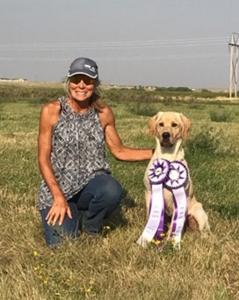


In today's episode we talk about the importance of starting a future upland hunter on the best foot possible. Often, we approach this work like they already know they are upland dogs, and we try to rush in the training. Upland work is a logical, linear process, which when done in a manner that suits that pup, results in the beautiful upland hunters who do not need one note of instruction.
This shorter episode is a discussion of the Handler's Seminar the RMPLC (and I) are hosting April 6, at the club lease just north of Brighton CO. This will be for all levels of handlers at retriever events, Junior, Started CP to Finished and Master. Handling a dog well is exactly equivalent to a good athlete having an okay coach or a coach really suited to them and very knowledgeable in their coaching skills. We need to be a great coach for our canine athletes. Preparedness for success begins with how you train each day, how you interact with your dog before, during and after training, and creating muscle memory for superb handling, so you do the right thing even when you are nervous or encounter unexpected things in competition. Sign up and more information will be available on the RMPLC Website. There will be room for a certain number of dogs, but not the number of people who wish to come. Love to see you there!
In today's "The season is upon is" episode, we talk about how to bulletproof yourself and your dog before you step up to the line and ways to avoid the "She never does that in training" phenomenon. You can't get rid of nervousness, but you can work around it. There are ways to help you, that will wind up really helping your dog.
In today's episode (using computer for sound, not podcast microphone), we discuss two more issues dog folks can occasionally encounter. The first is pointing retrievers creeping on a point, a problem often treated with pressure and correction, a dangerous thing to do to a dog with its live bird. The second is the difficult issue of mouth problems on retrievers. Mishandling in retrieving takes the form of barely carrying things but by a feather or a rope, mouthing, dropping, crunching and just not letting go. This is a problem area you don't want to get into, it is much easier to work on preventing it than fixing, but we discuss at length....
In today's episode, I break down two "dog problems" I helped with. One a dog with solid basics of handling choosing to not get into the water on either marks or blinds; the other a puppy who refused to retrieve any puppy bumper but its' own. Addressing behavioral problems is never about what they should be doing, but what you've done that allowed the problem to generate. Interesting study...
We address the more advanced training in this discussion. The more advanced training can be accomplished by staying in the most fundamental aspects of the training. Dogs learn more and have substantially more confidence not by practicing all the hard things, but by consistently practicing the components of the 'hard things'. It is a powerful tool for those with the patience to use it.
In this episode, we discuss how training your dog is a process, and your expertise is something that should continually progress - it is not a destination you reach with no further learning required. Our dogs continuously reflect us right back to us, if we are wise enough to perceive that phenomenon. With curiosity and strong enough self-evaluation tools, we can become accomplished to a level equivalent to our personal investment in the process.
In today's episode, we break down one of the biggest causes of training problems: looking right through your student. We often take our timelines and recipes and then stick the dog to them. This can work, but what do you when it doesn't, and how do you go about preventing problems by created by fitting your square peg into a round hole? Read on....
In today's episode, we talk about the reasons early and appropriate bird introduction is important, sometimes critically so. We often believe that "pointers will point" and "flushers will flush", but it can be problematic if they've been taught to be very concerned with you when they are performing their ancestral work of hunting birds. Emphasis on what is most important on the developing brain of a young pup can shorten the entire training process. Many of the problems in the young upland hunter stem from what their bird introductions taught them...
A recent discussion with a world class athlete reminded me of the importance of our attitude toward daily training, regardless of what you are training to accomplish. It is a good thing to have lofty goals and ambitious attitude, but the secret to the success of the best trainers in the world isn't the desired "trophy". It is the appreciation and love of the daily process that actually gets you there. Put all your effort and heart into that, and the rest usually takes care of itself....
From the publisher's feed
1,715 Listeners

38,060 Listeners
973 Listeners
631 Listeners

46,065 Listeners
262 Listeners
48 Listeners
81 Listeners