
Sign up to save your podcasts
Or

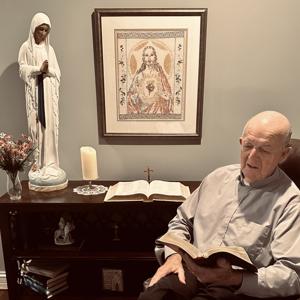


On Friday the Fourth Week of Lent our Church invites us to first read and reflect on a passage from the book of Numbers (14:1-25) entitled "The murmuring of the people and the intervention of Moses". Our treasure, which follows, is from an Easter letter by Saint Athanasius, bishop.
Saint Athanasius was born at Alexandria in 295. He served as Patriarch of Alexandria for a period of his life, leading the church in Egypt and playing a significant role in shaping the early church. He accompanied Alexander to the Council of Nicaea and succeeded him as Bishop of Alexandria.
Saint Atanasius defended the full divinity of Jesus Christ against the heresy of Arianism, insisting that the Son is truly God and "of the same substance" as the Father. Despite exile and opposition, he upheld the faith defined at the First Council of Nicaea (325), preserving the truth that only if Christ is fully divine can He truly save us. His unwavering witness secured the Church's understanding of the Trinity and made him one of the most important defenders of orthodox Christology.
His writings are outstanding in their explanation and defense of the true teachings of the faith. Athanasius penned numerous theological treatises, including "On the Incarnation" and the "Four Orations Against the Arians," which are still studied for their profound insights into the nature of Christ. His writings, particularly "The Life of St. Antony," a biography of the desert father that influenced the growth of monasticism in both the East and the West, are believed to have played a significant role in the conversion of St. Augustine.
Saint Athanasius is a Doctor of the Church. He died in 373.
The Book of Numbers derives its name from the account of the two censuses taken of the Hebrew people, one near the beginning and the other toward the end of the journey in the wilderness. It continues the story of that journey begun in Exodus and describes briefly the experiences of the Israelites for a period of thirty-eight years, from the end of their encampment at Sinai to their arrival at the border of the promised land. Numerous legal ordinances are interspersed in the account, making the book a combination of law and history.
The central message of the Book of Numbers is that God remains faithful to His people even when they are unfaithful, and He calls them to trust and obey Him on the journey to the Promised Land. Through Israel's repeated complaints, rebellions, and failures in the wilderness, the book shows the consequences of distrust and disobedience, yet also reveals God's enduring guidance, mercy, and commitment to His covenant. Ultimately, it teaches that progress toward God's promises requires faith, perseverance, and reliance on His leadership, even during times of trials and uncertainty.
Today, March 19, as our Church celebrates the Solemnity of Joseph, Husband of Mary, we are first invited to read and reflect on a passage from the letter to the Hebrews (11:1-6) entitled "The faith of the ancients." Our treasure, which follows, is from a sermon by Saint Bernardine of Siena, priest.
The Bible pays Joseph the highest compliment: he was a "just" man. The quality
meant a lot more than faithfulness in paying debts. When the Bible speaks of God "justifying" someone, it means that God, the all-
holy or "righteous" one, so transforms a person that the individual shares
somehow in God's own holiness, and hence it is "right" for God to love him or
her. In other words, God is not playing games, acting as if we were lovable when
We are not.
By saying Joseph was "just," the Bible means that he was one who was completely
open to all that God wanted to do for him. He became holy by opening himself
totally to God. The rest we can easily surmise. Think of the kind of love with which he wooed and won Mary, and the depth of the love they shared during their marriage.
It is no contradiction to Joseph's manly holiness that he decided to divorce Mary
when she was found to be with child. The important words of the Bible are that
he planned to do this "quietly" because he was "a righteous man, yet unwilling to
expose her to shame".
Saint Bernadine lived from 1380 until 1444. Most of the saints suffer great personal opposition, even persecution. Bernardine, by contrast, seems more like a human dynamo, who simply took on the needs of the world.
He was a greatest preacher of his time, journeying across Italy, calming strife-torn cities, attacking the paganism, he found rampant, attracting crowds of 30,000, following Saint Francis of Assisi's admonition to preach about "vice and virtue, punishment, and glory. "
Saint Bernadine's primary contribution to the Church was powerfully promoting devotion to the Holy Name of Jesus. Through his preaching, he encouraged the faithful to center their lives on Jesus Christ, often displaying the symbol "IHS" as a reminder of Christ's saving name. His teaching emphasized that invoking the Holy Name brings grace, unity, and moral renewal, helping to reform Christian life in a time of social division. In this way, he deepened the Church's understanding of the spiritual power and reverence due to the Name of Jesus.
Compared with Saint Paul by the pope, Bernadine had a keen intuition of the needs of the time, along with solid holiness and boundless energy and joy. He accomplished all this despite having a very weak and hoarse voice, miraculously improved later because of his devotion to Mary.
As early as the second century, this treatise, which is of great rhetorical power and force in its admonition to faithful pilgrimage under Christ's leadership, bore the title "To the Hebrews." It was assumed to be directed to Jewish Christians. Usually, Hebrews was attached in Greek manuscripts to the collection of letters by Paul. Although no author is mentioned (for there is no address), a reference to Timothy suggested connections to the circle of Paul and his assistants. Yet the exact audience, the author, and even whether Hebrews is a letter have long been disputed.
The central message of the Epistle to the Hebrews is that Jesus Christ is the perfect and eternal High Priest who fulfills and surpasses the old covenant, offering Himself once for all for the salvation of humanity. The letter teaches that through Christ, believers have direct access to God, and it calls them to persevere in faith, especially in times of trial, trusting in His definitive sacrifice. By showing how Christ completes the meaning of the Law, priesthood, and sacrifices of the Old Testament, Hebrews urges Christians to remain steadfast, confident, and faithful to Him.
On Wednesday the Fourth Week of Lent our Church invites us to first read and reflect on a passage from the book of Numbers (11:4-6, 10-30) entitled "The spirit poured out over Joshua and the elders". Our treasure, which follows, is from a letter by Saint Maximus the Confessor, abbot.
Saint Maximus was a Christian monk and scholar. In his early life he was a civil servant and an aid to the Byzantine Emperor Horus. He gave up his life in the political sphere to enter monastic life. Because of his theological positions Maximus was on the outs with the authorities. He was tried at a council and found to be a heretic, even though he was defending orthodoxy. To keep him from writing and speaking his so-called heretical views they damaged his right hand and his tongue. So, he is known as Maximus the Confessor.
Saint Maximus the Confessor's primary contribution to the Church was done by defending the truth that Jesus Christ possesses two wills—divine and human—perfectly united in one Person, a teaching that safeguarded the full reality of the Incarnation. Opposing the heresy of Monothelitism, Maximus taught that Christ's human will freely cooperates with His divine will, ensuring that human nature is truly healed and redeemed. His witness, confirmed at the Third Council of Constantinople (681), became foundational for the Church's understanding of how Christ saves us—not by overriding our humanity, but by restoring it to full harmony with God.
His theological positions made him extremely popular within one generation after his death. His theological positions were upheld by the Third Council of Constantinople, and he was declared the saint soon after his death.
The Book of Numbers derives its name from the account of the two censuses taken of the Hebrew people, one near the beginning and the other toward the end of the journey in the wilderness. It continues the story of that journey begun in Exodus and describes briefly the experiences of the Israelites for a period of thirty-eight years, from the end of their encampment at Sinai to their arrival at the border of the promised land. Numerous legal ordinances are interspersed in the account, making the book a combination of law and history.
The central message of the Book of Numbers is that God remains faithful to His people even when they are unfaithful, and He calls them to trust and obey Him on the journey to the Promised Land. Through Israel's repeated complaints, rebellions, and failures in the wilderness, the book shows the consequences of distrust and disobedience, yet also reveals God's enduring guidance, mercy, and commitment to His covenant. Ultimately, it teaches that progress toward God's promises requires faith, perseverance, and reliance on His leadership, even during times of trials and uncertainty.
On Tuesday the Fourth Week of Lent our Church invites us to first read and reflect on a passage from the book of Leviticus (19:1-18, 31-37) entitled "Right conduct towards one's neighbor". Our treasure, which follows, is from a sermon by Saint Leo the Great, pope.
Saint Leo became pope in the year 440. Saint Leo was a Roman aristocrat, and was the first pope to have been called "the Great". Saint Leo is known as one of the best administrative popes of the ancient Church. His work branched into many areas of the church, indicative of his notion of the pope's total responsibility for the flock of Christ. In the 96 sermons which have come down to us, we find Leo stressing the virtues of almsgiving, fasting, and prayer, and expounding Catholic doctrine with clarity and conciseness, particularly the dogma of the Incarnation. Leo is perhaps best known for having met Attila the Hun in 452 and having persuaded him to turn back from his invasion of Italy.
Saint Leo the Great's primary contribution to the teachings of the Catholic Church was his clear articulation of the two natures of Christ—fully divine and fully human—united in one person. In his famous Tome of Leo, he explained that Jesus Christ possesses both natures without confusion or division, a teaching that was affirmed by the bishops at the Council of Chalcedon and became a cornerstone of Catholic Christology. Leo also strengthened the understanding of the authority of the Bishop of Rome as successor of Saint Peter the Apostle, helping shape the doctrine of the papacy while safeguarding the Church's teaching about who Christ truly is.
The name "Leviticus" was given to the third book of the Pentateuch by the ancient Greek translators because a good part of this book deals with concerns of the priests, who are of the tribe of Levi.
The primary message of the Book of Leviticus is that God is holy, and His people are called to live in holiness in every aspect of life. Through laws about worship, sacrifice, moral conduct, and daily living, God teaches Israel how to remain in right relationship with Him and with one another. At its heart is the call: "Be holy, for I the Lord your God am holy" (Lev 19:2), showing that holiness involves not only proper worship but also justice, mercy, and love for neighbor. The book reveals that approaching God requires reverence, repentance, and purification, while also pointing forward to the deeper fulfillment of sacrifice and holiness in Jesus Christ.
On Monday the Fourth Week of Lent our Church invites us to first read and reflect on a passage from the book of Leviticus (16:2-28) entitled "The day of atonement". Our treasure, which follows, is from a homily on Leviticus by Origen, priest.
Origen of Alexandria was a second century priest also known as Origen Adamitius. He was an early Christian scholar, aesthetic, and theologian. He was also a prolific writer who wrote roughly 2000 treaties in multiple branches of theology and spirituality. He is one of the most influential and controversial figures in early Christian theology, apologetics, and aestheticism.
Origen made one of the earliest and most influential contributions to Christian theology by developing a systematic and deeply intellectual approach to interpreting Scripture. He taught that the Bible has multiple levels of meaning—literal, moral, and spiritual—and he helped establish the tradition of spiritual or allegorical interpretation that later theologians and Church Fathers would refine. Origen also advanced early reflection on the Trinity, Christ's divinity, and the relationship between faith and reason, helping the Church think more rigorously about doctrine. Although some of his speculative ideas were later rejected, his methods of biblical study and theological inquiry profoundly shaped the development of Christian theology and the intellectual tradition of the early Church. He has been described as "the greatest genius the early Church ever produced".
The name "Leviticus" was given to the third book of the Pentateuch by the ancient Greek translators because a good part of this book deals with concerns of the priests, who are of the tribe of Levi.
The primary message of the Book of Leviticus is that God is holy, and His people are called to live in holiness in every aspect of life. Through laws about worship, sacrifice, moral conduct, and daily living, God teaches Israel how to remain in right relationship with Him and with one another. At its heart is the call: "Be holy, for I the Lord your God am holy" (Lev 19:2), showing that holiness involves not only proper worship but also justice, mercy, and love for neighbor. The book reveals that approaching God requires reverence, repentance, and purification, while also pointing forward to the deeper fulfillment of sacrifice and holiness in Jesus Christ.
On the Fourth Sunday of Lent our Church invites us to first read and reflect on a passage from the book of Leviticus (8:1-17; 9:22-24) entitled "The ordination of the priests". Our treasure, which follows, is from a treatise on John by Saint Augustine, bishop.
Saint Augustine was born at Tagaste in Africa in 354. He was unsettled and restlessly searched for the truth until he was converted to the faith in Milan and baptized by Ambrose. Returning to his homeland, he embraced an ascetic life and subsequently was elected bishop of Hippo. For thirty-four years he guided his flock, instructing it with sermons and many writings.
Saint Augustine is perhaps the most significant Christian thinker after St. Paul. He adapted Classical teaching and created a powerful theological system of lasting influence. He also shaped the practice of biblical exegesis and helped lay the foundation for much of medieval and modern Christian thought.
Saint Augustine of Hippo made his primary contribution to the teachings of the Catholic Church by deeply explaining the relationship between God's grace and human salvation. In response to errors such as Pelagianism, he taught that humanity, wounded by sin, cannot save itself but is restored through the grace of God working within us. Augustine clarified the Church's understanding of original sin, divine grace, and the need for God's initiative in conversion, while also shaping Christian thought on the Trinity, the Church, and the inner life of the soul. His writings—especially the Confessions and The City of God—became foundational for Western Christian theology and continue to guide the Church's understanding of sin, grace, and redemption.
He fought bravely against the errors of his time and explained the Faith carefully and cogently through his writings. He is a preeminent Catholic Doctor of the Church. His most important teachings shape not only Western theology but the entire intellectual tradition of the Church. His thought deeply influenced later figures such as Saint Thomas Aquinas and remains foundational in Catholic doctrine. He died in 430.
Tractates on the Gospel of John by Augustine of Hippo is a collection of sermons in which Augustine carefully explains the meaning of the Gospel of John to ordinary Christians. In these reflections he guides believers through the words and signs of Jesus Christ, helping them understand both the literal meaning of the text and its deeper spiritual message.
These tractates, then give us a glimpse of the man that we do not often get from his other works. Augustine's preaching shows us not only his brilliant mind and rhetorical skills as he expounds upon the Scriptures but also the great love he had for Christ and for the faithful entrusted to his care.
The primary purpose of the work is to help Christians grow in faith by recognizing that Christ is truly the Son of God and the source of eternal life. Augustine shows that the Gospel invites believers not only to understand Christ intellectually but to believe in Him, love Him, and live in union with Him.
The name "Leviticus" was given to the third book of the Pentateuch by the ancient Greek translators because a good part of this book deals with concerns of the priests, who are of the tribe of Levi.
The name "Leviticus" was given to the third book of the Pentateuch by the ancient Greek translators because a good part of this book deals with concerns of the priests, who are of the tribe of Levi.
The primary message of the Book of Leviticus is that God is holy, and His people are called to live in holiness in every aspect of life. Through laws about worship, sacrifice, moral conduct, and daily living, God teaches Israel how to remain in right relationship with Him and with one another. At its heart is the call: "Be holy, for I the Lord your God am holy" (Lev 19:2), showing that holiness involves not only proper worship but also justice, mercy, and love for neighbor. The book reveals that approaching God requires reverence, repentance, and purification, while also pointing forward to the deeper fulfillment of sacrifice and holiness in Jesus Christ.
The Book of Exodus, the second book of the Pentateuch, takes its name from a Greek word meaning "departure," highlighting the defining event of Israel's history: the Lord's deliverance of His people from slavery in Egypt. Its Hebrew title, Shemoth — "Names" — comes from its opening line, reminding us that God's saving work unfolds within real history, among real persons whom He knows and calls.
Exodus continues the sacred story where Genesis ends. The descendants of Jacob, once welcomed in Egypt, find themselves oppressed and enslaved. Into this suffering, God reveals Himself not as distant, but as the One who hears the cry of His people. Through Moses, He performs mighty works, freeing Israel and leading them through the Red Sea — an event the Church has long recognized as a powerful foreshadowing of Baptism and redemption.
Yet liberation is only the beginning. At Mount Sinai, God establishes His covenant with Israel. The Law (torah) given through Moses is not merely a set of rules but the framework of a relationship. God saves first; then He teaches His people how to live in the freedom He has given. The moral, civil, and ritual laws form Israel into a holy nation, called to reflect God's own holiness before the world.
A striking portion of Exodus is devoted to the tabernacle, the portable sanctuary where God chooses to dwell among His people. This reveals the deeper purpose of salvation: communion. God does not simply rescue Israel from something — He rescues them for something — life in His presence. Even when Israel falls into rebellion, we witness repentance, covenant renewal, and divine mercy. The book culminates with the construction of the tabernacle and the descent of the cloud, the visible sign of God's glorious presence.
In Exodus, we see the foundations of Israel's identity: a people redeemed, covenanted, instructed, and indwelt by God. For Catholics, the book speaks not only of ancient history but of the enduring pattern of salvation: God delivers, God binds Himself to His people, God teaches, and God remains with them.
On Friday of the Third Week of Lent our Church invites us to first read and reflect on a passage from the book of Exodus (35:30---36:1; 37:19) entitled "The making of the sanctuary and the arch". Our treasure, which follows, is from the Moral Reflections on Job by Saint Gregory the Great, pope.
Doctor of the Church; born at Rome about 540; died 12 March 604. Saint Gregory is certainly one of the most notable figures in Ecclesiastical History. He has exercised in many respects a momentous influence on the doctrine, the organization, and the discipline of the Catholic Church. To him we must look for an explanation of the religious situation of the Middle Ages; indeed, if no account were taken of his work, the evolution of the form of medieval Christianity would be almost inexplicable. And further, in so far as the modern Catholic system is a legitimate development of medieval Catholicism, of this too Gregory may not unreasonably be termed the Father. Almost all the leading principles of the later Catholicism are found at any rate in germ, in Gregory the Great.
The Moral Reflections on Job is a commentary on the Book of Job by Saint Gregory the Great, written between 578 and 595. It began when Saint Gregory was at the court of Emperor Tiberius II in Constantinople but finished only several years after he had returned to Rome. It is Saint Gregory's major work, filling some 35 books or 6 volumes.
If everything God created was good, why does Isaiah say God created evil? The Hebrew word translated as "evil" in Isaiah 45:7 has two applications in the Bible. The term can be used in the sense of moral evil, such as wickedness and sin, or it can refer to harmful natural events, calamity, misfortune, adversity, affliction, or disaster. It is in this second sense that Isaiah speaks, and his meaning is reflected in most modern Bible translations of Isaiah 45:7: "I make success and create disaster"; "I make well-being and create calamity"; "I send good times and bad times". God does not create moral evil. For one thing, moral evil is not a "thing" to be made but a choice or intent contrary to God's good purposes, His holy character, and His law. Moral evil does not conform to God and His will. God is good, holy, and loving; therefore, His plans and purposes are good, holy, and loving.
As Ruler of the universe, God sometimes creates calamity to accomplish His will. He brought disaster to discipline His people when they turned their backs on Him and refused to repent.
The Book of Exodus, the second book of the Pentateuch, takes its name from a Greek word meaning "departure," highlighting the defining event of Israel's history: the Lord's deliverance of His people from slavery in Egypt. Its Hebrew title, Shemoth — "Names" — comes from its opening line, reminding us that God's saving work unfolds within real history, among real persons whom He knows and calls.
Exodus continues the sacred story where Genesis ends. The descendants of Jacob, once welcomed in Egypt, find themselves oppressed and enslaved. Into this suffering, God reveals Himself not as distant, but as the One who hears the cry of His people. Through Moses, He performs mighty works, freeing Israel and leading them through the Red Sea — an event the Church has long recognized as a powerful foreshadowing of Baptism and redemption.
Yet liberation is only the beginning. At Mount Sinai, God establishes His covenant with Israel. The Law (torah) given through Moses is not merely a set of rules but the framework of a relationship. God saves first; then He teaches His people how to live in the freedom He has given. The moral, civil, and ritual laws form Israel into a holy nation, called to reflect God's own holiness before the world.
A striking portion of Exodus is devoted to the tabernacle, the portable sanctuary where God chooses to dwell among His people. This reveals the deeper purpose of salvation: communion. God does not simply rescue Israel from something — He rescues them for something — life in His presence. Even when Israel falls into rebellion, we witness repentance, covenant renewal, and divine mercy. The book culminates with the construction of the tabernacle and the descent of the cloud, the visible sign of God's glorious presence.
In Exodus, we see the foundations of Israel's identity: a people redeemed, covenanted, instructed, and indwelt by God. For Catholics, the book speaks not only of ancient history but of the enduring pattern of salvation: God delivers, God binds Himself to His people, God teaches, and God remains with them.
On Thursday of the Third Week of Lent our Church invites us to first read and reflect on a passage from the book of Exodus (34:10-28) entitled "The second version of the Book of the Covenant". Our treasure, which follows, is from the treatise On Prayer by Tertullian, priest.
Tertullian was a priest and a prolific second century Christian author from Carthage in the Roman province of Africa. He was the first Christian author to produce an extensive corpus of Latin Christian literature. He was an early Christian apologist and a polemicist against heresy.
Tertullian's On Prayer (De Oratione), written in the late 2nd or early 3rd century, is one of the earliest Christian reflections on the meaning and practice of prayer. In this short treatise, Tertullian explains the importance of prayer in the life of believers and offers a detailed meditation on the words of the Lord's Prayer, which he calls the "summary of the whole Gospel." His primary message is that prayer is the essential expression of a Christian's relationship with God—an act that should arise from humility, sincerity, and a life striving for holiness. Tertullian teaches that true prayer is not merely spoken words but the offering of the heart, joined with repentance, charity, and faith. By reflecting on each petition of the Lord's Prayer, he shows how it teaches believers what to desire, how to trust in God's providence, and how to live in forgiveness and dependence on the Father. In this way, On Prayer presents prayer as both a school of faith and a guide for Christian living.
His most famous quotes include: "Nature soaks every evil with either fear or shame", "Hope is patience with the lamp lit", "The blood of martyrs is the seed of the church".
The Book of Exodus, the second book of the Pentateuch, takes its name from a Greek word meaning "departure," highlighting the defining event of Israel's history: the Lord's deliverance of His people from slavery in Egypt. Its Hebrew title, Shemoth — "Names" — comes from its opening line, reminding us that God's saving work unfolds within real history, among real persons whom He knows and calls.
Exodus continues the sacred story where Genesis ends. The descendants of Jacob, once welcomed in Egypt, find themselves oppressed and enslaved. Into this suffering, God reveals Himself not as distant, but as the One who hears the cry of His people. Through Moses, He performs mighty works, freeing Israel and leading them through the Red Sea — an event the Church has long recognized as a powerful foreshadowing of Baptism and redemption.
Yet liberation is only the beginning. At Mount Sinai, God establishes His covenant with Israel. The Law (torah) given through Moses is not merely a set of rules but the framework of a relationship. God saves first; then He teaches His people how to live in the freedom He has given. The moral, civil, and ritual laws form Israel into a holy nation, called to reflect God's own holiness before the world.
A striking portion of Exodus is devoted to the tabernacle, the portable sanctuary where God chooses to dwell among His people. This reveals the deeper purpose of salvation: communion. God does not simply rescue Israel from something — He rescues them for something — life in His presence. Even when Israel falls into rebellion, we witness repentance, covenant renewal, and divine mercy. The book culminates with the construction of the tabernacle and the descent of the cloud, the visible sign of God's glorious presence.
In Exodus, we see the foundations of Israel's identity: a people redeemed, covenanted, instructed, and indwelt by God. For Catholics, the book speaks not only of ancient history but of the enduring pattern of salvation: God delivers, God binds Himself to His people, God teaches, and God remains with them.
On Wednesday of the Third Week of Lent our Church invites us to first read and reflect on a passage from the book of Exodus (33:7-11, 18-23; 34:5-9, 29-35) entitled "The full revelation of God to Moses". Our treasure, which follows, is from a book addressed to Autolycus by Saint Theophilus of Antioch, bishop.
Saint Theophilus lived in the second century and was the seventh bishop of Antioch. His writings indicate that he was born a pagan and was led to embrace Christianity by studying the Holy Scriptures, especially the prophetical books. He was noted for his zeal as a shepherd in driving away heretics who were attacking Christ's flock. He made contributions to the departments of Christian literature, polemics, exegetics, and apologetics.
Saint Theophilus wrote a work called Apology to Autolycus, addressed to a pagan friend who questioned Christianity. In this writing he carefully explained that the Christian faith is not irrational or superstitious but deeply reasonable and rooted in truth. He showed how the teachings of Scripture reveal the true God and offer a fuller understanding of creation, morality, and human destiny.
One of his most significant contributions is that he was the first known Christian writer to use the term "Trinity" (Greek Trias) when speaking about God—referring to God, His Word (Logos), and His Wisdom. While later theology would develop this teaching more fully, Theophilus helped lay an early foundation for the Church's understanding of the mystery of the Father, Son, and Holy Spirit.
He also emphasized that God created the world freely and lovingly out of nothing, a teaching that distinguished Christianity from many Greek philosophical ideas about eternal matter. For Theophilus, creation itself reveals God's wisdom and invites humanity to know and love Him.
The Book of Exodus, the second book of the Pentateuch, takes its name from a Greek word meaning "departure," highlighting the defining event of Israel's history: the Lord's deliverance of His people from slavery in Egypt. Its Hebrew title, Shemoth — "Names" — comes from its opening line, reminding us that God's saving work unfolds within real history, among real persons whom He knows and calls.
Exodus continues the sacred story where Genesis ends. The descendants of Jacob, once welcomed in Egypt, find themselves oppressed and enslaved. Into this suffering, God reveals Himself not as distant, but as the One who hears the cry of His people. Through Moses, He performs mighty works, freeing Israel and leading them through the Red Sea — an event the Church has long recognized as a powerful foreshadowing of Baptism and redemption.
Yet liberation is only the beginning. At Mount Sinai, God establishes His covenant with Israel. The Law (torah) given through Moses is not merely a set of rules but the framework of a relationship. God saves first; then He teaches His people how to live in the freedom He has given. The moral, civil, and ritual laws form Israel into a holy nation, called to reflect God's own holiness before the world.
A striking portion of Exodus is devoted to the tabernacle, the portable sanctuary where God chooses to dwell among His people. This reveals the deeper purpose of salvation: communion. God does not simply rescue Israel from something — He rescues them for something — life in His presence. Even when Israel falls into rebellion, we witness repentance, covenant renewal, and divine mercy. The book culminates with the construction of the tabernacle and the descent of the cloud, the visible sign of God's glorious presence.
In Exodus, we see the foundations of Israel's identity: a people redeemed, covenanted, instructed, and indwelt by God. For Catholics, the book speaks not only of ancient history but of the enduring pattern of salvation: God delivers, God binds Himself to His people, God teaches, and God remains with them.
From the publisher's feed