
Sign up to save your podcasts
Or

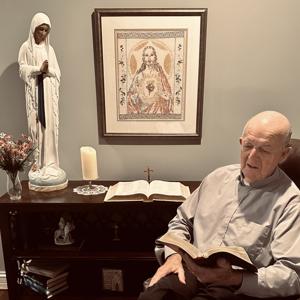


On Tuesday of the Third Week of Lent our Church invites us to first read and reflect on a passage from the book of Exodus (32: 1-20) entitled "The golden calf". Our treasure, which follows, is from a sermon by Saint Peter Chrysologus, bishop.
Saint Peter Chrysologus, also known as the "Doctor of Homilies," was a 5th-century Italian bishop and Doctor of the Church, celebrated for his eloquent and concise sermons. He was recognized for his ability to explain complex theological concepts in a clear and relatable way, particularly regarding the Incarnation, the Apostles' Creed, and contemporary heresies.
Saint Peter was nicknamed "Chrysologus" (golden-worded) due to his exceptional preaching skills, and his 176 surviving homilies are highly regarded. He actively opposed the heresies of his time, including Monophysitism, and emphasized the importance of obedience to the Pope.
The most significant contribution of the teaching of Saint Peter Chrysologus to Christians is his clear and beautiful explanation of the mystery of the Incarnation—God becoming truly human in Jesus Christ—and what that means for how we live.
Saint Peter Chrysologus constantly reminded Christians that the coming of Christ reveals the immense love and humility of God. In his sermons he emphasized that God did not save humanity from a distance; instead, He entered fully into our human condition. By becoming man, Christ restored human dignity and opened the path for us to share in divine life. For Peter Chrysologus, the Incarnation means that our humanity is not something to despise but something redeemed and made holy in Christ.
He died in Imola around 450 AD and was buried there. He was declared a Doctor of the Church in 1729 by Pope Benedict XIII, a recognition of his profound and influential writings. His feast day is celebrated on July 30th.
The Book of Exodus, the second book of the Pentateuch, takes its name from a Greek word meaning "departure," highlighting the defining event of Israel's history: the Lord's deliverance of His people from slavery in Egypt. Its Hebrew title, Shemoth — "Names" — comes from its opening line, reminding us that God's saving work unfolds within real history, among real persons whom He knows and calls.
Exodus continues the sacred story where Genesis ends. The descendants of Jacob, once welcomed in Egypt, find themselves oppressed and enslaved. Into this suffering, God reveals Himself not as distant, but as the One who hears the cry of His people. Through Moses, He performs mighty works, freeing Israel and leading them through the Red Sea — an event the Church has long recognized as a powerful foreshadowing of Baptism and redemption.
Yet liberation is only the beginning. At Mount Sinai, God establishes His covenant with Israel. The Law (torah) given through Moses is not merely a set of rules but the framework of a relationship. God saves first; then He teaches His people how to live in the freedom He has given. The moral, civil, and ritual laws form Israel into a holy nation, called to reflect God's own holiness before the world.
A striking portion of Exodus is devoted to the tabernacle, the portable sanctuary where God chooses to dwell among His people. This reveals the deeper purpose of salvation: communion. God does not simply rescue Israel from something — He rescues them for something — life in His presence. Even when Israel falls into rebellion, we witness repentance, covenant renewal, and divine mercy. The book culminates with the construction of the tabernacle and the descent of the cloud, the visible sign of God's glorious presence.
In Exodus, we see the foundations of Israel's identity: a people redeemed, covenanted, instructed, and indwelt by God. For Catholics, the book speaks not only of ancient history but of the enduring pattern of salvation: God delivers, God binds Himself to His people, God teaches, and God remains with them.
On Monday of the Third Week of Lent our Church invites us to first read and reflect on a passage from the book of Exodus (24:1-18) entitled "The ratification of the covenant on Mount Sanai". Our treasure, which follows, is from a homily by Saint Basil the Great, bishop.
Saint Basil the Great was a fourth century Church Father and a Doctor of the Church. Because of the majesty and keenness of his eloquence, he is honored as "the revealer of heavenly things" and "the Great". He was an early Roman Christian prelate who served as Bishop of Caesarea in Cappadocia from 370 until his death in 379..
He was an influential theologian who supported the Nicene Creed and opposed heresies of the early Christian church, especially Arianism. (Arianism taught that Jesus Christ was not divine). In addition to his work as a theologian, Saint Basil was known for his care of the poor and underprivileged. Basil established guidelines for monastic life which focus on community life, liturgical prayer, and manual labor.
The most significant teaching of Basil the Great is his clear vision that the Christian life is a life of transformation through the Holy Spirit, lived in communion with others through charity, humility, and disciplined prayer.
As one of the great leaders of the early Church and a defender of the divinity of the Holy Spirit during the First Council of Constantinople era, Basil emphasized that the Holy Spirit is truly God and the source of our sanctification. In his famous work, On the Holy Spirit, he explained that the Spirit makes us capable of sharing in God's life. Through the Spirit, believers are purified, enlightened, and gradually transformed into the likeness of Christ. For Basil, holiness is not merely moral improvement but participation in the divine life that the Spirit gives.
A second key aspect of his teaching is that faith must express itself in concrete love for others, especially the poor. Basil spoke strongly against indifference to the needy. He taught that the goods we possess are gifts entrusted to us by God for the benefit of all. In one of his most famous teachings he said, in essence, that the bread you keep belongs to the hungry and the cloak stored in your closet belongs to the one who lacks clothing. For Basil, charity was not optional generosity but a requirement of Christian justice.
The Book of Exodus, the second book of the Pentateuch, takes its name from a Greek word meaning "departure," highlighting the defining event of Israel's history: the Lord's deliverance of His people from slavery in Egypt. Its Hebrew title, Shemoth — "Names" — comes from its opening line, reminding us that God's saving work unfolds within real history, among real persons whom He knows and calls.
Exodus continues the sacred story where Genesis ends. The descendants of Jacob, once welcomed in Egypt, find themselves oppressed and enslaved. Into this suffering, God reveals Himself not as distant, but as the One who hears the cry of His people. Through Moses, He performs mighty works, freeing Israel and leading them through the Red Sea — an event the Church has long recognized as a powerful foreshadowing of Baptism and redemption.
Yet liberation is only the beginning. At Mount Sinai, God establishes His covenant with Israel. The Law (torah) given through Moses is not merely a set of rules but the framework of a relationship. God saves first; then He teaches His people how to live in the freedom He has given. The moral, civil, and ritual laws form Israel into a holy nation, called to reflect God's own holiness before the world.
A striking portion of Exodus is devoted to the tabernacle, the portable sanctuary where God chooses to dwell among His people. This reveals the deeper purpose of salvation: communion. God does not simply rescue Israel from something — He rescues them for something — life in His presence. Even when Israel falls into rebellion, we witness repentance, covenant renewal, and divine mercy. The book culminates with the construction of the tabernacle and the descent of the cloud, the visible sign of God's glorious presence.
In Exodus, we see the foundations of Israel's identity: a people redeemed, covenanted, instructed, and indwelt by God. For Catholics, the book speaks not only of ancient history but of the enduring pattern of salvation: God delivers, God binds Himself to His people, God teaches, and God remains with them.
On the Third Sunday of Lent our Church invites us to first read and reflect on a passage from the book of Exodus (22:20---23:9) entitled "The law concerning aliens and the poor (The Book of the Covenant)". Our treasure, which follows, is from a treatise on John by Saint Augustine, bishop.
Saint Augustine was born at Tagaste in Africa in 354. He was unsettled and restlessly searched for the truth until he was converted to the faith in Milan and baptized by Ambrose. Returning to his homeland, he embraced an ascetic life and subsequently was elected bishop of Hippo. For thirty-four years he guided his flock, instructing it with sermons and many writings. He fought bravely against the errors of his time and explained the Faith carefully and cogently through his writings. He is also a preeminent Catholic Doctor of the Church. His writings influenced the development of western philosophy and western Christianity, and he is viewed as one of the most important Church Fathers of the Latin Church in the Patristic Period. He died in 430.
Few ancient Christian authors attempted anything like a complete commentary on the Gospel of John, among them Origen, John Chrysostom and Augustine. Of these, Augustine's must count as the greatest. Unlike Origen's, it has come down to us in its entirety and of the others that remain it is certainly the most theologically profound. John's gospel allows Augustine to range broadly over themes that were his life's work -- the Trinity, the person of Christ, the nature of the Church and its sacraments, the fulfillment of the divine plan. In his preaching, St. Augustine developed an oratorical style based on the classical rhetoric he had learned prior to his conversion which he adapted to the unique demands of Christian preaching. He still recognized the classical ends of rhetoric: to teach, to please, and to persuade. He gave, however, the place of most importance to content: what was said was more important than how it was said. He eschewed the more elaborate figures of speech, using a more direct manner to educate an audience that was, to a great extent, illiterate. The result, however, is not a debased Ciceronian style but a method of preaching that is clear, lively, and well-suited to its purpose.
Just as Augustine's oratorical style was subordinated to the demands of preaching the gospel of Christ, so also his method of commentary was similarly influenced by his duty as pastor at Hippo to instruct his flock in matters of faith and morals. His commentary, then, contains more than exegesis. His reflections on Scripture lead him to discussions of both moral action and dogma.
Augustine's extemporaneous style and broad range of interests are evident in the tractates included in this volume, in which he comments on chapters 7-12 of St. John's Gospel. These chapters contain some of the best-known episodes from the life of Christ: the encounter with the woman caught in adultery, the healing of the man born blind, the raising of Lazarus from the dead, Mary's anointing of Christ's feet, and Christ's triumphant entrance into Jerusalem. The passages also contain some of Christ's most explicit teaching of his divinity. In unfolding the mysteries contained in these chapters of St. John, Augustine moves easily from exegesis to reflections on moral virtue and doctrine, especially the Trinity and the Incarnation. But he never loses sight of his audience. Even in his comments on the loftiest of ideas, he strives to make teaching accessible to all.
These tractates, then give us a glimpse of the man that we do not often get from his other works. Augustine's preaching shows us not only his brilliant mind and rhetorical skills as he expounds upon the Scriptures but also the great love he had for Christ and for the faithful entrusted to his care.
The Book of Exodus, the second book of the Pentateuch, takes its name from a Greek word meaning "departure," highlighting the defining event of Israel's history: the Lord's deliverance of His people from slavery in Egypt. Its Hebrew title, Shemoth — "Names" — comes from its opening line, reminding us that God's saving work unfolds within real history, among real persons whom He knows and calls.
Exodus continues the sacred story where Genesis ends. The descendants of Jacob, once welcomed in Egypt, find themselves oppressed and enslaved. Into this suffering, God reveals Himself not as distant, but as the One who hears the cry of His people. Through Moses, He performs mighty works, freeing Israel and leading them through the Red Sea — an event the Church has long recognized as a powerful foreshadowing of Baptism and redemption.
Yet liberation is only the beginning. At Mount Sinai, God establishes His covenant with Israel. The Law (torah) given through Moses is not merely a set of rules but the framework of a relationship. God saves first; then He teaches His people how to live in the freedom He has given. The moral, civil, and ritual laws form Israel into a holy nation, called to reflect God's own holiness before the world.
A striking portion of Exodus is devoted to the tabernacle, the portable sanctuary where God chooses to dwell among His people. This reveals the deeper purpose of salvation: communion. God does not simply rescue Israel from something — He rescues them for something — life in His presence. Even when Israel falls into rebellion, we witness repentance, covenant renewal, and divine mercy. The book culminates with the construction of the tabernacle and the descent of the cloud, the visible sign of God's glorious presence.
In Exodus, we see the foundations of Israel's identity: a people redeemed, covenanted, instructed, and indwelt by God. For Catholics, the book speaks not only of ancient history but of the enduring pattern of salvation: God delivers, God binds Himself to His people, God teaches, and God remains with them.
On Saturday of the Second Week of Lent our Church invites us to first read and reflect on a passage from the book of Exodus (20:1-17) entitled "The Law is given on Mount Sanai". Our treasure, which follows, is from a treatise on Flight from the World by Saint Ambrose, bishop.
Saint Ambrose was born of a Roman family at Trier about the year 340. He studied at Rome and served in the imperial government at Sirmium. In 374, while, living in Milan, he was elected bishop of the city by popular acclaim and ordained on December 7. He devotedly carried out his duties and especially distinguished himself by his service to the poor, and as an effective pastor and teacher of the faithful. He strenuously guarded the laws of the church and defended orthodox teaching by writings and actions against the Arians. He died on Holy Saturday, April 4, 397. Saint Ambrose is a Doctor of the Church.
Saint Ambrose's concept of "Flight from the World" isn't a call for monasticism or a complete withdrawal from society, but rather a spiritual detachment from worldly concerns and attachments. The core message is to find solace and strength in God, to "take refuge" in Him, and to live in a way that is pleasing to Him. Ambrose emphasizes the importance of holding fast to God with one's soul, heart, and strength, allowing oneself to be guided by faith and not outward show. The goal is to experience God's light, glory, and supernatural joy, which are found in Him.
The Book of Exodus, the second book of the Pentateuch, takes its name from a Greek word meaning "departure," highlighting the defining event of Israel's history: the Lord's deliverance of His people from slavery in Egypt. Its Hebrew title, Shemoth — "Names" — comes from its opening line, reminding us that God's saving work unfolds within real history, among real persons whom He knows and calls.
Exodus continues the sacred story where Genesis ends. The descendants of Jacob, once welcomed in Egypt, find themselves oppressed and enslaved. Into this suffering, God reveals Himself not as distant, but as the One who hears the cry of His people. Through Moses, He performs mighty works, freeing Israel and leading them through the Red Sea — an event the Church has long recognized as a powerful foreshadowing of Baptism and redemption.
Yet liberation is only the beginning. At Mount Sinai, God establishes His covenant with Israel. The Law (torah) given through Moses is not merely a set of rules but the framework of a relationship. God saves first; then He teaches His people how to live in the freedom He has given. The moral, civil, and ritual laws form Israel into a holy nation, called to reflect God's own holiness before the world.
A striking portion of Exodus is devoted to the tabernacle, the portable sanctuary where God chooses to dwell among His people. This reveals the deeper purpose of salvation: communion. God does not simply rescue Israel from something — He rescues them for something — life in His presence. Even when Israel falls into rebellion, we witness repentance, covenant renewal, and divine mercy. The book culminates with the construction of the tabernacle and the descent of the cloud, the visible sign of God's glorious presence.
In Exodus, we see the foundations of Israel's identity: a people redeemed, covenanted, instructed, and indwelt by God. For Catholics, the book speaks not only of ancient history but of the enduring pattern of salvation: God delivers, God binds Himself to His people, God teaches, and God remains with them.
On Friday of the Second Week of Lent our Church invites us to first read and reflect on a passage from the book of Exodus (19:1-19; 20:18-21) entitled "The promise of the covenant and the revelation of the Lord on Mount Sinai)". Our treasure, which follows, is from a treatise Against Heresies by Saint Irenaeus, bishop.
Saint Irenaeus was a late second century Greek bishop noted for his role in guiding and expanding Christian communities in the southern regions of present-day France and, more widely, for the development of Christian theology.
On Jan. 21, 2022, Pope Francis named a Saint Irenaeus as a Doctor of the Church. Although he has just now been named a doctor of the Church, St. Irenaeus has always been known as a brilliant and orthodox teacher of the faith. The documents of the Second Vatican Council cite 14 references to his work, and the Catechism of the Catholic Church cites him 29 times.
Pope Francis assigned St. Irenaeus the title "doctor of unity" for his efforts to unite the Church, which was competing against the heresy of Gnosticism. Gnosticism taught that the world was created and ruled by a lesser divinity, the demiurge, and that Christ was an emissary of the remote supreme divine being, esoteric knowledge (gnosis) of whom enabled the redemption of the human spirit.
St. Irenaeus might also be the first doctor of the Church to die as a martyr. St. Irenaeus is known mainly for his clear and systematic teaching of the Christian faith because he considered the role of a bishop primarily as a teacher. He was particularly interested in apostolic succession, and he produced one of the earliest lists of the first bishops, going back to the time of the Apostles.
He is most known, though, for his treatises Against All Heresies, written about the year 180. Most of these heresies, as already mentioned, were from Gnosticism. He clearly understood the need to articulate the orthodox faith taught by the Apostles and against those who promoted other ideas that threatened the Apostles' teachings. All this was more than 100 years prior to the Council of Nicaea, which began to codify Christian dogma.
Saint Irenaeus was the last known living connection with the apostles. He is the earliest surviving witness to regard all four of the canonical gospels as essential.
Against Heresies is a work of Christian theology written in Greek about the year 180 by Irenaeus, bishop of Lyon in France. In it, Irenaeus identifies and describes several schools of Gnosticism, and other schools of Christian thought, whose beliefs he rejects as heresy. He contrasts them with orthodox Christianity.
The Book of Exodus, the second book of the Pentateuch, takes its name from a Greek word meaning "departure," highlighting the defining event of Israel's history: the Lord's deliverance of His people from slavery in Egypt. Its Hebrew title, Shemoth — "Names" — comes from its opening line, reminding us that God's saving work unfolds within real history, among real persons whom He knows and calls.
Exodus continues the sacred story where Genesis ends. The descendants of Jacob, once welcomed in Egypt, find themselves oppressed and enslaved. Into this suffering, God reveals Himself not as distant, but as the One who hears the cry of His people. Through Moses, He performs mighty works, freeing Israel and leading them through the Red Sea — an event the Church has long recognized as a powerful foreshadowing of Baptism and redemption.
Yet liberation is only the beginning. At Mount Sinai, God establishes His covenant with Israel. The Law (torah) given through Moses is not merely a set of rules but the framework of a relationship. God saves first; then He teaches His people how to live in the freedom He has given. The moral, civil, and ritual laws form Israel into a holy nation, called to reflect God's own holiness before the world.
A striking portion of Exodus is devoted to the tabernacle, the portable sanctuary where God chooses to dwell among His people. This reveals the deeper purpose of salvation: communion. God does not simply rescue Israel from something — He rescues them for something — life in His presence. Even when Israel falls into rebellion, we witness repentance, covenant renewal, and divine mercy. The book culminates with the construction of the tabernacle and the descent of the cloud, the visible sign of God's glorious presence.
In Exodus, we see the foundations of Israel's identity: a people redeemed, covenanted, instructed, and indwelt by God. For Catholics, the book speaks not only of ancient history but of the enduring pattern of salvation: God delivers, God binds Himself to His people, God teaches, and God remains with them.
On Thursday of the Second Week of Lent our Church invites us to first read and reflect on a passage from the book of Exodus (18:13-27) entitled "The judges are appointed under Moses". Our treasure, which follows, is from the treatise on the psalms by Saint Hilary, bishop.
Saint Hilary was a fourth century bishop of Poitiers, France and a Doctor of the Church. His name comes from the Latin word for happy or cheerful. Saint Hilary is best known as the leading opponent of Arianism during his time. Arianism was named after Arian, a priest who taught that Jesus Christ was not divine. Arianism was becoming popular among Christians in this era and Saint Hilary's theological position was supported by Constantine the Great.
During the years between the Council of Nicaea (325) and the Council of Constantinople (381), imperial opposition to Nicene theology sent several of its supporters into exile. One of these supporters was Hilary, the Bishop of Poitiers. Begun during its author's exile (356-360), Hilary's "On the Trinity" provides a comprehensive discussion of the relationship between God the Father and God the Son: they are consubstantial, co-eternal, and fully equal. This work was a trailblazer in its day because, apart from Tertullian's relatively brief remarks on the Trinity, it is the earliest study of Trinitarian doctrine in the Latin language.
"Homilies on the Psalms" is a collection of homilies (sermons) or commentaries written by Saint Hilary of Poitiers, a 4th-century bishop and theologian, on the Book of Psalms. Hilary's commentary explores themes of faith, hope, love, and the nature of God, drawing connections between the Psalms and the Christian understanding of the Trinity and the Incarnation. Hilary lived during a period of significant theological debate, particularly concerning the nature of Christ, and his commentary on the Psalms reflects his defense of orthodox Christian doctrine against Arianism.
The Book of Exodus, the second book of the Pentateuch, takes its name from a Greek word meaning "departure," highlighting the defining event of Israel's history: the Lord's deliverance of His people from slavery in Egypt. Its Hebrew title, Shemoth — "Names" — comes from its opening line, reminding us that God's saving work unfolds within real history, among real persons whom He knows and calls.
Exodus continues the sacred story where Genesis ends. The descendants of Jacob, once welcomed in Egypt, find themselves oppressed and enslaved. Into this suffering, God reveals Himself not as distant, but as the One who hears the cry of His people. Through Moses, He performs mighty works, freeing Israel and leading them through the Red Sea — an event the Church has long recognized as a powerful foreshadowing of Baptism and redemption.
Yet liberation is only the beginning. At Mount Sinai, God establishes His covenant with Israel. The Law (torah) given through Moses is not merely a set of rules but the framework of a relationship. God saves first; then He teaches His people how to live in the freedom He has given. The moral, civil, and ritual laws form Israel into a holy nation, called to reflect God's own holiness before the world.
A striking portion of Exodus is devoted to the tabernacle, the portable sanctuary where God chooses to dwell among His people. This reveals the deeper purpose of salvation: communion. God does not simply rescue Israel from something — He rescues them for something — life in His presence. Even when Israel falls into rebellion, we witness repentance, covenant renewal, and divine mercy. The book culminates with the construction of the tabernacle and the descent of the cloud, the visible sign of God's glorious presence.
In Exodus, we see the foundations of Israel's identity: a people redeemed, covenanted, instructed, and indwelt by God. For Catholics, the book speaks not only of ancient history but of the enduring pattern of salvation: God delivers, God binds Himself to His people, God teaches, and God remains with them.
On Wednesday of the Second Week of Lent our Church invites us to first read and reflect on a passage from the book of Exodus (17:1-16) entitled "The water from the rock. The war against Amaleh". Our treasure, which follows, is from the treatise Against Heresies by Saint Irenaeus, bishop.
Saint Irenaeus was a late second century Greek bishop noted for his role in guiding and expanding Christian communities in the southern regions of present-day France and, more widely, for the development of Christian theology.
On Jan. 21, 2022, Pope Francis named a Saint Irenaeus as a Doctor of the Church. Although he has just now been named a doctor of the Church, St. Irenaeus has always been known as a brilliant and orthodox teacher of the faith. The documents of the Second Vatican Council cite 14 references to his work, and the Catechism of the Catholic Church cites him 29 times.
Pope Francis assigned St. Irenaeus the title "doctor of unity" for his efforts to unite the Church, which was competing against the heresy of Gnosticism. Gnosticism taught that the world was created and ruled by a lesser divinity, the demiurge, and that Christ was an emissary of the remote supreme divine being, esoteric knowledge (gnosis) of whom enabled the redemption of the human spirit.
St. Irenaeus might also be the first doctor of the Church to die as a martyr. St. Irenaeus is known mainly for his clear and systematic teaching of the Christian faith because he considered the role of a bishop primarily as a teacher. He was particularly interested in apostolic succession, and he produced one of the earliest lists of the first bishops, going back to the time of the Apostles.
He is most known, though, for his treatises Against All Heresies, written about the year 180. Most of these heresies, as already mentioned, were from Gnosticism. He clearly understood the need to articulate the orthodox faith taught by the Apostles and against those who promoted other ideas that threatened the Apostles' teachings. All this was more than 100 years prior to the Council of Nicaea, which began to codify Christian dogma.
Saint Irenaeus was the last known living connection with the apostles. He is the earliest surviving witness to regard all four of the canonical gospels as essential.
Against Heresies is a work of Christian theology written in Greek about the year 180 by Irenaeus, bishop of Lyon in France. In it, Irenaeus identifies and describes several schools of Gnosticism, and other schools of Christian thought, whose beliefs he rejects as heresy. He contrasts them with orthodox Christianity.
The Book of Exodus, the second book of the Pentateuch, takes its name from a Greek word meaning "departure," highlighting the defining event of Israel's history: the Lord's deliverance of His people from slavery in Egypt. Its Hebrew title, Shemoth — "Names" — comes from its opening line, reminding us that God's saving work unfolds within real history, among real persons whom He knows and calls.
Exodus continues the sacred story where Genesis ends. The descendants of Jacob, once welcomed in Egypt, find themselves oppressed and enslaved. Into this suffering, God reveals Himself not as distant, but as the One who hears the cry of His people. Through Moses, He performs mighty works, freeing Israel and leading them through the Red Sea — an event the Church has long recognized as a powerful foreshadowing of Baptism and redemption.
Yet liberation is only the beginning. At Mount Sinai, God establishes His covenant with Israel. The Law (torah) given through Moses is not merely a set of rules but the framework of a relationship. God saves first; then He teaches His people how to live in the freedom He has given. The moral, civil, and ritual laws form Israel into a holy nation, called to reflect God's own holiness before the world.
A striking portion of Exodus is devoted to the tabernacle, the portable sanctuary where God chooses to dwell among His people. This reveals the deeper purpose of salvation: communion. God does not simply rescue Israel from something — He rescues them for something — life in His presence. Even when Israel falls into rebellion, we witness repentance, covenant renewal, and divine mercy. The book culminates with the construction of the tabernacle and the descent of the cloud, the visible sign of God's glorious presence.
In Exodus, we see the foundations of Israel's identity: a people redeemed, covenanted, instructed, and indwelt by God. For Catholics, the book speaks not only of ancient history but of the enduring pattern of salvation: God delivers, God binds Himself to His people, God teaches, and God remains with them.
On Tuesday of the Second Week of Lent our Church invites us to first read and reflect on a passage from the book of Exodus (16:1-18, 35) entitled "The manna in the desert". Our treasure, which follows, is from a commentary on the psalms by Saint Augustine, bishop.
Saint Augustine was born at Tagaste in Africa in 354. He was unsettled and restlessly searched for the truth until he was converted to the faith in Milan and baptized by Ambrose. Returning to his homeland, he embraced an ascetic life and subsequently was elected bishop of Hippo. For thirty-four years he guided his flock, instructing it with sermons and many writings.
Augustine is perhaps the most significant Christian thinker after St. Paul. He adapted Classical teaching and created a powerful theological system of lasting influence. He also shaped the practice of biblical exegesis and helped lay the foundation for much of medieval and modern Christian thought.
He fought bravely against the errors of his time and explained the Faith carefully and cogently through his writings. He is also a preeminent Catholic Doctor of the Church. His most important teachings shape not only Western theology but the entire intellectual tradition of the Church. His thought deeply influenced later figures such as Saint Thomas Aquinas and remains foundational in Catholic doctrine. He died in 430.
The Book of Exodus, the second book of the Pentateuch, takes its name from a Greek word meaning "departure," highlighting the defining event of Israel's history: the Lord's deliverance of His people from slavery in Egypt. Its Hebrew title, Shemoth — "Names" — comes from its opening line, reminding us that God's saving work unfolds within real history, among real persons whom He knows and calls.
Exodus continues the sacred story where Genesis ends. The descendants of Jacob, once welcomed in Egypt, find themselves oppressed and enslaved. Into this suffering, God reveals Himself not as distant, but as the One who hears the cry of His people. Through Moses, He performs mighty works, freeing Israel and leading them through the Red Sea — an event the Church has long recognized as a powerful foreshadowing of Baptism and redemption.
Yet liberation is only the beginning. At Mount Sinai, God establishes His covenant with Israel. The Law (torah) given through Moses is not merely a set of rules but the framework of a relationship. God saves first; then He teaches His people how to live in the freedom He has given. The moral, civil, and ritual laws form Israel into a holy nation, called to reflect God's own holiness before the world.
A striking portion of Exodus is devoted to the tabernacle, the portable sanctuary where God chooses to dwell among His people. This reveals the deeper purpose of salvation: communion. God does not simply rescue Israel from something — He rescues them for something — life in His presence. Even when Israel falls into rebellion, we witness repentance, covenant renewal, and divine mercy. The book culminates with the construction of the tabernacle and the descent of the cloud, the visible sign of God's glorious presence.
In Exodus, we see the foundations of Israel's identity: a people redeemed, covenanted, instructed, and indwelt by God. For Catholics, the book speaks not only of ancient history but of the enduring pattern of salvation: God delivers, God binds Himself to His people, God teaches, and God remains with them.
On Monday of the Second Week of Lent our Church invites us to first read and reflect on a passage from the book of Exodus (14:10-31) entitled "The crossing of the Red Sea". Our treasure, which follows, is from the Catechesis by Saint John Chrysostom, bishop.
Saint John Chrysostom was an important, fourth century, Early Church Father who served as Archbishop of Constantinople. He is known for his preaching and public speaking, and for his denunciation of abuse of authority of both ecclesiastical and political leaders. He was among the most prolific authors in the early Christian church. The word 'Chrysostom' means 'golden-mounted'. This name was given to him after he died because all his sermons were eloquent and lovely to hear.
Saint John Chrysostom's catechesis, particularly his "Instructions to the Catechumens," provide insights into early Christian instruction and morality, focusing on baptism and the Christian life.
These instructions, given around 390 AD in Antioch, were delivered to candidates preparing for baptism, serving as a form of "mystagog" or instruction in the Christian faith. His purpose was not merely to explain doctrine, but to form Christians whose lives visibly reflected the grace they had received.
The central message of the Catechesis is this: conversion of heart that leads to a transformed life in Christ, especially through the sacraments.
These catechesis are valuable for understanding the early Church's approach to catechesis and Christian living. They demonstrate Chrysostom's pastoral concern for the spiritual growth of the faithful and his commitment to a life of holiness.
The Book of Exodus, the second book of the Pentateuch, takes its name from a Greek word meaning "departure," highlighting the defining event of Israel's history: the Lord's deliverance of His people from slavery in Egypt. Its Hebrew title, Shemoth — "Names" — comes from its opening line, reminding us that God's saving work unfolds within real history, among real persons whom He knows and calls.
Exodus continues the sacred story where Genesis ends. The descendants of Jacob, once welcomed in Egypt, find themselves oppressed and enslaved. Into this suffering, God reveals Himself not as distant, but as the One who hears the cry of His people. Through Moses, He performs mighty works, freeing Israel and leading them through the Red Sea — an event the Church has long recognized as a powerful foreshadowing of Baptism and redemption.
Yet liberation is only the beginning. At Mount Sinai, God establishes His covenant with Israel. The Law (torah) given through Moses is not merely a set of rules but the framework of a relationship. God saves first; then He teaches His people how to live in the freedom He has given. The moral, civil, and ritual laws form Israel into a holy nation, called to reflect God's own holiness before the world.
A striking portion of Exodus is devoted to the tabernacle, the portable sanctuary where God chooses to dwell among His people. This reveals the deeper purpose of salvation: communion. God does not simply rescue Israel from something — He rescues them for something — life in His presence. Even when Israel falls into rebellion, we witness repentance, covenant renewal, and divine mercy. The book culminates with the construction of the tabernacle and the descent of the cloud, the visible sign of God's glorious presence.
On the Second Sunday of Lent our Church invites us to first read and reflect on a passage from the book of Exodus (13:17---14:9) entitled "The crossing of the Red Sea". Our treasure, which follows, is from a sermon by Saint Leo the Great, pope.
Saint Leo became pope in the year 440. Saint Leo was a Roman aristocrat, and was the first pope to have been called "the Great". Saint Leo is known as one of the best administrative popes of the ancient Church. His work branched into many areas of the church, indicative of his notion of the pope's total responsibility for the flock of Christ. In the 96 sermons which have come down to us, we find Leo stressing the virtues of almsgiving, fasting, and prayer, and expounding Catholic doctrine with clarity and conciseness, particularly the dogma of the Incarnation. Leo is perhaps best known for having met Attila the Hun in 452 and having persuaded him to turn back from his invasion of Italy.
The Book of Exodus, the second book of the Pentateuch, takes its name from a Greek word meaning "departure," highlighting the defining event of Israel's history: the Lord's deliverance of His people from slavery in Egypt. Its Hebrew title, Shemoth — "Names" — comes from its opening line, reminding us that God's saving work unfolds within real history, among real persons whom He knows and calls.
Exodus continues the sacred story where Genesis ends. The descendants of Jacob, once welcomed in Egypt, find themselves oppressed and enslaved. Into this suffering, God reveals Himself not as distant, but as the One who hears the cry of His people. Through Moses, He performs mighty works, freeing Israel and leading them through the Red Sea — an event the Church has long recognized as a powerful foreshadowing of Baptism and redemption.
Yet liberation is only the beginning. At Mount Sinai, God establishes His covenant with Israel. The Law (torah) given through Moses is not merely a set of rules but the framework of a relationship. God saves first; then He teaches His people how to live in the freedom He has given. The moral, civil, and ritual laws form Israel into a holy nation, called to reflect God's own holiness before the world.
A striking portion of Exodus is devoted to the tabernacle, the portable sanctuary where God chooses to dwell among His people. This reveals the deeper purpose of salvation: communion. God does not simply rescue Israel from something — He rescues them for something — life in His presence. Even when Israel falls into rebellion, we witness repentance, covenant renewal, and divine mercy. The book culminates with the construction of the tabernacle and the descent of the cloud, the visible sign of God's glorious presence.
In Exodus, we see the foundations of Israel's identity: a people redeemed, covenanted, instructed, and indwelt by God. For Catholics, the book speaks not only of ancient history but of the enduring pattern of salvation: God delivers, God binds Himself to His people, God teaches, and God remains with them.
From the publisher's feed