
Sign up to save your podcasts
Or



You’ve probably heard that this week marks 50 years since humans first set foot on the Moon – a feat that still boggles the mind given the limitations of technology at the time and the global effort required to pull it off.
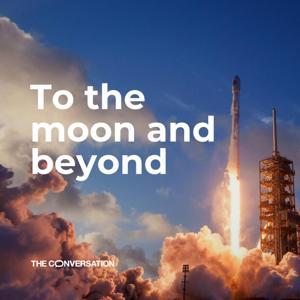
If you’re as fascinated as we are about the history and future of space exploration, check out The Conversation podcast, To the moon and beyond, a five-part podcast series from The Conversation. We’ve featured a little taste of it on Trust Me today.
Through interviews with academic experts around the world – from space scientists to historians, lawyers, futurists and a former astronaut – science journalist Miriam Frankel and space scientist Martin Archer look at the past 50 years of space exploration and what the 50 years ahead have in store.
Episode two features Australia’s own space archaeologist, Alice Gorman, in conversation with Sarah Keenihan about why Apollo 11 landing spots could become heritage sites for future generations of visitors to the Moon.
But today, The Conversation’s Molly Glassey sits down with a panel of astrophysicists to ask the big questions about space, like: what’s the next big thing that’s happening in space research, the thing that will blow us away or bring us together the way the Moon landing did back in 1969? And what’s the likelihood we’ll be living on Mars or the Moon in future?
Today, Molly chats to astrophysicists Jonti Horner and Belinda Nicholson from the University of Southern Queensland and planetary scientist Katarina Miljkovic from Curtin University.
You can find all the episodes of To the moon and beyond on your podcast app, or on our site here.
Podcasts are often best enjoyed using a podcast app. All iPhones come with the Apple Podcasts app already installed, or you may want to listen and subscribe on another app such as Pocket Casts (click here to listen to Trust Me, I’m An Expert on Pocket Casts).
You can also hear us on Stitcher, Spotify or any of the apps below. Just pick a service from one of those listed below and click on the icon to find Trust Me, I’m An Expert.
Credits:
To the moon and beyond is produced by Gemma Ware and Annabel Bligh. Sound editing by Siva Thangarajah. Thank you to City, University of London’s Department of Journalism for allowing use of their studios for To the moon and beyond, and to .
Music: Even when we fall by Philipp Weigl, via Free Music Archive
Fallen Stars by Ketsa, via Free Music Archive
Apollo 11 and 17 audio from NASA
Additional audio
Kindergarten by Unkle Ho, from Elefant Traks.
Pixabay/WikiImages
On the outskirts of Sydney, in a secret bushland location, lies what’s officially known as the Australian Facility for Taphonomic Experimental Research (AFTER). In books and movies, it’d be called a body farm.
Taphonomy is the study of how an organism breaks down after death. Research underway at the University of Technology Sydney’s AFTER facility is yielding some surprising new findings about how bodies decompose in the Australian bush.
And here’s an astonishing detail: until AFTER opened in Sydney in 2016, there was no facility like it in the southern hemisphere. Most of the world’s taphonomic research came from the US, meaning we were missing vital clues relating to how Australian weather, bugs and climate conditions affect the way a human body decomposes in the bush.
Today on our podcast, Trust Me, I’m An Expert, we take you on a journey to AFTER. The facility’s interim director, Maiken Ueland, and PhD student Samara Garrett-Rickman share with us:
And if you’re interested in finding out more about how to donate your body for such research, you can start here.
Podcasts are often best enjoyed using a podcast app. All iPhones come with the Apple Podcasts app already installed, or you may want to listen and subscribe on another app such as Pocket Casts (click here to listen to Trust Me, I’m An Expert on Pocket Casts).
You can also hear us on Stitcher, Spotify or any of the apps below. Just pick a service from one of those listed below and click on the icon to find Trust Me, I’m An Expert.
Kindergarten by Unkle Ho, from Elefant Traks.
Backyard by David Szesztay from Free Music Archive
UTS/Anna Zhu
A growing number of older Australians don’t own their homes. And whether they are private renters or live in social housing can make a big difference to their risk of loneliness and anxiety.
That’s the key finding of research led by Alan Morris, a professor at the UTS Institute for Public Policy and Governance, who interviewed older Australians about how their housing situation may relate to the loneliness they experience.
On today’s episode, Professor Morris shares some of the deeply moving stories he heard.
Podcasts are often best enjoyed using a podcast app. All iPhones come with the Apple Podcasts app already installed, or you may want to listen and subscribe on another app such as Pocket Casts (click here to listen to Trust Me, I’m An Expert on Pocket Casts).
You can also hear us on Stitcher, Spotify or any of the apps below. Just pick a service from one of those listed below and click on the icon to find Trust Me, I’m An Expert.
Kindergarten by Unkle Ho, from Elefant Traks.
Shutterstock
From the publisher's feed
43 Listeners
10 Listeners
1 Listeners
0 Listeners
5 Listeners
0 Listeners
0 Listeners

0 Listeners
12 Listeners
65 Listeners
0 Listeners
0 Listeners
0 Listeners
0 Listeners
51 Listeners
5 Listeners
3 Listeners
0 Listeners