
Sign up to save your podcasts
Or

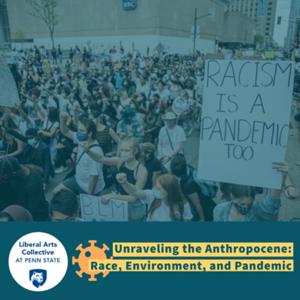


How does antiblackness, slavery, and police power structure society? What has the COVID-19 pandemic revealed about policing? In this episode LAC member Irenae Aigbedion has a provocative conversation with Dr. Tryon Woods (University of Massachusetts, Dartmouth; Providence College) on police violence, police power, and the interrelated systems and inequities that structure society. The two discuss the ways that state and police power has transformed from slavery to the present. Ultimately, they touch on the struggle to consume and process the vast amounts of information presented to us daily via multiple competing channels.
In this episode, LAC member Merve Tabur interviews community organizers Colleen Unroe, Teri Blanton, and Parson Brown. Unroe, Blanton, and Brown share their experiences with various nonviolent direct actions to stop mountaintop removal coal mining. They discuss the significance of documenting the stories of people who are most affected by the abuses of the coal industry. They also reflect on the evolution of community organizing strategies over the years and emphasize the importance of "Just Transition" efforts seeking to build alternative economic development and renewable energy within Central Appalachia.
In this episode, LAC member Müge Gedik has a conversation with Kyle Keeler on the colonial roots of our current epoch, popularly referred to as “the Anthropocene.” Keeler highlights the history of centuries of violent colonialism that would set in motion the industrial production, chemicals, and bomb blasts that are argued to distinguish the Anthropocene from previous epochs. Focusing on violent colonial theft, Keeler changes the name of this epoch to the Kleptocene, to call attention to to the theft of land, lives (both human and nonhuman), and materials that colonialism broadly, but U.S. settler colonialism specifically, imposed and imposes on North America and its Indigenous inhabitants, as a way to understand global environmental catastrophes. This episode foregrounds indigenous resistance that has been ongoing in this process of theft and extraction. Keeler situates his research on the Kleptocene as a way to imagine, decolonize, and create a future free of colonial theft and ecological destruction on repatriated land.
In this episode, LAC member Merve Tabur has a conversation with Dr. Daniel Finch-Race on the impact of climate change on Venice and the mitigation efforts led by the government, the NGOs, and the local community. Describing life in Venice during the November 2019 flood, Dr. Finch-Race discusses the various coping strategies adopted by the city's inhabitants and comments on how the pandemic has affected pollution levels in Venice. Dr. Finch-Race also examines the similarities and differences between our contemporary affective responses to environmental destruction and representations of environmental issues in late eighteenth-century French and Italian art and literature.
Pablo Valenzuela, Chilean teacher and drag queen, shares his experience and that of his community living during the COVID-19 pandemic.
In a conversation with LAC member Müge Gedik, Rimona Afana discusses the ties between speciesism and ecocide. She argues that without challenging our speciesist beliefs and institutions, we cannot advance justice and peace in the Anthropocene. Rimona’s cross-disciplinary research informs her multimedia artwork, collaborative projects, and activism. We will also listen to a short excerpt of her audio/video poem, “wood”, and learn about the story behind it.
In a conversation with LAC member Camila Gutiérrez (Penn State), Javiera Irribarren (Columbia University) discusses how contemporary graphic narratives from Chile, Argentina and Brazil offer non-western views on the interactions between species, time, and spaces. She argues that South American artists make a decolonial move in these comics; questioning historical and contemporary conflicts. In these materials, Irribarren finds powerful alter-native critiques of the current neoliberal State, which she describes as driven by politics of consumption in the age of the Anthropocene or Capitalocene. Irribarren also talks about her experience using these materials in the Spanish-language classroom at Columbia.
LAC member Camila Gutiérrez interviews working artist, teacher, and researcher Melissa Leaym-Fernandez. Leaym-Fernandez has worked in a variety of creative learning spaces that include rural towns, urban cities, and sites with environmental toxins, including with the lead-poisoned in Flint, Michigan, and many other students who are intimidated to develop creative skills but need them in the context of the COVID-19 pandemic. Her professional practice includes using artmaking to teach people how to express their personal voice, share feelings, and support their community through artistic skills in a non-threatening but challenging manner.
From the publisher's feed