
Sign up to save your podcasts
Or



In this episode, LAC member Müge Gedik welcomes Dr. Paulo Ilich Bacca, a legal ethnographer and the Director of Ethnic and Racial Discrimination Area at Dejusticia, Centre for the Study of Law, Justice, and Society in Bogotá, Colombia. Paulo’s research proposes the idea of indigenizing international law by following the anthropological turn in which indigenous cosmologies are direct to the framework of an international legal order. This displacement highlights the power of indigenous law to counteract international law’s colonial legacies. This episode covers the problem with conceptualizing legal subjects through the exclusion of indigenous people from legal orders. Paulo’s objective is to look at Western and indigenous jurisprudence by scrutinizing colonial enterprise and indigenous resistance and bridging the gap between indigenous and state-centric law.
In Episode 14, “‘All the Way to Hell’: Mineral Rights Between Art and Activism,” Hannah Matangos and Merve Tabur interview visual artist and activist Eliza Evans. Evans introduces her activist-art project “All the Way to Hell,” which aims to draw attention to fossil fuel development on private land in the U.S. by giving away mineral rights to participants. In addition to discussing the purpose and reception of the project, Evans, Hannah, and Merve also have a conversation about the history and legal aspects of mineral rights in Oklahoma.
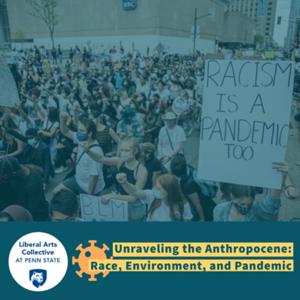
What is the connection between race and environmental justice? Which communities are disproportionately affected by the climate crisis? How does including race along with class, gender, sexuality, and disability for climate justice provide a broader perspective on climate change research and adaptation strategies? In this episode, LAC member Müge Gedik interviews Dr. Nancy Tuana (Penn State, UP) about her new project “Climate Apartheid: Forgetting of Race in the Anthropocene.” We focus on an eco-intersectional analysis that is necessary to understand intersecting and co-constituting axes of systemic oppression of certain groups of people and environmental exploitation and degradation. Topics include the intersections of the COVID-19 pandemic and the disproportionate effects of ecological destruction and climate change on black, native American, and indigenous communities in the United States and Brazil. Dr. Tuana highlights the importance of integrating ethical issues into modeling in climate change research to have ethically and epistemically responsible adaptation practices geared towards what communities value and to make the decisions that matter to them.
What does performance and protest look like in a time of pandemic? How do we study live performance at a moment when keeping our distance is the safest way to keep safe? When do we as researchers stop observing and put our bodies on the line in solidarity with protest movements? In this episode, Irenae Aigbedion (LAC) and Camila Gutiérrez (LAC) interview Dr. Elizabeth Gray (Penn State) on her current and future work on art and activism in Latin America. We focus on her book project, The Poetics of Intervention: Art and Activism in Contemporary Latin America, visiting Chile, Mexico, Brazil, and Argentina through Dr. Gray’s stories and reflections on the transformative art and publishing practices that have emerged in these countries. Our conversation shifts to an exploration of the beginnings of her second project, an analysis of Mapuche activism and the battle for land rights in Chile. Together, we open up a larger discussion of social movements—in particular student led movements—that have fundamentally reshaped the country.
From the publisher's feed