
Sign up to save your podcasts
Or

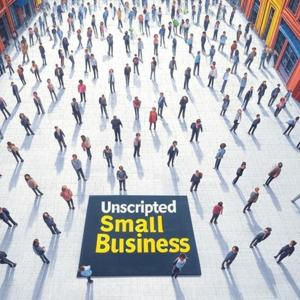


A broker once told a cocky 25-year-old plumbing-company owner five words that gutted him: "Louis, your business is worth nothing." Five years later Louis Swart sold his next business for $5M — and the only thing that changed was delegation. In this episode of Unscripted Small Business, Louis (founder of Iron Brij) unpacks the systems that turn a business you own a job in into one that's actually worth something.
Louis has built and sold companies the hard way — a plumbing business a broker valued at nothing, a later business sold for $5M, and another scaled to $35M and 450 staff. He's also the author of The B Myth (The Busyness Myth). Across the hour he trades practical, hard-won tools with host Jeremy Rivera on delegation, SOPs, creativity inside parameters, using AI without producing slop, and beating the "badge of honor" trap of being busy.
"Louis, your business is worth nothing."— Louis Swart (quoting the broker)"Would I pay somebody a hundred dollars an hour to do this task?"— Louis Swart"Creativity in, creativity out."— Louis Swart
Unscripted Small Business is hosted by Jeremy Rivera. Find every episode and recap at unscriptedsmallbusiness.com, and browse past guests by topic at unscriptedseo.com.
Ali Raymer launched her own agency the week this was recorded. Nine years in travel, a Title I high school English classroom before that, and a straight answer to the question her industry keeps ducking. No, you do not need a travel agent. Booking is solved. What she sells is the part that is left over.
None of that is necessarily hard. What you actually need is a travel advisor.
— Ali RaymerHer opening move is to concede the entire objection. You can book your own flights. Expedia works, the apps work, an AI assistant will happily do it. The booking layer is not where a person adds anything any more, and she says so before anyone else can.
What is left is judgement, and she describes it the way anyone selling a service against a free tool eventually has to. A client arrives certain they want Santorini because of a video. Ten minutes of conversation with them and their partner reveals that what they have actually described is Portugal.
So many of the conversations that I have go down that path.
— Ali RaymerShe calls this the marriage counsellor part of the job. It is also the part a booking engine structurally cannot do, because it requires disagreeing with the customer.
Asked what regulation shapes her work, she gives an answer against her own commercial interest.
I think that we should have higher regulations, much like realtors do.
— Ali RaymerRealtors carry individual licences and have to keep them current. Travel advisors do not. Someone can sit under a host agency, use that agency’s licence number, and start booking other people’s holidays this week.
Even with realtors, you have to do continuing ed every year. We aren’t required to do that.
— Ali RaymerHer practical advice to consumers is to interview the person the way you would interview any other professional, because the industry will not do the filtering for you. Her worry is not fraud so much as absence: people who like travelling but will not answer the phone when something goes wrong in Greece.
Two lines. A planning or consult fee on genuinely custom trips, often waived on simple ones, and commission from suppliers. She puts a typical advisor yield at around twelve per cent.
The interesting part is how she handles the price objection, which is that there usually is not one.
Either Disney is getting that extra 10 % commission or a small business owner like myself is.
— Ali RaymerShe does not fight the points-and-miles crowd either. She builds the whole trip, loads it with the hotel chain her client hoards points for, and lets him book those rooms himself. She still manages the trip and still earns on everything else.
Instagram and Facebook, split by age. Millennials and Gen X on one, retired boomers with time and money on the other. Nothing exotic, and no paid budget mentioned.
If I went to the gym and looked at my trainer and he didn’t have muscles, I wouldn’t go to that gym.
— Ali RaymerSo every trip she takes personally becomes content, roughly monthly. She also reports, from the customer side, the shift marketers keep arguing about. At the end of a consult call she asks who she can thank for the referral, and the answer has started coming back as an AI tool rather than Google.
If you run a local business, hear that and wonder how you would ever prove it, the SOP for proving a local booking actually came from search is the unglamorous version of the answer.
Every link above goes somewhere different. These are the ones not already mentioned above.
peaceandpearltravel.com, and Ali Raymer on LinkedIn, where she writes for the advisor trade rather than the traveller.
Raymer, Ali. Interviewed by Jeremy Rivera. “You Don’t Need a Travel Agent, You Need an Advisor.” Unscripted Small Business, 2026. https://unscriptedsmallbusiness.com/why-you-dont-need-a-travel-agent-you-need-an-advisor-ali-raymer/
Every purchase is a trust purchase. So why do we obsess over clicks?
Joshua Altman, Managing Director of Beltway Media and a fractional Chief Communications Officer (CCO), joins host Jeremy Rivera on the Unscripted Small Business Podcast to explain why the metrics most small businesses chase are quietly misleading them — and what to build instead.
We get into the "Four Languages" model (what people READ, SEE, HEAR, and EXPERIENCE), why a solopreneur can benefit from fractional comms just like a 250-person company, how Reddit backfires when you fake it, why buyer journeys now take 30+ touchpoints you'll never track, and how to use AI as a genuine tool for research and machine-readable pages — without letting it write your brand.
If you've ever felt duped by your analytics dashboard, this one's for you.
⏱️ CHAPTERS
00:00 Meet Joshua Altman & Beltway Media
00:55 What "fractional" + Chief Communications Officer actually means
02:08 Aligning internal and external communications
03:51 What size business needs comms? (solopreneur → 250 people)
07:02 The first weeks of an engagement: "Why isn't it working yet?"
08:58 The Four Languages model: read, see, hear, experience
11:43 There are no "content police" — cadence & repurposing
12:29 The red lines: what a CCO won't do
13:46 An unexpected win: Reddit (and how it backfires)
16:06 Build your own community vs. join where they already are
17:24 Fractional CCO vs. CMO — the trust difference
19:02 The biggest communications missteps
19:15 Why attribution is broken: 7 → 30+ touchpoints
21:55 What replaces cause-and-effect? Correlation + judgment
27:22 The Sears catalog lesson
28:28 AI: the worst support rep we have (but the one we've got)
29:15 Agentic AI, bots with wallets & optimizing for machines
32:20 AI research at scale — done right (government sources only)
35:11 Building an SEO Tactics Library with AI in an afternoon
37:47 What you can and can't control in discoverability
38:58 The one rule: everything you produce should be USEFUL
39:27 Where to find Joshua
GUEST — Joshua Altman, Beltway Media
Website: https://beltway.media/
Free tools & quizzes: https://beltway.media/our-free-tools/
LinkedIn: https://www.linkedin.com/in/joshuaialtman/
✉️ Email: [email protected]
MENTIONED IN THIS EPISODE
• SEO Teric (Matt Brooks): https://seoteric.com
• Open Source SEO: https://openseo.so/
• Permacast Walls — precast concrete walls in Florida: https://permacastwalls.com/
️ THE SHOW
Unscripted Small Business Podcast — real conversations with the people building and marketing small businesses.
Hosted by Jeremy Rivera, who runs the same fractional model for search: fractional SEO consulting.
#SmallBusiness #Marketing #FractionalCCO #Communications #BrandStrategy #ContentMarketing #AImarketing #Reddit #TrustMarketing #Podcast
Ask a room of owners who their biggest competitor is and you will get a list of company names. Jorge Chavez, president and co-founder of Topaz Sales Consulting, thinks nine out of ten of those answers are wrong. The competitor that beats you most often is the customer deciding to do nothing at all.
And here’s our favorite question: what happens if you do nothing? What if you don’t change, which is the biggest competitor for everyone, the status quo?
— Jorge ChavezThe move he is describing is not a closing technique. It is a diagnostic. If nothing bad happens when the buyer does nothing, there is no deal to run, and the polite thing is to find that out early rather than after three proposals.
But the real answer is no change.
— Jorge ChavezHe is specific about the shapes it takes. They keep using a competitor. They do it in house. They have been meaning to sort the website out for years and will get to it. Every one of those is the same answer wearing a different coat.
The goal can’t be to sell. It’s a byproduct of right thinking and effectively executing your process.
— Jorge ChavezThis is where the episode stops being a sales talk. He argues that a rep who wants the sale will sell less, because wanting it distorts every question they ask. The alternative is uncomfortable: work out whether the buyer can solve the problem without you, and be willing to say so.
And you have to be not seeking yeses and not seeking no’s, but seeking the truth.
— Jorge ChavezHe is equally blunt about why people distrust the profession. Show up, throw up, pressure, overcome objections, chase the yes. His objection to it is commercial before it is ethical. It does not work as well.
Asked whether empathy is a business superpower, he does not simply agree. He reframes it as a skill with a name.
You have to care. If you don’t care about people, sales, and relationships, you’re in the wrong business.
— Jorge ChavezAbove active listening he puts empathetic listening: suspending your own biases and training long enough to look at the situation from where the other person is standing. His claim is that questions stop being hard to invent once you do it.
We say infinite curiosity is running out of time before you run out of questions.
— Jorge ChavezHis diagnosis is that curiosity is a skill people lose after childhood, which is why so many salespeople freeze when the script runs out. It is also why he prefers a live conversation to any amount of written back and forth.
He has trained over a hundred chief marketing officers, which gives him an unusual answer to the oldest question in the building. Marketing makes assumptions about a market it cannot interview, and its job is to raise curiosity. Sales makes no assumptions at all.
Instead of making assumptions in sales, you make no assumptions.
— Jorge ChavezThe bridge those CMOs described back to him is that modern marketing has started behaving like the sales side: asking questions tied to real pain rather than announcing services. Not here are our SEO packages but do you feel your site is reaching the right market.
The closing-the-loop section is the one to send to anyone running acquisition. Weekly review of lead quality rather than lead count, a first-person narrative writer who actually knows the business, and a tech partner who asks whether a lead was any good. Jeremy’s counter-story is the three-hundred-per-cent lead increase that the sales team experienced as the worst month they had ever had. If you have that problem, the routine for deciding what to ship next when everything looks urgent is a way in.
Every link above goes somewhere different. These are the ones not already mentioned above.
topazsalesconsulting.com, where the contact form asks for a conversation rather than a demo, which is rather the point of the whole episode.
Chavez, Jorge. Interviewed by Jeremy Rivera. “The Status Quo Is Your Biggest Competitor.” Unscripted Small Business, 2026. https://unscriptedsmallbusiness.com/the-status-quo-is-your-biggest-competitor-jorge-chavez-on-selling-without-selling/
Ameera Virani spent two decades producing the stages for Wayne Dyer, Bob Proctor, Tony Robbins and Robin Sharma before building her own coaching practice. She watched people build empires from the wings, and her conclusion is not the one the industry sells. Intentional living is not something you get to once the business is stable. It is the job.
Designing your life is not just your first priority, it’s your responsibility.
— Ameera ViraniThe reframe lands hardest on business owners, who are the most practised at deferring it. There is always a launch, a hire, a quarter. She has watched enough people reach the top of that ladder to know what is waiting.
No one ever looked back on their deathbed and said, I wish I had spent more time at work.
— Ameera ViraniDelivered by someone who spent twenty years backstage with people who built empires, which is what stops it being a platitude.
She rejects work-life balance outright. Balance implies a scale with work on one side and everything else on the other, which is already the wrong picture. She works across five pillars: health, business or career, wealth, fulfilment and relationships.
The difference matters practically. A scale can be tipped back. A pillar that has been neglected does not tip, it fails, and it takes part of the structure with it.
Her diagnostic is unglamorous: write down where the week actually went, then sort it against the five pillars. Most people discover the starving pillar is not the one they would have guessed.
Her model for why people revert. You raise income, health or the quality of your relationships, and then something quietly returns you to the level you are used to. She starts clients on what they actually desire rather than on tactics, because a tactic applied against a thermostat is wasted.
And she is clear about the pattern underneath it: we run subconscious scripts, and most people wait until the pain is unbearable before rewriting one. That is a change happening to you.
It’s never about changing everything, but it is about taking those small steps forward towards the life that you desire to live.
— Ameera ViraniAsked what she runs into most often, she does not say time, money or discipline. She says the fear of being fully seen.
If you know what you should be publishing and you are not publishing it, that is the thing worth examining before you buy another course on consistency. The practical constraints are usually real. They are also usually not the reason.
Every link above goes somewhere different. These are the ones not already mentioned above.
ameeravirani.com
Virani, Ameera. Interviewed by Jeremy Rivera. “Design Your Life on Purpose.” Unscripted Small Business, 2026. https://unscriptedsmallbusiness.com/ameera-virani-designing-your-life-is-your-job/
Jessica Malnik opens with the take that hybrid is not the safe compromise. It is the hardest model, because it stacks every hard part of in-office on every hard part of remote. Jessica does positioning, messaging and product marketing for tech companies (her about page) and has run The Remote Work Tribe, a media site, podcast and newsletter for remote and hybrid leaders, for almost six years.
From there: tool sprawl, documentation culture, who maintains a vibe-coded tool after its builder leaves, build vs buy, and the ClickUp lesson. Jeremy's full recap, with the quotes and the frameworks written out, is at Jessica Malnik on remote work, AI and beating commodity content. Jessica asked for one link in the notes: the Remote Work Tribe newsletter, twice a month.
In this episode
Related on the network: Mark Pearson on getting cited by AI agents (the "LLMs are table stakes" line Jeremy quotes), Mason McCumber on AI agents and agentic workflows, and Jeremy's piece on leveraging AI writing tools without commoditizing the content. The executable plays are filed in the SEO Tactic Library.
Jessica's own interviews with remote leaders are on the Remote Work Tribe podcast. Unscripted Small Business is hosted by Jeremy Rivera. Want to be on the show? Apply to be a guest.
Agents already hold wallets, and it started at the enterprise end. Mark Pearson went from Tony Robbins life coaching to business coaching to AI consulting, and has narrowed to two things small businesses are about to need: getting found by AI, and getting paid by it. The second one is the part nobody has built for.
SEO has graduated into the agentic world as well. And that is the AEO, that is LLM Visibility.
— Mark PearsonA useful corrective to the rebrand-everything reflex. The practical corollary he draws is that backlinks have not stopped counting, because the systems doing the citing are still leaning on the ranking systems that use them.
the more places that your business can get seen and cited so that the AI is building up that credibility for you
— Mark PearsonPress releases, blogs, directories, socials. The unit of work is presence in many places rather than perfection in one.
His framing is three steps rather than two: get found, get chosen, get paid by AI. The first is answer-engine work everyone is already arguing about. The third is a payment rail, and almost nobody has built for it.
It requires a catalogue a machine can read, with schema and discrete SKUs, plus a calendar and checkout an agent can actually operate. His example is a chiropractor turning a ten-pack of visits into a purchasable, schema-tagged item — which is what productising a service means once the buyer is software.
He points at the Stripe and OpenAI partnership, a competing Google protocol, and Home Depot, Lowe’s, Etsy, Wayfair and Shopify storefronts as places this is already running. He also notes the United States is trailing China here.
they are business to business of the agents just doing a lot of those like reorders, you know, monthly reorders on things.
— Mark PearsonThis reframes who should prepare first, and it is not who the coverage suggests. The consumer brand imagining an agent doing someone’s Christmas shopping is a long way behind the supplier whose customers reorder the same thing every month without thinking about it.
the consistency of blogging and the recent citations, just recency in general is really, really good for AI.
— Mark PearsonCombined with breadth, because every model searches differently. Being cited recently in many places beats being cited beautifully in one. Jeremy connects the same idea back to entity work and the about page that tells the machines who you actually are.
you don’t want to give it full agency. You don’t wanna just let it run your life
— Mark PearsonThe counterweight to everything else in the episode, and he raises it unprompted. Use the model to create rather than to offload, because it hallucinates and it is working from borrowed anecdotes.
Every link above goes somewhere different. These are the ones not already mentioned above.
agentbuyable.ai.
Pearson, Mark. Interviewed by Jeremy Rivera. “On Getting Cited by AI Agents.” Unscripted Small Business, 10 August 2026. https://unscriptedsmallbusiness.com/mark-pearson-on-getting-cited-by-ai-agents/
In this episode — Jeremy asks Brad Poulos what the next ten years look like for hands-on local service businesses:
JEREMY RIVERA: I’m curious what your advice is right now for SMBs in manual services — tree trimming like McAllister Tree Service, installing concrete walls in Florida, doing home repair in Tennessee. If you’re geo-based and doing services, what does that look like from your perspective?
BRAD POULOS: I actually love those kinds of businesses. They’re never gonna go away. A lot of digital tools may come and go, but a tree trimming service will virtually always be here. The thing that’s changed over the past ten years is that the really good players are both good at executing their trade and good at executing digital marketing.
It’s becoming necessary to stand above the crowd and to get the leads first. I’m a member of a group that has a wedding photographer in it, and that wedding photographer is spending two hundred dollars a day on Facebook ads. So you better be good at it when you’re spending six thousand dollars a month.
Brad Poulos is an educator and consultant in the small business space. He teaches in the entrepreneurship department at Toronto Metropolitan University in Toronto, where he has been on faculty for about fifteen years. Alongside his teaching, Brad consults to small businesses in Canada and the United States, primarily those in the $5–50 million revenue range. He is the author of three books — Most Problems Solve Themselves, The Small Business Operator's Manual, and From Pitch to Payoff — and operates a business planning and cadence system for small business owners at confidentoperator.com.
Brad opens with a story that reframes how most people think about business planning. Early in his career, he raised two million dollars from Bell Canada's board using a thick business plan full of projections — and had never spoken to a single prospective customer before the meeting. That was the old playbook. Today's curriculum is built on lean startup methodology: validate with real customers before you write a single number. The infrastructure shift matters too — what once required custom bank-approval code is now a Shopify checkbox. Entrepreneurship is more democratic, but that cuts both ways.
The episode hits its stride when Brad and Jeremy dig into what it takes to actually own a business versus a high-paying job. Brad's test is clean: "If you can't go to Barbados and sit on the beach and you're making money, you do not have a business. You own your job." The fix isn't hiring more people — it's changing what you hand them. Jeremy's framing lands hard: don't delegate tasks, delegate outcomes. A-players figure out the tasks themselves. B-players need the list. Knowing the difference is what separates a good operator from a frustrated one.
Brad introduces a framework for thinking about org design that's been around for decades but stays underused: the spectrum from organic organizations (high autonomy, outcomes-focused, multi-directional communication) to mechanistic ones (consistency-first, top-down, execution-driven). His McDonald's example is memorable: the fries are solved. You don't want an entrepreneurial person in the fryer questioning the process. For local service businesses, the same principle applies — knowing which roles need A-players and which need reliable executors is what makes a small business actually scalable.
Brad closes with his most controversial take: the post-pandemic generation of students is significantly weaker at problem-solving than previous cohorts, and he attributes it primarily to bulldozer parenting — parents who remove every obstacle before their child encounters it. His recommended read is Jonathan Haidt's The Coddling of the American Mind, which argues that children are anti-fragile: they get stronger through challenge, not weaker. For business owners hiring from this cohort, the organic vs. mechanistic distinction matters more than it used to.
Website: bradpoulos.com
Planning System: confidentoperator.com
LinkedIn: linkedin.com/in/bradpoulos
Books on Amazon: Most Problems Solve Themselves · The Small Business Operator's Manual · From Pitch to Payoff
The Unscripted Small Business Podcast is hosted by Jeremy Rivera and features candid, unscripted conversations with small business owners, operators, and entrepreneurs. New episodes drop weekly at unscriptedsmallbusiness.com.
Jared Harman has spent eight years building One Group Agency in Vancouver and twenty-five years in marketing before that. His read on AI is contrarian in a useful direction. The value is in the back office, not the brand voice.
The people who ignore it are gonna end up being left behind. Where there’s a ton of value right now that doesn’t require a ton of investment or time is in the logistical side or the operational side of AI.
— Jared HarmanThe distinction matters commercially. Operational gains are cheap, immediate and invisible to the client, which means they improve margin rather than becoming a discount conversation.
Creative gains are visible, and the moment a client believes the work was generated, the price is up for renegotiation whether the quality changed or not.
What we can offer you is an actual voice in the market that is on the other side of that phone or email thread.
— Jared HarmanI truly believe that there’s opportunity that comes from working across different industries.
— Jared HarmanEvery piece of agency advice for a decade has said niche down. Jared deliberately did not, and his reasoning is about transfer. A tactic that is standard in one sector is often unheard of in another, and that arbitrage only exists if you are in both.
It is a genuine trade. He gives up the referral velocity and the pricing power a specialist gets, and buys a wider view.
His analogy for the core commercial problem is a good one. Sell someone an apple and the transaction is finished, because both parties can see the apple. Sell someone brand strategy and the negotiation never really closes.
The consequence is that intangible services attract haggling in a way tangible ones do not, and it has nothing to do with the quality of the work.
So like you’ve gotta go in and you gotta kinda like shave the dream down a bit to what will work with what you have.
— Jared HarmanThat is the budget conversation, and it is the one most agencies avoid until it is too late to have well.
We’ve adopted the approach of, hey, our pricing’s our pricing, we’re gonna stick with it. Even if there’s a chance to price more just ’cause the client can pay more, we’re not gonna do that. But we’re also not gonna reduce the price just to get the business.
— Jared Harmanwe’ve lost clients before because they’ve said we’re not charging enough.
— Jared HarmanThat second line is the more interesting one. In a market with no pricing standards, a low quote reads as a quality signal rather than a bargain, and he has lost work by being cheaper than expected.
We we don’t practice what we preach all the time. It’s not because we’re ignoring it, we just literally don’t have time sometimes.
— Jared HarmanAn honest admission that most agency owners will recognise. The client work always wins, and the agency’s own marketing is the thing that gets moved to next month, every month.
But if Joe Blow goes to your website or your social channels or wherever, are they gonna have any idea what you’re talking about or what you’re selling?
— Jared HarmanHis same-day action is to strip the message back until somebody outside your industry can repeat it. It costs nothing, it takes an afternoon, and it is the highest-return thing on the list.
Every link above goes somewhere different. These are the ones not already mentioned above.
One Group Agency is at onegroupagency.ca. Hosted by Jeremy Rivera. More at Unscripted Small Business.
Harman, Jared. Interviewed by Jeremy Rivera. “Running a Full-Service Agency in the AI Era.” Unscripted Small Business, 2026. https://unscripted-small-business.castos.com/episodes/jared-harman
George Rivera spent 31 years building businesses, including a supplement company he took from zero to over $200 million in sales. Now he runs Founder Dad Tables, small structured gatherings where successful founder dads talk about what the business is costing them at home. His diagnosis: "Most founder dads think that they have a time problem and they really don't. It's a dependency problem. The business still runs through them." The cost, he says, is that the people you love eventually stop competing with the business for your attention, and then they just stop asking.
Read the full episode recap: George Rivera on Building a Business You Can Step Away From.
What George and Jeremy cover
Resources George mentioned
Related episodes
Jeremy mentions his conversation with Brandon Moon on planning your exit. For more on getting out of the day-to-day, hear Louis Swart's $100-an-hour rule, Brad Poulos on a business that runs without you and Joel Miller on human marketing in the attention economy. More in the interview archive.
Host: Jeremy Rivera. Guest: George Rivera, founder, Founder Dad Tables.
From the publisher's feed