
Sign up to save your podcasts
Or

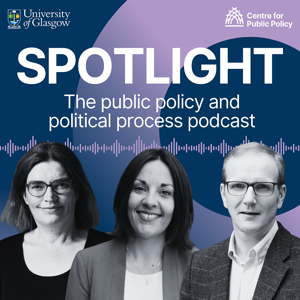


On this special episode focussing on minority government, we speak to Geoff Aberdein, former FM chief of staff to Alex Salmond, and Professor Nicola McEwen, Director of the UofG Centre for Public Policy.
They discuss what minority government might mean for Scotland, from day-to-day practicalities to potential implications longer term for the political process and public policy.
Produced by Fresh Air Studios for The University of Glasgow.
We are delighted to bring you this special episode on Minimum Unit Pricing, ahead of an anticipated rise by the Scottish Government later this spring.
Professor Nicola McEwen talks to Dr Peter Rice, a former addiction psychiatrist and President of the European Alcohol Policy Alliance. He is also Chair of the Institute of Alcohol Studies.
Dr Rice was one of the founders, and a former Chair, of the Scottish Health Action on Alcohol Problems (SHAAP), which was set up in 2006. He was part of the SHAAP group that developed the proposal for Minimum Unit Pricing in 2007, which was adopted by the Scottish Government, became law in 2012 and introduced in 2018.
This special episode focusses on the UK Budget detailed last week by the UK Chancellor.
Joining us for analysis are three of our UofG experts: Graeme Roy, Dean of external engagement here at the University of Glasgow, he also serves as Chair of the Scottish Fiscal Commission. Nicola McEwen is the Director of the Centre for Public Policy and Claire Macrae is a Senior Lecturer with research expertise on equality and risk distribution.
Together they'll be looking at the fiscal choices the Chancellor made, what they mean for Scotland's balance sheet and their impact on the UK public services more generally.
On this episode, we are joined by Dr Marianne Sensier, from the University of Manchester and The Productivity Institute, and Neil Lee, Professor of Economic Geography at the London School of Economics.
Marianne and Neil recently took part in a workshop at the University of Glasgow discussing the priorities for the Glasgow City region, as part of the University's 'policy lab' with the Glasgow City Region Intelligence Hub.
The concept of these policy labs is to provide a way for policy makers to engage with the academic community, as well as key stakeholders - all with the aim of finding new solutions and ideas to 'wicked problems'.
After the workshop Marian and Neil joined Graeme Roy and David Waite, lead of the Glasgow Economic Development Policy Lab and Lecturer in Urban Studies at the University of Glasgow, to discuss regional inequalities and inclusive growth.
This episode investigates the relationship between traumatic brain injuries resulting from sporting activities and the link to dementia.
We talk to Dr Willie Stewart, Consultant Neuropathologist at the Queen Elizabeth and Honorary Professor in Psychology and Neuroscience, about the pioneering work being done at the University to demonstrate a link between sporting head injuries and dementia.
We also speak to Michael Marra, North East of Scotland Labour MSP, about his campaign Injury Time, and the current work to include footballing injuries in the scope of the proposed Industrial Injuries bill.
The theme for this week's episode is climate change.
We speak to Chris Stark, Chief Executive of the Climate Change Committee.
We also talk to Dr Hannah Salamon, UofG Research Associate at the Centre for Public Policy, on the relationship between gender and climate change.
Back for Season 3!
On this episode we are joined by our new Spotlight co-host Professor Nicola McEwan. Nicola is Professor of Public Policy and Director of the new Centre for Public Policy at the University of Glasgow.
We hear from Nicola about the exciting programme of work planned for the recently established Centre. We also have analysis around recent political developments including the SNP's annual conference and what October's bi-election results will mean for the coming general election.
In February 2023, Keith Tribe delivered a talk at the University of Oxford's Balliol College as part of the Smith Around the World series. This event was held in advance of the annual Snell Dinner, commemorating the 17th century benefactor and Scot John Snell, whose generosity has enabled University of Glasgow students to pursue postgraduate degrees at Balliol. Famously, Adam Smith was a Snell exhibitioner, attending Oxford after his time as a student at Glasgow.
As an independent historian, economic scholar and expert in language and translation, Keith was an ideal speaker to discuss the dissemination of Smith's ideas over time. He is a highly regarded economic historian and has held numerous posts throughout Europe, including as senior research fellow at the University of Tartu in Estonia.
In this podcast, Keith explores the ideas and thinking behind his talk with Professor Graeme Roy of the University of Glasgow.
In this episode, we speak to Professor Nicola McEwan, an expert in devolution and inter-governmental relations, who recently joined Glasgow to establish and run a new Centre for Public Policy.
We also talk to Theodore Koutmeridis about behavioural economics and how nudges – changes to the incentives that we face – can change the outcomes of policymaking.
Timestamps
Nicola McEwan: 1:03
Theodore Koutmeridis: 19:06
In this episode we speak to Chris Chapman, Professor of Educational Policy and Practice, and Graham Donaldson, an Honorary Professor at the School of Education, about the future direction of education policy in Scotland.
We also talk to Philip Whyte, Director of the Institute for Public Policy Research Scotland and one of the authors of a new report published this week called Tipping the scales which looks at the social and economic harms of poverty in Scotland today.
Timestamps
Chris Chapman and Graham Donaldson: 1:47
Philip Whyte: 19:26
From the publisher's feed

299 Listeners

371 Listeners

111,866 Listeners

642 Listeners
0 Listeners

15,908 Listeners

358 Listeners

3,015 Listeners

1,112 Listeners

2,231 Listeners

48 Listeners