Chapter 59: Tiny Pushes
Episode Overview
In this final, definitive installment of Watertown: Under Color of Law, we deliver a searing audit of the institutional apparatus that allowed a multi-jurisdictional retaliation campaign to thrive. We trace the lineage of civic integrity from Watertown’s own Supreme Court Justice Benjamin Robbins Curtis to the modern whistleblower, dismantle the “Townie silence” that protected administrative malpractice, and name the specific gatekeepers—from the police precinct to the City Council—who presided over this systemic collapse of accountability.
Key Themes & Discussion Points
* The Mission of the “Tiny Push”
* We honor the legacy of U.S. Supreme Court Justice Benjamin Robbins Curtis, a Watertown titan who resigned in protest rather than serve as a background extra in a corrupt political arrangement.
* We frame the work of documenting municipal standards of conduct as a continuation of his mission: stabilizing government through the “aggregate of the tiny pushes of each honest worker.” Every individual records request, every cited violation, and every public audit is a vital rep in the maintenance of a republic.
* The Whistleblower’s Audit: Beyond the “Bitter Ex” Narrative
* We reject the department’s exhausted, misogynistic playbook that attempted to pathologize a “Master Plus 60” veteran educator as a “bitter, crazy ex.” This is the same unoriginal narrative structure used to isolate and discredit Kathleen Donahue, whose victory in federal court proved that systems only default to attacking credibility when they cannot refute the facts.
* We highlight the whistleblower’s legitimate civic pedigree: a product of Lawrence High grit, an educator with three decades of service, a former school committee candidate, and a writer syndicated in The Washington Post.
* The Hall of Shame: Systemic Failure & Indifference
* We explicitly document the network of enablers who prioritized administrative comfort over the civil liberties of a citizen:
* Judicial/Clerical: Judge John Garner’s abdication of neutrality, BPD Detective Nancy Cellucci and Officer Pat Kelley’s reduction of their badges to an institutional concierge service for a private party, and the alleged bureaucratic “hook-up” provided by Assistant DA Tim Ferriter.
* Supervisory Failures: Detective Kenny Swift and Captain Justin Hanrahan, who allowed their own egos to convince them they operate above the law.
* Operational Cowardice: Captain Danny Unsworth and Sergeant Ryan Vaughan, whose attempts to pass the buck regarding the authorship of legally deficient charging documents collapsed under the weight of the physical signature on the pages.
* Political Silence: Town Manager George Proakis and the entirety of the Watertown City Council—including Council President Mark Sideris and members Vincent J. Piccirilli, Jr., John M. Airasian, Caroline Bays, John G. Gannon, Anthony Palomba, Theophilus Offei, Nicole Gardner, Lisa J. Feltner, and Emily Izzo—who sat in total, indifferent silence while a citizen was subjected to unconstitutional overreach.
* The Residency Fraud & Jurisdictional Games
* We analyze how the institution willfully ignored that a disgraced former state trooper—hired as a department trainer—was masquerading as a Massachusetts resident just nine days after swearing under oath in a federal mortgage affidavit that he resided in Manchester, New Hampshire.
* The Watertown apparatus deliberately ignored the sloppy, legally deficient charging documents specifically designed to re-adjudicate a 2022 New Hampshire judicial ruling that had already protected the whistleblower’s right to share public records.
Quotes Featured in This Episode
“I have always been deeply civically minded. When bad actors within law enforcement expected a quiet subtraction, they instead encountered a spine of iron... Sunlight is the best disinfectant. It is time to turn the light on collectively for these people and make the world a better place. Democracy and institutional integrity die in the quiet corners of complacency. Class dismissed.”
Book Club & Discussion Questions
* The Diagnostic Whistleblower: Why does a defensive administration view a citizen-auditor as a “threat” rather than as a diagnostic tool for identifying internal corruption and ethics violations?
* The “Townie” Silence: How does the culture of “indifferent silence” from elected representatives—who refuse to engage with detailed documentation of constitutional abuse—act as a protective shield for rogue police command staff?
* The Accountability Standard: Given the $5 million verdict in the Donahue case, why is it vital for taxpayers to demand structural reforms that prevent the repetition of historical civil rights violations?
Resource Links & References
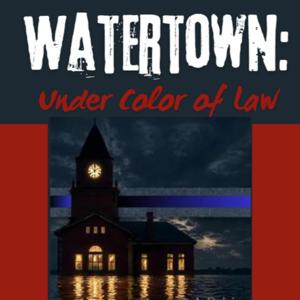
* Featured Book: Watertown: Under Color of Law by Amy M. Dubé (2026, Red Oak Media).
This is a public episode. If you would like to discuss this with other subscribers or get access to bonus episodes, visit adminethicsindex.substack.com