
Sign up to save your podcasts
Or



Aquí está:
¿Sabías que las abejas meliponas polinizan hasta el 80% de la flora amazónica — y que la mayoría de la gente ni sabe que existen?
Ornella Muñoz creció en Dos de Mayo, a orillas del río Ucayali, en la Amazonía peruana. Desde pequeña se preguntaba de dónde venía el aire fresco, cómo los árboles hacían posible la vida y por qué su comunidad dependía tanto de la naturaleza. Esa curiosidad se convirtió en vocación. Hoy es ingeniera forestal e investigadora en Amazon Research International, donde trabaja en la conservación de las abejas nativas sin aguijón y en la investigación forestal en Loreto, Perú.
En esta conversación con Sara, Ornella nos lleva al corazón de la Amazonía: a las comunidades remotas, a las colonias de abejas meliponas que sostienen la regeneración del bosque, y a los jóvenes investigadores indígenas que están transformando la relación de sus comunidades con la ciencia.
Hablamos de meliponicultura, conocimiento indígena, deforestación, y de dónde encontrar esperanza cuando la Amazonía sigue demostrando una capacidad de resiliencia extraordinaria.
"La conservación no es responsabilidad exclusiva de investigadores, gobiernos u organizaciones. Es una tarea colectiva."
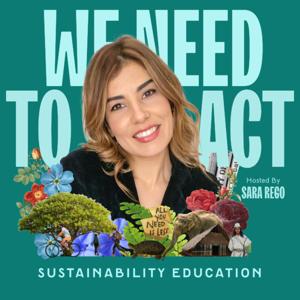
We Need to Act es un podcast sobre las personas, ideas y movimientos que están construyendo un presente mejor.
What if whales are not just animals — but ancestors?
Dr. Mere Takoko is a Māori Ocean and Climate conservationist from Aotearoa New Zealand and one of the leading voices behind the movement to grant whales legal personhood across the Pacific. A descendant of Māui and Paikea — the ancestor who arrived in New Zealand on the back of a whale — Mere holds what she describes not as a job, but an inherited sovereign duty: to protect her ancestors and rebuild the relationship between people and nature.
In this conversation with Sara, Mere explains why whales are the ocean's greatest climate engineers — each one capable of storing the carbon equivalent of over a thousand trees — and why restoring one million whales to the Pacific is not just an ecological goal, but a cultural and spiritual one.
She talks about authoring He Whakaputanga Moana, the declaration that confers legal personhood on whales under customary law, signed by paramount chiefs across Polynesia and championed by the late Māori King. She speaks candidly about the rise of "blue colonialism" — large conservation organisations moving into the Pacific and absorbing resources that rarely reach the Indigenous communities doing the actual work. And she shares her quiet concern about artificial intelligence falling into the wrong hands in the race to "communicate" with whales.
But beneath the critique is something rarer: a genuinely different way of seeing. Not nature as resource. Not whales as biomass. Kinship. Ancestry. A 22-generation-old covenant still being honoured today.
In this episode:
About Dr. Mere Takoko:
Dr. Mere Takoko is a Māori conservationist of Ngāti Porou, Te Whānau-a-Apanui, and Rongowhakaata descent, and Executive Trustee of the Moananui Sanctuary. She is the author of He Whakaputanga Moana, the declaration granting legal personhood to whales across the Polynesian triangle, and Chief Executive of the Pacific Whale Fund, where she is leading efforts to establish a US$100 million biodiversity blue bond for marine conservation. A descendant of Māui and Paikea, Mere leads a global effort to recover one million whales across the Pacific.
What does the godfather of the global sustainability movement think is coming next?
John Elkington has been working at the intersection of business, environment, and society for over 50 years. He coined the Triple Bottom Line. He wrote the Green Consumer Guide. He conceived the Green Swan. He has advised governments, corporations, and movements across the world. And after all of that — after five decades of watching the system from the inside — he is, unexpectedly, more optimistic than he has been in a very long time.
In this conversation with Sara, John doesn't pull his punches. He talks about capitalism not surviving more than a decade or two in its current form. About the UN becoming obsolete. About democracy being under existential threat. About a major financial crash coming. About the very real possibility of nuclear weapons being used.
And yet — through all of it — he keeps returning to one conviction: the golden age of sustainability hasn't happened yet. It's still ahead of us. And the people alive today will be part of building it.
This is a conversation for anyone who has ever wondered whether the people who have worked longest in this field still believe change is possible. John's answer, at 76, with a seven-year-old grandson, is a clear and considered yes.
In this episode:
About John Elkington:
John Elkington is one of the world's most influential voices in sustainability. Often described as the godfather of the global sustainability movement, he coined the Triple Bottom Line in 1994 and has spent over 50 years advising businesses, governments, and civil society organisations. He is the author of more than 20 books, including Green Swans and The Green Consumer Guide. He is co-founder of Volans and SustainAbility, and continues to work at the frontier of systems change, business innovation, and regenerative futures.
What does it take to stop a coal plant from being built in your community — when you're young, when the government is pushing it, and when the promises of jobs and opportunity are pulling people the other way?
For Portia, the answer was relationships, strategy, and an unshakeable belief that there is always an alternative.
A grassroots climate advocate, royal native of Asuom in Ghana's Eastern Region, founder of Dreamhunt, and member of 350 Ghana, Portia has spent over a decade working at the intersection of climate justice, renewable energy, and community empowerment. In this conversation with Sara, she shares the story of the Coal Kills campaign — how a group of young people took on the fossil fuel industry, engaged ten chiefs in their local dialects, used the media as their most powerful tool, and won.
But this episode goes far beyond one campaign. Portia talks about what it really means to work with communities — not for them. About why climate finance is failing the Global South. About the women in the Savannah region living without electricity in the 21st century. About why, for an African, just energy transition is not just energy — it's food, shelter, and clothing.
And about hope. Not the abstract kind, but the kind you build by showing up with solar panels and staying long enough to see the light come on.
In this episode:
About Portia:Portia is a climate justice advocate, founder of Dreamhunt, and member of 350 Ghana. A royal native of Asuom in Ghana's Eastern Region, she works at the intersection of renewable energy, community empowerment, and climate finance advocacy. With a background in banking and finance, she brings both grassroots experience and policy-level understanding to the fight for a just and sustainable future.
Available on:
Spotify
Apple Podcasts
YouTube
www.weneedtoact.org
What if the environmental crisis is really a crisis of worldview? In this episode, Sara sits down with Professor Carl Mika — Professor of Māori and Indigenous Philosophies, and Head of School of Aotahi: School of Māori and Indigenous Studies, University of Canterbury — for a conversation that goes straight to the roots of how we see ourselves in relation to everything else.
Carl challenges some of the most taken-for-granted assumptions in Western thought: that the self is separate from the world, that knowledge is something to be accumulated, that sustainability is "out there" to be managed. Drawing from Māori philosophy and his own work at the intersection of indigenous thought and academia, he invites us to sit with what we can't fully know — and to find that discomfort deeply instructive.
Together, Carl and Sara explore how colonization didn't just reshape land and bodies, but also language, academic structures, and the very way we relate to each other and to the Earth. They talk about the Māori concept of te kore and te pō — nothingness and darkness — not as absence or failure, but as vital and ever-present dimensions of existence that our optimism-obsessed culture desperately tries to escape.
This is a conversation about what sustainability could mean if we stopped treating nature as "out there" — and started recognizing, as Carl puts it, that "the environment is not the environment. There is no such thing as environment."
Expect philosophy, provocation, and a reminder that the most radical act might just be to sit with someone over coffee — no agenda, no formal structure — and simply get to know them.
In this episode:
About Carl Mika:Professor Carl Mika is a philosopher and Head of School at the University of Canterbury, Aotearoa New Zealand. Of Tūhorangi and Ngāti Whānauapiti descent, his work sits at the intersection of Māori philosophy, indigenous studies, and the philosophy of language. He holds a background in law and a PhD in German Studies, and his writing explores how indigenous thought can fundamentally challenge — and enrich — Western intellectual traditions.
Available on:
Spotify
Apple Podcasts
YouTube
www.weneedtoact.org
What does it actually take to make someone fall in love with nature? Not lecture them, not overwhelm them with data, but genuinely make them fall in love?
That’s the question driving everything Natalie Kyriacou does. Environmentalist, author, storyteller, and founder of My Green World, Natalie has spent over a decade building games, education programs, and now a sweeping new book - Nature’s Last Dance: Tales of Wonder in an Age of Extinction - all in service of one mission: helping people feel the wonder of the natural world before it’s too late.
In this conversation with Sara, Natalie brings her trademark blend of warmth, urgency, and radical honesty. She talks about the 12-year-old forest defender who made a promise to an endangered owl. She talks about the economy as the root cause of our ecological crisis - an incentive structure that “make more money off humans and nature being sick.” She talks about the alarming rise of AI as an amplifier of destruction, the need for better models of human behaviour and leadership, and why the degrowth movement just needs a better name.
But beneath all of it runs a single thread: the belief that most people are fundamentally good, that they care, and that what’s missing is not willpower but connection - to nature, to community, to each other.
This is an episode for anyone who has ever felt the weight of environmental news and wondered whether hope is still a reasonable thing to feel. Natalie’s answer is a clear, grounded, and deeply human yes.
In this episode:
• How a childhood spent camping, reading, and running around with frogs shaped a lifelong environmentalist
• Why Natalie wrote Nature’s Last Dance for people who would never pick up a nature book, and what makes it different
• The story of Gracie: the 12-year-old who made a promise to an endangered owl and is now dedicating her life to protecting them
• Why our economy is fundamentally incompatible with human and environmental health, and what changing it would look like
• Natalie’s frank take on AI: not a tool for good, but an accelerant of destruction, and why she’s deeply alarmed
• The rise of toxic masculinity and its ripple effects on people, politics, and the planet
• Why degrowth is brilliant economics with a terrible name, and needs a rebrand
• Simple first steps to reconnect with nature: go outside, look up, watch a bird
About Natalie Kyriacou:
Natalie Kyriacou is an environmentalist, author, and the founder of MyGreen World, a wildlife and environmental charity that has reached hundreds of thousands of young people through award-winning apps and education programs. She is Director at the Foundation for National Parks and Wildlife and an Ambassador for the Australian Conservation Foundation. Her debut book, Nature’s Last Dance: Tales of Wonder in an Age of Extinction, is out now in Australia and launching in the UK and Europe.
Yuvelis Morales tiene 25 años, creció pescando en el Río Magdalena y hoy es la voz más joven y potente de la lucha antifracking en Colombia. Ganadora del Premio Goldman de Medio Ambiente 2026, el reconocimiento más importante del activismo ambiental en el mundo, Juve nos habla desde el corazón del Valle Medio colombiano.
En este episodio descubrirás:
→ Qué significa ser "gente del río" y por qué el Magdalena no es un recurso sino una madre
→ Por qué Colombia es el país más peligroso del mundo para los defensores ambientales, y cómo Juve convirtió el miedo en herramienta
→ El papel de América Latina y del Sur Global en la transición energética justa
→ Qué está en juego en las próximas elecciones colombianas para el medioambiente
→ El rol de las mujeres en la defensa de la naturaleza: rebeldes, fieras y con voz propia
→ Un mensaje de esperanza para las juventudes del mundo
Una conversación sobre resistencia, comunidad, territorio y la construcción del nuevo mundo libre de combustibles fósiles.
weneedtoact.org
@weneedtoactpodcast
Apóyanos mostrando tu interés de las siguientes maneras:
🎧 Escucha y suscríbete al podcast We Need to Act en Spotify o Apple Podcasts.
☕ Apoya a nuestro trabajo comprándonos un café.
📲 Únete a nuestra comunidad en Instagram, LinkedIn, y YouTube
📬 Suscríbete a nuestro boletín informativo en nuestra página web.
What does it mean to truly belong - not as an individual seeking acceptance, but as part of an interconnected whole?
In this episode, Sara Rego speaks with Lana Jelenjev, a Filipina facilitator and systems thinker based in the Netherlands, whose work sits at the intersection of nervous system literacy, belonging, and organizational transformation.
Lana introduces us to kapwa - the Filipino value of seeing our shared humanity - and pakikiramdam, the practice of deep sensing and empathy. She explores why so many of our modern systems were built on trauma responses, and what it would look like to build for flourishing instead.
Together, Sara and Lana discuss:
• Why belonging is not something we need to find - it's something we need to remember
• How ancestral grief and intergenerational trauma shape our nervous systems and our institutions
• The "sandwich generation" navigating between hyper-individualism and collective roots
• Healing-centered responses: stop, soften, flock, flow, and surrender - as alternatives to fight or flight
• What the Filipino concept of kapwa can teach us about building life-centered organizations
If you've ever felt the weight of living in a world that moves too fast and connects too little, this conversation offers both a diagnosis and a path forward.
"Settled bodies settle bodies." - Lana Jelenjev
If you want to learn more about Lana's work, please visit her website.
Please show us your support by...
In this episode of We Need to Act, Sara Rego speaks with Cynthia Tina, intentional community expert, author of Intentional Community, and founder of CommunityFinders and Ecovillage Tours, about how intentional communities and ecovillages are reshaping housing, health, and happiness.
With experience visiting 200+ intentional communities worldwide and living in a Vermont ecovillage, Cynthia explores how community living can help address the loneliness crisis, social isolation, and the growing need for sustainable housing solutions. She explains how eco-villages are built around shared values, cooperation, and belonging, helping people reconnect with nature, purpose, and each other.
The conversation dives into how intentional communities support better housing models, improved well-being, and more sustainable lifestyles through permaculture, shared housing, and cooperative living. Cynthia also shares who is joining these communities today, from young adults and families to retirees, and how people can join or even start their own community-led housing projects.
They also discuss sustainable tourism and ecovillage tours, showing how travel to intentional communities can directly support local sustainability efforts while offering immersive, real-world learning experiences.
Key points discussed:
Please show us your support by...
En este episodio conversamos con Carolina Castro Jorquera, artista e investigadora chilena, sobre el arte como una forma de vida, de conocimiento y de conexión profunda con la naturaleza.
Desde el Valle del Aconcagua, Carolina nos invita a repensar el arte más allá de los objetos, como una práctica que cultiva la atención, el cuidado y la sensibilidad. Exploramos cómo el arte puede abrir espacios de escucha, transformar nuestra percepción y ayudarnos a reconstruir la relación con los territorios, especialmente en un contexto de crisis climática y desconexión con lo natural.
Hablamos sobre el vínculo entre arte, espiritualidad y conciencia, así como su potencial para acompañar procesos de sanación, memoria y resistencia, especialmente en comunidades afectadas por el extractivismo y la pérdida de identidad.
También reflexionamos sobre el papel de lo femenino, la maternidad y la educación en tiempos de incertidumbre, y cómo recuperar el asombro puede ser clave para reconectar con la vida.
Un episodio que es, sobre todo, una invitación a habitar el mundo con más atención, más cuidado y más conciencia.
Puntos clave
• El arte como forma de conocimiento y no solo de creación• La crisis ambiental como crisis de relación• El poder de la atención y el asombro• Arte, naturaleza y sanación• Reconectar con lo local y lo esencial
Apóyanos mostrando tu interés de las siguientes maneras:
🎧 Escucha y suscríbete al podcast We Need to Act en Spotify o Apple Podcasts.
☕ Apoya a nuestro trabajo comprándonos un café.
📲 Únete a nuestra comunidad en Instagram, LinkedIn, y YouTube
📬 Suscríbete a nuestro boletín informativo en nuestra página web.
From the publisher's feed