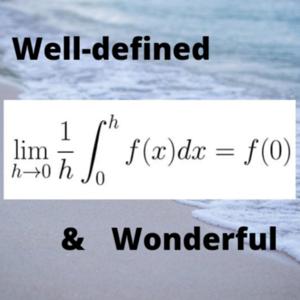
Well-defined & Wonderful

Well-defined & Wonderful

By profmoppiScienceMathematics
Download on the App Store

Well-defined & Wonderful episodes

  • Supremum of Sets and The Bolzano--Weierstraß Theorem

    In this episode we apply our knowledge of real numbers to obtain that for any non-empty bounded above set of real numbers there exists a least upper bound in the real numbers. This helps to construct the square-root or, in fact, any integer root, of non-negative real numbers. Furthermore, we introduce the Bolzano--Weierstraß Theorem, that is, we prove that any bounded sequence contains a convergent subsequence.

    12 min
  • Sequences and the Completeness Axiom (with Gabriel Barrenechea)
    In this special episode we have a guest mathematician. Gabriel Barrenechea joins us talking about sequences, convergence and completeness. We identify the last remaining axiom we need to uniquely identify the real numbers. Asking for completeness, that is, any Cauchy sequence is supposed to converge, we provide a means to fill the holes of the rationals. With this property we can show existence of square roots of any positive number, which will be done in the next chapter.
    12 min
  • Order Axioms Part 2
    This is the second part dedicated to § 4. In this second part, we draw the attention to some consequences of the definition of order. Namely, the existence of a modulus. We provide elementary properties of the modulus and, most importantly, mention both the triangle and inverse triangle inequality, the name of which will be more properly justified later on. The other half of this episode in concerned with the size or proportion of the natural numbers that have been identified last time in the set of reals. This size can be fixed introducing the so-called Archimedean axiom basically telling that always finitely many rocks will fit a given suitcase. The consequences of the Archimedean axiom together with the modulus will play the major role in the next episode, when we talk about sequences and convergence.
    11 min
  • Order Axioms Part 1
    The field axioms from the last episode are not enough in order to have a good enough basis to do analysis. A striking fact underlining this lack of definedness can be seen in that the field consisting of 0 and 1 only is fine with the field axioms and surely does not contain the natural numbers. So what's the fix then? We introduce the existence of positive elements. These positive elements are closed under multiplication and addition and obey the rule that any real number is exactly one of the three alternatives it is either positive, zero or its negative is positive. With these properties we can show seemingly obvious statements like 1 is positive. Note that only with the field axioms such a conclusion cannot be made. So we need the order axioms. Finally, this will eventually also suffice to find the natural numbers as a subset of the reals, which is the main theorem of this episode.
    19 min
  • Field Axioms
    In this episode we introduce and describe the basic rules of computing numbers. We formulate the axioms of addition and mutiplication and draw some interesting consequences from these rules. Interestingly, all the axioms are satisfied by a set with 2 elements only. In our quest to get a hand on the nature of the real numbers we're thus quite far away.
    9 min
  • The Natural Numbers & Mathematical Induction
    In this episode we will focus on the core properties of natural numbers and the principle of mathematical induction. We detail the four axioms of Peano's thus characterising natural numbers and the foundation of addition and mutiplication.
    8 min
  • Sets, Relations, and Mappings
    We provide a very brief overview of some basic notions in set theory and how to properly define mappings. At the concluding part of the episode we state and prove the well-ordering theorem for the set of natural numbers.
    19 min

About Well-defined & Wonderful

From the publisher's feed

In Well-defined & Wonderful we embarque on the quest to understand the core principles of mathematical analysis. Being based on a lecture course aimed at first year students in Germany the podcast…